The layout and the numbers that set it
An RV park site plan is a yield study drawn against a stack of rules, and only a few states publish the numbers directly. Florida (64E-15.002: 1,200 sq ft per space, 25 units per gross acre), Michigan (R 325.1556: 1,200 sq ft and 15 ft of road frontage) and Colorado (6 CCR 1010-9: 900 sq ft, 25 campsites per acre net of roads, buildings and common areas) set hard site-size and yield rules [1, 3, 2]. Michigan's EGLE guidance adds a 20 ft road width to its state numbers [6]. Utah, Arizona, Georgia and Tennessee regulate sanitation and spacing and leave density to local zoning [7, 8, 9, 10]. No state RV park design rule was found for Texas, North Carolina, South Carolina or Missouri: there the caps come from county and city codes, and the state reaches the layout through water and wastewater rules [11, 12, 13, 14]. Texas added one statewide layer in 2025: SB 1 requires a campground to comply with NFPA 1194, 2021 Edition, other than Sections 1.1.1 and 5.1.1.1, and limits local regulation of sanitation, electrical, LPG and fire protection [5, 15].
On most parcels the density cap is not what binds. Electrical, wastewater and road rules usually decide the count first, which is why the plan is drawn to all of them at once. The arithmetic of yield, gross against net, is worked through in RV sites per acre, and the state rules are compared in RV park regulations by state.
What the preliminary plan carries
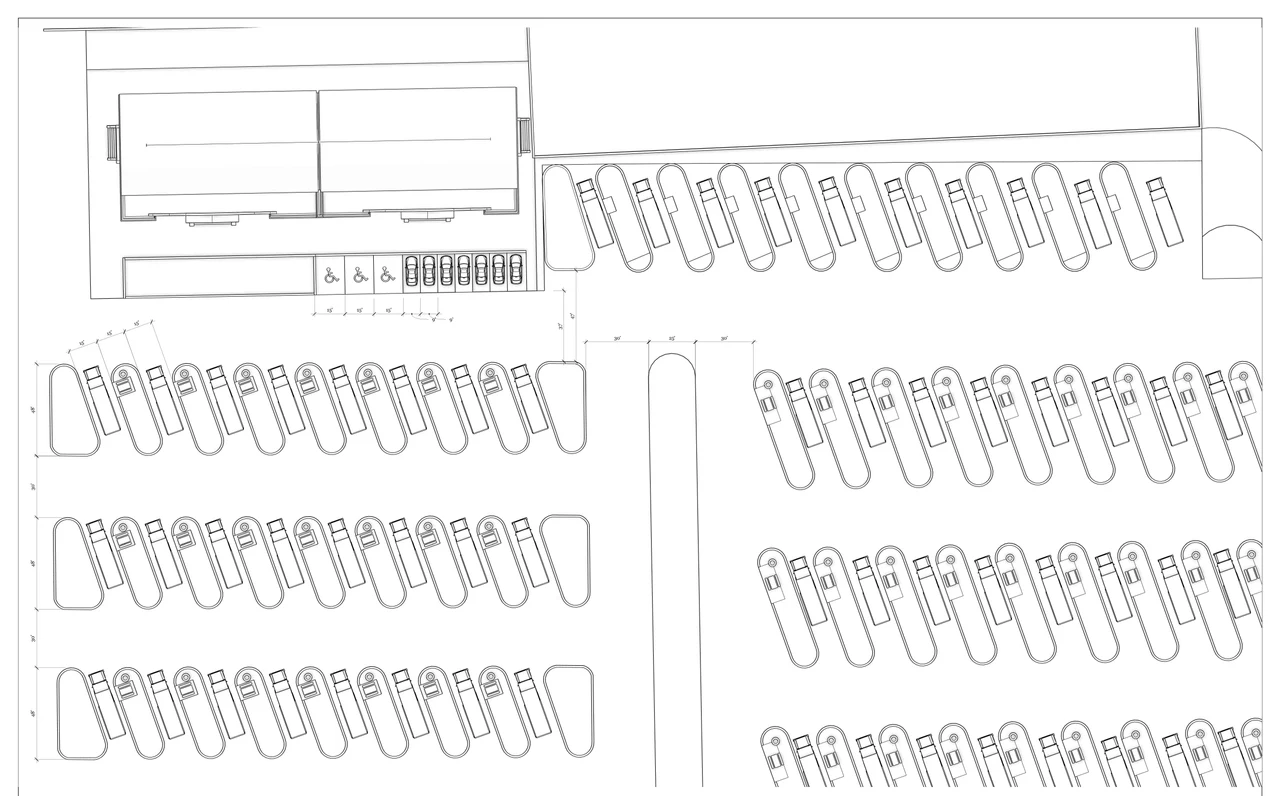
A preliminary RV park plan is a real first draft of the park: the entrance and office, the internal roads, every site numbered and dimensioned, the amenity core, bathhouses, dump station and stormwater areas, organized on one sheet with a site data table. For an RV park, the lines that matter most are:
- gross and net acreage, because Florida counts density on the gross site and Colorado on the net [1, 2];
- the site count by type: back-in, pull-through, tent, and park model or cabin;
- density achieved against the cap, stated on the cap's own basis;
- the smallest site area against the state minimum;
- unit separation, and setbacks to lot lines and public right-of-way;
- road widths, one-way and two-way, and turnarounds;
- the electrical mix: the count of 20 A, 30 A and 50 A sites against NEC 551.71;
- wastewater design flow in gallons per day, and the review threshold it crosses;
- dump stations, water stations and bathhouse fixtures against the state ratio.
The plan stops where engineering starts. Water and sewer design, electrical feeders and transformers, and grading and drainage are by the client's engineer of record, who builds the sealed set on the approved layout. The service itself is set out on preliminary site plans.
Pad types and dimensions
No primary code sets pad length by RV class. The dimensions a layout is drawn to come from local codes, federal accessibility guidance and construction practice:
| Element | Dimension | Source |
|---|---|---|
| Site, back-in to pull-through | 30 x 50 ft back-in to 45 x 70 ft pull-through | 2026 construction guide, secondary [16] |
| Hardened pad, Parker County, TX | At least 12 ft by 40 ft; 9 in. base compacted to 6 in. | Parker County order [17] |
| RV space, Town of Parker, AZ | 1,250 sq ft and 30 ft wide, at a maximum density of 20 spaces per net acre | Town Code 10-11-16 [18] |
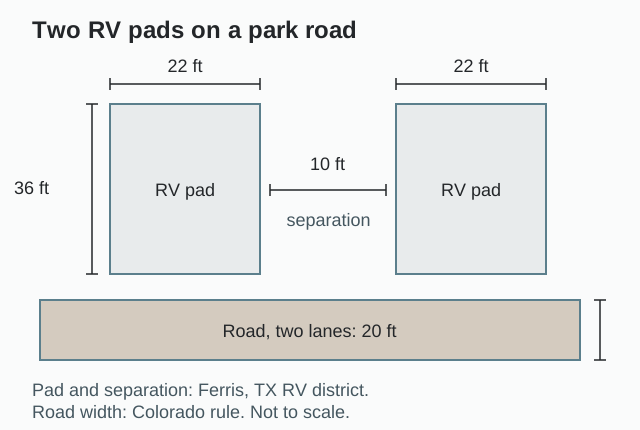
| RV space, Ferris, TX RV district | 22 ft by 36 ft, with 10 ft separation | City code [19] |
| RV space, Holtville, CA | 1,250 sq ft, with 5 ft setbacks, in a park of at least 3 acres | Chapter 17.50 [20] |
| Site frontage, Michigan | 15 ft, and every site must abut a roadway | R 325.1556 [3] |
| Accessible RV parking space | 20 ft wide, or 16 ft for a second adjoining space, with accessible utility and sewage hookups | U.S. Access Board [21] |
| Tent site, Florida | 500 sq ft | 64E-15.002(3)(c) [1] |
| Park model RV | Single chassis, at most 400 sq ft in setup mode | ANSI A119.5, as quoted in North Carolina guidance [12] |
Back-in sites can line both sides of a single road. Pull-through sites touch a road at each end, so a row of them needs a road on both sides; how the two are mixed is set out on the RV resort site plan page. Buddy sites pair two pads around a shared patio; in Michigan group camping areas, R 325.1556b bars connecting more than one unit to an outlet, so each pad keeps its own pedestal [22].
Separation is measured to the deployed unit where a code says so. Parker County, Texas measures its 12 ft separation "with slide-outs extended" [17]. Colorado counts "awnings or other attachments" as part of the unit under s. 5.11, and the Town of Parker, Arizona counts awnings inside its 5 ft [2, 18]. The plan draws each pad to the fully deployed footprint, not the chassis.
Park models and cabins. Florida allows one park model on an RV space [23]. Utah requires every unit to carry a data plate showing NFPA 1192 (2021) or ANSI A119.5 (2020) compliance, and says a tiny house is not a park model RV [7]. North Carolina's August 2024 guidance sizes park model wastewater at 150 gpd per unit [12]. The Town of Parker, Arizona bans park models outright [18]. Michigan lets camping cabins under 400 sq ft without a water connection sit on campsites, but not resort cabins [24]. Because flows differ and some codes ban the units, a mixed program keeps park models and cabins in their own pod, which can be sized, permitted or dropped on its own.

Design standards that shape the layout
State numbers where a state sets them, county benchmarks where it does not:
| Standard | Rule | Code section |
|---|---|---|
| Density, Florida | 25 RV units per acre of gross site | 64E-15.002(3)(b) [1] |
| Density, Colorado | 25 campsites per acre, excluding roads, buildings and other common use areas | 6 CCR 1010-9, s. 5.4 [2] |
| Site area | 1,200 sq ft (FL, MI); 900 sq ft (CO) | 64E-15.002(3)(a); R 325.1556(1); s. 5.3 [1, 3, 2] |
| Unit separation, state rules | 15 ft or more (TN, July 2002 text); 10 ft including awnings (CO) | Rule 1200-01-05 [10]; s. 5.11 [2] |
| Unit separation, Texas county orders | 12 ft with slide-outs extended (Parker County); 10 ft (Wilson County); 25 ft (Callahan County) | County orders [17, 25, 26] |
| Trailer to building; trailer to internal driveway | 15 ft; 10 ft (GA) | Rule 511-6-2 [9] |
| Setback from campsite lot lines | 3 ft (CO) | s. 5.10 [2] |
| Setback from public highway right-of-way | 25 ft (CO) | s. 5.2 [2] |
| Setbacks, Parker County benchmark | 25 ft from public right-of-way, 15 ft from property line, 15 ft from internal road | County order [17] |
| Roads, Colorado | 10 ft one lane; 20 ft two lanes; 24 ft entrance; 50 ft turnaround; 13 ft overhead and 3 ft side clearance | s. 4.3 to 4.4 [2] |
| Two-way road, California | 18 ft; 25 ft with parking on one side; 32 ft with parking on both sides | 25 CCR 2106, parks built on or after September 15, 1961 [27] |
| One-way road, California | 12 ft; 19 ft with parking | 25 CCR 2106 [27, 28] |
| Roads, Michigan and Georgia | 20 ft (MI, EGLE guidance); all-weather, at least 20 ft unobstructed (GA) | EGLE guidance [6]; Rule 511-6-2 [9] |
| County road benchmark | One-way 20 ft, two-way 24 ft, cul-de-sac 50 ft radius (Jefferson County, TX) | Appendix 7, 2023 [29] |
| Maneuvering | Parking and maneuvering may not use sidewalks, rights-of-way or private ground outside the park (FL) | 64E-15.002(1)(b) [1] |
| Dump station siting | At least 50 ft from any site, with a curbed apron at least 3 ft by 3 ft (UT); at least 50 ft from sites and from water stations (CO) | R392-301-6(2) [7]; 6 CCR 1010-9 [2] |
| Boundary rule, Florida | None set for RV parks; the boundary figure in 64E-15.002(2)(c) governs mobile home and lodging park spaces | 64E-15.002(2)(c) [1] |
Florida locks the geometry in. Separation distances between sites "must be the distances established at the time of the initial approval" by the Department of Health and the local government, and the statute supersedes any later county, city or special district rule on lot size, density, separation or setback (F.S. 513.1115) [30]. The first approved site plan is therefore the park's permanent layout entitlement, and it is worth drawing the full build-out into it, including later phases.
Electrical: NEC Article 551, Part VI
The receptacle mix is a count the site data table carries and a load the engineer of record sizes.
- Receptacle mix, 551.71 (2023 text). Every site with electrical supply needs at least one 20 A, 125 V receptacle. At least 70 percent need a 30 A receptacle. At least 20 percent of existing sites and 40 percent of new sites need a 50 A, 125/250 V receptacle, and every 50 A site must also have a 30 A receptacle. Dedicated tent sites may be excluded [4].
- Where the 40 percent came from. The 40 percent share for new sites entered the code in the 2017 cycle [4, 31].
- The 40 percent is a floor. The Informational Note warns that seasonal parks could approach 100 percent 50 A [4]. A snowbird or long-stay park is drawn to that end of the range.
- Feeder demand, 551.73. The per-site loads are 2,400 VA for a 20 A-only site and 3,600 VA for a 20/30 A site [32]. The 50 A per-site load is taken from the NEC edition the state has adopted, which the engineer of record confirms before transformers are sized.
- 2026 NEC. The 2026 edition retitles 551.71 to name alternating-current receptacles [33]. The NEC reaches a park through each state's electrical code, and the adopted edition varies.
Water, wastewater and sanitation
Wastewater flow decides whether a park can be served on site, who must design the system and how far up the review goes. These are the numbers the plan is sized against:
| Rule | Value | Source |
|---|---|---|
| Design flow, park model (NC) | 150 gpd, assuming at most 4 occupants | 15A NCAC 18E guidance, August 2024 [12] |
| Local health department ceiling (NC) | 1,500 gpd; a PE above that; state review above 3,000 gpd or with a dump station | Same [12] |
| Water demand (CO) | 100 gpd per hookup site; 75 gpd with common facilities and flush toilets; 50 gpd with common facilities and privies | 6 CCR 1010-9, s. 6.6 [2] |
| On-site sewage ceiling (TX) | An OSSF treating over 5,000 gpd ("approximately 100 hookups") needs a TCEQ domestic wastewater permit | RG-499 [11] |
| Water and sewer specifications, Callahan County (TX) | PE-sealed and TCEQ-approved, on a 50 gpd per site estimate | County requirements [26] |
| Public water system (TX) | "at least 15 connections or 25 people at least 60 days out of the year" | RG-499 [11] |
| Construction stormwater (TX) | Disturbing 1 acre or more requires Construction General Permit TXR150000 | RG-499 [11] |
| Public water system (GA) | Required at an average of 25 spaces for 60 days a year | Rule 511-6-2 [9] |
| Dump stations (FL) | 1 per 100 spaces; 1 per 250 when over 50 percent have sewer hookups | 64E-15.004(5) [23] |
| Dump and water stations (CO) | Dump station 1 per 100 sites without sewer; water station 1 per 100 sites | s. 8.10, s. 6.12 [2] |
| Dump station (GA) | Sized to the sites, on a 6 ft by 6 ft pad; 3 in. sewer connection per space | Rule 511-6-2 [9] |
| Water stations (FL) | 1 per 100 spaces without water hookups; 1 per 250 when over 50 percent have water and sewer | 64E-15.003(3)(b) [23] |
| Restrooms (FL) | Men: 1 toilet, 1 urinal, 1 lavatory, 1 shower. Women: 2 toilets, 1 lavatory, 1 shower. Repeat per 25 non self-contained spaces | 64E-15.005(2), (3) [23] |
| Fixtures (CO) | Dependent units: 1 per 15 sites and 1 shower per 30; self-contained units: 1 toilet and 1 lavatory per sex per 100 | s. 12.3 [2] |
| Fixtures (UT) | 1 toilet, 1 hand sink and 1 bath fixture per sex for every 15 dependent sites, located 15 to 500 ft from them | R392-301-7(4) [7] |
| Bathhouses (GA) | 1 commode, lavatory and shower per sex for every 10 dependent spaces, within 200 ft | Rule 511-6-2 [9] |
| Toilets and water (AZ) | 1 toilet per 25 dependent RVs, within 400 ft; potable water within 300 ft at 20 psi | R9-8-503, R9-8-505 [8] |
| Fixtures (TN, July 2002 text) | From 1 water closet, lavatory and shower per gender for 1 to 15 sites up to 4 (men) and 5 (women) water closets and 3 showers each for 81 to 100 sites; above 100, 1 more water closet and lavatory per gender per 25 sites and 1 shower per 40 | Rule 1200-01-05 [10] |
North Carolina treats RV wastewater as high strength unless tested (BOD 350, TSS 100, TKN 100, FOG 30 mg/L), which shapes the treatment train the engineer chooses [12]. Its guidance counts an RV space without hookups as a campsite where a bathhouse and "an independent, non-discharging dump station permitted by the Division of Waste Management" are available [12]. In South Carolina, R.61-56 lists campgrounds as large onsite system users and counts park model RVs and RVs as dwellings [13]; Pickens County bars individual septic systems per site and requires master-metered utilities [34, 35].
State rules for RV parks
States regulate RV parks in three ways: a health license with hard numbers, a sanitation rule that leaves geometry to local zoning, or nothing at state level beyond water and wastewater. The table is limited to the states whose rules are confirmed in the primary text:
| State | State regime | Density | Minimum site | Separation | RV park page |
|---|---|---|---|---|---|
| Florida | DOH permit under F.S. Ch. 513 and 64E-15, plus local zoning [1, 30] | 25 per gross acre | 1,200 sq ft RV; 500 sq ft tent | Fixed at initial approval | RV parks in Florida |
| Michigan | EGLE construction permit (MCL 333.12505) and license for 5 or more sites (MCL 333.12506) [3, 6, 36, 37] | No numeric cap; sites limited to the licensed count | 1,200 sq ft, 15 ft frontage | Four-foot unobstructed path (EGLE) | RV parks in Michigan |
| Colorado | CDPHE, 6 CCR 1010-9, plus county [2] | 25 per acre net | 900 sq ft | 10 ft including awnings; 3 ft from site lines | RV parks in Colorado |
| Utah | R392-301 sanitation rule, local health officer [7] | Local zoning | Local zoning | Local zoning | None |
| California | HCD Special Occupancy Parks (H&SC 18860 et seq.; 25 CCR Ch. 2.2) [38, 27, 20] | Local | Local (Holtville 1,250 sq ft) | Road widths under 25 CCR 2106 | None |
| Georgia | DPH tourist accommodation permit (511-6-2) [9] | Local zoning | Local zoning | 15 ft to buildings; 10 ft to driveways | RV parks in Georgia |
| Tennessee | TDH organized camp permit (Rule 1200-01-05, July 2002 text) [10] | Local zoning | Local zoning | 15 ft between units | RV parks in Tennessee |
| Arizona | ADHS R9-8-501 to R9-8-507, plus county or city [8, 39, 18] | Local (Coconino County 12 per acre; Parker 20 per net acre) | Local (Parker 1,250 sq ft) | Local (Coconino County 10 ft) | RV parks in Arizona |
| Texas | No state density rule found; TCEQ utility rules; counties under LGC Ch. 232; NFPA 1194 by statute [11, 5, 40, 41, 19, 17, 26] | Local (Fannin County 10 per acre; El Campo 20 per acre) | Local (Ferris 22 ft by 36 ft) | Parker County 12 ft with slide-outs; Callahan County 25 ft | RV parks in Texas |
| North Carolina | State wastewater, 15A NCAC 18E; no state design rule found [12] | Local | Local | Local | RV parks in North Carolina |
| South Carolina | State wastewater, R.61-56; no state design rule found [13, 34, 35, 42] | Local (Duncan 12 per acre; Pickens County 4 per acre) | Pickens County 690 sq ft | Local | South Carolina state page |
| Missouri | No state RV design rule found; the lodging rule covers five or more guest rooms [14] | Local | Local | Local | None |
Everywhere else, density, site size and separation are set locally, and the county or city code is read for the parcel before the layout is drawn. The state pages for Texas, Florida, Arizona and North Carolina carry the local layer for those states.
Local caps usually sit below the state cap. Malabar, Florida requires 5 acres minimum in its RVP district and allows at most 15 RV sites per gross acre, well below the state's 25 [43]. Mineral County, Colorado caps RV parks at 12 per gross acre and campgrounds at 15 [44]. Coconino County, Arizona caps density at 12 per acre unless the Board of Supervisors approves a master plan, and the Town of Parker allows at most 20 spaces per net acre [39, 18]. El Campo, Texas allows 20 units per acre, and Fannin County's November 14, 2023 order allows a maximum of 10 recreational vehicles per acre [41, 40]. Parker County, Texas requires a 5.0 acre minimum [17]. Duncan, South Carolina requires 5 acres minimum and caps density at 12 units per physical acre [42]. Pickens County, South Carolina requires 5 acres minimum, caps density at 4 sites per acre, and requires 690 sq ft per site and a 100 ft perimeter setback [34, 35]. Holtville, California requires 3 acres and 2,000 sq ft of recreation area [20]. Savannah, Georgia caps stays at 90 days on a 5 acre minimum, and Cherokee County, Georgia requires 10 acres [45, 46]. The Colorado state page carries the wider approval context there.
State permit fees are small next to the layout decisions but appear on the pro forma: Florida charges $4 per space a year, with a $100 minimum and a $600 maximum [23]; Michigan charges $600 for a new construction permit and $225 for an alteration, and $75 to $500 for the license by site count [36].
Floodplain, accessibility and fire
- Floodplain. Under 44 CFR 60.3(c)(14) for A zones and (e)(9) for V zones, an RV in a special flood hazard area must meet manufactured home elevation and anchoring unless it is on site fewer than 180 consecutive days, or is fully licensed and ready for highway use: on wheels or a jacking system, attached only by quick-disconnect utilities, with no permanently attached additions [47, 48]. Michigan also requires water outlets above the 100-year floodplain elevation (R 325.1552(3)) [36], and Colorado bars sites "subject to periodic flooding" (s. 3.2) [2]. Long-stay sites and park models cannot lean on the RV exemption, so the plan keeps them out of mapped flood areas.
- Accessibility. The DOJ 2010 ADA Standards govern a private park's buildings, accessible routes and parking. The 2013 Access Board camping provisions (F244; technical sections 1011 to 1019) "have no legal effect" on private entities, which may use them for guidance [49]. For RV parking, the Access Board points to 20 ft wide accessible spaces [21].
- Fire. NFPA 1194 is the standard for RV parks and campgrounds; NFPA lists the 2026 edition, issued October 16, 2024, as current [50]. Its Section 5.1.1 requires site plans [51]. Texas requires campgrounds, by statute, to comply with the 2021 edition, and the Town of Duncan, South Carolina adopts NFPA 1194 as a reference in its ordinance [5, 42].
Approval path patterns
Seven patterns cover the approval paths the primary sources document. The third column records what the sources say about the plan at that stage:
| Pattern | Examples | What the sources document about the plan |
|---|---|---|
| By right in an RV zoning district | Ferris, TX s. 154.019 RV district [19]; Malabar, FL RVP district, Ord. 2021-09 [43]; Savannah, GA, 5 acres and 90 day stays [45] | Zoning review typically precedes engineered plans |
| Conditional use, special use or special exception | Apache County, AZ, CUP under Art. 11 s. 1107 [52]; Newberry County, SC, special exception in R2 under s. 153.141, with 100 ft setbacks [53] | A hearing decides the use before construction plans |
| Rezoning, PUD, master plan or RV park chapter | Coconino County, AZ, where density over 12 per acre needs a Board-approved master plan [39]; Malabar, FL rezoning into the RVP district [43]; Holtville, CA Chapter 17.50 [20] | Master plan or zoning chapter standards |
| Rural county infrastructure rules, no zoning | Bastrop County, TX under LGC Ch. 232 with a 30-day review [54]; Parker County, TX infrastructure development plan [17]; Fannin County, TX order [40] | Jefferson County, TX uses a "Preliminary Site Plan" stage before construction plans [29]; Callahan County, TX requires PE-sealed water and sewer specifications [26] |
| State health plan approval plus local zoning | Florida DOH under 64E-15.010 [23]; Georgia DPH, plans 14 days before construction [9]; Tennessee organized camp permit [10] | Florida new-park plans "drawn to scale", with no seal language in the rule text [23] |
| Special state regime | Michigan EGLE construction permit and license [37]; California HCD Special Occupancy Parks [38]; Texas SB 1, NFPA 1194 statewide [5] | Michigan plans must be prepared and sealed by a Michigan-registered engineer or architect, with written as-built verification before licensure [37, 3] |
| Wastewater-driven state review | North Carolina 15A NCAC 18E [12]; Texas TCEQ above 5,000 gpd [11] | Sealed design above the threshold |
The concept and preliminary stages the sources document without engineering requirements are Bandera County's sketch plan and Florida's drawing rules. For a new Florida park, 64E-15.010(2)(c) asks for a plan drawn to scale showing tract area and dimensions, space numbers, space locations and sizes, roads and service buildings; for an existing park without plans on file, the drawing "does not have to be drawn to scale or completed by an engineer if the space dimensions are shown" [23]. Bandera County, Texas defines its sketch plan as a map "not required to be drawn with precision" [55]. Texas county practice is laid out in RV park approval in Texas counties.
The stages that need a seal are the utility ones and Michigan's state permit: wastewater above 1,500 gpd in North Carolina, a TCEQ wastewater permit in Texas, engineered systems under R.61-56 in South Carolina, road and drainage plans in Bandera County "signed and sealed by a Professional Engineer" before the preliminary plat is approved, the Michigan EGLE construction permit, and Callahan County's water and sewer specifications [12, 11, 13, 55, 37, 26]. Where a seal is required, the preliminary plan is the layout the engineer of record builds the sealed set on.
What the engineer of record adds
| Element | On the preliminary site plan | Added by the engineer or architect of record |
|---|---|---|
| Tract, spaces, roads, service buildings | Drawn to scale with tract area and dimensions, space numbers, sizes and locations | Boundary survey |
| Roads | Layout, widths, turnarounds | Pavement section, geometry and profiles |
| Water supply | Station and hookup locations | Plans under 64E-8, 62-550 and 62-555 in Florida (64E-15.010(2)(e)) [23] |
| Sewage | Dump station and sewer service areas; design flow by site type | Collection and treatment design under 64E-6 or 62-600 (64E-15.010(2)(f)) [23]; sealed design above the state threshold |
| Electrical | Count of 20 A, 30 A and 50 A sites | Feeder and transformer sizing under NEC 551.73 [32] |
| Stormwater | Pond and impervious areas | Florida ERP design under 62-330, triggered above 5 acres of project area [56] |
| Floodplain | Sites and park models kept out of mapped flood areas | Elevation data and flood studies |
| Permanent buildings | Footprints and a schematic fixture layout | Floor plans showing the number, types and distribution of plumbing fixtures (64E-15.010(2)(b)) [23] |
Visuals for the hearing
One recorded hearing shows what a conditional use board hears. In New Hanover County, North Carolina, neighbors of a planned RV park raised noise, light pollution, traffic, safety and trespassing; the developer offered a 50-ft buffer, double the requirement, an 8-ft privacy fence at the entrance and a 30-day stay cap [57]. An aerial view with the buffers drawn in and a night lighting view answer those points directly. The views are built from the same model as the plan: see RV park and resort rendering.
Model projects, states and related plans
Five model projects show how one jurisdiction's rules shape an RV or campground plan:
- RV resort, Bandera County, Texas: an unzoned county where the plat and infrastructure rules, groundwater and wastewater set the count.
- RV park, Polk County, Florida: a conditional use under Land Development Code Section 303, rewritten for RV parks by Ordinance 2024-032, on top of the state's 64E-15 floor [58].
- Snowbird RV park, Mohave County, Arizona: by right in C-RE and C-2H, and in R-RV with an RV Park Plan; a Board-issued special use permit elsewhere [59].
- RV resort with cabins, Sevier County, Tennessee: in Pigeon Forge a travel trailer park is "any plot of land approved as a planned unit development" (340.1) [60].
- Campground with cabins, Chaffee County, Colorado: a campground under Colorado's 6 CCR 1010-9 rule.
State pages for RV parks: Texas RV parks, Florida RV parks, Arizona RV parks, North Carolina RV parks, Tennessee RV parks, Georgia RV parks, Colorado RV parks and Michigan RV parks. The wider state context is on the Tennessee and Georgia pages.
Related asset plans: RV resort site plans for the amenity-led program, campground site plans, glamping site plans and RV and boat storage site plans. The studio's notes on RV park design standards and RV resort entitlement cover requirements, and RV park development cost per pad and what it costs to build an RV park or campground set out the cost side.
Frequently asked questions
How many RV sites fit on an acre?
Florida caps density at 25 RV units per gross acre (64E-15.002(3)(b)) [1]. Colorado caps it at 25 campsites per acre, excluding roads, buildings and other common use areas [2]. Local codes often sit lower: Malabar, Florida allows 15 RV sites per gross acre, Coconino County, Arizona 12 per acre, and Fannin County, Texas a maximum of 10 recreational vehicles per acre [43, 39, 40].
How big is an RV site?
Florida and Michigan require at least 1,200 sq ft per site, and Michigan adds 15 ft of road frontage; Colorado requires 900 sq ft [1, 3, 2]. The Town of Parker, Arizona requires 1,250 sq ft and a 30 ft width [18]. A 2026 construction guide (secondary) gives site dimensions from 30 x 50 ft back-in to 45 x 70 ft pull-through [16].
How wide do RV park roads need to be?
In California Special Occupancy Parks, two-way roads are at least 18 ft and one-way roads 12 ft, rising to 25 ft two-way with parking on one side (25 CCR 2106) [27]. Colorado requires 10 ft for one lane, 20 ft for two lanes and 24 ft at the entrance [2]. Georgia requires driveways at least 20 ft wide, and Michigan's EGLE guidance gives 20 ft roads [9, 6]. Jefferson County, Texas requires one-way 20 ft and two-way 24 ft [29].
How far apart must RVs be?
Tennessee's rule (July 2002 text) requires units 15 ft or more apart, and Georgia requires 15 ft between trailers and buildings [10, 9]. Colorado requires 10 ft and counts awnings as part of the unit [2]. Among Texas county orders, Parker County requires 12 ft with slide-outs extended and Callahan County 25 ft between RVs [17, 26].
How many 50 amp sites does a new RV park need?
At least 40 percent of new sites under NEC 551.71 (2023 text), and every 50 A site must also have a 30 A receptacle. The code's Informational Note warns that seasonal parks could approach 100 percent 50 A [4].
Do I need a bathhouse if every site is full hookup?
In Florida, a park that rents only to self-contained units with water and sewer at every site can file an exemption letter (64E-15.005(6)) [23]. Tennessee exempts holding-tank camps from its restroom requirements (July 2002 text) [10]. Colorado's ratio for self-contained sites is 1 toilet and 1 lavatory per sex per 100 [2].
Can the site plan be submitted without a seal?
It depends on the stage. Bandera County, Texas takes a sketch plan that is not required to be drawn with precision, and Florida's health rule asks for new park plans drawn to scale with no seal language in the rule text [55, 23]. Michigan's EGLE construction permit is the state-level exception: its plans must be prepared and sealed by an engineer or architect registered in Michigan [37]. Utility design is sealed too: wastewater above 1,500 gpd in North Carolina needs a professional engineer, who builds on the preliminary plan [12].
Can RVs sit in a flood zone?
Sources
- 1)Fla. Admin. Code R. 64E-15.002, Sites: Mobile Home, Lodging, and Recreational Vehicle Parks, Florida Department of Health (via Cornell LII). Accessed 2026-10-09.
- 2)6 CCR 1010-9, Colorado campground and recreation area regulations, Colorado Department of Public Health and Environment (Colorado Secretary of State). Accessed 2026-10-09.
- 3)Mich. Admin. Code R 325.1556, campground sites, Michigan Department of Environment, Great Lakes, and Energy (via Cornell LII). Accessed 2026-10-09.
- 4)NEC 551.71(A)(B)(C)(F), Receptacle Requirements at RV Parks (2023 NEC), Leviton Captain Code. Accessed 2026-10-09.
- 5)SB 1, 89th Legislature, 2nd Called Session: House bill analysis, Texas Legislature Online. Accessed 2026-10-10.
- 6)New Campground Guidance (October 2025), Michigan Department of Environment, Great Lakes, and Energy. Accessed 2026-10-10.
- 7)Utah Admin. Code R392-301, Recreational Vehicle Park Sanitation, Utah Department of Health and Human Services (TriCounty Health Department copy). Accessed 2026-10-09.
- 8)Ariz. Admin. Code Title 9, Chapter 8, Article 5 (R9-8-501 to R9-8-507), Arizona Department of Health Services (Arizona Secretary of State). Accessed 2026-10-09.
- 9)Ga. Comp. R. & Regs. 511-6-2, Tourist Accommodations Rules and Regulations, Georgia Department of Public Health. Accessed 2026-10-09.
- 10)Rule 1200-01-05, Organized Camps (July 2002 revision), Tennessee Department of Health. Accessed 2026-10-09.
- 11)RG-499, RV parks compliance guide (revised February 2024), Texas Commission on Environmental Quality. Accessed 2026-10-09.
- 12)RV park wastewater guidance, On-Site Water Protection Branch (August 21, 2024), North Carolina Department of Health and Human Services. Accessed 2026-10-09.
- 13)S.C. Regulation 61-56, Onsite Wastewater Systems, South Carolina Department of Environmental Services. Accessed 2026-10-09.
- 14)19 CSR 20-3, lodging establishment rules, Missouri Secretary of State, Code of State Regulations. Accessed 2026-10-10.
- 15)Texas SB 1, 89th Legislature, 2nd Called Session (2025), bill history and Senate Research Center analysis, LegiScan. Accessed 2026-10-09.
- 16)RV Park Construction and Development Guide for 2026, propertybuild.com. Accessed 2026-10-09.
- 17)Parker County Infrastructure Requirements for Recreational Vehicle Parks (December 2024), Parker County, Texas. Accessed 2026-10-09.
- 18)Town Code 10-11-16, Recreational Vehicle Parks, Town of Parker, Arizona (American Legal Publishing). Accessed 2026-10-09.
- 19)Code of Ordinances s. 154.019, RV Recreational Vehicle Park District, City of Ferris, Texas (American Legal Publishing). Accessed 2026-10-09.
- 20)Municipal Code Chapter 17.50, RV Parks, City of Holtville, California (Code Publishing). Accessed 2026-10-10.
- 21)Guide to the ADA Accessibility Standards, Chapter 5: Parking Spaces, U.S. Access Board. Accessed 2026-10-09.
- 22)Mich. Admin. Code R 325.1556b, Group camping areas, Michigan Department of Environment, Great Lakes, and Energy (via Cornell LII). Accessed 2026-10-09.
- 23)Chapter 64E-15, F.A.C., Mobile Home, Lodging, and Recreational Vehicle Parks and Recreational Camps (2018 version), Florida Department of Health. Accessed 2026-10-09.
- 24)Cabins and Park Models in Campgrounds (Rev. 8/2025), Michigan Department of Environment, Great Lakes, and Energy. Accessed 2026-10-10.
- 25)Wilson County Infrastructure Requirements for Lodging and Recreational Vehicle Park Developments (July 22, 2019), Wilson County, Texas. Accessed 2026-10-09.
- 26)Callahan County Infrastructure Requirements for Recreational Vehicle Parks, Callahan County, Texas. Accessed 2026-10-10.
- 27)Cal. Code Regs. tit. 25, s. 2106, Roadways, California Department of Housing and Community Development (via Cornell LII). Accessed 2026-10-09.
- 28)Cal. Code Regs. tit. 25, s. 2106, Roadways (Justia copy), Justia Regulations. Accessed 2026-10-09.
- 29)Appendix 7, Recreational Vehicle Park Development Regulations (2023), Jefferson County, Texas. Accessed 2026-10-09.
- 30)Chapter 513, 2025 Florida Statutes, Mobile Home and Recreational Vehicle Parks, The Florida Senate. Accessed 2026-10-09.
- 31)NEC 551.71, Type Receptacles Provided, Recreational Vehicle Parks (2017 NEC), Leviton Captain Code. Accessed 2026-10-10.
- 32)NEC 551.73, calculated load for RV park feeders (training summary of the 2017 and later editions), JADE Learning.
- 33)551.71 Type Receptacles Provided (2026 NEC), UpCodes. Accessed 2026-10-09.
- 34)Pickens County Planning Commission workshop packet, Pickens County, South Carolina. Accessed 2026-10-09.
- 35)Article 3, Standards for Certain Uses, Pickens County, South Carolina. Accessed 2026-10-09.
- 36)Public Health Code Part 125, Campgrounds (Act 368 of 1978), Michigan Department of Environment, Great Lakes, and Energy. Accessed 2026-10-09.
- 37)Campground construction permits and licenses, Michigan Department of Environment, Great Lakes, and Energy. Accessed 2026-10-10.
- 38)Special Occupancy Parks: laws and regulations, California Department of Housing and Community Development. Accessed 2026-10-09.
- 39)Zoning Ordinance Section 3.18, RV Parks in Commercial Zoning Districts, Coconino County, Arizona. Accessed 2026-10-09.
- 40)Order Adopting Recreational Vehicle Park Regulations (approved November 14, 2023), Fannin County, Texas. Accessed 2026-10-10.
- 41)Article 10.15, Recreational Vehicle Parks, City of El Campo, Texas (eCode360). Accessed 2026-10-09.
- 42)Town of Duncan campground and RV park ordinance (Spartanburg County), Town of Duncan, South Carolina. Accessed 2026-10-09.
- 43)Ordinance 2021-09, Recreational Vehicle Park (RVP) Zoning, Town of Malabar, Florida. Accessed 2026-10-09.
- 44)Mineral County Mobile Home Park/RV Park and Campground Regulations, Mineral County, Colorado. Accessed 2026-10-09.
- 45)Ordinance of June 22, 2017 (RV park zoning), City of Savannah, Georgia (enCodePlus). Accessed 2026-10-10.
- 46)Zoning FAQ: Recreational Vehicles, Cherokee County, Georgia. Accessed 2026-10-10.
- 47)44 CFR 60.3, Flood plain management criteria for flood-prone areas, Electronic Code of Federal Regulations. Accessed 2026-10-10.
- 48)Recreational Vehicle (glossary entry), Federal Emergency Management Agency. Accessed 2026-10-09.
- 49)Guide to the ABA Accessibility Standards, Chapter 10: Outdoor Developed Areas, U.S. Access Board. Accessed 2026-10-09.
- 50)NFPA 1194, Standard for Recreational Vehicle Parks and Campgrounds: standard development page, National Fire Protection Association. Accessed 2026-10-09.
- 51)NFPA 1194: Standard for Recreational Vehicle Parks and Campgrounds, 2026 edition, fire-police-ems.com. Accessed 2026-10-09.
- 52)Recreational Vehicle Placement Policy, Planning and Zoning backup documents (January 6, 2022), Apache County, Arizona. Accessed 2026-10-09.
- 53)Code of Ordinances s. 153.141, Campgrounds and Recreational Vehicle (RV) Parks, Commercial, Newberry County, South Carolina (American Legal Publishing). Accessed 2026-10-10.
- 54)Infrastructure Requirements for Lodging and RV Park Developments (revised September 12, 2022), Bastrop County, Texas. Accessed 2026-10-09.
- 55)Bandera County Subdivision and Land Development Regulations (revised through August 25, 2022), Bandera County, Texas. Accessed 2026-10-09.
- 56)Fla. Admin. Code 62-330.020, Regulated Activities, Florida Department of Environmental Protection (via elaws). Accessed 2026-10-09.
- 57)Neighbors being neighborly: business owner, neighbors compromise on planned RV park, Port City Daily. Accessed 2026-10-07.
- 58)Polk County Land Development Code, 2024 ordinances (Ord. 2024-032), Polk County, Florida (Municode). Accessed 2026-10-09.
- 59)Mohave County Zoning Ordinance (revised through August 3, 2026), Mohave County, Arizona. Accessed 2026-10-09.
- 60)Pigeon Forge Zoning Ordinance (updated through July 2023), City of Pigeon Forge, Tennessee. Accessed 2026-10-09.