Five conditions that shape a Hawaii site plan
Hawaii layers state approvals on top of county approvals to a degree found nowhere else in the country [1]. A commercial project can face two full tiers of land use control before a building permit is in view. Five conditions change what a Hawaii site plan must show and who approves it.
1. A state zoning layer sits above the county
All land in Hawaii is classified into four state land use districts: Urban, Rural, Agricultural and Conservation (HRS Chapter 205; HAR 15-15) [1]. Oahu currently has no land classified Rural [1]. Moving a parcel between districts takes a District Boundary Amendment. Under HRS 205-3.1(c), amendments of "fifteen acres or less" are "determined by the appropriate county land use decision-making authority" [1]. The State Land Use Commission (LUC) decides the larger ones, plus all Conservation district land and Important Agricultural Lands, and approval needs at least six of its nine commissioners (HRS 205-4) [1]. The district comes first on the site data table, ahead of county zoning.
2. The coast is a permit zone
The Special Management Area (SMA) under HRS Chapter 205A is a broad coastal band administered by the four counties [2]. Act 125 (2025), signed May 29, 2025, raised the SMA minor permit ceiling to $750,000 in valuation; the $500,000 limit still applies to shoreline parcels and parcels affected by waves, storm surge, high tide or erosion [2]. Above the ceiling, or where substantial adverse effects are possible, an SMA major permit needs a public hearing and approval by the county planning commission, or by the City Council on Oahu [2]. The statewide shoreline setback is a minimum 40 ft from the certified shoreline (HRS 205A-43) [2], and Honolulu Ordinance 23-3 raised Honolulu's setback to 60 to 130 ft based on erosion rate, effective July 1, 2024 [3]. A coastal layout starts from a certified shoreline survey by a licensed surveyor, certified by DLNR [2].
3. Environmental and cultural review reach further
Hawaii's environmental review law (HEPA, HRS Chapter 343 and HAR 11-200.1) is triggered by the use of state or county land or funds, Conservation district land, work in the shoreline area, effects on historic sites, and the other HRS 343-5 triggers [6]. The land-or-funds trigger is broad [6]. Historic and archaeological review under HRS Chapter 6E runs through the State Historic Preservation Division (SHPD), whose concurrence is generally required before a permitted project moves forward, and the Island Burial Councils determine treatment of previously identified Native Hawaiian burial sites [7].
4. Cesspool parcels carry a conversion deadline
The US EPA counts approximately 88,000 cesspools in Hawaii, and each must be upgraded, converted or closed by January 1, 2050 [8, 5]. Act 132 (SB2567) states that Hawaii's cesspools "deposit approximately fifty-three million gallons of raw sewage directly into the groundwater every day" [9]. A major building permit or a property transfer can bring the conversion forward, and basalt makes the excavation costly [5]. On a cesspool parcel, the wastewater system the engineer of record designs is part of the site from the first layout.
5. The islands carry their own hazard maps
On Hawaii Island, the USGS lava flow hazard map runs from Zone 1 (highest) to Zone 9 (lowest), published in 1992 [10]. Zones 1 and 2 are effectively uninsurable in the standard market, with the Hawaii Property Insurance Association as the residual carrier, which constrains lending. The State Building Code adopts Appendix W, the Hawaii Wind Design Provisions, with hurricane protection area and safe room provisions [11]. Tsunami evacuation zones are mapped statewide, and the Sea Level Rise Exposure Area (SLR-XA) on the state viewer is now referenced in county rules [12].
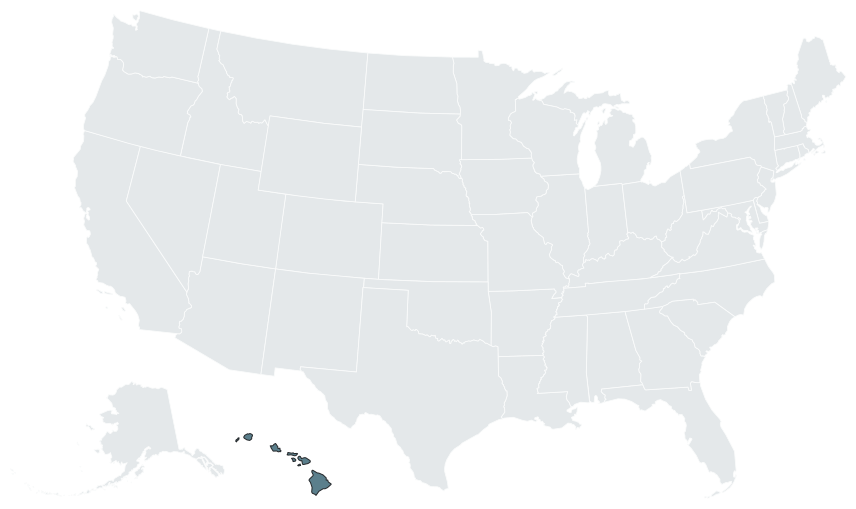

Approval layers: state, county and the cross-cutting reviewers
Hawaii has only four county governments: the City and County of Honolulu, Hawaii County, Maui County and Kauai County. Above them sits a set of state bodies that no mainland county plan has to clear.
| Layer | Body | What it decides | Authority |
|---|---|---|---|
| State | Land Use Commission | District Boundary Amendments above the county threshold, Conservation land, Important Agricultural Lands | HRS 205-3.1; HRS 205-4 [1] |
| State | Office of Planning and Sustainable Development | Represents state interests before the LUC (HRS 205-17); CZM lead agency | [1, 2] |
| State | BLNR and DLNR OCCL | Conservation District Use Applications and Permits | HAR 13-5 [13] |
| State | Department of Health | NPDES construction stormwater, wastewater and cesspool conversion, underground storage tanks | Clean Water Branch [14] |
| State | Department of Transportation | Access and connection permits on state highways, traffic impact review | DOT permits |
| State | SHPD and Island Burial Councils | Historic, archaeological and burial review | HRS Chapter 6E [7] |
| State | Commission on Water Resource Management | Water use permits inside Water Management Areas, well permits | CWRM [15] |
| County | Planning departments and commissions | Zoning, SMA permits, subdivision, boundary amendments up to fifteen acres | HRS 205; HRS 205A [1, 2] |
| County | County councils | General plan, community plans, zoning ordinance; SMA major permits on Oahu | [2] |
| Special districts | Waikiki Special District; county design-review committees; HCDA | Added design approvals in defined areas; Kakaako and Kalaeloa fall under HCDA | Local |
Who prepares and seals what
The governing statute is HRS Chapter 464, administered by the Board within the DCCA Professional and Vocational Licensing Division [4]. HRS 464-11 is the operative rule for a site plan headed to a permit counter:
"No official of the State nor of any political subdivision thereof, charged with the enforcement of laws or ordinances relating to the construction or alteration of buildings or structures, shall accept or approve any plans or specifications that are not stamped with the seal of a licensed architect or with the seal of a licensed engineer who has qualified in the structural engineering branch" [4]
| Document | Who seals it | Rule |
|---|---|---|
| Building plans and specifications for permit | Licensed architect, or licensed engineer in the structural branch | HRS 464-11 [4] |
| Grading, drainage and utility design | Licensed professional engineer in the civil or other relevant branch | HRS Chapter 464 [4] |
| Boundary surveys, subdivision plats, certified shoreline surveys, land court maps | Licensed land surveyor | HRS 464-4(b); HRS 464-11 [4] |
| Planting, landscape grading, irrigation, site amenity design | Licensed landscape architect | HRS Chapter 464 [4] |
| Drawings produced under a licensee | Allowed where the licensee in direct charge prepares or supervises the work | HRS 464-12 [4] |
HRS 464-13(a) exempts any privately owned or controlled one-storied building or structure with an estimated cost not exceeding $40,000, and a two-storied one not exceeding $35,000; no structure whose principal members are reinforced concrete or structural steel with riveted, bolted or welded connections is exempt [4]. HRS 464-13(b) sets $50,000 for one-storied structures used primarily as a residence [4]. A separate track, HRS 46-88, exempts certain non-dwelling agricultural buildings up to 1,000 sq ft, and greenhouses up to 60,000 sq ft, from building permit and building code requirements, with a second tier for 1,000 to 8,000 sq ft farm structures built to prescriptive standards [16]. Given the size of the Agricultural district, that track matters for farm-based hospitality.
Our preliminary site plan is the unsealed first draft of the project: the layout, buildings, internal roads, parking, pads and units, and the yield, with a site data table that carries the state district, county zoning, SMA status and setback lines. You use it to choose a site, raise capital, brief a lender and get a contractor's price. The Hawaii-licensed architect, engineer and surveyor of record then prepare or supervise, and seal, the permit set built on it [4]. The split between a preliminary and a final site plan follows that seal line. For the general division of labor, see who prepares a site plan and do I need an architect for a site plan; for the stages at which jurisdictions take an unsealed plan, see where unsealed site plans are accepted.
Statewide overlays
| Overlay | Rule | Source |
|---|---|---|
| State land use districts | Urban, Rural, Agricultural, Conservation; change by District Boundary Amendment | HRS Chapter 205 [1] |
| Special Management Area | Minor permit to $750,000; major permit above it, with a public hearing | HRS Chapter 205A; Act 125 (2025) [2] |
| Shoreline setback | 40 ft statewide minimum; Honolulu 60 to 130 ft; Maui and Kauai erosion-rate based | HRS 205A-43 [2]; Ord. 23-3 [3] |
| Kauai erosion buffer | Mandatory 20-foot additional safety buffer for lots in the Kauai Coastal Erosion Study | County of Kauai [17] |
| Conservation district | CDUA approved by the BLNR; 180 days from official receipt | HAR 13-5 [13] |
| Environmental review | Environmental assessment or impact statement on HEPA triggers | HRS Chapter 343 [6] |
| Construction stormwater | NPDES coverage at 1 acre of disturbance, or less within a larger common plan | DOH Clean Water Branch [14] |
| Lava hazard | Zones 1 to 9, Hawaii Island only | USGS [10] |
| Building code | State Building Code based on the 2018 IBC, effective April 20, 2021; Appendix W wind provisions | HRS Chapter 107; SBCC [11] |
| Historic and burial sites | SHPD review; Island Burial Councils | HRS Chapter 6E [7] |
Sites discharging to Class AA marine or Class 1 inland waters cannot use the NPDES general permit and need an individual permit [14]. All four counties participate in the NFIP, so FEMA flood zones apply. The SBCC has since adopted the IBC 2021 (October 8, 2022), counties adopt and amend on their own cycles, and the Governor's 15th Emergency Proclamation on Affordable Housing (September 23, 2025) temporarily suspended parts of HRS 107 [11, 18]. For how coastal overlays change feasibility elsewhere, see climate overlay zones.
Top jurisdictions
| Jurisdiction | Permit system | Who decides | Fees |
|---|---|---|---|
| Honolulu (Oahu), DPP | HNL Build, launched August 4, 2025 [19] | DPP director for administrative permits; City Council for SMA major permits and zone changes | ROH 18-6.2, valuation based (Table 18-A), amended by Ord. 24-3 (2024); work started without a permit triples fees [19] |
| Hawaii County | EPIC, live since late July 2021; no paper applications [20] | Planning Department; Department of Public Works (Building) | Hawaii County Code 5-31; all submittals and payments through EPIC [20] |
| Maui County | MAPPS, launched April 18, 2022; no paper applications [21] | Department of Planning; Development Services Administration | Ch. 16.26: building permit and plan review fees set in the annual budget ordinance [21] |
| Kauai County | ePlan for building plans; Click2Gov for status [22] | Public Works Building Division; Planning Department for SMA and zoning | Chapter 12, valuation based, payable to the Director of Finance [22] |
| Land Use Commission | Petition under HRS 205 and HAR 15-15 | Six of nine commissioners | $5,000 private petition fee (HRS 205-4.1) [1] |
Honolulu. Pre-application is recommended, especially for SMA and large commercial work [19]. Per Civil Beat, "the median wait time to obtain a new building permit dropped to 2.5 months in the period from August through April, a 40% decrease" on the year before, while for a commercial building "it's been four months" [23]. DPP carried a 24% vacancy rate [23].
Hawaii County. Kona and leeward projects face water availability, lava zone exposure on Hualalai and Mauna Loa, and drought and wildfire; Hilo and windward projects face high rainfall, flood and Zone 3 lava around Puna. Fees double if work starts without a permit [20].
Maui County. Residential submittals require eight sets of plans including the site plan [21]. In Lahaina, Ordinance 5780 (effective March 24, 2025) gives eligible owners until April 1, 2029 to permit and rebuild nonconforming structures [24]. The February 4, 2025 emergency proclamation waived SMA rules for properties mauka of Front Street and outside the erosion hazard line; parcels within the shoreline setback still need an SMA use permit with public hearings [25]. Commercial rebuilding on Front Street remained largely stalled as of mid-2026, held up by SMA, historic review and SHPD archaeological requirements.
Land Use Commission. On a special permit over 15 acres, the LUC must decide within 45 days after receiving the complete county record [1]. For a contrast in how a state layer works, compare Alaska; for another shoreline-driven regime, see Washington.
Asset registries
| Asset | State and federal layer | County layer |
|---|---|---|
| RV parks and campgrounds | No statewide RV park licensing statute; state park camping only at designated locations, five consecutive nights maximum per park (HAR 13-146; HRS 184-5) [26] | Private campgrounds and RV parks are a permitted or conditional use under county zoning; county park camping by permit (Hawaii County Code Chapter 15) [20] |
| Glamping | No state glamping classification documented; Rosehill v. State (Haw. 2024) held farm-stay short-term rentals impermissible in the agricultural district [27] | Set by county zoning; on Agricultural land, agritourism must be incidental to a bona fide agricultural operation (HRS 205-4.5; HRS 205-6) [1] |
| Hotels and short-term rentals | Act 17 (SB2919, 2024) lets counties amortize nonconforming short-term rentals [28] | Honolulu: 30-day minimum for pre-existing lawful uses [28]; Maui: Minatoya List phase-out [29] |
| Fuel retail | DOH underground storage tank program; NPDES coverage for treated groundwater discharges from leaking UST remediation (NOI Form D) [14] | Set locally |
| Car washes | NPDES if discharging; DOH wastewater rules for washwater [14]; CWRM water use permit inside a Water Management Area [15] | Set locally |
| Self storage | No special state licensing; NPDES over 1 acre [14] | County zoning, typically industrial or commercial districts |
| Marinas | DOBOR use permits (HAR Chapter 13-231) [30]; CDUA from the BLNR [13]; USACE Sections 10, 404 and 103; DOH Section 401 certification; CZM federal consistency | SMA permit for coastal development [2] |
Agricultural district land on parcels under 15 acres can host unusual and reasonable uses by county special permit (HRS 205-6); over 15 acres needs both county and LUC approval [1]. That rule governs much of the rural land where a campground or glamping resort would sit. Hawaii's posture differs sharply from the mainland states summarized in the RV park site plan hub.
On short-term rentals, Honolulu Ordinance 25-2 (Bill 62), signed January 3, 2025, reintroduced a 90-day minimum, but DPP treats pre-existing lawful rentals as nonconforming at the 30-day minimum [28]. In Maui, Bill 9 (Ordinance 5909), signed December 15, 2025, phases out apartment-zoned transient vacation rentals on the Minatoya List; per the county release it "is expected to return more than 6,000 units to long-term residential use," with West Maui ceasing by January 1, 2029 and the rest of the county by January 1, 2031 [29]. Honolulu's rental-period rules apply outside resort zones, so on a hotel site plan in Hawaii the zoning district is the first question [28].
A marina site plan meets the deepest stack: most submerged lands and state marine waters are in the Conservation district, so marina and shoreline structures typically require a CDUA [13], and a Corps permit triggers DOH Section 401 water quality certification [14]. Car washes are gated by water and washwater, not by a car wash rule; see the car wash site plan, gas station site plan and self storage site plan hubs for layout standards. For multifamily, HRS 201H-38 lets HHFDC exempt a qualifying project from planning, zoning and construction standards where at least 50% plus one of the units are affordable to households at or below 140% of area median income; the county council must act within 45 days or the application is deemed approved [31].
Timelines and bottlenecks
The worst-case sequence for a large greenfield project runs: LUC boundary amendment, county general or community plan amendment, county rezoning, HEPA review, SMA permit, SHPD review, CWRM water use permit and county will-serve, NPDES, then the building permit.
| Step | Statutory or reported clock | Source |
|---|---|---|
| LUC special permit over 15 acres | Decision within 45 days of the complete county record | [1] |
| CDUA | 180 days from official receipt; if the BLNR fails to act, the applicant may put the land to the proposed use, subject to conditions | [13] |
| CWRM water use permit | 90 days for a complete application, 180 with a hearing | [15] |
| Island Burial Councils | 45 days for previously identified burials | [7] |
| HRS 201H-38 housing | 45 days, or deemed approved | [31] |
| Honolulu building permit | Median 2.5 months for a new permit; commercial about four months | [23] |
The recurring chokepoints are SHPD archaeology (inventory surveys and monitoring, with inadvertent discovery of iwi kupuna triggering Island Burial Council review) [7], water commitments in Water Management Areas and county will-serve letters, especially on leeward Hawaii Island and parts of Maui [15], and the Honolulu permit software transition. For how these clocks compare nationally, see permitting timelines across US markets.
Proof points
- Act 125 (2025). Signed May 29, 2025; SMA minor ceiling raised to $750,000, with the $500,000 limit kept for shoreline-impacted parcels [2].
- Building activity. Private building authorizations in Q4 2025 fell $688.4 million (64.5%) in Honolulu County, $158.7 million (47.7%) in Hawaii County and $182.4 million (70.8%) in Maui County against Q4 2024 [32].
- Construction cost. The Honolulu Construction Cost Index for a single-family residence rose 5.0% in Q4 2025 against Q4 2024, and the high-rise index rose 4.7% [32].
- Lahaina rebuild. Ordinance 5780 sets an April 1, 2029 rebuild deadline for nonconforming structures [24].
What the engineer of record adds
The preliminary plan fixes the program, the layout and the yield. The Hawaii engineer and architect of record add the wastewater design and any cesspool conversion, the NPDES coverage and its inspections, grading and drainage, utility connections and the county will-serve, the Appendix W wind and seismic structural design, and the sealed permit set. The surveyor of record adds the boundary and the certified shoreline. For the full scope of the work, see site plan services; to scope a Hawaii site, see service areas or start a project.
Frequently asked questions
Do I need state approval on top of county zoning in Hawaii?
Only if the parcel needs reclassification between state land use districts. Boundary amendments of fifteen acres or less are decided by the county under HRS 205-3.1(c); larger ones, all Conservation land and Important Agricultural Lands go to the State Land Use Commission [1].
When do I need an SMA permit?
When the project is development inside the coastal Special Management Area. A minor permit covers work up to $750,000 in valuation under Act 125 (2025); above that, or above $500,000 on shoreline-impacted parcels, or where substantial adverse effects are possible, a major permit with a public hearing applies [2].
Who seals a site plan in Hawaii?
Plans submitted for a permit are prepared or supervised by, and sealed by, a Hawaii-licensed architect or structural engineer, with a Hawaii-licensed surveyor for boundary surveys (HRS 464-11) [4]. The preliminary site plan is the drawing that licensee builds the sealed set on.
Is there a small-project exemption from the seal requirement?
Yes. HRS 464-13 exempts one-storied private structures with an estimated cost not exceeding $40,000, or $50,000 where the structure is primarily a residence, but not where principal members are reinforced concrete or bolted or welded structural steel [4].
My parcel is on a cesspool. Does that affect the project?
Yes. All cesspools must convert by January 1, 2050 under HRS 342D-72, and a major building permit or a property transfer can bring the requirement forward [5].
Can I build an RV park in Hawaii?
There is no statewide RV park statute. Camping on public land is a park-permit matter (HAR 13-146), and a private campground or RV park depends on county zoning as a permitted or conditional use [26].
How long does a Honolulu building permit take?
After HNL Build, the median wait for a new building permit fell to 2.5 months; the median for a commercial building has recently run about four months [23].
Do I need a water use permit?
Only inside a designated Water Management Area, where CWRM must decide a complete application within 90 days, or 180 with a hearing. Outside one you still need a county water will-serve letter [15].
Sources
- 1)HRS Chapter 205 (205-3.1, 205-4, 205-4.1, 205-4.5, 205-6, 205-17) and HAR 15-15, State Land Use Law; LUC Proceedings page, Hawaii State Legislature; State Land Use Commission. Accessed 2026-09-01.
- 2)HRS Chapter 205A, Coastal Zone Management (SMA; HRS 205A-43 shoreline setback), and Act 125 (2025), Hawaii State Legislature; Office of Planning and Sustainable Development. Accessed 2026-09-01.
- 3)Ordinance 23-3, shoreline setbacks, City and County of Honolulu. Accessed 2026-09-01.
- 4)HRS Chapter 464 (464-2, 464-4, 464-11, 464-12, 464-13), Professional Engineers, Architects, Surveyors and Landscape Architects, Hawaii State Legislature; DCCA Professional and Vocational Licensing Division. Accessed 2026-09-01.
- 5)HRS 342D-72, cesspool conversion deadline, Hawaii State Legislature. Accessed 2026-09-01.
- 6)HRS Chapter 343 and HAR 11-200.1, environmental review (HEPA), State of Hawaii. Accessed 2026-09-01.
- 7)HRS Chapter 6E, historic preservation review; Island Burial Councils, DLNR State Historic Preservation Division. Accessed 2026-09-01.
- 8)Cesspools in Hawaii, US Environmental Protection Agency. Accessed 2026-09-01.
- 9)Act 132 (SB2567), cesspools, Hawaii State Legislature. Accessed 2026-09-01.
- 10)Lava flow hazard zones, Hawaii Island (1992), U.S. Geological Survey. Accessed 2026-09-01.
- 11)State Building Code (HRS Chapter 107), adoptions and Appendix W, Hawaii Wind Design Provisions, State Building Code Council. Accessed 2026-09-01.
- 12)Hawaii Sea Level Rise Viewer, Sea Level Rise Exposure Area (SLR-XA), State of Hawaii. Accessed 2026-09-01.
- 13)HAR Chapter 13-5, Conservation District Use Applications, DLNR Office of Conservation and Coastal Lands; Board of Land and Natural Resources. Accessed 2026-09-01.
- 14)NPDES construction stormwater general permit coverage (Clean Water Branch e-Permitting); NOI Form D, treated groundwater from leaking UST remediation, Hawaii Department of Health, Clean Water Branch. Accessed 2026-09-01.
- 15)Water use permits in designated Water Management Areas, DLNR Commission on Water Resource Management. Accessed 2026-09-01.
- 16)HRS 46-88, agricultural building permit exemption, Hawaii State Legislature. Accessed 2026-09-01.
- 17)Shoreline setbacks for lots in the Kauai Coastal Erosion Study, County of Kauai. Accessed 2026-09-01.
- 18)15th Emergency Proclamation on Affordable Housing (September 23, 2025), Office of the Governor, State of Hawaii. Accessed 2026-09-01.
- 19)ROH 18-6.2 building permit fees (Table 18-A, amended by Ord. 24-3) and the HNL Build permit portal (honolulu.gov/dpp/hnl-build), City and County of Honolulu, Department of Planning and Permitting. Accessed 2026-09-01.
- 20)Hawaii County Code Chapter 5-31 (building fees) and Chapter 15 (parks); EPIC permit portal, County of Hawaii. Accessed 2026-09-01.
- 21)Maui County Code Chapter 16.26 (building fees) and the MAPPS permit system, County of Maui. Accessed 2026-09-01.
- 22)Kauai County Code Chapter 12, building permit fees; ePlan review, County of Kauai, Department of Public Works. Accessed 2026-09-01.
- 23)Honolulu building permit wait times after HNL Build (June 17, 2026), Honolulu Civil Beat. Accessed 2026-09-01.
- 24)Ordinance 5780, rebuilding of nonconforming structures, County of Maui. Accessed 2026-09-01.
- 25)Emergency proclamation of February 4, 2025 (SMA rules, Lahaina), Office of the Governor, State of Hawaii. Accessed 2026-09-01.
- 26)HAR 13-146 (HRS 184-5), state park camping, DLNR Division of State Parks. Accessed 2026-09-01.
- 27)Case Law Index: Agritourism (Rosehill v. State, Haw. 2024), National Agricultural Law Center. Accessed 2026-10-10.
- 28)Ordinance 22-7 (Bill 41, 2022) and Ordinance 25-2 (Bill 62), short-term rental minimum stays; Act 17 (SB2919, 2024), City and County of Honolulu; Hawaii State Legislature. Accessed 2026-09-01.
- 29)Bill 9 (Ordinance 5909), transient vacation rentals on the Minatoya List; county release of December 15, 2025, County of Maui. Accessed 2026-09-01.
- 30)HAR Chapter 13-231, small boat harbor use permits, DLNR Division of Boating and Ocean Recreation. Accessed 2026-09-01.
- 31)HRS 201H-38, housing project exemptions, Hawaii State Legislature; Hawaii Housing Finance and Development Corporation. Accessed 2026-09-01.
- 32)Honolulu Construction Cost Index and private building authorizations, Q4 2025, Hawaii Department of Business, Economic Development and Tourism (DBEDT). Accessed 2026-09-01.