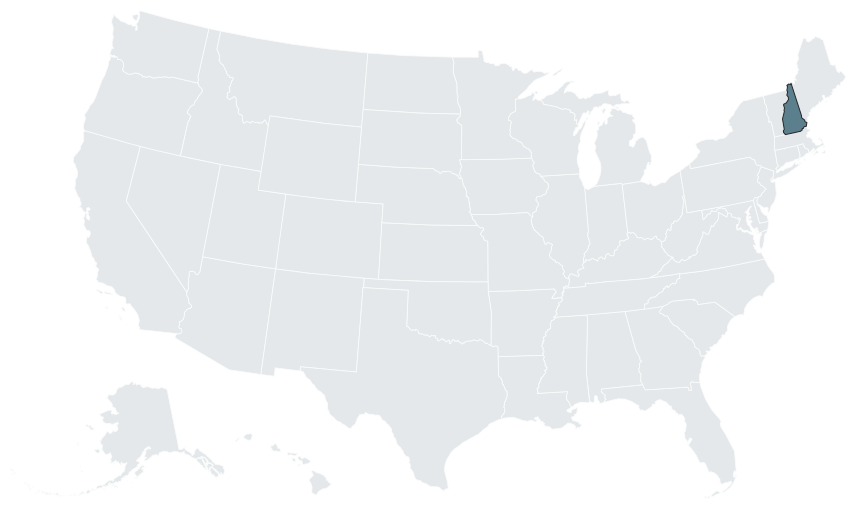
The New Hampshire thesis: five conditions that shape the plan
New Hampshire site plan approval is local, volunteer-run and statute-driven, and it splits environmental review between a state agency and EPA. Five conditions change how the plan is drawn and how fast it moves.
1. Site plan power is delegated, not inherent. A planning board does not automatically hold site plan authority. Under RSA 674:43, a municipality that has a zoning ordinance and subdivision regulations "may by ordinance or resolution further authorize the planning board" to review and approve or disapprove site plans "for nonresidential uses or for multi-family dwelling units, which are defined as any structures containing more than 2 dwelling units" [5]. Jurisdiction exists only after the local legislative body (town meeting in towns, the council or board of aldermen in cities) votes the power and the board adopts site plan review regulations under RSA 674:44 [5, 6]. Those regulations set the procedures, standards, performance guarantees and waiver provisions the plan is checked against [6]. The review also reaches "change or expansion of use," so a change of use in an existing nonresidential building can trigger it without new construction [5].
2. The clock starts at acceptance, and state permits cannot stop it. Under RSA 676:4, the board must determine completeness and vote on acceptance at its next regular meeting or within 30 days of delivery of the application, then approve, conditionally approve or disapprove within 65 days of acceptance [1]. If the board fails to act within the 65-day window, the selectmen or city council certify approval, and the superior court can order approval on the applicant's petition, acting within 30 days [1]. The statute adds a rule that matters for sequencing: an application "shall not be considered incomplete solely because it is dependent upon the submission of an application to or the issuance of permits or approvals from other state or federal governmental bodies" (RSA 676:4, I(b)) [1]. The completeness review is where schedules are lost, because the 65-day clock does not run until the board accepts the application.
3. Regional impact is a mandatory test. On receiving an application, the board must decide whether the development could reasonably be construed as having potential regional impact, and doubt must be resolved in favor of that finding (RSA 36:56) [7]. The factors in RSA 36:55 include the size and number of dwelling units, proximity to municipal borders, transportation networks, emissions, and shared aquifers and surface waters [7]. A finding gives the regional planning commission and affected municipalities abutter status, requires certified-mail notice and submission of plans to the commission at the applicant's expense, and adds 30 days to the RSA 676:4 clock [7]. A site near a town line should be drawn and documented for that wider audience from the first submission.
4. Two stormwater regimes, one state and one federal. The state Alteration of Terrain (AoT) permit applies at more than 100,000 sq ft of contiguous disturbance, or 50,000 sq ft if any portion is within the protected shoreland (RSA 485-A:17; Env-Wq 1500) [2]. Separately, New Hampshire is not delegated to run the NPDES program, so EPA Region 1 issues the permits and NHDES certifies them [8]. The EPA Construction General Permit, reissued effective February 17, 2022 and expiring February 16, 2027, applies at 1 acre or more of disturbance and requires a Stormwater Pollution Prevention Plan [3]. A project can sit below the state AoT threshold and still need federal coverage [3].
5. The shoreland act sets hard numbers near water. Under RSA 483-B, the protected shoreland extends 250 feet from the reference line of public waters, meaning lakes, ponds and impoundments greater than 10 acres and fourth-order or higher rivers and streams [4]. The first 50 feet is the waterfront buffer, where a 50-point tree and sapling score must be maintained per 50-foot segment [4]. No more than 30 percent of the lot within the protected shoreland may be impervious, and exceeding 20 percent triggers a stormwater management system designed to infiltrate the increase [4]. On a lakefront lot, impervious area in the site data table is a permit number, not just a zoning number.

Approval layers: municipal, regional and state
New Hampshire counties have essentially no land use regulatory authority; they administer courts, corrections, registries of deeds and some human services, but they do not review site plans. Land use power sits with municipalities and the state.
| Layer | Body | What it decides |
|---|---|---|
| Municipal | Planning board | Subdivision review (RSA 674:35) and site plan review (RSA 674:43), where the town has granted the power [9, 5] |
| Municipal | Zoning board of adjustment | Variances, special exceptions, appeals from administrative decisions and equitable waivers, before or in parallel with planning board review |
| Municipal | Conservation commission | Advisory on wetlands and shoreland; receives copies of NHDES wetlands applications and may intervene (RSA 482-A:11) [10] |
| Municipal | Historic district or heritage commission | Design review within designated historic districts (RSA 674:45-46) |
| Municipal | Building inspector | Building permits under the state building code; site plan approval comes first where it applies |
| Regional | Regional planning commissions | Nine commissions; advisory, with mandatory referral of developments of regional impact (RSA 36:54-58) [7] |
| State | NHDES | Alteration of Terrain, wetlands, shoreland, subsurface systems and water supply [2, 10, 4] |
| State | NHDOT | Driveway and access permits on state highways (RSA 236:13) [11] |
| State | State Fire Marshal | Plan review for certain occupancies |
Most towns run volunteer planning boards that meet once or twice a month with part-time or shared staff. A missed submission deadline can cost a full month, and technical questions may wait for the next meeting. RSA 674:43, III also lets a town delegate minor site plan review to a technically qualified administrative committee [5].
Who prepares and seals what
The design professions are codified in RSA 310-A and administered by profession-specific boards under the Office of Professional Licensure and Certification [12].
| Work on the plan | Who seals it | Rule |
|---|---|---|
| Boundary determination and plats that establish or depict property lines | New Hampshire licensed land surveyor | RSA 310-A:53-74 [12] |
| Drainage and stormwater design, structural design, utility design, road and grading design | Licensed professional engineer | RSA 310-A [12] |
| Buildings covered by the state building code | Licensed architect, except single-family and two-family residences, farm buildings and other listed exemptions | RSA 310-A:52 [13] |
| Landscape architecture | Licensed landscape architect | RSA 310-A:140-160 [12] |
| Subsurface disposal (septic) system plans | NHDES-permitted septic system designer, not necessarily a PE | RSA 485-A:35 [14] |
RSA 310-A:52 requires "the seal of a licensed architect" for "all buildings or structures covered by the New Hampshire building code under RSA 155-A," with exemptions [13]. Firms register too. An engineering firm needs a certificate of authorization, and the person responsible for its engineering must be a New Hampshire licensed PE employed at least 37.5 hours per week (RSA 310-A:20; Eng 306.01) [15]. Land surveying firms need a certificate under RSA 310-A:65-a [16], and architecture firms a business organization certificate under Arch 307.01, with the responsible architect licensed in the state and employed at least 37.5 hours per week [17]. New Hampshire offers licensure by endorsement under Plc 313 for professionals licensed elsewhere [18].
A preliminary site plan from Innowave Studio carries the program: building footprints, drive aisles, parking against the ordinance count, pads or units, amenities, and a site data table with acreage, zoning, density against the cap, setbacks, disturbed area and impervious area. The plans are preliminary. Your New Hampshire surveyor supplies the boundary base, and your engineer of record takes the layout into the sealed drainage, stormwater, utility and grading set, with the septic designer and architect sealing their own sheets. For the division of labor, see who prepares a site plan, where unsealed site plans are accepted and preliminary vs final site plan; for how the studio works beside your team, see site plan consultant and site plan architect.
Statewide overlays and their thresholds
| Overlay | Trigger or standard | What the plan shows |
|---|---|---|
| Alteration of Terrain (NHDES) | More than 100,000 sq ft of contiguous disturbance; 50,000 sq ft within the protected shoreland [2] | Limit of disturbance and disturbed area in the data table |
| EPA Construction General Permit | 1 acre or more, or less within a larger common plan totaling 1 acre [3] | Disturbed acreage; the SWPPP is the engineer's |
| Protected shoreland (RSA 483-B) | 250 feet from the reference line; 50-foot waterfront buffer; 30 percent impervious cap; stormwater above 20 percent [4] | Reference line, buffer lines and impervious percentage |
| Wetlands (RSA 482-A) | Permit for excavation, fill, dredge or construction in or adjacent to wetlands; minimum, minor and major impact tiers [10] | Flagged wetland edge and impact areas |
| NHDOT driveway permit | Any access on a Class I or III highway, or the state-maintained portion of a Class II highway [11] | Curb cuts and access geometry on state roads |
| State building code | 2021 IBC, IEBC, IPC, IMC, ISPSC and IRC, adopted by reference, effective July 1, 2024; 2018 IECC; 2023 NEC effective July 1, 2025 [19] | Building type and occupancy assumptions |
| State fire code (RSA 153) | NFPA 1 and NFPA 101, 2021 editions [19] | Occupancy and life safety assumptions for review |
Smaller disturbances can still need an AoT permit under the "larger plan of development" rule (Env-Wq 1502.39) and the steep-slope rule (Env-Wq 1502.58(c)), and slopes greater than 25 percent must be terraced or benched under AoT guidance (Env-Wq 1508.20) [2]. Env-Wq 1500 was readopted with amendments effective January 19, 2026 [2]. For a shoreland-area project, the AoT fee for review of an area of at least 50,000 but less than 200,000 sq ft is $3,125, with an additional $1,250 for each additional area of up to 100,000 sq ft [20]. In its 2025 testimony on SB 110, NHDES stated that it "consistently meets its 50-day timeframe for review of applications" [21].
Wetland permits run on their own clock. The Wetlands Bureau will approve or deny a standard application within 30 days of receipt of all required information, or schedule a public hearing (RSA 482-A:3, XIV(a)(3)), and minimum-impact expedited applications carry a 14-day conservation commission intervention window [10]. The statute does not itself impose wetland setbacks, but municipalities may, and prime wetlands under RSA 482-A:15 may carry a 100-foot buffer [10].
The 2024 I-Codes have been adopted with a July 1, 2026 effective date and a concurrency period through December 31, 2026 [19]. Snow is a site factor as well as a structural one: the building code cites "Ground Snow Loads for New Hampshire" (ERDC/CRREL TR-02-6) directly, most of the state is a case-study area or has elevation limits above which site-specific case studies are required, and a licensed engineer determines the site value [22].
Top jurisdictions
Every municipality runs the same RSA 676:4 clock. What differs is the board's support, its submission format and its local districts. Fee schedules are adopted locally, so take the current schedule from the planning office when you file. Impact fees (RSA 674:21) and growth management ordinances (RSA 674:22) apply where a town has adopted them.
| Jurisdiction | Who reviews | What shapes the submission |
|---|---|---|
| Manchester | Planning Board, supported by a Technical Review Committee drawing from Planning, Fire, Highway and Manchester Water Works [23] | Applicants notified not less than 10 days before the hearing under RSA 676:4 [1]; third-party peer review engineering escrow; paper sets plus PDF, and as-built mylars with a companion AutoCAD .dwg file [23] |
| Salem | Planning Board of seven members with a Town Manager-appointed agent; rules of procedure revised August 13, 2024 [24] | Abutter notice by certified mail; the board may combine submission and hearing notice under RSA 676:4 [24] |
| Portsmouth | Planning Board; Technical Advisory Committee for larger projects | Historic District Commission design review downtown |
| Laconia | Planning Board | Lake Winnipesaukee shoreland under RSA 483-B is heavily in play [4] |
| Conway | Planning Board | Route 16 corridor; steep terrain and floodplain along the Saco River; seasonal traffic informs state access review |
| Nashua, Concord, Derry, Dover, Rochester, Keene, Londonderry | Planning Board | Reviewed under the statewide framework; confirm cadence, fees and portal with the planning office |
Many towns retain outside review engineers at the applicant's expense, which adds a review-and-response cycle to the calendar. For the neighboring regimes, see Massachusetts, Vermont, Maine and Rhode Island.
Asset registries for the classes the studio plans
| Asset | State rule | What it means for the site plan |
|---|---|---|
| RV parks and campgrounds | Campground water and sewage fall under NHDES rules for subsurface disposal and small water systems; manufactured housing parks are governed separately (RSA 205-A) | Site size, density and layout standards are set locally |
| Glamping | No state glamping classification is documented | How a tent, yurt or cabin unit is classified is set locally |
| Fuel retail | NHDES UST program under the Env-Or 400 rules: registration, secondary containment, spill and overfill protection, financial responsibility; an EPA-approved state program under 40 CFR Part 282 [25] | NFPA 30A, 2021 edition as adopted in New Hampshire: emergency shutoff not less than 20 ft nor more than 100 ft from dispensers, with an added device per island group (§6.7.10.2), and extinguishers at 75 ft maximum travel [26] |
| Car washes | Discharge to municipal sewer with pretreatment or an industrial user permit, or to subsurface disposal under Env-Wq rules and RSA 485-A | Water reclaim reduces discharge volume; siting and design standards are set locally |
| Hotels | Lodging collects the 8.5 percent Meals and Rooms tax (RSA 78-A) [27]; NFPA 101 drives occupancy requirements [19] | Larger hotels trigger site plan review, AoT and often state access review |
| Self storage | Standard nonresidential site plan review | Low traffic and low water and sewer demand; AoT and stormwater apply on larger footprints [2] |
| Marinas and waterfront | Docks, piers and moorings need NHDES wetlands permits (RSA 482-A), and shoreland permits within the protected shoreland (RSA 483-B) [10, 4] | Shoreland structure and impervious limits constrain waterfront commercial layouts |
| Multifamily | More than 2 dwelling units triggers site plan review [5]; every municipality must "provide reasonable and realistic opportunities for the development of workforce housing" (RSA 674:59, I) [28] | Parking and by-right rules below change the yield |
New Hampshire has no general sales tax and no tax on earned wage income [27]. Cross-border shoppers from Massachusetts drive retail concentration in Salem, Nashua, Seabrook and Portsmouth. For the campground market itself, see why so few campgrounds get built.
Recent housing laws change the numbers on residential plans. SB 284 (2025, Chapter 258, effective September 13, 2025) reduced the maximum required residential parking to 1 space per unit for most housing, with exceptions for small workforce units and developments of 10 or more units, which may require up to 1.5 spaces per unit [29]. HB 631 (2025, Chapter 201, effective July 1, 2026) requires municipalities to permit multifamily and mixed-use residential on commercially zoned land by right [30]. Under RSA 674:32, municipalities "shall not exclude manufactured housing completely from the municipality" [31].
Timelines and bottlenecks
| Step | Statutory or published clock | Authority |
|---|---|---|
| Completeness and acceptance | Next regular meeting or within 30 days of delivery | RSA 676:4 [1] |
| Planning board decision | 65 days from acceptance, subject to extension or waiver | RSA 676:4 [1] |
| Development of regional impact | Adds 30 days | RSA 676:4; RSA 36:54-58 [1, 7] |
| Wetlands, standard application | 30 days after all required information, or a public hearing | RSA 482-A:3 [10] |
| Alteration of Terrain review | 50-day timeframe stated by NHDES | SB 110 testimony [21] |
| Zoning board appeal window | Fixed 30 days under RSA 676:5 | HB 296 (2025, Chapter 175, effective September 13, 2025) [32] |
The real time is spent before acceptance and at the state agencies. Boards can find an application incomplete and reset the calendar, which makes front-loading completeness the highest-leverage schedule move. Volunteer cadence means each iteration costs weeks. A major state highway access (scoping, safety and sight distance, a traffic study) should be started first on any state-road site, because it can outlast the local review. Planning board decisions are appealable to the superior court's Land Use Review Docket under RSA 677:15. For the general sequence, see the commercial site plan process.
Proof points
- Permits at a high. In 2024 New Hampshire municipalities issued permits for 5,822 housing units, the highest annual total since 2005 [33].
- The AoT rules are new. Env-Wq 1500 was readopted with amendments effective January 19, 2026 [2].
- Accessory units by right. HB 577 (2025, Chapter 197, effective July 1, 2025) requires one accessory dwelling unit by right, attached or detached, with no conditional use permit or special exception, and a size range of no less than 750 sq ft and up to 950 sq ft unless the town allows more [34].
- Named growth sites. Salem's major retail corridor includes the Rockingham Park redevelopment (Tuscan Village), and Londonderry, at the I-93 and Route 28 growth spine, hosts the Woodmont Commons planned unit development and airport-adjacent industrial and flex sites.
Innowave Studio prepares preliminary site plans for developers across the service areas, with the New Hampshire thresholds above built into the layout from the first draft. See site plan services for the full scope, or start a project.
Frequently asked questions
Do I need site plan review for a change of use with no construction?
Often, yes. RSA 674:43 authorizes review of the development or change or expansion of use of tracts for nonresidential uses or for multi-family dwelling units, so a use change alone can trigger site plan review where the town has granted the power [5]. Some towns exempt minor changes, so read the local regulations adopted under RSA 674:44 [6].
How long does the planning board have to act?
The board determines completeness and votes on acceptance at its next regular meeting or within 30 days of delivery of the application, then must approve, conditionally approve or disapprove within 65 days of acceptance, plus 30 days if the project is a development of regional impact. If it fails to act, the selectmen or city council certify approval, and the superior court can order approval on the applicant's petition [1].
What triggers an Alteration of Terrain permit?
Disturbing more than 100,000 sq ft of contiguous terrain, or 50,000 sq ft if any portion is within the protected shoreland (RSA 485-A:17; Env-Wq 1500). Smaller disturbances can still need a permit under the larger plan of development rule and the steep-slope rule [2].
Is New Hampshire's stormwater program state or federal?
Can I build within 50 feet of a lake?
The first 50 feet from the reference line is the waterfront buffer under RSA 483-B, where a 50-point tree and sapling score must be maintained per 50-foot segment. A shoreland permit is required for most construction within the protected shoreland [4].
Do I need a state driveway permit or a town one?
A state permit from the Commissioner of Transportation for access to a Class I or III highway or the state-maintained portion of a Class II highway (RSA 236:13). Access on local roads is permitted by the planning board or its delegate. Some sites need both [11].
Who can design my septic system?
A septic system designer permitted by NHDES under RSA 485-A:35, not necessarily a PE. Installation must be by a permitted installer, with NHDES approvals for construction and for operation [14].
What is a development of regional impact?
A project the local board finds could reasonably be construed as having potential regional impact, with doubt resolved in favor of that finding (RSA 36:56). It gives the regional planning commission and affected municipalities abutter status and adds 30 days to the decision clock [7].
Sources
- 1)RSA 676:4, Board's Procedures on Plats (gc.nh.gov/rsa/html/lxiv/676/676-4.htm), New Hampshire General Court. Accessed 2026-08-31.
- 2)RSA 485-A:17 and Env-Wq 1500, Alteration of Terrain (rules effective January 19, 2026; des.nh.gov/document/env-wq-1500-alteration-terrain-effective-january-19-2026), New Hampshire Department of Environmental Services. Accessed 2026-08-31.
- 3)New Hampshire NPDES permits: Construction General Permit (epa.gov/npdes-permits/new-hampshire-npdes-permits), U.S. Environmental Protection Agency. Accessed 2026-08-31.
- 4)RSA 483-B, Shoreland Water Quality Protection Act (gc.nh.gov/rsa/html/L/483-B/483-B-mrg.htm), New Hampshire General Court. Accessed 2026-08-31.
- 5)RSA 674:43, Power to Review Site Plans (gc.nh.gov/rsa/html/LXIV/674/674-43.htm), New Hampshire General Court. Accessed 2026-08-31.
- 6)RSA 674:44, Site Plan Review Regulations (gc.nh.gov/rsa/html/LXIV/674/674-44.htm), New Hampshire General Court. Accessed 2026-08-31.
- 7)RSA 36:54 to 36:58, Developments of Regional Impact (gc.nh.gov/rsa/html/III/36/36-mrg.htm), New Hampshire General Court. Accessed 2026-08-31.
- 8)NPDES Permits and Compliance (des.nh.gov/waste/wastewater/npdes-permits-and-compliance), New Hampshire Department of Environmental Services. Accessed 2026-08-31.
- 9)RSA 674:35 (subdivision review), New Hampshire General Court. Accessed 2026-08-31.
- 10)RSA 482-A, Fill and Dredge in Wetlands (gc.nh.gov/rsa/html/l/482-a/482-a-mrg.htm), New Hampshire General Court. Accessed 2026-08-31.
- 11)RSA 236:13, Driveways (gc.nh.gov/rsa/html/XX/236/236-13.htm), New Hampshire General Court. Accessed 2026-08-31.
- 12)RSA 310-A, Professional Engineers, Architects, Land Surveyors, Natural Scientists, Landscape Architects and Foresters (gc.nh.gov/rsa/html/XXX/310-A/310-A-mrg.htm), New Hampshire General Court. Accessed 2026-08-31.
- 13)RSA 310-A:52, Architect Exemptions (gc.nh.gov/rsa/html/xxx/310-a/310-a-52.htm), New Hampshire General Court. Accessed 2026-08-31.
- 14)RSA 485-A:35 and 485-A:36, Septic system designer and installer permits (gc.nh.gov/rsa/html/L/485-A/485-A-35.htm), New Hampshire General Court. Accessed 2026-08-31.
- 15)RSA 310-A:20, Engineering Certificates for Business Organizations, and Eng 306.01, Business Organization Certificate Requirements, New Hampshire General Court; Board of Professional Engineers. Accessed 2026-08-31.
- 16)RSA 310-A:65-a, Application for Certificate of Authorization (gc.nh.gov/rsa/html/XXX/310-A/310-A-65-a.htm), New Hampshire General Court. Accessed 2026-08-31.
- 17)Arch 307.01, Business Organization Certificate Requirements, Board of Architects. Accessed 2026-08-31.
- 18)Plc 313, licensure by endorsement (adopted rules), New Hampshire Office of Professional Licensure and Certification. Accessed 2026-08-31.
- 19)RSA 155-A, New Hampshire Building Code, and NH adopted codes (August 2024), New Hampshire General Court; State Fire Marshal. Accessed 2026-08-31.
- 20)Alteration of Terrain fee schedule, New Hampshire Department of Environmental Services. Accessed 2026-08-31.
- 21)Testimony on SB 110 (2025), New Hampshire Department of Environmental Services. Accessed 2026-08-31.
- 22)Ground Snow Loads for New Hampshire (ERDC/CRREL TR-02-6), ERDC/CRREL (cited in the New Hampshire building code). Accessed 2026-08-31.
- 23)Site plan and subdivision applications, fees and Development Guide (manchesternh.gov/pcd), City of Manchester, Planning and Community Development. Accessed 2026-08-31.
- 24)Planning Board Rules of Procedure (revised August 13, 2024), Town of Salem. Accessed 2026-08-31.
- 25)40 CFR Part 282, Approved Underground Storage Tank Programs, eCFR. Accessed 2026-10-09.
- 26)REM-41 (2025), additional operating requirements, New Hampshire Department of Environmental Services. Accessed 2026-10-09.
- 27)RSA 78-A, Meals and Rooms Tax; Overview of NHDRA taxes (January 21, 2025), New Hampshire General Court; New Hampshire Department of Revenue Administration. Accessed 2026-08-31.
- 28)RSA 674:58 to 674:61, Workforce Housing (gc.nh.gov/rsa/html/LXIV/674/674-58.htm), New Hampshire General Court. Accessed 2026-08-31.
- 29)SB 284 (2025, Chapter 258), residential parking (legiscan.com/NH/text/SB284/id/3081564), New Hampshire General Court. Accessed 2026-08-31.
- 30)HB 631 (2025, Chapter 201), residential uses in commercial zones (legiscan.com/NH/text/HB631/id/3063103), New Hampshire General Court. Accessed 2026-08-31.
- 31)RSA 674:32, Manufactured Housing (gc.nh.gov/rsa/html/LXIV/674/674-32.htm), New Hampshire General Court. Accessed 2026-08-31.
- 32)HB 296 (2025, Chapter 175), zoning board of adjustment appeals under RSA 676:5, New Hampshire General Court. Accessed 2026-08-31.
- 33)2024 Housing Report, New Hampshire Department of Business and Economic Affairs. Accessed 2026-08-31.
- 34)HB 577 (2025, Chapter 197), accessory dwelling units under RSA 674:71 to 674:73 (legiscan.com/NH/text/HB577/id/3239311), New Hampshire General Court. Accessed 2026-08-31.