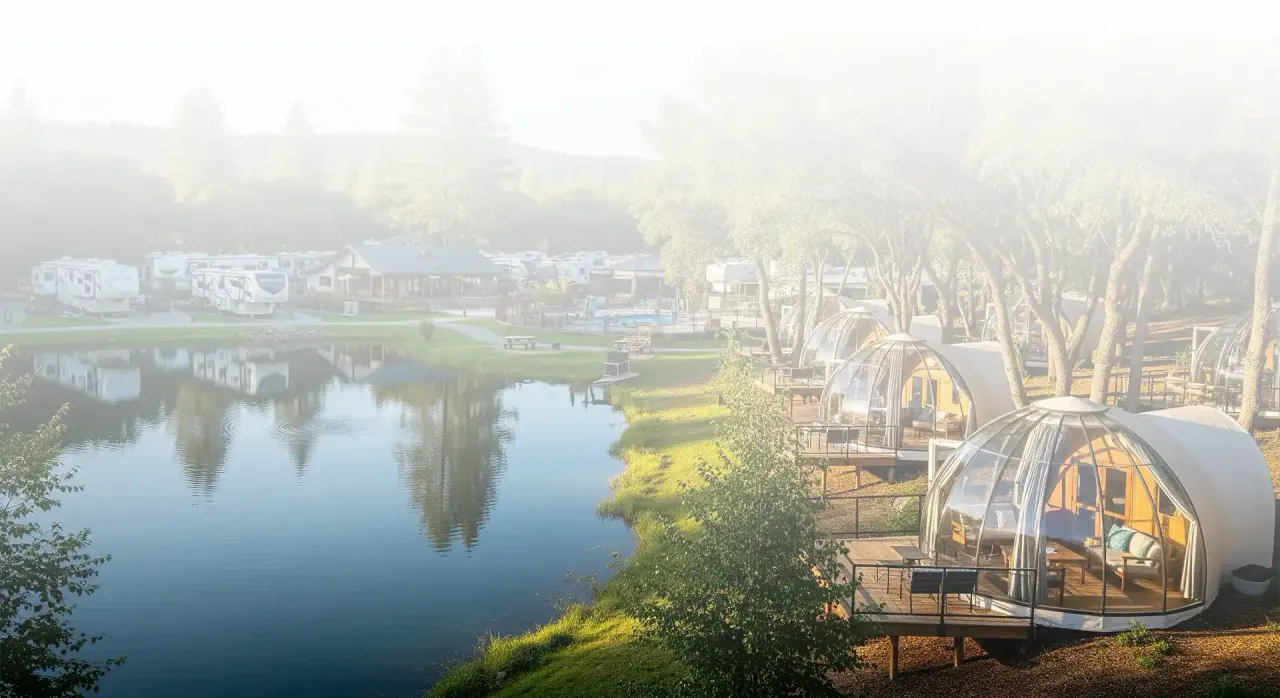
Unit types and how each one is classified
The classification of a glamping unit turns on plumbing, foundation and size, not on how the unit looks. A unit is regulated as one of three things: a camping unit on a licensed campground site, usually a relocatable shelter under 400 sq ft with no interior plumbing; a lodging or rooming-house unit once it gains plumbing, a permanent foundation or more than 400 sq ft; or a local zoning use approved by conditional use permit where the state has no campground license [1, 2, 3, 4]. The 2026 state-by-state review located no state campground license in North Carolina or Texas, where zoning and the building code drive approval; Texas now applies NFPA 1194 (2021 edition) to private campgrounds and cabin properties under Health and Safety Code Ch. 762 (SB 1, signed September 5, 2025) [9].
| Unit type | How it is treated | Code hook | Source |
|---|---|---|---|
| Canvas or safari tent | California organized camps: a tent is any shelter with 25% or more of walls or roof covered with fabric (CBC Section 450, Group C) | Building code occupancy | [10] |
| Tent on a deck or platform (North Carolina) | Tents erected on decks or platforms, or used 180 days or more, are permanent membrane structures under Building Code Sec. 3102; the platform itself is a structure. A temporary tent is limited to 180 consecutive days within a 12-month period, and needs a fire code official permit before it goes up | NC Fire Code Ch. 31 | [11] |
| Yurt (Oregon) | Round domed cloth or canvas shelter on a collapsible frame with no plumbing, sewage hookup or internal cooking appliance (ORS 215.459(3)); a land use definition, not a building code one | Farm and forest zone rules | [12] |
| Geodesic dome (Buncombe County, NC) | A PVC or fabric dome is a membrane structure; a rigid-panel dome is a building | Fire Code Ch. 31; Building Code | [11] |
| Hard-sided camping cabin | California: relocatable, under 400 sq ft, no plumbing, only in special occupancy parks or state parks (HSC 18862.5). New York: under 400 sq ft, on skids or readily movable, no cooking, sinks, showers, laundry or toilets (7-3.1(c)) | State campground rule | [1, 2] |
| Cabin with a bathroom | Michigan "resort cabin" needing a building permit; in North Carolina an R-1 or R-3 occupancy depending on configuration | Building code; lodging rules | [3, 13] |
| Tiny house on a foundation | IRC Appendix Q (2018), AQ (2021), BB (2024): houses of 400 sq ft or less; not mandatory unless adopted; ceiling at least 6 ft 8 in; lofts at least 35 sq ft; R310 escape openings | IRC appendix where adopted | [8, 14] |
| Montana "shelter unit" | Licensee-supplied structure including tents, cabins, yurts and tipis; may have plumbing; no size cap (ARM 37.111.1201(27)) | State campground rule | [15] |
| Park model or tiny home on wheels (Buncombe County) | A travel trailer: 180 days per calendar year, and it may not be "permanently set up or affixed" (Sec. 78-664); Utah's R392-301 states a tiny house is not a park model RV | Vehicle, not a building | [16, 17] |
| Kane County, Utah glamping unit | "A canvas or membrane-covered frame structure"; glamping on a permanent or semi-permanent foundation, no larger than 774 sq ft | County definition (KCLUO 9-1-7) | [18] |
| Garfield County, Utah glamping unit | Habitable space per the IBC; no glamping unit may be used for residential purposes | County ordinance | [6] |
The appendix route for tiny houses has limits. Its scope is tiny houses that serve as single dwelling units [14], and states amend it: New Hampshire raises the cap to 600 sq ft of habitable space [19]; New Mexico applies it to units on a permanent foundation, excludes RVs and brings a unit under the code once its axles come off [20]; and Montana's adopted appendix says tiny houses do not meet the building code requirements for commercial or business occupancy and prohibits them for those uses, so an appendix tiny house cannot be a rental glamping unit there [21]. North Carolina's amendments exempt camping units in a campground from sprinklers if they are one story, under 400 sq ft and without a kitchen [22].
Where the unit stops being a camping unit
| Jurisdiction | Still a camping unit | Becomes a building or lodging unit | Source |
|---|---|---|---|
| California | Hard-sided, relocatable, under 400 sq ft; no plumbing and no fuel-burning heating or cooking appliances | Plumbing, 400 sq ft or more, or not relocatable | [1, 23] |
| Michigan | Yurts, tipis, Tentrr units, glamping units and canvas tents under 400 sq ft; outlets allowed | Over 400 sq ft, permanently attached, or interior water | [3] |
| New York | Camping cabin under 400 sq ft | Outside the definition: 150 gal water per unit per day vs 55 gal per campsite (7-3.7) | [24] |
| Wisconsin | Camping cabin of 400 sq ft or less, including a yurt (ATCP 79.03(4)) | Operator-provided unit over 400 sq ft: tourist rooming house license (ATCP 79.13(3)); cabins must meet the building code (79.13(3)(d)) | [4, 25] |
| Oregon farm zones | Yurt on the ground or a wood floor; only yurts may get electrical service | Permanent foundation, plumbing or cooking appliance (OAR 660-033-0130(19)) | [7] |
| Oregon recreation parks | Units not permanently affixed | Sites with units for human occupancy permanently affixed fall outside the recreation park definition (OAR 333-031-0002(12)) | [26] |
| Montana | "Shelter unit" of any size, plumbing allowed (ARM 37.111.1201(27)) | Not set by size or plumbing in the definition | [15] |
| Pennsylvania (Erie County) | 400 sq ft or less on skids, no direct water, electricity allowed | Resort cabin with interior water must connect to approved sewage | [27] |
| Missouri | Lodging model for groups of 5 or more cabins | DHSS lodging license for 5 or more guest rooms, including cabins (RSMo 315.005 to 315.065) | [28] |
Fire and life safety follow the class. A California camping cabin needs a smoke detector in each sleeping room, a second exit or a window at least 20 in by 24 in with a sill 44 in or less, and a flame spread of 200 or less [29]. Utah county ordinances route glamping-unit fire protection through the building official and the planning commission [6, 30]. On the plan, the unit schedule lists each unit type's floor area, plumbing and foundation, the three entries that decide which column of the table above it falls in.

Spacing, privacy and buffers
State minimums for unit spacing are tight; county ordinances, boundary setbacks and buffers set the larger distances.
| Standard | Value | Source |
|---|---|---|
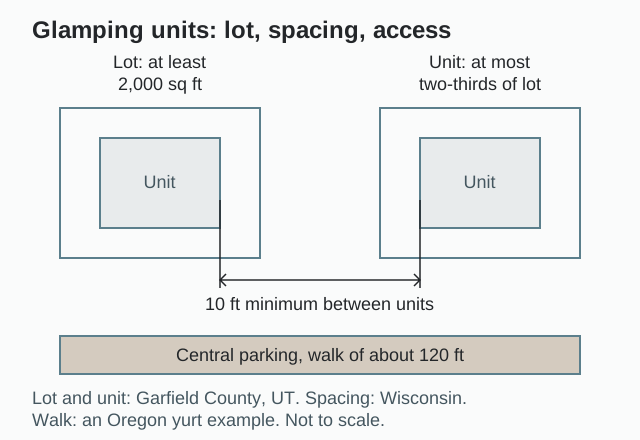
| Between camping units (Wisconsin) | 10 ft minimum (ATCP 79.13(1)) | [31] |
| Units and buildings (Colorado) | 10 ft from buildings and other camping units | [32] |
| Michigan sites | 1,200 sq ft; 4 ft unobstructed path around units (R 325.1556) | [33] |
| Lot per unit (Garfield County, Utah) | At least 2,000 sq ft; unit area no more than two-thirds of the lot | [6] |
| Glamp-ground setbacks (Kane County, Utah) | 100 ft from private property boundaries; 25 ft from public land (9-5A-5(G)) | [34] |
| Buffer strip (Buncombe County, NC) | 20 ft where a nonresidential lot of 1 acre or more adjoins a residential use (Sec. 78-667(a)) | [16] |
| Small accessory structures (Buncombe County) | 320 sq ft or less and 15 ft or less: 7 ft side and rear setback (Sec. 78-663(1)) | [16] |
| Height (Adirondack Park Agency Permit 2023-0042) | 15 ft max for glamping tent platforms and tiny home | [35] |
| Commercial campground (Banner Elk, NC) | 5 acres; 70% open space; campsites at least 3,000 sq ft; 35 ft from a property line in a residential zone and 200 ft from a non-associated residence (Code 152.207) | [36] |
The Kane County setback shows how a boundary rule eats a parcel. A 20-acre square (about 933 ft per side) with private neighbors on all sides keeps only about 733 by 733 ft of buildable core, roughly 12.3 acres; a boundary with BLM land needs only 25 feet [5]. Buncombe's buffer strip is planted with two staggered evergreen rows, 5 ft tall at planting, or an 8 ft solid fence [16].
Central parking with a walk to the unit is one pattern on record. Oregon State Parks' Champoeg yurt lists the walk at approx. 120 feet, with one vehicle per yurt [37]. Washington County, Utah requires "one designated vehicle parking space" per tent site plus "one guest parking space for every five tent sites" [38]. Buncombe County's stall is 9 ft by 18 ft, and a vacation rental complex parks 1 space per 2 guest rooms (Sec. 78-658) [16].
Utilities per unit
Utility service is the decision that moves a unit between classes, so it is set unit type by unit type.
| Tier | What the unit has | Regulatory consequence | Source |
|---|---|---|---|
| Dry | No water or power | Camping cabin or tent; central bathhouse sized to the state ratio | [1, 2] |
| Partial | Power only | Still a camping cabin in Michigan and Oregon (yurts may get electric) | [3, 7] |
| Full | Water, sewer, ensuite bath | Resort cabin or lodging; New York water at 150 gal per unit per day | [24] |
Ensuite baths carry a rate premium and a code cost. RVBusiness and Woodall's Campground Magazine both reported from the September 29, 2026 Glamping Show Americas operator panel that "73% of operators now have private in-unit bathrooms or plan to add them," with Sage data showing an average rate premium of about $98 (market evidence) [39, 40]. Those bathrooms usually trigger lodging and building-code classification, and in North Carolina a lodging establishment must provide baths, sinks and toilets for each guest room or unit [41].
The bathhouse for dry units is sized by the state ratio. In a worked example of 40 dry glamping tents, New York needs 4 base toilets plus 1 per sex for sites 26 to 40, so 6 toilets and 3 handwash fixtures; Georgia needs 8 toilets, 8 lavatories and 8 showers [42, 43]. The full state ratio table is on the campground site plan page.
Unit mix also sets the wastewater permit tier. In North Carolina, a 30-tent site on a bathhouse is about 2,100 gpd (30 times 70), under the 3,000 gpd State-review line; thirty 1-bedroom cabins at 240 gpd minimum per dwelling unit is about 7,200 gpd, which forces State or DEQ review [44]. In Utah, on-site systems run up to 5,000 gpd; above that, or for recreational facilities, the system is a large underground wastewater system under the Division of Water Quality [45]. A Utah resort becomes a public water system at 15 connections or 25 people for 60 days a year, and 8 connections are deemed 25 people [46].
Dark sky lighting
Dark-sky numbers come from county codes and permit conditions.
| Jurisdiction | Lighting rule | Source |
|---|---|---|
| Chaffee County, Colorado | Fixtures over 500 lumens fully shielded and DarkSky-compliant; pole mounts 20 ft max; path lights 36 in max; parking 10 fc max, 1 fc average; color temperature below 2,700 K; motion lights off within 5 minutes | [47] |
| Buncombe County, NC | 0.75 footcandles at any property line, 3.0 at a public street right-of-way; 4.5 average for the developed area; LED 4,300 degrees Kelvin maximum (Sec. 78-668(e)(1)); lighting plan sealed by a licensed engineer | [16] |
| Kane County, Utah | Code only encourages "hooded lighting practices" (9-10-14); the Camp Kaia CUP was conditioned on shielded LED lighting at 3000K max | [5] |
| Banner Elk, NC | Buffering to reduce noise and light affecting adjoining residential property (Code 152.207) | [36] |
Zion National Park was named an International Dark Sky Park in a National Park Service release of June 3, 2021, with the Kane County and Washington County Commissions among the supporting partners; no county ordinance retrieved turns that designation into a binding rule [48]. On the plan, lighting is drawn as zones: path, parking and unit decks, each with fixture height and the photometric limit that applies.
Wildfire and fire access
The fire record sits in permit conditions and fire codes, and in one state now in a statute.
- Texas: Health and Safety Code Ch. 762 (SB 1, signed September 5, 2025) makes NFPA 1194 (2021 edition) mandatory for private campgrounds and cabin properties, "other than Sections 1.1.1 and 5.1.1.1," and requires floodplain evacuation plans [9].
- California: special occupancy park accessory structures in Fire Hazard Severity Zones must meet CRC R327 ignition-resistant construction [23].
- Colorado: in the wildland-urban interface, Chaffee County requires a fire protection plan (IWUIC Sec. 405) and a defensible space plan (IWUIC Sec. 603, 604), with driveways 14 ft wide and 14 ft clear height [47]. Park County 20CUP-08 relied on fire protection district approval of cleared areas around fire rings [49]. The Chaffee County campground model project maps these rules onto a layout.
- Utah: Kane County applies the IWUIC under Ord. 2006-2 [50]; its glamp-ground conditions set fire apparatus roads 20 ft wide with 13 ft 6 in clearance [34]. Camp Kaia's water system lacked pressure for fire flow, so a 100,000-gallon tank was required [5].
- North Carolina: Buncombe County requires documentation from the Fire Marshal of the adequacy of facilities for emergency medical and fire services (Sec. 78-677(d)(5)) [16].
Density by tier
| Tier | Density | Evidence | Source |
|---|---|---|---|
| Low (wilderness or luxury) | About 1 unit per acre | Mendocino County Wildwood Campground: 73 sites on 65 acres, 1.12/ac | [51] |
| Dry primitive | 1.6 sites per acre | San Bernardino County CUP: 12 sites on 7.5 acres (2026) | [52] |
| Mid (rural CUP) | About 3 units per acre | Valley County, Idaho, C.U.P. 22-32: Phase 1 at 3.1 du/ac if tents count as dwelling units | [53] |
| High (ordinance cap) | 5 to 10 units per acre | Tropic, Utah 5/ac; Garfield County, Utah 10/ac | [6, 30] |
| Campground ceiling | 20 sites per acre | Wisconsin ATCP 79.11(5)(a) | [31] |
Kane County ties site count to acreage in its RU-10 and RU-40 zones: 14 sites for the first 10 acres plus 8 for each additional 10 acres, up to 70 sites on 80 acres or more [5]. That yields 22 sites at 20 acres, 38 at 40 acres, 54 at 60 acres and 70 at 80 acres, and a 60-unit program needs about 70 acres [5]. Washington County, Utah allows only 1 tent site per 2 acres in OST-20 and A-20 or 1 per 5 acres in OSC-20, and bars campgrounds inside any overlay zone [38].
In Buncombe County, the Bel Air Resort PUD, approved at a special Board of Adjustment meeting on December 13, 2023, proposed 89 commercial units, 65 of them glamping, on 104.19 acres, with most land held as open space and a clustered resort core [54, 55]. Its preliminary site plan, marked "PRELIMINARY - NOT FOR CONSTRUCTION," carried "GLAMPING (1 SP / UNIT): 65 SPACES" in the parking table [56].
As market evidence, the 2026 Glamping Industry Report panel put the top 10 brands at about 40 units per property against about 9 for independents, and counted "around 2,500 glamping-only properties in the U.S., with about 8,000 traditional campground properties that offer some sort of glamping" [40].
Zoning paths: conditional use, glamping ordinances and STR overlays
| Pattern | Example | Source |
|---|---|---|
| CUP in agricultural, forest or rural zones | Clallam County, Washington, PCUP2024-00020: glamping studio cabins phased over six years on a 29.46-acre forested parcel, after staff found "recreational cabins are not defined as a use" | [57] |
| CUP for yurt campsites | Valley County, Idaho, C.U.P. 22-32: five yurt campsites plus three RV sites | [53] |
| CUP as a commercial campground | Park County, Colorado, 18CUP-08 Black Tree Resort: 20 furnished tents in the Agricultural zone (Planning Commission September 11, 2018); tents with interior wood stoves approved as a commercial campground, with meals from a commercial kitchen delivered to the tents | [58] |
| CUP for a dry campground | San Bernardino County, California: 12-site dry campground in the RL zone (hearing notice March 25, 2026) | [52] |
| Campground permit stretch | Michigan licenses glamping units as camping cabins; Oregon allows farm-zone yurts up to one-third of sites or 10 | [3, 7] |
| Dedicated glamping ordinance | Garfield County Ord. 2019-2 and Tropic Town Ord. 2020-3, Utah: density caps of 10/ac and 5/ac, planning commission review of street, sanitary and unit layout; Tropic requires the overall development plan 30 days before the hearing | [6, 30] |
| Rezone, then CUP | Kane County, Utah: zone change to RU-10 ($400), then a Planning Commission CUP; "Zone change applications must be approved prior to submitting a Conditional Use Permit" | [59] |
| Special use permit as a PUD | Buncombe County, NC: more than 4 principal buildings on a lot requires a PUD (Sec. 78-662), heard by the Board of Adjustment | [16] |
| Regional agency overlay | Adirondack Park Agency Permit 2023-0042: 23 glamping tents | [35] |
| Agritourism shortcut | North Carolina exempts agritourism only on bona fide farm property (G.S. 160D-903(a)); Hawaii's Rosehill v. State (2024) held farm-stay short-term rentals impermissible in the agricultural district | [60, 61] |
In Park County, Colorado, the county found the commercial campground use authorized, compatible and consistent with a master-plan goal of "business diversification on agricultural lands" [49]. Kane County also requires proof of all required utilities before any zone change to a denser zone (9-4-4E) [34], so water and wastewater feasibility come before entitlement. In Montana, Flathead County treats glamping tents as a campground needing a state campground license [62]; see Montana site plans. The Clallam County decision is one data point for Washington.
Short-term rental and lodging law sits on top of zoning:
- Arizona: ARS 11-269.17(A) says "A county may not prohibit vacation rentals or short-term rentals," and ARS 9-500.39 applies the same rule to cities and towns [63, 64].
- Buncombe County, NC: a vacation rental complex includes no more than 10 units; more than 10 is a hotel or motel except in the Open Use district (Sec. 78-581) [16].
- Lodging licenses: Missouri's DHSS lodging license covers establishments of 5 or more guest rooms, including cabins [28]. Wisconsin's tourist rooming house license under ATCP 72 applies to operator-provided units over 400 sq ft [4].
- Utah: Tropic defines "transient" as 5 days or fewer and bars residential use [30].
Which stages accept an unsealed concept plan
| Jurisdiction | Unsealed stage | Where a seal enters | Source |
|---|---|---|---|
| Buncombe County, NC | Pre-application "sketch development plan"; the SUP development plan must be "drawn to scale, with the date of preparation" (Sec. 78-677(d)) | Sealed lighting plan and as-built (Sec. 78-668(f)); geotechnical engineer in the steep slope overlay (Sec. 78-644(f)) | [16] |
| Kane County, Utah | CUP staff reports accept an unsealed "preliminary site concept plan" | Utah Code 58-53-602(1): "Any site plan prepared in this state shall bear the seal of a landscape architect," with exemptions for engineers and architects (58-53-304); plats by PLS; construction drawings by PE | [5, 65] |
| Garfield County, Utah | Street, sanitary and unit layout plans; no seal requirement stated | Not stated | [6] |
| Michigan | Not stated | Engineered construction plans before the EGLE construction permit; engineer or owner statement at permit close-out that construction matched the approved plans (EQP2280) | [66, 67] |
Two points from the Buncombe record matter for the concept set. Sec. 78-581 says a sketch plan that "fails to describe with reasonable certainty the type and intensity of use" does not count as a site specific development plan for vesting, so the plan has to fix unit counts, types and locations [16]. At the Bel Air hearing, board member Carla Barnard said: "We really want a complete site plan and know what it is we are approving" [68]. A preliminary site plan that pins down every unit and amenity answers both; where a seal is required, it is the base the engineer, architect or landscape architect of record builds the sealed set on.
Renderings at the hearing
A San Bernardino County CUP for a 4-site geodome campground on 2.39 acres in Joshua Tree carried three photoreal renderings of the entry and geodome units, with a site plan, in the record; its conditions covered quiet hours, no events, downward lighting with a photometric study, septic approval, fire access with a hydrant within 300 ft, and a 50-ft buffer around Joshua trees [69]. That record shows what a glamping hearing looks at: the units, the entry and the lighting after dark. Rendering for glamping projects is covered under glamping visualization.
What the engineer of record adds
The preliminary plan fixes the unit schedule, layout, roads, parking, setbacks and the site data table. The engineer of record and the other licensed professionals add the wastewater system design and its state permit, the water system and fire-flow design, the sealed lighting plan where required, the geotechnical report in steep or hazard areas, erosion and stormwater plans, and building construction documents for cabins, platforms and permanent membrane structures. In Kane County, the CUP application asks for feasibility letters from UDOT, Southwest Utah Public Health, Garkane Energy, Kane County Water Conservancy and Western Kane County Special Service District [70]; the septic or large-system design, water system design and fire-flow modeling behind those letters are the engineer of record's work.
Model projects and related pages
The two glamping model projects show these rules on a real parcel: Buncombe County, North Carolina (special use permit as a PUD, steep slope overlay, post-Helene floodway rules) and Kane County, Utah (RU-10 acreage formula, 774 sq ft unit cap, 100 ft setbacks). The statewide rules are on glamping site plans in North Carolina and glamping site plans in Utah. The glamping and campground regulations by state guide sets the state rules side by side, and the campground site plan page carries the campground density caps and bathhouse ratios behind a mixed park; Colorado's statewide picture is on campground site plans in Colorado. Mixed parks with RV pads are covered on the RV resort site plan page, and Wisconsin's camping-cabin rule on Wisconsin site plans. For background, see glamping in U.S. RV parks and RV resorts and glamping sites as a use of land.
Frequently asked questions
How large can a glamping cabin be and still count as a camping cabin?
Can a Michigan glamping cabin have a bathroom?
No. Interior water makes it a resort cabin, which cannot go on a licensed campsite. Electrical outlets are allowed, installed by a licensed electrician with a permit [3].
How many yurts can an Oregon farm-zone campground have?
One-third of sites or 10, whichever is smaller, with a stay limit of 30 days in any six-month period (OAR 660-033-0130(19)) [7].
Does the IRC tiny house appendix apply automatically?
No. The 2024 IRC states that Appendix BB is not mandatory unless specifically referenced in the adopting ordinance. It covers houses of 400 sq ft or less and sets a ceiling height of at least 6 ft 8 in [8, 14]. States amend it: New Hampshire raises the cap to 600 sq ft of habitable space [19], and Montana's adopted appendix prohibits tiny houses for commercial or business occupancy [21].
Is a glamping tent a campground in Montana?
Yes. Flathead County, citing DPHHS, states that glamping tents are considered a campground and require a campground license [62].
How many glamping units fit on 40 acres in Kane County, Utah?
38 under the RU-10 formula (14 + 8 x 3), approved as a conditional use (KCLUO 9-5C-6) [5].
Can an Arizona county ban short-term rentals?
Will Buncombe County, North Carolina accept an unsealed concept plan?
Sources
- 1)Cal. Health and Safety Code 18862.5 (Special Occupancy Parks Act), California Legislature (via Justia). Accessed 2026-10-09.
- 2)10 NYCRR 7-3.1, Definitions, New York State Department of Health (via Justia). Accessed 2026-10-09.
- 3)Cabins and Park Models in Michigan Campgrounds, Michigan Department of Environment, Great Lakes, and Energy (EGLE). Accessed 2026-10-09.
- 4)Chapter ATCP 79, Campgrounds, Wisconsin Legislature. Accessed 2026-10-09.
- 5)September 13, 2023 Kane County Planning Commission, Land Use Authority packet (Camp Kaia CUP staff report), Kane County, Utah. Accessed 2026-10-09.
- 6)Garfield County, Utah Glamping Ordinance No. 2019-2 (Appendix C), Garfield County, Utah. Accessed 2026-10-09.
- 7)OAR Chapter 660, Division 33 (OAR 660-033-0130(19)), Oregon Land Conservation and Development Commission. Accessed 2026-10-09.
- 8)2024 International Residential Code, Appendix BB, Tiny Houses, International Code Council. Accessed 2026-10-09.
- 9)Bill analysis, SB 1, 89th Legislature, 2nd Called Session (Senate Research Center), Texas Legislature Online. Accessed 2026-10-10.
- 10)California Building Code Section 450, Group C [SFM], California State Fire Marshal (via UpCodes). Accessed 2026-10-09.
- 11)Chapter 31, Tents and Other Membrane Structures, North Carolina Fire Prevention Code 2018, North Carolina OSFM (via UpCodes). Accessed 2026-10-09.
- 12)ORS 215.459, Oregon Legislature (via oregon.public.law). Accessed 2026-10-09.
- 13)Chapter 3, Use and Occupancy Classification, 2018 North Carolina State Building Code, International Code Council. Accessed 2026-10-09.
- 14)Appendix AQ Tiny Houses, North Carolina Residential Code 2024 (North Carolina Building Code Council), North Carolina Building Code Council (via UpCodes). Accessed 2026-10-09.
- 15)ARM Title 37, Chapter 111, Subchapter 12, trailer court and campground rules (2023), Montana DPHHS. Accessed 2026-10-10.
- 16)Buncombe County Zoning Ordinance, Ch. 78 (compiled, as amended May 1, 2018), Buncombe County, North Carolina. Accessed 2026-10-09.
- 17)Utah Admin. Code R392-301, Recreational Vehicle Park Sanitation, TriCounty Health Department, Utah. Accessed 2026-10-09.
- 18)KCLUO 9-1-7, Definitions, Kane County, Utah (American Legal Publishing). Accessed 2026-10-09.
- 19)Appendix AQ Tiny Houses, New Hampshire Residential Code 2021, New Hampshire Building Code Review Board (via UpCodes). Accessed 2026-10-10.
- 20)Appendix AQ Tiny Houses, New Mexico Residential Code 2021, New Mexico Construction Industries Division (via UpCodes). Accessed 2026-10-10.
- 21)Appendix AQ Tiny Houses, Montana Residential Code 2021, Montana Department of Labor and Industry (via UpCodes). Accessed 2026-10-10.
- 22)September 13, 2022, 2018 NC State Building Code Amendments, North Carolina Office of State Fire Marshal. Accessed 2026-10-09.
- 23)Ignition-Resistant Construction for Manufactured Housing and Special Occupancy Parks, California Department of Housing and Community Development. Accessed 2026-10-09.
- 24)10 NYCRR Subpart 7-3, Campgrounds (Public Health Law 225), New York State Department of Health (Cortland County copy). Accessed 2026-10-09.
- 25)Wis. Admin. Code ATCP 79.13, Camping units, Wisconsin DATCP (via Cornell LII). Accessed 2026-10-09.
- 26)OAR 333-031-0002, Definitions, Oregon Health Authority (via public.law). Accessed 2026-10-10.
- 27)Erie County Department of Health Organized Camps and Campgrounds Ordinance, Erie County, Pennsylvania. Accessed 2026-10-09.
- 28)Lodging Licensing, Missouri Department of Health and Senior Services. Accessed 2026-10-09.
- 29)California Health and Safety Code, Part 2.3, Special Occupancy Parks Act, EasyLawLookup. Accessed 2026-10-09.
- 30)Glamping Ordinance #2020-3, Town of Tropic, Utah. Accessed 2026-10-09.
- 31)Wis. Admin. Code ATCP 79.13(2)(a)1.a. and ATCP 79.11, Wisconsin Legislature. Accessed 2026-10-09.
- 32)6 CCR 1010-9, Campgrounds and Recreation Areas (adopted Feb 19, 1975), Colorado Department of Public Health and Environment (Code of Colorado Regulations). Accessed 2026-10-09.
- 33)Mich. Admin. Code R 325.1556, Michigan EGLE (via Cornell LII). Accessed 2026-10-09.
- 34)March 8, 2023 Kane County Planning Commission packet (Binyamini CUP; Ord. O-2023-07), Kane County, Utah. Accessed 2026-10-09.
- 35)Adirondack Park Agency Permit 2023-0042, Adirondack Park Agency. Accessed 2026-10-09.
- 36)Banner Elk Code of Ordinances 152.207, Commercial Campgrounds, Town of Banner Elk, North Carolina (American Legal Publishing). Accessed 2026-10-10.
- 37)Site YURTB, Loop Park at Champoeg State Heritage Area, OR (reservation listing), Oregon State Parks. Accessed 2026-10-09.
- 38)Washington County Code 10-18B-5, Campgrounds: Specific Standards, Washington County, Utah (American Legal Publishing). Accessed 2026-10-09.
- 39)Glamping Show Americas operator panel, September 29 (Shari Heilala, Scott Bahr, Whitney Scott), RVBusiness. Accessed 2026-10-09.
- 40)Glamping Rates Rise as Parks Expand Amenities, Experiences (October 1, 2026), Woodall's Campground Magazine. Accessed 2026-10-10.
- 41)15A NCAC 18A .1800, Lodging Establishments, North Carolina DHHS. Accessed 2026-10-09.
- 42)10 NYCRR 7-3.15, Toilets, lavatories and utility sinks, New York State Department of Health (via Cornell LII). Accessed 2026-10-09.
- 43)Tourist Accommodations Rules and Regulations, Ga. Comp. R. & Regs. 511-6-2, Georgia Department of Public Health. Accessed 2026-10-09.
- 44)15A NCAC 18E, Wastewater Treatment and Dispersal Systems, North Carolina DHHS. Accessed 2026-10-09.
- 45)Utah Admin. Code R317-5-1, Large Underground Wastewater Disposal Systems, Utah Division of Water Quality (via Cornell LII). Accessed 2026-10-09.
- 46)DAR File No. 34112, Section R309-100-4 (Utah Bulletin 2010-20), Utah Division of Drinking Water. Accessed 2026-10-09.
- 47)Chaffee County LUC Appendix A, Development Review Manual and Application Materials, Chaffee County, Colorado. Accessed 2026-10-09.
- 48)Zion National Park named an International Dark Sky Park (news release, June 3, 2021), National Park Service. Accessed 2026-10-09.
- 49)Planning Commission Staff Report, 20CUP-08, Park County, Colorado. Accessed 2026-10-09.
- 50)Kane County Ordinance No. 2013-8 (lists IWUIC Ord. 2006-2), Kane County, Utah (American Legal Publishing). Accessed 2026-10-09.
- 51)Planning Commission Staff Report, Use Permit Renewal, November 20, 2025 (Wildwood Campground), Mendocino County, California (via CEQAnet). Accessed 2026-10-09.
- 52)Planning Commission Staff Report, PROJ-2023-00023 (12-site campground CUP), San Bernardino County Land Use Services, California. Accessed 2026-10-10.
- 53)Valley County Planning and Zoning Commission minutes (C.U.P. 22-32), Valley County, Idaho. Accessed 2026-10-09.
- 54)Development Roundup: Board of Adjustment to discuss proposed spa resort, Mountain Xpress. Accessed 2026-10-09.
- 55)Glamping Park in N.C. to Feature Pickleball, Domes, Woodall's Campground Magazine. Accessed 2026-10-09.
- 56)Bel Air site plan, Board of Adjustment, December 13, 2023 (ZPH2023-00028), Buncombe County, North Carolina. Accessed 2026-10-09.
- 57)Hearing Examiner decision, PCUP2024-00020, Clallam County, Washington. Accessed 2026-10-09.
- 58)BOCC Staff Report 18CUP-08 (Black Tree Resort), Park County, Colorado. Accessed 2026-10-10.
- 59)Zone Change Application (rev. 8-4-2026), Kane County Land Use Authority. Accessed 2026-10-09.
- 60)What the heck is "agritourism"? Defining a non-farming agricultural use, UNC School of Government. Accessed 2026-10-10.
- 61)Case Law Index, Agritourism (Rosehill v. State, Haw. 2024), National Agricultural Law Center. Accessed 2026-10-10.
- 62)Trailer Courts and Campgrounds, Flathead County, Montana, Environmental Health. Accessed 2026-10-09.
- 63)SB 1379 text (ARS 11-269.17), Arizona Legislature. Accessed 2026-10-09.
- 64)HB 2663 text (ARS 9-500.39), Arizona Legislature. Accessed 2026-10-09.
- 65)Utah Code Title 58, Chapter 53, Landscape Architects Licensing Act, Utah Legislature. Accessed 2026-10-09.
- 66)Starting a campground in Michigan, Michigan EGLE. Accessed 2026-10-10.
- 67)Obtaining a Construction Permit for a Campground (EQP2280), Michigan EGLE. Accessed 2026-10-09.
- 68)Bel Air Asheville: East Buncombe boutique glamping OK'd, pickleball denied, Asheville Citizen-Times (via Yahoo News). Accessed 2026-10-09.
- 69)Agenda Item 2, PROJ-2022-00040, Joshua Tree Campsite (hearing March 5, 2026), San Bernardino County Land Use Services. Accessed 2026-10-07.
- 70)Procedures for a Residential Conditional Use Permit (rev. 2-2-2026), Kane County Land Use Authority. Accessed 2026-10-09.