What a campground site plan carries
A campground site plan is a count of sites, a sanitation plan and a road network, drawn on one sheet. The preliminary plan fixes the program before engineering starts: tent sites, RV sites, camp cabins, the bathhouse and laundry, the office, the sanitary waste station, internal roads, parking and the amenity core. A mixed program like the 60 to 120 site model project in Chaffee County, Colorado combines RV full-hookup sites, tent sites and cabins with an office, bathhouse and laundry, and a sanitary waste station.
The site data table on a campground sheet carries the numbers a reviewer checks first:
- gross acreage, and net acreage where the cap is measured net of roads, buildings and common areas;
- zoning district and the use category (campground, RV park, rural resort or lodging);
- sites per acre against the state cap and the county cap;
- setbacks from property lines, roads, streams and between sites;
- sanitary fixtures required against fixtures provided, and the walk distance to the bathhouse;
- parking required against provided, and the unit mix by site type.
The studio draws this as a preliminary site plan: layout, yield and the data table. Wastewater design, water supply, grading and drainage are engineering, done by the client's engineer of record on the same base.
Site counts: density caps and site sizes
The cap sets the ceiling, and states define it differently. Colorado counts campsites per acre net of roads, buildings and common areas; Florida counts units per gross acre; Michigan sets no numeric cap and limits sites to the licensed count.
| Jurisdiction | Density cap | Minimum site | Source |
|---|---|---|---|
| Colorado, statewide | 25 campsites per acre, excluding roads, buildings, common areas (6 CCR 1010-9 Sec. 5.4) | 900 sq ft per campsite (Sec. 5.3) | [1] |
| Chaffee County, Colorado | 20 campsites or camp cabins per acre, aggregate (AR, RR, MUR, MUC); 10 per acre in PCR | County setbacks govern | [2] |
| Mineral County, Colorado | Campgrounds 15 per gross acre; RV parks 12 | Not stated | [5] |
| Wisconsin | 20 sites per acre; 6 campers or one family per site (ATCP 79.11(5)); group sites 80 campers per acre | Not stated | [3] |
| Florida | 25 units per gross acre (64E-15.002(3)(b)) | 1,200 sq ft RV; 500 sq ft tent | [4] |
| Michigan | No numeric cap; sites limited to licensed count | 1,200 sq ft, 15 ft road frontage (R 325.1556) | [6] |
| Ohio | 1 RV plus 2 portable units, or 3 portable units, per site | 1,000 sq ft (OAC 3701-26) | [7] |
| California | One camping cabin, or one RV plus one tent, per lot (25 CCR 2118) | Not stated | [8] |
| Massachusetts | Safari field, overflow only: 60 camping units per acre (105 CMR 440.06) | Not stated | [9] |
| Banner Elk, North Carolina | 5 acres required; 30% use and 70% open space | 3,000 sq ft per campsite (Code 152.207) | [10] |
The county cap in Chaffee County is gross, so a 60 to 120 unit program needs 3 to 6 gross acres by code, and realistic gross area is materially larger once the 100 ft residential-edge setbacks, OWTS fields, augmentation and drainage areas, and resource setbacks are applied [2]. The RV sites per acre guide covers the gap between these caps and built yields.
Wastewater flow can resize the count before density does. In Colorado, Regulation 43 Table 6-2 sets 50 gpd per campsite, and an on-site system above 2,000 gpd becomes a domestic wastewater treatment works under Regulation 22 site location approval, so more than 40 campsites crosses the line [11, 12]. A 2022 public notice described Chaffee County's Applejack RV Park as 29 RV-only spaces proposed in two phases, served by a commercial well and two OWTS [13]. North Carolina sizes bathhouse campsites at 70 gal per campsite and sends systems above 3,000 gpd to State review [14]; how unit type changes the flow is covered on the glamping site plan page.

Classification: what the state calls the project
Whether a state licenses the campground, and how, decides who reviews the plan before construction. Michigan's license applies to any campground with 5 or more recreational units (MCL 333.12501) [15]. New York defines a campground as 5 or more campsites (10 NYCRR 7-3.1(b)) [16]. Wisconsin licenses campgrounds of 4 or more sites, or 1 to 3 sites if advertised (ATCP 79.05(1)(a)) [17]. Minnesota licenses "recreational camping areas" of 5 or more tents or RVs [18]. Colorado's rule defines campground classes up to developed and modern campgrounds [1]; Chaffee County's PCR district allows only primitive, semi-primitive or semi-developed campgrounds at 10 sites per acre, which rules out a full-hookup cabin campground there [2].
| State | Regulator and rule | Plan review, permit or fee | Source |
|---|---|---|---|
| Colorado | CDPHE, 6 CCR 1010-9 | County plan sets in some counties (Mineral County) | [1, 5] |
| Michigan | EGLE, Part 125, MCL 333.12501; R 325.1551 | Engineered plans, then an EGLE construction permit before building (MCL 333.12505) | [15, 19] |
| New York | DOH and local health departments, 10 NYCRR Subpart 7-3 | Sewage plans at least 30 days before construction (7-3.14(a)) | [20] |
| Florida | DOH, F.S. Ch. 513; F.A.C. Ch. 64E-15 | Plans drawn to scale before construction (64E-15.010(2)(c)) | [21] |
| Georgia | DPH tourist accommodation permit, 511-6-2 | Local plan review fees (Clayton County $250 to $550) | [22, 23] |
| Ohio | ODH plan approval, local license; ORC Ch. 3729; OAC 3701-26 | State plan approval; $110 state fee plus local fee | [7] |
| Montana | DPHHS; ARM 37.111 subchapter 12 | Plan review and pre-licensing inspection | [24] |
| Wisconsin | DATCP or local agent; ATCP 79 | Plans per ATCP 79.04 | [17] |
| Virginia | VDH campground permit; 12VAC5-450 | Not stated in the rule reviewed | [25] |
| Vermont | ANR DEC wastewater and water permit for 4 or more campsites | DEC permit | [26] |
| Oregon | OHA, OAR 333-031 | DCBS Building Codes Division plan approval before construction (333-031-0059) | [27] |
| Pennsylvania | DOH and local health departments, 28 Pa. Code ch. 19 | Permit under 19.11, issued for the calendar year (19.13) | [28] |
| Massachusetts | DPH, 105 CMR 440.000 | License from the local Board of Health | [9] |
| Maine | Maine CDC Health Inspection Program, 10-144 CMR ch. 205 | Annual license $205 (5 to 24 sites), $240 (25 to 124), $270 (over 124) under 10-144 CMR ch. 201 | [29] |
| Tennessee | TDH organized camp permit, T.C.A. 68-110-103; Rule 1200-01-05 (July 2002 text) | Plan approval for construction or extensive remodeling | [30, 31] |
| Texas | Health and Safety Code Ch. 762 (SB 1, 2025) | NFPA 1194 (2021 edition) mandatory; floodplain evacuation plans | [32] |
No state campground license was located for North Carolina or Texas in the 2026 review, so zoning and the building code drive approval there. Texas's TCEQ regulates septic, drinking water and stormwater (RG-499) [33], and North Carolina reaches RV parks through its septic rules (15A NCAC 18E) [34]. For every state not listed here, confirm the licensing agency and its rule with the county and the state health department at pre-application.
Tent sites, RV sites and setbacks
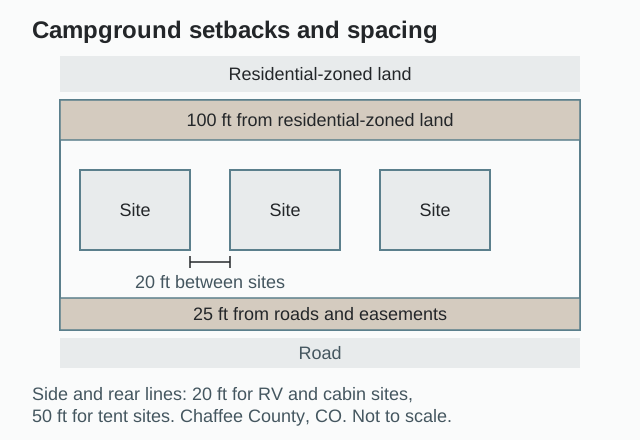
Tent and RV sites follow different setback lines even inside one campground. Chaffee County's code shows the split clearly [2]:
| Setback (Chaffee County, Colorado) | RV and cabin sites | Tent sites |
|---|---|---|
| From residential-zoned private land | 100 ft | 100 ft |
| Side and rear property lines | 20 ft | 50 ft |
| Roads and access easements | 25 ft | 25 ft |
| Between sites | 20 ft from other campsites, buildings, structures | 20 ft from other sites |
| Rivers and streams | Resource setbacks | 100 ft from river or stream edge |
| Internal roads and drives | 10 ft | Not stated |
State spacing rules sit underneath, and the county's 20 ft between sites is twice the state's 10 ft [1, 2]. Colorado keeps units 10 ft from buildings and units on adjacent sites, 3 ft from campsite lot lines and 25 ft from a public highway right-of-way [1]. Wisconsin requires a 10 ft minimum between camping units (ATCP 79.13(1)) [3]. Michigan requires a 4 ft unobstructed path around units on sites of at least 1,200 sq ft [6]. Tennessee requires 15 ft or more between units under its organized camp rule (Rule 1200-01-05, July 2002 text) [31]. Banner Elk, North Carolina sets a 35 ft perimeter setback from a property line in a residential zone and 200 ft from a non-associated residence [10].
Creek setbacks can remove the most marketable sites. At Pine Creek in Chaffee County, the applicant asked for 100 ft creek setbacks where, the Chaffee County Times reported, "the county land use code requires 300 and Colorado Parks and Wildlife recommended 500" [35]. At Cottonwood Creek, the Chaffee County Times reported that a 2026 request to cut the 300 ft setback to 100 ft failed when the Board of Adjustment could not reach a unanimous vote to overturn staff [36]. RV pads inside a campground follow the RV park rules for pad size, hookups and electrical mix, set out on the RV park site plan and RV resort site plan pages.
Cabins in a campground
A camp cabin is a campsite for density and a building for permits. In Chaffee County, camp cabins sit 20 ft from all roads and drives, need a permanent foundation or treated timbers anchored for wind, may need a building permit, and carry a fire alarm with battery backup and an extinguisher in each [2]. Cabins with full kitchens and baths sized like lodging may instead be read as "Rural Resort" (FAR cap 0.05 in MUR) or "Commercial Lodging" [2]. At state level, Colorado's campground rule allows permanent or semi-permanent cabins only by the owner and under building codes (6 CCR 1010-9 Sec. 5.8) [1].
State rules draw the line at size and plumbing: California, Michigan and New York set the camping-cabin line under 400 sq ft with no interior plumbing, and a larger or plumbed cabin moves to lodging or building rules [37, 38, 39]. Wisconsin requires a tourist rooming house license under ATCP 72 for an operator-provided unit over 400 sq ft (ATCP 79.13(3)(a)2) [17]. Montana goes the other way: its "shelter unit" (ARM 37.111.1201(27)) covers tents, cabins, yurts and tipis, may have plumbing and has no size cap [24]. Missouri's DHSS lodging license covers establishments of 5 or more guest rooms, including cabins (RSMo 315.005 to 315.065) [40]. Michigan bars footings below grade for accessory structures on licensed campsites [41]. The unit-by-unit code treatment of cabins, tents, yurts, domes and tiny homes is on the glamping site plan page.
Bathhouse sizing
The bathhouse is sized from the count of dependent sites (sites without their own toilet and sewer connection) and placed by the walk-distance rule.
| State | Fixture ratio | Walk distance | Source |
|---|---|---|---|
| Colorado | 1 toilet and 1 lavatory per sex per 15 sites; 1 shower per sex per 30 sites; independent-only parks 1 per sex per 100 sites | Service building 10 to 400 ft from dependent sites | [1] |
| Utah (RV parks) | 1 toilet, 1 hand sink and 1 bath fixture per sex for every 15 dependent RV or tent sites | 15 to 500 ft from those sites | [42] |
| New York | At least 4 toilets (2 per sex), then 1 per sex per 25 more unsewered sites or per 75 sewered sites; 1 handwash per 2 toilets | Within 500 ft | [43] |
| Georgia | 1 toilet, 1 lavatory, 1 shower per sex, plus 1 urinal, per 10 dependent RV spaces or 10 non-permanent structures | Within 200 ft | [22] |
| Florida (recreational camps) | Toilets 1:10 females, 1:15 males; showers 1:15 (64E-15.009) | Not stated | [44] |
| Minnesota | 1 to 15 dependent sites: 1 toilet each sex, 1 urinal, 1 lavatory and 1 shower each sex; 1 sanitary station per 100 sites | Within 400 ft | [18] |
| Vermont | 1 toilet per 10 or fewer dependent sites; privies and composting toilets allowed | Within 400 ft | [26] |
| Michigan (primitive) | A potable water outlet and privies for every 25 sites (R 325.1556a) | Not stated | [45] |
| Michigan (primitive sites beside a modern campground) | Add 1 toilet and 1 lavatory per sex for every 50 primitive sites served by the modern service building (Rule 21 schedule) | Not stated | [46] |
Virginia uses a step table instead of a ratio (12VAC5-450-100) [25]:
| Sites | Toilets | Lavatories | Showers |
|---|---|---|---|
| 1 to 15 | 2 | 2 | 2 |
| 16 to 30 | 4 | 4 | 2 |
| 31 to 45 | 6 | 6 | 2 |
| 46 to 60 | 8 | 6 | 4 |
| 61 to 75 | 10 | 8 | 4 |
Support stations follow the same count. Colorado requires a water fill station per 100 sites, set 50 ft from the sanitary station; a sanitary waste station per 100 sites without sewer hookups, 50 ft from any campsite; and common faucets within 150 ft of sites [1]. Utah keeps a dump station at least 50 ft from any site [42]. Colorado refuse containers hold 8 cu ft (60 gal) per 5 campsites and sit within 300 ft of sites [1].
Roads, parking and fire access
Campground roads are set by the state campground rule, the county road standard and the fire code, and the strictest one governs each segment.
| Standard | Value | Source |
|---|---|---|
| Entrance (Colorado) | 24 ft unless separate exit; at least two means of access to the entrance | [1] |
| Interior lanes (Colorado) | One lane 10 ft; two lanes 20 ft; parallel parking lane 10 ft; 13 ft overhead and 3 ft side clearance | [1] |
| Dead ends (Colorado) | 50 ft turnaround, Y or T | [1] |
| Parking (Colorado) | At least 1 space per campsite | [1] |
| Commercial two-way driveway (Chaffee County) | 24 ft minimum; cul-de-sac turnaround radius 45 ft; parcels over 10 acres show an alternate access road | [47] |
| Grades (Chaffee County) | 8% maximum on local (residential) roads; grades over 5% need a PE drainage plan | [47] |
| Fire apparatus driveways (Chaffee County IWUIC) | 14 ft clear width, 14 ft clear height; turnarounds beyond 150 ft; turnouts 10 ft x 30 ft every 400 ft | [48] |
| Special occupancy parks (California) | Two-way 18 ft, one-way 12 ft; 25 ft with parking on one side; 32 ft both sides (25 CCR 2106) | [49] |
| Georgia | All-weather driveway, at least 20 ft unobstructed | [22] |
| Washington County, Utah | 40 to 59 sites: paved two-way, 20 ft minimum width; 60 or more: paved, 28 ft minimum; 20 tent sites or more: tent roads looped for emergency access | [50] |
NFPA 1194, the national standard for RV parks and campgrounds, is in its 2026 edition and requires site plans in Section 5.1.1 [51]. Texas made NFPA 1194 (2021 edition) mandatory for private campgrounds and cabin properties, "other than Sections 1.1.1 and 5.1.1.1," under Health and Safety Code Ch. 762 (SB 1, signed September 5, 2025), which also requires floodplain evacuation plans [32]. The local layer in Texas is on RV park site plans in Texas.
Approval paths
Two patterns cover most campground approvals.
Conditional use in rural zones. In Chaffee County, Colorado, Campground or RV Park is a Conditional Use with a public hearing in AR, RR, MUR, MUC and PCR, decided by the Board of County Commissioners [2]. Campgrounds moved from Limited Impact Review to this Conditional Use path when the new Land Use Code took effect on January 1, 2025 [52], and the code lets the board impose future moratoria "for a period not to exceed 32 months" [2]. One review standard is "a demonstrated need in the County for the conditional use" [2]. Under the former code, Heart of the Rockies Radio reported that the Planning Commission approved Aspire Tours on the Arkansas River (10 campsites and 7 cabins) 6-1 [53], and Ark Valley Voice reported that the commissioners unanimously upheld the approval on appeal on April 12, 2022, with minor modifications to its 41 conditions [54]. Under the new code, the Mountain Mail reported that the commissioners unanimously denied the Ramble Outdoors campground at Pine Creek on June 9, 2026, although staff had recommended approval with conditions; Commissioner Wood said "I don't believe the demonstrated need has been fulfilled, and then I don't believe the wildlife mitigation was adequately answered" [55]. Elsewhere, Park County, Colorado 20CUP-08 (Planning Commission January 13 and February 10, 2021) approved a commercial campground with noise and fire conditions [56]; San Bernardino County, California heard a CUP for a 12-site dry campground on 7.5 acres in the RL zone (hearing notice March 25, 2026), 1.6 sites per acre [57]; and Benton County, Oregon LU-25-022 sought a CUP for a "low-intensity campground facility" on a 116-acre Forest Conservation parcel [58].
State campground permit. Where the state licenses campgrounds, a construction permit or plan approval sits alongside zoning: Michigan EGLE requires engineered construction plans and a construction permit before work [15, 19], New York's sewage plans go in at least 30 days before construction [20], Oregon requires DCBS Building Codes Division plan approval before construction [27], and Ohio requires state plan approval [7].
The Chaffee County sequence shows which stages take an unsealed plan. The pre-application packet asks for a "conceptual site plan showing the boundaries of the property, physical features including buildings, driveways, slopes, waterways, utilities" [48].
| Stage | Body | What is filed | Sealed? |
|---|---|---|---|
| Pre-application conference | County planning staff | Letter of intent and conceptual site plan; no fee; staff summary within 8 business days, valid about 6 months [48] | No |
| Neighborhood meeting | Applicant-run, documented | Required for CUP [48] | No |
| Conditional Use Permit | BOCC, public hearing | $7,500 plus consultant escrow; completeness review 12 business days, technical sufficiency 16 business days; mailed notice and posted sign at least 15 days before hearing [48, 59] | Septic suitability report by a Colorado PE; other studies by qualified professionals |
| Site plan or zoning permit | Planning staff | $800; civil plans for drainage, utilities and parking [59, 60] | Civil plans |
| Floodplain or hazard development permit | County Engineer | $160, where the site is in a flood or fluvial zone [59] | Fluvial hazard assessment |
| County road driveway permit | Road and Bridge | $160 [59] | Not stated |
| CDPHE site location and design approval | CDPHE Water Quality Control Division | System above 2,000 gpd [61] | Engineered design (PE) |
Published county fees put the baseline at $8,620 (CUP $7,500, site plan $800, floodplain $160, driveway $160) before consultant escrow, recording and referral fees; a 1041 permit, if triggered, adds a $5,000 deposit plus cost basis plus 10% [59]. An appeal costs $2,500, refunded if successful, and a variance $1,250 [59].
The full approval table, design standards and comparable decisions are in the Chaffee County campground model project; the statewide picture is on the Colorado campground page and the Colorado RV park and campground page. For Michigan, see RV park site plans in Michigan.
What the engineer of record adds
The preliminary plan carries the layout, counts and data table; the sealed set is built on it. In the Chaffee County model, the engineer of record and the other licensed professionals on the team add [47, 48]:
- the preliminary drainage report, "prepared, certified, and signed by a registered professional engineer licensed in the State of Colorado," and a GESC plan when more than 1 acre is graded;
- the septic suitability report and wastewater design by a Colorado PE, with test pits on at least 20% of lots [48];
- the water supply report by a "County approved licensed water engineer, geologist, or hydrologist," with augmentation (UAWCD $3,850 per 0.10 AF unit) [62];
- fluvial hazard assessment where mapped, and the fire protection and defensible space plans in the wildland-urban interface;
- the photometric report for site lighting, where the county requires fixtures over 500 lumens to be fully shielded, under 2,700 K, on poles of 20 ft or less [48];
- plats and surveys by a Colorado PLS, a final 24 in x 36 in mylar with the PLS seal on the cover [48], and building permits for cabins, the bathhouse and the office.
Other states add a close-out step. Michigan requires written verification before initial licensure that construction matched the approved plans (R 325.1556(3)) [6], and EGLE asks for an engineer or owner statement at permit close-out [63]. The Town of Watson, New York requires water and sewage systems "designed by a licensed New York State engineer or architect" [64].
Related pages
The glamping and campground regulations by state guide sets the state rules side by side. Glamping units inside a campground are covered on the glamping site plan page, with model projects in Buncombe County, North Carolina and Kane County, Utah, and state pages for glamping in North Carolina and glamping in Utah. Cabins inside an RV resort are covered in the Sevier County, Tennessee model project. Cost context is in how much it costs to build an RV park or campground, and the supply side in everyone wants to camp, almost nobody is building campgrounds.
Frequently asked questions
How many campsites fit on an acre?
It depends on the state and county cap. Colorado allows 25 campsites per acre net of roads, buildings and common areas, with 900 sq ft minimum per campsite (6 CCR 1010-9 Sec. 5.3, 5.4) [1]. Chaffee County, Colorado caps campsites and camp cabins at 20 per acre in aggregate, so a 60 to 120 unit program needs 3 to 6 gross acres by code before setbacks [2]. Wisconsin allows 20 sites per acre (ATCP 79.11(5)) [3], and Florida 25 units per gross acre (64E-15.002) [4].
Do cabins count toward campground density?
In Chaffee County, Colorado, yes: the cap is 20 campsites or camp cabins per acre, measured in the aggregate, and each camp cabin needs a permanent foundation or treated timbers, wind anchoring, a fire alarm with battery backup and an extinguisher [2].
How many toilets does a campground bathhouse need?
It is set by state rule. Colorado requires 1 toilet and 1 lavatory per sex per 15 dependent sites and 1 shower per sex per 30 sites [1]. New York requires at least 4 toilets, then 1 per sex per 25 more unsewered sites, within 500 ft (10 NYCRR 7-3.15) [43]. Georgia requires 1 toilet, 1 lavatory and 1 shower per sex for every 10 dependent RV spaces or non-permanent structures, within 200 ft [22].
Does a tent or cabin-only campground in New York need a dump station?
No. 10 NYCRR 7-3.14(e) does not require a dump station for tent or cabin-only sites [20].
When does a campground septic system need state approval in Colorado?
Can a campground be built by right in Chaffee County, Colorado?
No. Campground or RV Park is a Conditional Use requiring a public hearing in the AR, RR, MUR, MUC and PCR districts, and it is prohibited in RS, RM and IN [2].
Does Texas license campgrounds?
No state campground license was located, but Health and Safety Code Ch. 762 (SB 1, signed September 5, 2025) now makes NFPA 1194 (2021 edition) mandatory for private campgrounds and cabin properties [32]. TCEQ regulates septic, drinking water and stormwater (RG-499) [33], and county or city codes set the layout.
Does a Chaffee County pre-application need a sealed plan?
No. The pre-application conference takes a letter of intent and a conceptual site plan, with no fee, and staff send a summary within 8 business days [48]. Sealed work comes later: the septic suitability report by a Colorado PE with the Conditional Use Permit, and civil plans for drainage, utilities and parking at site plan [48, 60].
Sources
- 1)6 CCR 1010-9, Campgrounds and Recreation Areas (adopted Feb 19, 1975), Colorado Department of Public Health and Environment (Code of Colorado Regulations). Accessed 2026-10-09.
- 2)Chaffee County Land Use Code (adopted 11-19-2024, effective 1-1-2025), Chaffee County, Colorado. Accessed 2026-10-10.
- 3)Wis. Admin. Code ATCP 79.13(2)(a)1.a. and ATCP 79.11, Wisconsin Legislature. Accessed 2026-10-09.
- 4)Fla. Admin. Code R. 64E-15.002, Sites, Florida Department of Health (via Cornell LII). Accessed 2026-10-09.
- 5)Mineral County Mobile Home Park/RV Park and Campground Regulations, Mineral County, Colorado. Accessed 2026-10-09.
- 6)Mich. Admin. Code R 325.1556, Michigan EGLE (via Cornell LII). Accessed 2026-10-09.
- 7)Ohio Adm. Code Chapter 3701-26, Ohio Department of Health (Ohio Laws). Accessed 2026-10-09.
- 8)Cal. Code Regs. Tit. 25, 2118, Lot Occupancy, California HCD (via Cornell LII). Accessed 2026-10-10.
- 9)105 CMR 440.000, State Sanitary Code Chapter VI, developed family type campgrounds, Massachusetts Department of Public Health. Accessed 2026-10-10.
- 10)Banner Elk Code of Ordinances 152.207, Commercial Campgrounds, Town of Banner Elk, North Carolina (American Legal Publishing). Accessed 2026-10-10.
- 11)5 CCR 1002-43.6, Wastewater Flow and Strength (Table 6-2), Colorado Water Quality Control Commission (via Cornell LII). Accessed 2026-10-09.
- 12)5 CCR 1002-22.2, Definitions (Regulation 22), Colorado Water Quality Control Commission (via Cornell LII). Accessed 2026-10-09.
- 13)Public notice, Applejack RV Park Limited Impact Review (Mar 16, 2022), Chaffee County Times. Accessed 2026-10-10.
- 14)15A NCAC 18E, Wastewater Treatment and Dispersal Systems, North Carolina DHHS. Accessed 2026-10-09.
- 15)Public Health Code (excerpt), Act 368 of 1978, Part 125, Michigan Legislature. Accessed 2026-10-09.
- 16)10 NYCRR Subpart 7-3, Campgrounds (Public Health Law 225), New York State Department of Health (Cortland County copy). Accessed 2026-10-10.
- 17)Chapter ATCP 79, Campgrounds, Wisconsin Legislature. Accessed 2026-10-10.
- 18)Summary of General Requirements for Recreational Camping Areas, Minnesota Department of Health. Accessed 2026-10-09.
- 19)Starting a campground in Michigan, Michigan EGLE. Accessed 2026-10-10.
- 20)10 NYCRR 7-3.14, New York State Department of Health (via Justia). Accessed 2026-10-09.
- 21)Chapter 64E-15, F.A.C. (2018 version), Florida Department of Health. Accessed 2026-10-09.
- 22)Tourist Accommodations Rules and Regulations, Ga. Comp. R. & Regs. 511-6-2, Georgia Department of Public Health. Accessed 2026-10-09.
- 23)Tourist Accommodations, Clayton County Health District, Georgia. Accessed 2026-10-09.
- 24)ARM Title 37, Chapter 111, Subchapter 12, trailer court and campground rules (2023), Montana DPHHS. Accessed 2026-10-10.
- 25)12VAC5-450-100, Sanitary facilities, Virginia Administrative Code. Accessed 2026-10-09.
- 26)Code Vt. R. 12-033-001, Wastewater System and Potable Water Supply, Vermont Agency of Natural Resources (via Cornell LII). Accessed 2026-10-09.
- 27)OAR Chapter 333, Division 31, Travelers' accommodations and recreation parks, Oregon Secretary of State (Oregon Health Authority rules). Accessed 2026-10-10.
- 28)28 Pa. Code Chapter 19, Organized Camps and Campgrounds, Pennsylvania Code and Bulletin. Accessed 2026-10-10.
- 29)Health Inspection Program Administration Rule, 10-144 CMR ch. 201 (effective June 3, 2024), Maine Center for Disease Control and Prevention. Accessed 2026-10-10.
- 30)T.C.A. 68-110-103, Organized camps, permits, Tennessee General Assembly (via Justia). Accessed 2026-10-10.
- 31)Rule 1200-01-05, Organized Camps (July 2002 revision), Tennessee Department of Health. Accessed 2026-10-09.
- 32)Bill analysis, SB 1, 89th Legislature, 2nd Called Session (Senate Research Center), Texas Legislature Online. Accessed 2026-10-10.
- 33)RG-499: RV Parks: Am I Regulated?, Texas Commission on Environmental Quality. Accessed 2026-10-09.
- 34)RV Parks design guidance, North Carolina DHHS, On-Site Water Protection. Accessed 2026-10-09.
- 35)Chaffee commissioners deny permit for Pine Creek campground, Chaffee County Times. Accessed 2026-10-10.
- 36)Board of Adjustment upholds 300 ft setback at Cottonwood Creek, Chaffee County Times. Accessed 2026-10-09.
- 37)Cal. Health and Safety Code 18862.5 (Special Occupancy Parks Act), California Legislature (via Justia). Accessed 2026-10-09.
- 38)10 NYCRR 7-3.1, Definitions, New York State Department of Health (via Justia). Accessed 2026-10-10.
- 39)Cabins and Park Models in Michigan Campgrounds, Michigan Department of Environment, Great Lakes, and Energy (EGLE). Accessed 2026-10-09.
- 40)Lodging Licensing, Missouri Department of Health and Senior Services. Accessed 2026-10-09.
- 41)EQ0106 (12/2025), Structures on Licensed Campsites, policy DWEHD-368-125-002, Michigan EGLE. Accessed 2026-10-09.
- 42)Utah Admin. Code R392-301, Recreational Vehicle Park Sanitation, TriCounty Health Department, Utah. Accessed 2026-10-09.
- 43)10 NYCRR 7-3.15, Toilets, lavatories and utility sinks, New York State Department of Health (via Cornell LII). Accessed 2026-10-09.
- 44)Fla. Admin. Code 64E-15.009, Recreational Camp Standards, Florida Department of Health (via elaws). Accessed 2026-10-09.
- 45)Mich. Admin. Code R 325.1556a, Primitive campgrounds; privies; potable water, Michigan EGLE (via Cornell LII). Accessed 2026-10-09.
- 46)Michigan campground rules, R 325.1551 et seq. (Rule 21 fixture schedule), Michigan Office of Administrative Hearings and Rules. Accessed 2026-10-10.
- 47)Chaffee County LUC Appendix C, Engineering Criteria Manual (rev. 2026), Chaffee County, Colorado. Accessed 2026-10-09.
- 48)Chaffee County LUC Appendix A, Development Review Manual and Application Materials, Chaffee County, Colorado. Accessed 2026-10-10.
- 49)Cal. Code Regs. Tit. 25, 2106, Roadways, California HCD (via Cornell LII). Accessed 2026-10-09.
- 50)Washington County Code 10-18B-5, Campgrounds: Specific Standards, Washington County, Utah (American Legal Publishing). Accessed 2026-10-09.
- 51)NFPA 1194, Standard for Recreational Vehicle Parks and Campgrounds, National Fire Protection Association. Accessed 2026-10-09.
- 52)Commissioners approve LUC, Chaffee County Times. Accessed 2026-10-10.
- 53)Chaffee Planning Commission approves Aspire campground, outfitting facility, Heart of the Rockies Radio. Accessed 2026-10-10.
- 54)Chaffee BoCC addresses appeal of Aspire Tours Limited Impact Review, finalizes resolution, Ark Valley Voice. Accessed 2026-10-10.
- 55)Commissioners deny permit for Pine Creek campground, The Mountain Mail. Accessed 2026-10-10.
- 56)Planning Commission Staff Report, 20CUP-08, Park County, Colorado. Accessed 2026-10-10.
- 57)Planning Commission Staff Report, PROJ-2023-00023 (12-site campground CUP), San Bernardino County Land Use Services, California. Accessed 2026-10-10.
- 58)LU-25-022 Staff Report, Benton County, Oregon. Accessed 2026-10-10.
- 59)Chaffee County Fee Schedule (updated December 2024, effective Jan 1, 2025), Chaffee County, Colorado. Accessed 2026-10-10.
- 60)Zoning Permit Application Instructions (rev. 02-11-2026), Chaffee County, Colorado. Accessed 2026-10-10.
- 61)5 CCR 1002-43, Regulation 43, On-Site Wastewater Treatment Systems, Colorado Water Quality Control Commission. Accessed 2026-10-10.
- 62)Augmentation Services and fee table, Upper Arkansas Water Conservancy District. Accessed 2026-10-10.
- 63)Obtaining a Construction Permit for a Campground (EQP2280), Michigan EGLE. Accessed 2026-10-09.
- 64)Town of Watson campground local law (2020), Town of Watson, New York. Accessed 2026-10-09.