The New Mexico thesis: five conditions that shape the plan
Five conditions, each specific to New Mexico, decide how a site plan is drawn here and which office approves it.
1. The state is often the building department. The Construction Industries Division (CID) of the Regulation and Licensing Department is the authority having jurisdiction for building, electrical, mechanical, plumbing and LP gas wherever there is no certified local building department [1]. Certified departments in Albuquerque, Santa Fe, Las Cruces and other cities review inside their limits; elsewhere CID reviews and inspects [1]. Counties keep the zoning gate even where they issue no permits. Sandoval County issues no building permits, but CID will not accept a building permit application there until County Planning and Zoning clears a Zoning Compliance and Floodplain Determination Checklist [6]. Submitting to the wrong authority, CID or local, is one of the usual causes of a resubmittal.
2. The seal line is set by valuation and occupancy, not by floor area. The Handbook for New Mexico Building Officials, issued by the joint practices committee of the three licensing boards, requires the seals of both an architect and an engineer on non-residential projects, and on residences not otherwise exempt, with a construction valuation greater than $400,000 or a total occupant load greater than 50 [2]. The 2025 edition treats a non-residential building valued over $600,000 with an occupant load under 10 as a multiple-discipline project that still needs both seals [7]. Out-of-state seals may not be used on any New Mexico project.
3. Water is permitted before it is designed. The Office of the State Engineer (OSE) permits all water use and all wells, and gates water-intensive uses [8]. The New Mexico Subdivision Act (NMSA Chapter 47, Article 6) requires a subdivider to demonstrate water availability sufficient in quantity and quality and to make disclosures to buyers [9]. Many commercial dischargers also need an NMED groundwater discharge permit under 20.6.2 NMAC, which runs a fixed five-year term [4]. For a car wash, hotel or RV park, the water source and the discharge path are settled before the pad count is.
4. Arroyos drive the drainage review. Arroyos are ephemeral desert watercourses that carry flash floods in the monsoon season. In Albuquerque the Albuquerque Metropolitan Arroyo Flood Control Authority (AMAFCA) manages regional flood control, and the Integrated Development Ordinance (IDO) defines an arroyo as a watercourse expected to exceed 1,000 cubic feet per second in a 100-year storm [10]. Drainage studies are routine for commercial development, and incomplete drainage data is a common cause of resubmittal. The preliminary plan shows the arroyo corridor and the mapped floodplain as constraints from the first draft; the engineer of record's drainage study then fixes the final lines.
5. Sovereign land, acequias and design overlays sit outside the ordinary zoning map. Tribal trust land, national forests and military installations are outside CID and county jurisdiction, and construction there follows tribal and federal permitting. Acequias, the community irrigation ditches, are political subdivisions of the state with their own governance and water rights; a parcel crossed by or next to one carries easement, drainage and water-delivery obligations that belong on the site plan. In Santa Fe, the historic and escarpment overlays control height, massing, roof form, materials and placement [11].
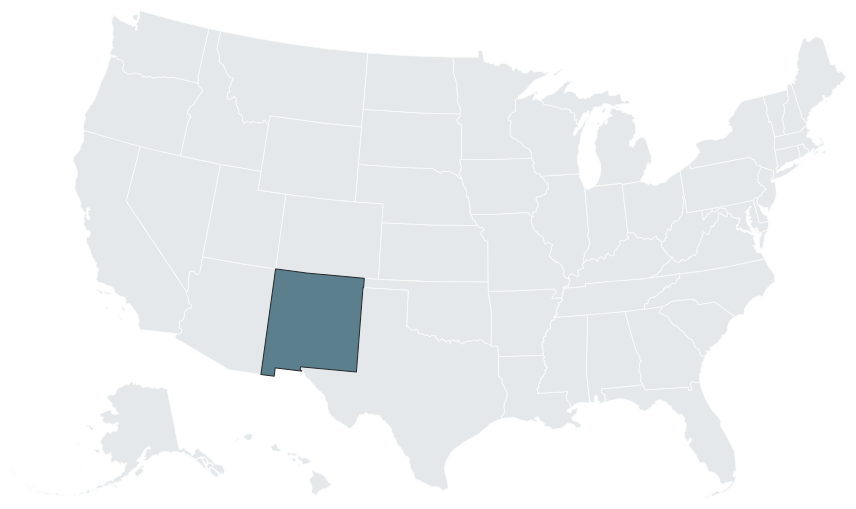

Approval layers: state, county and city
| Layer | Body | What it decides |
|---|---|---|
| Local | City planning or development services; county planning and zoning | Land use, setbacks, parking, landscaping and site plan compliance; zoning compliance and floodplain determination before CID issues a permit [6] |
| Local, under state law | Counties (Subdivision Act, NMSA Chapter 47, Article 6); cities (NMSA Chapter 3, Article 20) | Land division, water availability and buyer disclosure [9] |
| State or certified local | CID or a certified local building department | Building plan review and inspection [1] |
| State | New Mexico Environment Department (NMED) | Groundwater discharge (20.6.2 NMAC), on-site liquid waste (20.7.3 NMAC), underground storage tanks [4, 12, 13] |
| Federal | EPA Region 6 | Construction General Permit NMR100000 [14, 15] |
| State | Office of the State Engineer | Water rights and wells [8] |
| State or local | NMDOT; city or county | State highway access (18.31.6 NMAC); local street access [5] |
| State or local | State Fire Marshal or a local fire prevention bureau | Fire code review where there is no local fire authority |
| Utility | Water and sewer utility (the Albuquerque-Bernalillo County Water Utility Authority in the metro) | Will-serve letters |
The local zoning and site plan step is where a preliminary site plan does its work: buildings, pads, internal roads, parking, amenities and the site data table, settled before the engineer of record draws the sealed civil set. The difference between the two drawings is set out in preliminary vs final site plan, and the full scope of the studio's drawings is on the site plan page.
Who prepares and seals what
Three boards govern design documents in New Mexico: the Board of Licensure for Professional Engineers and Professional Surveyors (16.39 NMAC, under NMSA Chapter 61, Article 23), the Board of Examiners for Architects (16.30 NMAC, under NMSA Chapter 61, Article 15) and the Board of Landscape Architects.
| Deliverable | Who seals it | Rule |
|---|---|---|
| Non-residential projects over $400,000 valuation or occupant load over 50 | Architect and engineer | 61-15-2(B), 16.30.1.7.12 NMAC, 61-23-10(H), 16.39.4.8.3 NMAC [2] |
| Architect's plans, specifications, plats and reports | Architect of record, on all sheets; no multiple architectural seals on one document | 16.30.3.18 NMAC [16] |
| Final engineering design drawings, specification certification page, engineering reports; site civil (grading, drainage, utilities, paving, stormwater) | Professional engineer | 16.39.3.11 NMAC [17] |
| Boundary surveys, plats, topographic surveys, legal descriptions | Professional surveyor | 16.39.5.10 NMAC [18] |
| Landscape and planting plans | Landscape architect | Landscape Architects Act |
| Single-family dwellings up to two stories; wood-frame multiple dwellings up to two stories and four units | No architect required where public health or safety is not involved; the building official may still require a seal | 61-15-9 NMSA [19, 2] |
A registrant may affix an electronically generated seal, signature and date if a secure method of affixation is used [7, 16]. In Albuquerque, the Development Facilitation Team (DFT) requires every plan sheet to be signed and sealed by a New Mexico-licensed engineer, architect or surveyor [3].
The preliminary plan sits ahead of those seals. It places the buildings, pads, roads, parking and amenities, carries the yield and the site data table, and is the base the New Mexico architect, engineer and surveyor of record build the sealed set on. Engineering is by the client's engineer of record. For the division of labor, see who prepares a site plan, where unsealed site plans are accepted, site plan architect and site plan consultant.
Statewide overlays
| Overlay | Trigger or rule | Authority |
|---|---|---|
| Building codes | 2021 NM Commercial Building Code (14.7.2 NMAC); 2021 NM Commercial Energy Code (14.7.9, effective July 30, 2024); 2020 NM Electrical Code (14.10.4); Earthen Building Materials (adobe) code (14.7.4) | Title 14 NMAC [1, 20] |
| Local amendments | Home-rule jurisdictions may adopt more stringent, never less stringent, amendments | NMSA 60-13-44 [21] |
| Construction stormwater | EPA Region 6 permit NMR100000, as the state lacks NPDES primacy; SB21 (2025) authorizes NMED to seek primacy | EPA; NMED [14, 15] |
| Groundwater discharge | Many commercial dischargers; fixed five-year term | 20.6.2 NMAC [4] |
| On-site liquid waste | Septic where there is no sewer; Bernalillo County has its own ordinance for unincorporated areas | 20.7.3 NMAC [12] |
| Subdivision water | Water availability in quantity and quality; buyer disclosure | Subdivision Act [9] |
| Cultural properties | Surveys on state land, with state permits or funding, or where ground disturbance may affect known resources | Cultural Properties Act; Historic Preservation Division |
| Floodplain | FEMA National Flood Insurance Program standards | Local floodplain administrators |
| Cannabis siting | A local school or daycare buffer may not exceed 300 feet; no local prohibition | NMSA 26-2C-12, 26-2C-13 [22] |
The cannabis rule is a cap, not a setback. Section 26-2C-12 says a local minimum distance "shall not be set at any more than three hundred feet from a school or daycare center" [22]. Section 26-2C-13(B) bars a local jurisdiction from completely prohibiting an establishment, though localities may set reasonable time, place, manner and density rules [22].
Top jurisdictions
| Jurisdiction | Site plan process | What binds the layout |
|---|---|---|
| Albuquerque and Bernalillo County | One IDO (Chapter 14, Article 16 of the city code) since 2018 for the city and the unincorporated county. DFT reviews commercial projects over 50,000 square feet, multi-family over 50 units and projects needing major public infrastructure; other site plans are reviewed with the building permit; larger or more sensitive projects go to the Environmental Planning Commission | All DFT sheets sealed; IDO updated every other year, in odd years [3] |
| Rio Rancho and Sandoval County | Rio Rancho runs its own development review. Sandoval County issues no building permits and routes CID and Manufactured Housing Division applications after its checklist clears | Zoning compliance and floodplain determination first [6] |
| Santa Fe | Historic Overlay Zoning District (Section 14-5.2) with Historic Districts Review Board review; Escarpment Overlay District (Section 14-5.6) with ridgetop and foothills subdistricts and a viewline | No new subdivision entirely inside the escarpment overlay; permits need elevations, materials, colors, heights and cross-sections to natural grade [11] |
| Las Cruces and Doña Ana County | City: Development Services Department, Accela/ePlan, with an engineered site plan as the key pre-application document. County: Unified Development Code (Chapter 350), Planning and Zoning Commission on the second and fourth Thursdays, Clariti portal | Commission hears variances, special use permits, zone changes, master plans and subdivisions [23, 24] |
| San Juan County (Farmington area) | County permits and inspects unincorporated areas plus Aztec, Bloomfield and Kirtland on CID-amended codes | Mobile homes go to the Manufactured Housing Division [25] |
| Gallup | City issues building and site development permits | Mechanical, electrical and plumbing permits go to CID [26] |
Fee schedules are set by each jurisdiction's planning department, and CID publishes its own fee schedule [1]. Los Alamos County, a combined city-county, runs its own development review. For the neighboring regimes, see Arizona, Texas, Colorado and Utah.
Asset registries in New Mexico
RV parks, campgrounds and glamping
Private RV parks are regulated as lodging or campground facilities, and state park camping falls under a separate rule, 19.5.2 NMAC. For a private park, water supply and either an on-site liquid waste permit (20.7.3 NMAC) or a groundwater discharge permit (20.6.2 NMAC) are the gating approvals [12, 4]. The numbers that shape the layout (density, site size, spacing and road widths) are set locally by the county or city, and so is the classification of campgrounds, cabins and glamping units. Colorado, the neighboring state with a statewide number, caps campgrounds at 25 campsites per acre excluding roads, buildings and common areas, with 900 sq ft per campsite (6 CCR 1010-9) [27]. See Colorado site plans, RV park site plans in Colorado, RV sites per acre and the Chaffee County campground model project. The asset hubs are RV park site plans, campground site plans and glamping site plans.
Fuel, truck stops and car washes
Underground storage tanks are regulated by the NMED Petroleum Storage Tank Bureau under 20.5.101 to 20.5.125 NMAC. Owners give NMED written notice at least 30 days before installation, installers must be PSTB-certified, tanks within 1,000 feet of a water supply well draw added scrutiny, and every new tank meets the federal technical standards of 40 CFR 280 [13, 28]. New Mexico runs its tank program under EPA State Program Approval (40 CFR Part 282) [28, 29, 30]. Car washes face OSE water-rights scrutiny and often a 20.6.2 NMAC discharge permit, and water reclaim systems are frequently required or encouraged by local ordinance and the utility [8, 4]. Car wash and fuel siting standards are set by the city or county. See gas station site plans, truck stop site plans and car wash site plans.
Hotels, storage, marinas and industrial
Hotels are regulated as public accommodations, with the standard site plan, building and NMED reviews. Self storage follows the commercial site plan and building permit process, with no special state license. Marinas on reservoirs such as Elephant Butte and Navajo Lake involve the U.S. Bureau of Reclamation as landowner, state parks and potentially the Army Corps and NMED. Industrial users that discharge to ground need the 20.6.2 NMAC permit [4]. Manufactured homes go to the Manufactured Housing Division of RLD. See hotel, self storage, RV and boat storage, marina and industrial site plans.
Timelines and bottlenecks
Entitlement and permitting for a commercial site runs from months to quarters, and the time is spent mostly on front-end entitlement and specialty clearances rather than building plan review.
| Choke point | What adds time |
|---|---|
| Water rights and will-serve | Securing or transferring rights through OSE and obtaining a utility will-serve letter [8] |
| CID review queues | Plan review capacity and inspection scheduling where CID is the reviewer |
| Arroyo and drainage review | Drainage studies and flood control coordination in the metro areas |
| Groundwater discharge | A separate NMED review track under 20.6.2 NMAC [4] |
| Tribal or archaeological clearance | Additional review near tribal land or cultural resources |
| NMDOT access | About 30 days to a determination, longer with turn-lane or traffic study requirements; construction must begin within six months [5, 31] |
Resubmittals come from the wrong authority (CID or local), incomplete drainage or geotechnical data, missing professional seals, and designs that miss the Santa Fe escarpment or historic standards or the Albuquerque IDO. A site plan consultant who reads the overlays before the layout is drawn removes the last of those.
Permit volume gives the pace. Statewide, 513 residential units were authorized in January 2026, 783 in December 2025 and 642 in November 2025 [32]. The Albuquerque MSA authorized 134 units in January 2026 and 355 in December 2025 [33].
Proof points: where New Mexico is building
| Project | What the record shows |
|---|---|
| Intel, Rio Rancho | Fab 9 opened January 24, 2024 as part of the announced $3.5 billion investment; cumulative capital investment in Rio Rancho since 1980 exceeds $16 billion [34, 35] |
| Netflix ABQ Studios, Albuquerque | $2 billion cumulative commitment; 108-acre expansion with four soundstages completed June 2024, which hired 2,800 construction workers [36, 37] |
Growth is concentrated in the Albuquerque, Rio Rancho and Sandoval corridor (semiconductors and film), the Las Cruces and Santa Teresa border logistics region, and the Permian Basin counties of Lea and Eddy.
What the engineer of record adds
The preliminary plan fixes the program, the layout and the yield. The New Mexico engineer of record then adds what the site demands. Expansive and collapsible soils are common across the state and call for geotechnical investigation and engineered foundations rather than prescriptive footings. Grading, drainage, utilities, paving and stormwater are sealed by the engineer of record, and the arroyo and floodplain work goes through the local flood control review. For views that answer the Santa Fe design boards, the plan carries into 3D renderings. To start a New Mexico site, see service areas or start a project.
Frequently asked questions
Who reviews my building plans in New Mexico, the state or the city?
It depends on the parcel. Certified local building departments, including Albuquerque, Santa Fe and Las Cruces, review within their limits. Elsewhere the Construction Industries Division reviews and inspects [1]. Counties that issue no building permits, such as Sandoval County, still clear zoning compliance and floodplain first [6].
When do I need an architect and an engineer seal?
On non-residential projects, and on residences not otherwise exempt, with construction valuation over $400,000 or occupant load over 50, both seals are required [2]. The 2025 Handbook treats a non-residential building over $600,000 with an occupant load under 10 as a multiple-discipline project that still needs both [7].
Can an unlicensed person prepare plans in New Mexico?
Does New Mexico issue its own construction stormwater permit?
Do I need water rights for a commercial project?
Any water use requires an Office of the State Engineer permit, and water-intensive uses must secure rights before they proceed [8].
Do I need a groundwater discharge permit?
Many commercial dischargers do, including wineries, dairies, car washes and facilities with on-site effluent. Even a small winery discharging 75 gallons per day has been permitted under 20.6.2 NMAC [4].
How long does an NMDOT access permit take?
Does Santa Fe restrict building height and appearance?
Yes. The Historic Overlay Zoning District (Section 14-5.2) and the Escarpment Overlay District (Section 14-5.6) control height, massing, materials and viewlines [11].
Sources
- 1)Construction Industries Division (rld.nm.gov/construction-industries), New Mexico Regulation and Licensing Department. Accessed 2026-09-01.
- 2)Handbook for New Mexico Building Officials (sblpes.state.nm.us), New Mexico Board of Licensure for Professional Engineers and Professional Surveyors, Joint Practices Committee. Accessed 2026-09-01.
- 3)Site Plan Administrative, Development Facilitation Team (cabq.gov/planning/development-review-services/site-plan-admin-dft), City of Albuquerque Planning Department. Accessed 2026-09-01.
- 4)Ground Water Quality Bureau, discharge permits under 20.6.2 NMAC (env.nm.gov/gwqb), New Mexico Environment Department. Accessed 2026-09-01.
- 5)Access permits, ePermitting, 18.31.6 NMAC (dot.nm.gov/epermitting), New Mexico Department of Transportation. Accessed 2026-09-01.
- 6)Planning and Zoning, Zoning Compliance and Floodplain Determination Checklist (sandovalcountynm.gov/departments/planning-zoning), Sandoval County. Accessed 2026-09-01.
- 7)2025 Handbook for New Mexico Building Officials (bea.state.nm.us), New Mexico Board of Examiners for Architects. Accessed 2026-09-01.
- 8)Water rights and well permits (ose.nm.gov), New Mexico Office of the State Engineer. Accessed 2026-09-01.
- 9)New Mexico Subdivision Act, NMSA Chapter 47, Article 6, New Mexico Statutes Annotated.
- 10)City of Albuquerque Integrated Development Ordinance, arroyo definition (read via abq-zone.com), City of Albuquerque (via abq-zone.com). Accessed 2026-09-01.
- 11)Santa Fe City Code, Sections 14-5.2 (Historic Overlay) and 14-5.6 (Escarpment Overlay), City of Santa Fe. Accessed 2026-09-01.
- 12)On-site liquid waste permits, 20.7.3 NMAC (env.nm.gov/septic), New Mexico Environment Department. Accessed 2026-09-01.
- 13)Petroleum Storage Tank Bureau, 20.5 NMAC (env.nm.gov/petroleum_storage_tank), New Mexico Environment Department. Accessed 2026-09-01.
- 14)Construction stormwater and NPDES primacy (env.nm.gov), New Mexico Environment Department. Accessed 2026-09-01.
- 15)Construction General Permit NMR100000 and SB21 primacy (inspectionsplus.com, secondary), Inspections Plus. Accessed 2026-09-01.
- 16)16.30.3.18 NMAC, architect seals, New Mexico Board of Examiners for Architects.
- 17)16.39.3.11 NMAC, engineer seals, New Mexico Board of Licensure for Professional Engineers and Professional Surveyors.
- 18)16.39.5.10 NMAC, surveyor seals, New Mexico Board of Licensure for Professional Engineers and Professional Surveyors.
- 19)Architectural Act, NMSA Chapter 61, Article 15 (bea.state.nm.us), New Mexico Board of Examiners for Architects. Accessed 2026-09-01.
- 20)Title 14 NMAC, construction codes (srca.nm.gov), New Mexico State Records Center and Archives. Accessed 2026-09-01.
- 21)NMSA 60-13-44, local amendments to state codes, New Mexico Statutes Annotated.
- 22)Cannabis Regulation Act, NMSA Chapter 26, Article 2C (rld.nm.gov/cannabis), New Mexico Regulation and Licensing Department, Cannabis Control Division. Accessed 2026-09-01.
- 23)Development Services (lascruces.gov), City of Las Cruces. Accessed 2026-09-01.
- 24)Unified Development Code, Chapter 350 (donaana.gov), Doña Ana County. Accessed 2026-09-01.
- 25)Building permits and inspections (sjcounty.net), San Juan County. Accessed 2026-09-01.
- 26)Planning and Development Department (gallupnm.gov), City of Gallup. Accessed 2026-09-01.
- 27)6 CCR 1010-9, campgrounds and recreation areas, Colorado Department of Public Health and Environment (via Colorado Secretary of State). Accessed 2026-10-09.
- 28)New Mexico underground storage tank program (federalregister.gov), Federal Register. Accessed 2026-09-01.
- 29)List of States With Approved UST Programs and Respective Federal Register Notices, US EPA. Accessed 2026-10-09.
- 30)40 CFR Part 282, Approved Underground Storage Tank Programs, eCFR. Accessed 2026-10-09.
- 31)NMDOT access permit summary (openei.org), OpenEI. Accessed 2026-09-01.
- 32)New Private Housing Units Authorized by Building Permits for New Mexico, NMBPPRIV (fred.stlouisfed.org/series/NMBPPRIV), Federal Reserve Bank of St. Louis (Census Building Permits Survey). Accessed 2026-09-01.
- 33)New Private Housing Units Authorized by Building Permits, Albuquerque MSA, ALBU735BPPRIV (fred.stlouisfed.org/series/ALBU735BPPRIV), Federal Reserve Bank of St. Louis (Census Building Permits Survey). Accessed 2026-09-01.
- 34)Intel Rio Rancho investment (newsroom.intel.com), Intel. Accessed 2026-09-01.
- 35)Intel Rio Rancho (nist.gov), National Institute of Standards and Technology. Accessed 2026-09-01.
- 36)Netflix ABQ Studios expansion (cabq.gov), City of Albuquerque. Accessed 2026-09-01.
- 37)Netflix ABQ Studios expansion (businessfacilities.com), Business Facilities. Accessed 2026-09-01.