What shapes a site plan in metro Denver
Metro Denver splits review between a home rule city with a two-stage plan process and suburban counties that each set their own pre-application rules. Five conditions follow, and each one changes how a preliminary site plan is drawn and reviewed here.
- Denver reviews a concept before a plan. A Concept Plan is mandatory and free, and only then does the formal Site Development Plan (SDP) follow under DZC Sec. 12.4.3 [1]. The concept stage runs one review cycle, up to three on request, with a Project Champion as the applicant's contact [2].
- The approved plan runs with the land. An SDP is recorded against the property and becomes the basis for zoning use and construction permits, under the city's SDP Manual revised March 10, 2026 [3].
- Water is priced into every unit. Denver Water raised its single-family tap fee 32% from July 1, 2026, to $10,450 inside the city and $14,680 in its suburban service area, and a single-family tap in Castle Rock costs $45,760 [6].
- Housing permits have fallen. The Denver metro authorized 15,570 housing units in 2024 against 20,650 the year before, and the City and County of Denver 3,994 against 5,725 [4].
- One land use is on pause. City Council unanimously approved CB26-0431, which pauses data centers from May 21, 2026 to May 21, 2027 and exempts work already permitted [5].
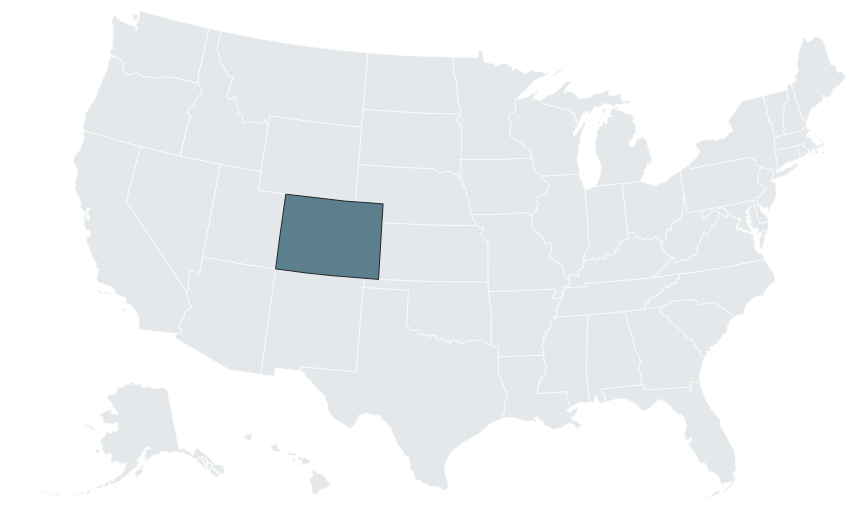

Jurisdiction map: who governs where
| Jurisdiction | What governs a site plan there | Source |
|---|---|---|
| City and County of Denver (home rule) | Concept Plan, then an SDP for commercial construction, residential of 3 or more units and some change-of-occupancy tenant finish, reviewed administratively by Community Planning and Development staff | [1, 7] |
| City of Aurora (home rule) | A required pre-application; administrative and Planning Commission tracks, with a public hearing for most development applications; DevPortal.AuroraGov.org launched July 11, 2025 | [8] |
| Douglas County | A Site Improvement Plan approved administratively by Planning Services; a free, optional pre-submittal meeting; the Accela ACA portal retired March 13, 2026 | [9] |
| Arapahoe County | No application without a presubmittal or a waiver; Current Planning staff decide site plans, the Planning Commission and Board of County Commissioners decide rezonings, and the Board of Adjustment hears variances | [10] |
| Adams County | A required conceptual review; an administrative Development Review Team; resubmittals reviewed in 21 days | [11] |
| Jefferson County | A Site Development Plan that is administrative and non-discretionary; pre-application optional but recommended | [12] |
| City of Boulder (home rule) | Staff, the Planning Board or both; a pre-application required before a form-based code review | [13] |
| Boulder County (unincorporated) | Site Plan Review decided administratively; a pre-application conference required | [14] |
Rules for Lakewood, Thornton, Westminster and the other cities are confirmed with each jurisdiction before a layout is fixed. Site plans in Colorado sets out the statewide rules, from the architect exemption to the construction stormwater permit, and the Phoenix and Las Vegas pages cover the other Mountain West metros.
Site plan process: City and County of Denver
| Stage | What happens | Source |
|---|---|---|
| Concept Plan | Mandatory and free; one review cycle, up to three on request; a Project Champion as contact | [1, 2] |
| Formal SDP | A technical submittal covering drainage, transportation and design review compliance; fees assessed with the initial comments | [1] |
| Filed with the formal SDP | A TDM Plan; green building rules for buildings over 25,000 sq ft | [2] |
| Code edition | The Denver Zoning Code, effective June 25, 2010 and restated Feb. 25, 2025 | [15] |
| Expiration | Governed by DZC Sec. 12.4.3.6 | [15] |
| After approval | The SDP is recorded against the property and is the basis for zoning use and construction permits | [3] |
Suburban review paths
Jefferson County's fee policy, effective June 24, 2025 under Res. CC25-165, makes fees non-refundable and covers the request plus the first revision, with further resubmittals charged extra [12]. In the City of Boulder an application fee covers up to 3 reviews, revision comments come back in about 3 weeks, and an applicant has a 60-day window to revise [13]. Boulder County bills less predictable reviews at $103.83 per hour, and its Site Plan Review regulations were amended in 2024 and 2025 under Docket DC-24-0003 [14]. Aurora takes building permits through Aurora4Biz alongside its DevPortal [8].
Asset rules in metro Denver
| Asset | Rule in metro Denver | Source |
|---|---|---|
| Data centers, Denver | Paused from May 21, 2026 to May 21, 2027 under CB26-0431; work already permitted is exempt | [5] |
| Buildings over 25,000 sq ft, Denver | Green building rules apply with the SDP | [2] |
| Residential of 3 or more units, Denver | An SDP is required | [7] |
| Single-family water taps | Denver Water $10,450 in the city and $14,680 suburban from July 1, 2026; Castle Rock $45,760 | [6] |
Layouts for these programs are on the hotel, multifamily and industrial hubs. Outside the metro, Colorado's campground rules are worked through in the campground with cabins model project in Chaffee County and on RV park site plans in Colorado.
Growth corridors and proof points
Statewide, Colorado authorized 32,185 housing units in 2024, and the City and County of Denver accounted for 3,994 of them, down from 5,725 [4].
Site factors
- Snow load. The 2016 Colorado Design Snow Loads report puts ground snow on the Front Range and in Denver at roughly 43 psf, against 125 to 155 psf at mountain ski bases [16].
- Hail. The Front Range averages 7 to 9 hail days a year, with three to four storms a year classed as catastrophic, each causing at least $25 million in insured damage [17].
- Water. Tap fees are set by the provider, from $10,450 for a Denver Water single-family tap in the city to $45,760 in Castle Rock [6].
- Drainage and floodplain. Local drainage criteria are confirmed with each city and county engineer before a layout is fixed.
What the preliminary plan carries in Denver
Denver's Concept Plan is the first drawing the city reviews, so the preliminary site plan is drawn to it: buildings, drives, parking, pads and open space, with a site data table that reports zoning, units, parking and floor area, so that the 25,000 sq ft green building line and the 3 unit SDP trigger show from the start [1, 2, 7]. In the suburbs the same sheet serves Aurora's required pre-application, Arapahoe's presubmittal and Adams County's conceptual review [8, 10, 11].
The sheet also goes to a lender, to a general contractor for pricing and to the investors behind the purchase; the engineer of record then designs drainage, utilities, grading and access and seals the construction set. The site plan consultant and site plan services pages explain how the studio works with the engineer and architect of record, where unsealed site plans are accepted covers the concept stage, hotel renderings show a board the massing, the case studies show the method on model projects, and service areas lists every metro covered.
Frequently asked questions
Is a concept plan mandatory in Denver?
Yes. Denver requires a Concept Plan before a formal Site Development Plan, and the concept review is free [1].
How many review cycles does a Denver concept plan get?
One review cycle, with up to three on request, and a Project Champion serves as the applicant's contact [2].
When does a Denver SDP expire?
Expiration is governed by DZC Sec. 12.4.3.6 [15].
What does an approved SDP do in Denver?
It is recorded against the property and becomes the basis for zoning use and construction permits [3].
Is Denver pausing data center development?
Yes. City Council approved CB26-0431, a pause from May 21, 2026 to May 21, 2027 that exempts work already permitted [5].
Is a pre-application meeting required in Aurora?
Yes. Aurora states that its pre-application is not optional, and most development applications there go to a public hearing [8].
What does a Denver Water tap cost?
From July 1, 2026, a single-family tap is $10,450 inside the city and $14,680 in the suburban service area, after a 32% increase [6].
Sources
- 1)Formal Site Development Plans and Plan Amendments, City and County of Denver, Community Planning and Development. Accessed 2026-10-10.
- 2)Concept Plans, City and County of Denver, Community Planning and Development. Accessed 2026-10-10.
- 3)Site Development Plan Manual (revised March 10, 2026), City and County of Denver, Community Planning and Development. Accessed 2026-10-10.
- 4)2024 Annual Building Permits highlights, U.S. Census Bureau. Accessed 2026-10-10.
- 5)Council Bill CB26-0431, temporary pause on data center development, City and County of Denver. Accessed 2026-10-10.
- 6)Denver Water and Castle Rock tap fees (June 19, 2026), The Colorado Sun (coloradosun.com). Accessed 2026-08-02.
- 7)Site Development Plan review (denvergov.org), City and County of Denver. Accessed 2026-08-02.
- 8)Development applications and pre-application (auroragov.org), City of Aurora. Accessed 2026-08-02.
- 9)Site Improvement Plan review (douglas.co.us), Douglas County. Accessed 2026-08-02.
- 10)Current Planning and presubmittal (arapahoeco.gov), Arapahoe County. Accessed 2026-08-02.
- 11)Development review and conceptual review (adamscountyco.gov), Adams County. Accessed 2026-08-02.
- 12)Site Development Plan and fee policy, Res. CC25-165 (jeffco.us), Jefferson County. Accessed 2026-08-02.
- 13)Development review and 2026 Schedule of Fees (bouldercolorado.gov), City of Boulder. Accessed 2026-08-02.
- 14)Site Plan Review, Docket DC-24-0003 (bouldercounty.gov), Boulder County. Accessed 2026-08-02.
- 15)Site Development Plan modification template, City and County of Denver, Community Planning and Development. Accessed 2026-10-10.
- 16)2016 Colorado Design Snow Loads (seacolorado.org), Structural Engineers Association of Colorado. Accessed 2026-08-02.
- 17)Colorado hail data from the Rocky Mountain Insurance Information Association (denver7.com), Denver7. Accessed 2026-08-02.