A model project in unincorporated Polk County
This is a model project, not a built one: an 80 to 150 site RV park on 10 to 30 acres in unincorporated Polk County, used to show how the county's conditional use rules and the state rules above them shape a Central Florida site plan. No developer, parcel or approval is implied. The program is a transient and seasonal RV park with a bathhouse or clubhouse, an office, dump and potable water stations, internal roads and stormwater ponds.
Polk is the jurisdiction here because it rewrote its RV park conditional use criteria in 2024 and publishes a complete land development fee schedule [1, 5]. The county lies between the Tampa and Orlando markets. A park of this size needs three separate approvals: a county conditional use (or Planned Development) under Land Development Code (LDC) Section 303, an Environmental Resource Permit (ERP) from the water management district, and an annual Florida Department of Health (DOH) operating permit under F.S. Chapter 513 and F.A.C. Chapter 64E-15 [6, 3]. For the statewide regime see RV park site plans in Florida and the Florida site plan hub.
| Item | Model project |
|---|---|
| Asset | Recreational vehicle park: under F.S. 513.01(11), "a place set aside and offered by a person, for either direct or indirect remuneration of the owner, lessor, or operator of such place, for the parking, accommodation, or rental of five or more recreational vehicles or tents" [7] |
| Same asset, other names | F.S. 513.01(11) makes "campground," "camping resort," "RV resort," "travel resort," and "travel park" synonymous with "recreational vehicle park" [7] |
| Program | 80 to 150 RV spaces; bathhouse or clubhouse; office; dump station(s); potable water station(s); internal roads; stormwater ponds |
| Parcel | 10 to 30 acres |
| Jurisdiction | Unincorporated Polk County: Board of County Commissioners (BoCC), Planning Commission (PC), Land Development Division; DOH in Polk County; SWFWMD |
| Zoning path | A use-table conditional use under Section 303; a Planned Development (PD) is an optional conditional use [8] |
| State permit | DOH, "the exclusive regulatory and permitting authority for sanitary and permitting standards" (F.S. 513.051) [9] |
| State floor | 25 RV units per gross acre; 1,200 sq ft per RV space [3] |
| Water management | ERP: the park exceeds the 5 acre and impervious-area thresholds of F.A.C. 62-330.020(2), and anything of 10 acres or more leaves the self-certification lane [6, 4] |
The definition matters for marketing and permitting alike. A project branded an "RV resort" is legally an RV park under 513.01(11), so it carries the full DOH permit burden and is exempt from Chapter 509 hotel regulation (513.012) [7]. Any park of five or more sites is therefore a state-permitted facility [7]. Under s. 513.014, a mobile home park with five or more RV sites must meet the RV park rules for those sites [10]. The RV resort site plan hub covers the resort program; in Florida law it is the same asset.
How Polk reviews the use
Polk runs a single-map system. Staff put it directly in the LDCT-2023-7 report: "In Polk County, there is not a separate zoning map. Planned Developments are optional conditional uses working within the framework of the Comprehensive Plan Future Land Use Map." [8] The entitlement question is therefore what the parcel's Future Land Use district allows in LDC Table 2.1, not what the zoning is.
In the 2019 codified Chapter 2, the Table 2.1 row for "Recreational Vehicle Park" reads P in one standard district and C2 in one other [11]. Which districts those two columns are is not confirmed in the documents for this page, so the column check is the first diligence step on any parcel. Chapter 2 sorts conditional uses by review: a C2 use gets a Level 2 review, with a site plan reviewed by the Development Review Committee (DRC); a C3 use gets a Level 3 review, a DRC site plan review plus a public hearing before the Planning Commission; a C4 use gets a Level 4 review, with public hearings before both the Planning Commission and the BoCC [11]. Chapter 2 also names the Planned Development as the route to higher densities, pointing to Section 303 [11]. A Level 3 decision is appealed to the BoCC, which hears it de novo under LDC Section 921.C.3 [12].
Ord. 2024-032 (LDCT-2024-3) amended Section 303 "to modify conditional use criteria for Recreational Camping and RV Parks; and adding a definition for Primitive Camping to Chapter 10" [1, 2]. The Planning Commission approved it on April 3, 2024, and Legistar File 24-0490 records that action as "4/3/2024 Planning Commission Approved Pass" [1]. The ordinance's adoption date is not settled: the code publisher's ordinance list and the county's meeting video give dates that cannot both be right, so the date is taken from the signed ordinance before anyone relies on it. In the BoCC minutes a staff member said RV parks "are significantly more intense" than recreational camping [13].
The governing text is current: the LDC is Ordinance 00-09 as amended, and Supplement 12 is codified through Ord. 2026-024 (enacted March 21, 2026), with online content updated August 26, 2026 [14]. Section 303's post-2024 numeric RV standards (density, buffers, setbacks, road widths and minimum park size) are not reproduced in the documents for this page; they are read from the current code at the pre-application conference and drawn onto the plan from there.
Three county rules from the LDCT-2023-7 report reach an RV park directly. Sewer counts as "available" when a line is within 1/2 mile, within 3/4 mile when serving 10 or more ERUs, or within 1 mile when serving 20 or more ERUs, and Section 702 requires connection where it is available [8]. Public water is available with "an adequately sized distribution system within one mile of the property" [8]. A PD more than one mile from water and wastewater services "will not be eligible for consideration," so rural parcels lose the PD route [8]. The same amendment let unpaved areas dedicated to RV parking count as open space, a change to Section 750 [8]. A PD application carries a concept plan, an open space plan and an amenity plan (the change to Section 903.G), and its "External Design" element asks the applicant to show buffering, screening and transition to less intense neighbors [8].
Overlays add their own layer. Amendments affecting the Green Swamp Area of Critical State Concern (LDC Chapter 5) require state review [8]. Appendix E carries parcel-specific conditions: Ord. 2024-037 lists "Recreational Vehicle Parks" among prohibited uses on a CR 630 parcel near Frostproof [15, 14]. On the clock, Polk issues development permits and orders as a county under F.S. 125.022, the county counterpart of the municipal F.S. 166.033, and SB 1080 (2025, ch. 2025-177) rewrote the timeframes and refunds in both [16].

Approval path
Every approval the documents name, listed in the usual order; several run in parallel. Fees are from the Polk Land Development Fee Schedule (effective October 1, 2023, posted as the ADA version on 11/14/2025) unless noted [5]; timelines and seals the documents do not state are marked "Not stated".
| # | Approval | Body | Code section | Stage | Fee | Timeline | Seal |
|---|---|---|---|---|---|---|---|
| 1 | Pre-application conference | Land Development Division | Not stated | Concept | $250 [5] | Not stated | No (concept) |
| 2 | Land use or comprehensive plan amendment, if the district does not allow the use | Planning Commission (as Local Planning Agency), then BoCC | F.S. 163.3164; LDC Ch. 9 | Entitlement | Small-scale map amendment: $4,008 + $600 advertising [5] | Large-scale: transmittal plus adoption hearings, as in the Mims 2021 example [17, 18] | Not stated |
| 3 | Conditional use, C2 or C3 | DRC (Level 2), or DRC plus Planning Commission (Level 3); Level 3 appeal to the BoCC de novo | LDC 205.E; Sec. 303; Sec. 921.C.3 [11, 12] | Entitlement | Level 3: $4,023 + $450 advertising [5] | PC hears monthly (third-party tracker, secondary) [19] | Not stated |
| 3 alt | Level 4 review | DRC, then Planning Commission and BoCC hearings | LDC 205.E; Sec. 303 [11] | Entitlement | Level 4: $4,086 + $850 advertising [5] | BoCC meets twice monthly (third-party tracker, secondary) [19] | Not stated |
| 4 | Traffic study | Land Development Division | LDC Appendix C [20] | Entitlement and site plan | Minor $176; major $1,105 [5] | Not stated | Not stated |
| 5 | Engineered site plan, Level 2 | Development Review Committee | LDC Ch. 7 site standards | Construction documents | Inspection $7,506.75 base + $30 per site; final inspection $2,189 [5] | Not stated | Not stated |
| 6 | Flood hazard management review | Land Development | Polk floodplain regulations | Site plan | Minor (<5 ac) $254; major (>5 ac) $500; flood study $500 [5] | Not stated | Not stated |
| 7 | Driveway and access | Polk County on county roads; FDOT District 1 on state roads | Not stated | Site plan | Non-residential driveway $1,134 [5] | Not stated | Not stated |
| 8 | Plat, where lots are subdivided for sale | Land Development | LDC Ch. 8 | Optional | Plat review $3,810 + $3 per lot [5] | Not stated | Not stated |
| 9 | Environmental Resource Permit | SWFWMD | F.A.C. 62-330.020(2); F.S. 403.814(12); Applicant's Handbook Vols. I and II [6, 4] | Site plan, in parallel | Not stated | Not stated | Not stated |
| 10 | Water and wastewater | DOH (64E-6 OSTDS), DEP (62-555, 62-600) or the utility | 64E-15.003, 64E-15.004, 64E-15.010(2)(e) and (f) [3] | Construction documents | Not stated | Not stated | Not stated |
| 11 | DOH plan review and park permit | DOH in Polk County | F.S. 513.02, 513.03; 64E-15.010; DH Form 4037 | Before operation | $4.00 per space, $100 minimum, $600 maximum a year [3] | File at least 30 days before operations [3] | Plans "drawn to scale"; no seal language [3] |
| 12 | Building permits: bathhouse, clubhouse, office | Polk Building Division | Florida Building Code, 8th Edition (2023), effective December 31, 2023; Rule 64E-15.006 [21] | Construction | Not stated | Not stated | Not stated |
| 13 | Fire | State Fire Marshal standards | F.S. 633.206, carved out of DOH rule authority by F.S. 513.05 [9] | Construction | Not stated | Not stated | Not stated |
| 14 | Final inspection and certificate of occupancy | Polk Building Division; Land Development | LDC; FBC | Close-out | Final inspection $2,189 [5] | Not stated | n/a |
A PD can stand in for the conditional use, but the documents for this page do not agree on which review level a PD takes, so the level is confirmed at pre-application. The fee schedule doubles fees for applications arising from an LDC violation and makes third-party review costs "the obligation of the applicant" [5].
An illustrative county total for 120 sites at Level 3, counting only the identified fee lines: $250 + $4,023 + $450 + $7,506.75 + $3,600 + $2,189 + $500 + $1,105 = $19,623.75 [5]. That illustrative total excludes the site plan review line, ERP, utility, impact and building fees; the DOH permit is separate, at $4.00 per space up to the $600 cap [3].
SWFWMD reviews most of Polk, and the district is confirmed for each parcel at the start. Per SJRWMD, "Effective July 1, 2003, the Polk County portion of SJRWMD was transferred to SWFWMD."
Design standards that bind the layout
The numeric floor is state law. Chapter 64E-15 sets the numbers below; its operative site rule was last amended 12-30-09 [3]. Polk's Section 303 adds its own standards on top.
| Standard | Value | Citation |
|---|---|---|
| Minimum RV space area | 1,200 sq ft | 64E-15.002(3)(a) [3] |
| Maximum density | 25 RV units per acre of gross site | 64E-15.002(3)(b) [3] |
| Minimum tent space | 500 sq ft | 64E-15.002(3)(c) [3] |
| Space identification | Each space clearly identified | 64E-15.002(3)(d) [3] |
| Exterior boundary setback | Not set in the rule text of subsection (3) on RV parks; the 5 ft standard sits in 64E-15.002(2)(c), for mobile home and lodging park spaces; DOH inspection practice for RV spaces is confirmed with the county health department | 64E-15.002(2)(c) [3] |
| Potable water stations | 1 per 100 spaces without water hookups; 1 per 250 where more than 50 percent have water and sewer hookups | 64E-15.003(3)(b) [3] |
| Dump stations | 1 per 100 spaces or fraction; 1 per 250 where more than 50 percent have sewer hookups | 64E-15.004(5) [22] |
| Dump station build | Trapped 4 inch riser, sloped concrete apron, hinged cover, backflow-protected washdown | 64E-15.004(6) [3] |
| Washdown sign | Letters at least 3 inches: "WATER NOT SAFE FOR DRINKING" | 64E-15.004(7) [3] |
| Base sanitary fixtures | Men: 1 toilet, 1 urinal, 1 lavatory, 1 shower. Women: 2 toilets, 1 lavatory, 1 shower | 64E-15.005(2) [3] |
| Fixture multiplier | Minimum set per 25 non-self-contained spaces or fraction | 64E-15.005(3) [3] |
| Full-hookup exemption | Letter to the county health department exempts the park from 64E-15.005(2) and (4), 64E-15.004(5) to (7) and 64E-15.003(3)(b) | 64E-15.005(6) [3] |
| Garbage | Collected twice weekly or per the collection jurisdiction | 64E-15.007(3) [3] |
| Separations and setbacks | Fixed at initial DOH and local approval; later local ordinances superseded | F.S. 513.1115(1), (2), (4) [7] |
| Disaster rebuild | Same site, same density standards as approved and permitted | F.S. 513.1115(3) [9] |
| Transient presumption | 6 months or less | F.S. 513.01(12), 513.112(3) [7] |
| Lake County cap (comparable outside Polk) | 8.71 spaces per gross acre | Lake LDR Section 3.02.05(D), as quoted in staff report FLU-22-14-4 [23] |
| Lake comparable layout (outside Polk) | 2,400 sq ft minimum space; front 5 ft; 10 ft between structures; one-way drive 12 ft; two-way drive 20 ft; 20 ft minimum roadway frontage; 25 ft Type B buffers | Haines Creek concept plan, FLU-22-14-4 Attachment C [23] |
The provisions that bind the layout, quoted from the DOH, the Legislature and the Lake County staff report:
"Each recreational vehicle space shall contain a minimum of 1,200 square feet." 64E-15.002(3)(a) [3]
"The density shall not exceed 25 recreational vehicle units per acre of gross site." 64E-15.002(3)(b) [3]
"Recreational vehicle parks constructed after the effective date of this rule shall provide a potable water supply station for each 100 spaces, or fraction thereof, that do not have water hookups at the site." 64E-15.003(3)(b) [3]
Parks "which offer spaces to non self-contained units, shall provide the minimum required sanitary fixtures for each 25 non self-contained spaces or fractions thereof." 64E-15.005(3) [3]
"Separation distances between recreational vehicle sites within a recreational vehicle park must be the distances established at the time of the initial approval of the recreational vehicle park by the department and the local government." F.S. 513.1115(1) [7]
"Setback distances from the exterior property boundary of the recreational vehicle park must be the setback distances established at the time of the initial approval by the department and the local government." F.S. 513.1115(2) [9]
"this section supersedes any county, municipality, or special district ordinance or regulation regarding the lot size, lot density, or separation or setback distance of a recreational vehicle park which goes into effect after the initial permitting and construction of the park." F.S. 513.1115(4) [7]
Lake LDR 3.02.05(D), as quoted by staff: "existing and future RV parks shall not exceed 8.71 spaces per gross acre of land." [23]
Two more state provisions shape the plan; their text was read through a code mirror, so they are paraphrased here. Every park must leave room for parking, loading and maneuvering so that no unit needs sidewalks, rights-of-way or private ground outside the park (64E-15.002(1)(b)), and spaces must be graded so that drainage leaves no standing water under the unit (64E-15.002(1)(a)) [24]. Parks built after the dump station rule took effect provide one sanitary dump station for each 100 spaces or fraction, or one for each 250 spaces or fraction when more than half the spaces have sewer hookups (64E-15.004(5)) [22].
Local zoning elsewhere in Florida shows how far below the state cap a district can sit: Malabar's RVP district (Ordinance 2021-09) requires 5 acres minimum and allows at most 15 RV sites per gross acre [25]. For a cross-state comparison of caps, see RV sites per acre and RV park regulations by state.
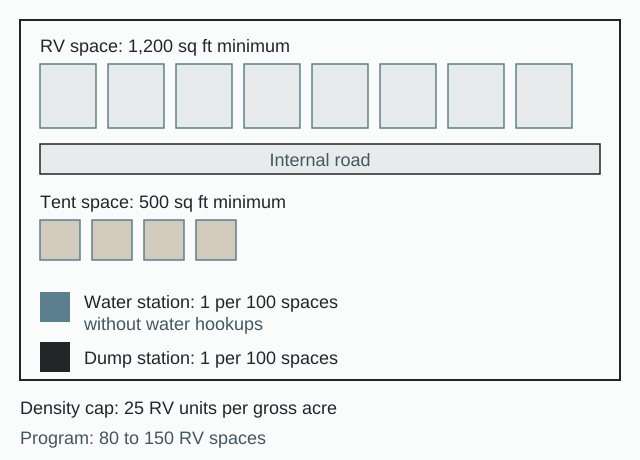
Determination: as proposed and as resized
The state cap does not decide this program. On 20 gross acres the state permits up to 500 RV units, so the 25 per acre cap rarely binds a 10 to 30 acre, 150-site program [3]. At 25 units per acre and 1,200 square feet each, spaces would occupy 30,000 of 43,560 square feet, or 69 percent of every gross acre, which is achievable only with almost no amenities or stormwater area [3]. The model's own range runs from 3 to 15 sites per gross acre: 80 sites on 30 acres up to 150 sites on 10 acres.
The closest documented Central Florida benchmark, Haines Creek RV Village in Lake County, planned 159 lots on 27.71 gross acres at 5.73 gross and 7.1 net units per acre, against a Lake cap of 8.71 spaces per gross acre [23]. The documents for this page do not state a final site count for the Polk model after Section 303, so none is given here.
| Element | As proposed | As resized by code and site | Rule |
|---|---|---|---|
| RV spaces | 80 to 150 spaces on 10 to 30 acres | At the state cap of 25 per gross acre, 80 sites need at least 3.2 gross acres and 150 sites at least 6.0; the cap does not bind [3] | 64E-15.002(3)(b) |
| Space area | RV spaces | Floor of 1,200 sq ft; one acre is 43,560 sq ft, so the floor allows 36 sites before any roads, and the cap implies at least about 1,742 sq ft of gross land per site [3] | 64E-15.002(3)(a), (b) |
| Internal roads | Internal roads | Parking, loading and maneuvering stay inside the park [24]; the Lake comparable drew a 12 ft one-way and a 20 ft two-way drive [23]; Polk's widths come from Section 303 | 64E-15.002(1)(b) |
| Stormwater ponds | Stormwater ponds | ERP triggers include more than 4,000 sq ft vehicular impervious, more than 9,000 sq ft total impervious and a project area over 5 acres [6]; 10 acres or more leaves the self-certification lane [4] | 62-330.020(2); 403.814(12) |
| Wetlands | Wetlands and buffers | In the Lake comparable, 5.34 of 27.71 acres were wetland, with a 50 ft upland buffer on the concept plan [23] | ERP; county buffers |
| Dump station(s) | Dump station(s) | 150 sites: 2 at one per 100; 1 if more than 50% sewered [22] | 64E-15.004(5) |
| Potable water station(s) | Potable water station(s) | 1 per 100 spaces without water hookups; 1 per 250 where more than 50 percent have water and sewer [3] | 64E-15.003(3)(b) |
| Bathhouse or clubhouse | Bathhouse or clubhouse | Not required for an all full-hookup, self-contained park that files the exemption letter; otherwise one fixture set per 25 non-self-contained spaces [3] | 64E-15.005(3), (6) |
| Sewer | Central sewer or onsite | Connection is mandatory where a line is available: 1/2 mile, 3/4 mile at 10 or more ERUs, 1 mile at 20 or more ERUs [8] | Polk LDC Section 702 |
| Site separations | As drawn at approval | Locked at initial DOH and local approval, so the first approved plan carries the build-out separations [7] | 513.1115(1) |
| Phasing | Phased build-out | Adding spaces is a modification under 64E-15.001(6); written notice to the county health department at least 30 days before [3] | 64E-15.010(1)(c) |
The 513.1115 lock-in turns the first approved site plan into a long-lived asset: the separations and setbacks drawn at initial approval become the park's permanent entitlement [7]. That is the strongest reason to draw the full master plan, not just the first phase, before the first approval.
Site data and yield
The site data table carries the items that govern this model. Values are from the cited documents; the county's Section 303 numbers are added from the current code at pre-application.
| Site data item | Model value | Source |
|---|---|---|
| Gross parcel | 10 to 30 acres | Model program |
| RV spaces | 80 to 150 | Model program |
| Zoning path | Conditional use (Section 303) or Planned Development | [1, 8] |
| State density cap | 25 RV units per gross acre | [3] |
| Minimum gross acreage at the cap | 3.2 acres for 80 sites; 6.0 acres for 150 sites | [3] |
| State ceiling on 20 gross acres | 500 RV units | [3] |
| Space share of a gross acre at the cap | 30,000 of 43,560 sq ft, 69 percent | [3] |
| Minimum RV space | 1,200 sq ft | [3] |
| Minimum tent space | 500 sq ft | [3] |
| Dump stations, 150 sites | 2, or 1 if more than 50% sewered | [22] |
| Sanitary fixtures | Base set per 25 non-self-contained spaces, or exempt by letter | [3] |
| ERP | Required over 5 acres of project area; self-certification only under 10 acres and 2 acres impervious | [6, 4] |
| Traffic study | Minor Traffic Study above 50 and up to 750 average daily trips | [20] |
| Sewer and water test | Sewer within 1/2 to 1 mile by ERUs served; water within one mile | [8] |
| DOH annual permit | $320 at 80 sites; $600 at 150 sites | [3] |
| Identified county fees, 120 sites (illustrative) | $19,623.75 | [5] |
| Lake benchmark (outside Polk) | 8.71 spaces per gross acre cap; Haines Creek at 5.73 gross and 7.1 net | [23] |
Yield in Polk is a drainage and wetland question first. Under 62-330.020(2) a permit is required for any of: work in wetlands, more than 4,000 sq ft of vehicular impervious area, more than 9,000 sq ft of total impervious area, a project area over 5 acres, impounding over 40 acre-feet, or being part of a larger common plan [6]. The self-certification general permit under F.S. 403.814(12) is only for "less than 10 acres of total project area and less than two acres of impervious surface," and SWFWMD has "no additional District-specific thresholds" beyond the statewide rule [4, 26]. A SWFWMD standard general permit covers less than 100 acres of project area and less than 1 acre of wetland impacts, so a design that keeps wetland impacts under 1 acre stays out of an individual permit [27]. Chapter 62-330 and the ERP Applicant's Handbook Volumes I and II were amended effective June 28, 2024, with new water quality performance standards (Volume I Sections 8.0 and 9.0) and operation and maintenance changes (Section 12.0) [26]. Parts of Lake, Marion and Sumter counties carry added SJRWMD thresholds, for example 12 or more acres of impervious area [28].
DOH separately evaluates each new park site to confirm it is not subject to environmental hazards (64E-15.002(1)(a)) [24]. In a special flood hazard area, an RV must meet manufactured home elevation and anchoring unless it "is on the site for fewer than 180 consecutive days, or is fully licensed and ready for highway use" (44 CFR 60.3(c)(14)) [29]. Polk charges a flood hazard review ($254 under 5 acres, $500 over) and a flood study ($500) [5]; the floodplain ordinance itself, including any freeboard, is applied by the engineer of record.
Comparable approvals and denials, 2021 to 2026
No applicant RV park conditional use with a full staff report, vote and conditions was found for unincorporated Polk in 2021 to 2026. The record below is the county's own RV rulemaking, Polk hearing records for park-type uses, and two comparables outside Polk, with source quality stated. Two further Polk park-type decisions from 2025 and 2026 appear only in third-party meeting summaries; they are left out until the county's own minutes or staff reports are read.
| # | Case | Jurisdiction | Program | Outcome | Conditions and themes | Source quality |
|---|---|---|---|---|---|---|
| 1 | LDCT-2024-3, Ord. 2024-032 (county-initiated) | Polk County | Rewrite of Section 303 conditional use criteria for Recreational Camping and RV Parks; adds a "Primitive Camping" definition | Planning Commission approved April 3, 2024; became Ord. 2024-032 [1] | RV parks "are significantly more intense" than recreational camping (staff, BoCC minutes) [13] | Primary (Legistar) |
| 2 | Ord. 2024-037 (LDCT-2024-1, LDCPAS-2023-34) | Polk County | Parcel near CR 630, Section 16, T31S, R30E | RV parks prohibited, with multifamily, mobile home parks, towers, helistops and seaplane bases; enacted June 4, 2024 [15] | JLUS lighting and signage conditions; military low-level flight area compatibility [15] | Primary (certified ordinance) |
| 3 | Mims RV Park, LDCPAL-2021-6 | Polk County | 979.65 acres from Phosphate Mining and A/RR to Leisure Recreation, Rural Development Area [17] | Transmittal hearing September 21, 2021; Polk TV agendas list adoption hearings on November 30, 2021 and December 14, 2021 [17, 18]; outcome not stated | Not stated | Hearing index only |
| 4 | Brooklyn Meadows MHP, LDPD-2021-23 | Polk County | 46-unit mobile home park on about 9.2 acres in RL-2 [17] | BoCC adoption hearing September 21, 2021 [17] | Not stated | Hearing index only |
| 5 | Thornhill Road PD modification, LDPD-2024-14 | Polk County | Modification of LDPD-2018-48 from a 247-lot mobile home park to a 262-lot single-family subdivision [30] | Planning Commission approved November 6, 2024 [30] | A manufactured-housing PD entitlement converted to for-sale housing | Legistar file |
| 6 | Polk City Ord. 2025-02 | Polk City (municipality in Polk County) | Section 3.09.01.02 "Recreational Vehicle Parks" buffer changed from a masonry wall to a solid fence [31] | Adopted 2025 [31] | Buffer standard changed by ordinance | Code publisher ordinance list |
| 7 | Haines Creek RV Village, FLU-22-14-4 with RZ-22-30-4 | Lake County (comparable outside Polk) | 159 MH, park model and RV lots (90 existing plus 69 new); 15,000 sq ft commercial; 27.71 gross acres [23] | Staff found consistent; PZB April 5, 2023; BCC May 2, 2023 [23] | 25 percent open space, 50 ft wetland buffer, 25 ft Type B buffers, RV ISR 0.75, 35 ft height, well and septic [23] | Primary staff report |
| 8 | Copper Penny Farm RV park, case 260808ZC, 7400 S US Hwy 441, Ocala | Marion County (comparable outside Polk) | 173 units (133 RV spaces plus 40 park model or manufactured home lots) on 26.05 acres of a 31.37-acre parcel; rezoning from B-2/A-1 to P-RV; retention pond, 1.5 acre utility area, office, two commercial outparcels (news report, secondary) [32] | Hearing record reported only in news coverage; outcome not stated here | Projected "12,975 gallons per day" of water and wastewater demand; about 801 daily vehicle trips onto U.S. Hwy 441 (news report, secondary) [32] | Secondary (news) |
For county-wide context, the third-party tracker ZoneWire (secondary) reports a 72% approval rate on 18 special exception or conditional use decisions and says "Polk County approved 87% of 194 land-use decisions in the last 24 months" [33]. The Polk hearing records show the county processing RV and manufactured-housing parks through land use changes and PDs, and Thornhill Road shows a park entitlement giving way to single-family lots [30].
Haines Creek is the comparable with a full public file. The existing park was approved by CUP #119-5 on March 10, 1969 and amended on May 14, 1985; staff describe it as a "+55 community (12.91 ± acres)" with 90 lots, about 6.97 lots per acre [23]. The request took the site from Rural Transition to PUD, with flood zones "AE" and "X", and the concept plan committed to 25 percent open space, a 50 ft wetland buffer, 25 ft Type B buffers on the south and west, an RV ISR of 0.75, 35 ft height, and well and septic service under "Appropriate permits through St. Johns River Water Management District and the Florida Department of Health" [23]. Traffic was 60 PM peak hour trips on a County Road 44 segment operating at 82 percent of capacity, LOS C, and as a 55-and-over community it was not subject to school concurrency [23]. The staff report records no opposition themes, and the City of Leesburg stated it had "no comments" [23]. Its concept plan carried the note "Plans are Conceptual Only and are subject to engineering" and took the comprehensive plan amendment to hearing without a seal [23].
Copper Penny sought Marion's Recreation Vehicle Park (P-RV) classification, LDC Sec. 4.2.25 [34]. Read through a secondary mirror (elaws) of the Marion County code, P-RV sets a 1,500 sq ft lot for a park model or travel trailer without additions and 2,400 sq ft with additions, 30 ft and 35 ft minimum widths, 15 ft unit-to-unit separation for park models, 10 ft between additions, a 20 ft front setback reducible to 8 ft where parking is provided elsewhere, a 10 ft rear setback and a 40 ft height, and it still requires a service building with toilets, showers and laundry [35].
Cost and phasing benchmarks
Florida hard cost per site is not published in the documents for this page. Market evidence and Polk's own fee lines follow, each labelled.
| Item | Figure | Source |
|---|---|---|
| Cost per site (national) | $15,000 to $50,000+ (RoverPass 2025, secondary vendor figure) | [36] |
| Resort-quality property (national) | "$5 million or more for 100-site resort-quality properties" (RoverPass 2025, secondary) | [36] |
| Polk lakefront RV resort, about 50 sites | Listed at $2.95 million, with "more than $2 million in recent capital improvements"; an asking price, not a closed sale (trade press, secondary) | [37] |
| Polk MH and RV park, 28 sites on 2.07 acres | Listed at $615,000, reduced from $690,000; an older mixed park (broker listing, secondary) | [38] |
| DOH annual permit | $4.00 per space, $100 minimum, $600 maximum; $320 at 80 sites and $600 at 150 | [3] |
| Statutory fee band | $3.50 to $6.50 per space, $50 to $600 total (F.S. 513.045(1)(b)) | [9] |
| Conceptual ERP approval | "20 year duration as long as construction of first phase starts" | [39] |
| Site plan time extension at the PC | $500 | [5] |
| Minor modification | $609 | [5] |
Phasing runs through DOH as well as the county. Adding spaces counts as a modification under 64E-15.001(6), and Rule 64E-15.010(1)(c) requires a permit holder to "notify the local county health department in writing at least 30 days prior to the modification of any park" [3]. Every phase is therefore a DOH modification filing [3]. Because a conceptual ERP approval holds for 20 years once the first phase starts [39], and 513.1115 fixes separations at initial approval [7], the master plan is drawn whole and built in phases. National cost context is in the RV park cost post and the 2026 per-pad benchmarks post.
Submittal anatomy: what the preliminary plan carries
The DOH layout drawing and the county land use or PD plan are layout documents; the engineering documents follow them. The preliminary site plan carries the first column; the engineer, surveyor and architect of record carry the second.
| Stage and element | Preliminary plan carries | Engineer, surveyor or architect of record adds |
|---|---|---|
| DOH new park, 64E-15.010(2)(c): plans "drawn to scale" showing the area and dimensions of the tract, space numbers, the location and size of all RV and tent spaces, roadways and added service buildings [3] | All items | Boundary survey |
| DOH buildings, 64E-15.010(2)(b): floor plan "showing the number, types and distribution of all plumbing fixtures" [3] | Fixture count and layout | Plumbing design |
| DOH water and sewer, 64E-15.010(2)(e) and (f): per 64E-8 or 62-550, 62-555, 62-560 (water) and 64E-6 or 62-600 (sewage) [3] | Locations and conceptual routing | Engineered systems |
| Dump and water stations, under the 64E-15.003 and 64E-15.004 ratios [3] | Counts and locations | Riser, apron and backflow details |
| Spaces and grading, 64E-15.002(1)(a) [24] | Space layout | Finished grades per space |
| Roadways | Layout | Pavement design and turning templates |
| County land use or PD (Section 903.G) [8] | Concept plan, open space plan and amenity plan, with the site data table | n/a at this stage |
| Traffic, Appendix C [20] | Land use and unit counts | Trip generation and the study |
| ERP, SWFWMD Part C fields [27] | Project area, impervious area, wetland boundaries and impacts | Stormwater calculations and design under the 2024 rule |
| Polk checklist items | Confirmed at pre-application | Confirmed at pre-application |
DOH accepts an unscaled, non-engineer drawing only for existing parks with space dimensions shown (64E-15.010(2)(b)) and for consolidations (64E-15.010(2)(d)) [3]. For an existing park without plans on file, the drawing "does not have to be drawn to scale or completed by an engineer if the space dimensions are shown"; new parks under (2)(c) must be "drawn to scale," and the rule states no seal requirement [3].
Polk staff reports attach a location map, a future land use map, context and close aerials, the site plan and the applicant's justification (example: the LDLVAR-2025-37 exhibits list) [40]. Polk Activity Center Plan staff reports also carry applicant map exhibits (for example LDCT-2024-27), with architectural standards reviewed "as part of the Level 2 process" and a template that uses fully shielded "dark sky" fixtures [41]. The Lake comparable's concept plan carried a site data table, "Typical RV Lot" details and a "Typical 25' Buffer" section [23]. No retrieved Polk, Lake or Marion RV park standard requires renderings or elevations, so the site plan, the typical lot detail, the buffer section and an aerial context view are the exhibits that answer the hearing's "how it fits" question; see RV park and resort rendering.
Conditions and handoff
The conditions to anticipate, from Polk's record, the Lake comparable and the state rules:
- Parcel conditions: Appendix E conditions can bar RV parks outright and impose JLUS dark-sky lighting, as Ord. 2024-037 does on CR 630 east of Frostproof [15].
- Utilities: central sewer is mandatory where a line is available under Section 702, and a PD more than one mile from water and wastewater services is not eligible for consideration [8].
- Comparable conditions: the Lake approval carried open space, wetland and Type B buffers, an impervious ratio, a height limit, and water management district and DOH permits for well and septic [23].
- DOH operation: file on DH Form 4037 "at least 30 days before a park or camp's operations are scheduled to begin"; spaces clearly identified; garbage collected twice weekly [3].
- Stay length: a guest occupying for more than six months creates "a rebuttable presumption that the occupancy is nontransient," and Chapter 83 eviction applies (F.S. 513.01(12)) [9]; Polk's own public campgrounds cap stays at 14 consecutive days and 100 days per year, which applies to county parks only [42].
- Rebuild: after a disaster the park may rebuild "on the same site using the same density standards that were approved and permitted" (F.S. 513.1115(3)) [9].
- Fire: state firesafety standards under F.S. 633.206 apply, carved out of DOH rule authority by F.S. 513.05 [9].
The handoff to the engineer and architect of record is the sealed set: the boundary survey, the engineered Level 2 site plan for the Development Review Committee, the ERP design under 62-330 as amended in 2024, the water and sewer plans under 64E-15.010(2)(e) and (f), the traffic study, the flood study and the building permits [3, 26]. Park buildings are permitted under the Florida Building Code, 8th Edition (2023), effective December 31, 2023 per the Florida Building Commission, alongside Rule 64E-15.006, and the edition in force is confirmed on the permit date [21].
The same split between the preliminary layout and the sealed set runs through the Bandera County, Texas resort case, the Mohave County, Arizona snowbird park, the Sevier County, Tennessee resort and the other case studies. The RV park site plan hub sets out what each preliminary plan includes, and RV park design standards compares the numbers across states.
Frequently asked questions
What is the maximum RV park density in Florida?
Does the DOH plan need an engineer's seal?
The rule requires plans drawn to scale for a new park, with the tract, space numbers, space sizes, roadways and service buildings shown, and no seal language appears in 64E-15.010(2)(c) [3]. The ERP design and the water and sewer systems are engineered by the engineer of record.
Do I need a bathhouse if every site has full hookups?
Not if every site has water and sewer, you rent only to self-contained units, and you file the 64E-15.005(6) letter with the county health department [3].
How many dump stations does a 150 site park need?
Two at one per 100 spaces, or one if more than 50 percent of the spaces have sewer hookups (64E-15.004(5)) [22].
What does the DOH operating permit cost?
Is an Environmental Resource Permit required?
Can the county change my setbacks after approval?
If a hurricane destroys the park, can I rebuild at the same density?
Yes. F.S. 513.1115(3) allows rebuilding on the same site using the density standards that were approved and permitted [9].
Sources
- 1)Legistar File 24-0490, LDCT-2024-3, Recreational Camping and RV Parks, Polk County, Florida. Accessed 2026-10-10.
- 2)Polk County Land Development Code, 2024 ordinances list (Ord. 2024-032), Polk County, Florida (via Municode). Accessed 2026-10-10.
- 3)Chapter 64E-15, Florida Administrative Code (DOH posted version), Florida Department of Health. Accessed 2026-10-10.
- 4)Environmental Resource Permit Applicant's Handbook, Volume II, Southwest Florida Water Management District (via flrules). Accessed 2026-10-10.
- 5)Polk County Land Development Fee Schedule (effective October 1, 2023), Polk County, Florida. Accessed 2026-10-09.
- 6)F.A.C. 62-330.020, Regulated Activities (Environmental Resource Permitting), Florida Department of Environmental Protection (via elaws). Accessed 2026-10-09.
- 7)Florida Statutes Chapter 513, Mobile Home and Recreational Vehicle Parks, Florida Legislature (Online Sunshine). Accessed 2026-10-10.
- 8)Adoption hearing staff report, LDCT-2023-7 (Planned Developments), Polk County, Florida. Accessed 2026-10-10.
- 9)Chapter 513, 2025 Florida Statutes, The Florida Senate. Accessed 2026-10-10.
- 10)Chapter 513, 2024 Florida Statutes, The Florida Senate. Accessed 2026-10-09.
- 11)Polk County Land Development Code, Chapter 2, Land Use Districts and Regulations (2019 codified version), Polk County, Florida (Municode library). Accessed 2026-10-10.
- 12)Polk County Board of County Commissioners meeting agenda (Level 3 appeal under Section 921.C.3), Polk County, Florida. Accessed 2026-10-10.
- 13)Board of County Commissioners accessible minutes, Polk County, Florida. Accessed 2026-10-09.
- 14)Polk County Land Development Code, Supplement 12, Polk County, Florida (via Municode). Accessed 2026-10-10.
- 15)Ordinance No. 2024-037 (LDCT-2024-1, LDCPAS-2023-34), Polk County Board of County Commissioners. Accessed 2026-10-10.
- 16)Bill analysis and fiscal impact statement, SB 1080 (2025), The Florida Senate. Accessed 2026-10-10.
- 17)BoCC Regular Meeting and Public Hearing, September 21, 2021, Polk County TV. Accessed 2026-10-10.
- 18)BoCC Regular Meeting, November 30, 2021, Polk County TV. Accessed 2026-10-10.
- 19)Conditional Use Permit in Polk 2026: Cases and Votes, ZoneWire (third-party tracker, secondary). Accessed 2026-10-09.
- 20)Polk County Land Development Code, Appendix C, Traffic Impact Study Methodology and Procedures, Polk County, Florida (Municode library). Accessed 2026-10-10.
- 21)Florida Building Code, 8th Edition (2023), Florida Building Commission. Accessed 2026-10-10.
- 22)F.A.C. 64E-15.004, Sewage Disposal, Florida Department of Health (via elaws). Accessed 2026-10-10.
- 23)Staff report FLU-22-14-4, Haines Creek RV Village, Lake County, Florida. Accessed 2026-10-10.
- 24)Fla. Admin. Code R. 64E-15.002, Sites: Mobile Home, Lodging, and Recreational Vehicle Parks, Florida Department of Health (via Cornell LII). Accessed 2026-10-10.
- 25)Town of Malabar Ordinance 2021-09, Recreational Vehicle Park (RVP) Zoning, Town of Malabar, Florida. Accessed 2026-10-09.
- 26)Environmental Resource Permits (2024 rule amendments), South Florida Water Management District. Accessed 2026-10-10.
- 27)Environmental Resource Permit application, Part C, Southwest Florida Water Management District. Accessed 2026-10-10.
- 28)Environmental Resource Permit Applicant's Handbook, Volume II, St. Johns River Water Management District (via flrules). Accessed 2026-10-09.
- 29)Recreational Vehicle (glossary, 44 CFR 59.1 and 60.3), Federal Emergency Management Agency. Accessed 2026-10-10.
- 30)Legistar File 24-2004, LDPD-2024-14 Thornhill Road, Polk County, Florida. Accessed 2026-10-10.
- 31)Land Development Code, 2025 ordinances list (Polk City Ordinance 2025-02), Municode library. Accessed 2026-10-10.
- 32)Marion County case 260808ZC, Copper Penny Farm RV park (news report, August 17, 2026), Ocala-News.com (secondary). Accessed 2026-10-10.
- 33)Polk County Zoning and Comp Plan Amendments 2026, ZoneWire (third-party tracker, secondary). Accessed 2026-10-09.
- 34)Marion County Land Development Code, Article 4, Zoning, Marion County, Florida (via Municode). Accessed 2026-10-10.
- 35)Marion County Land Development Code Sec. 4.2.25, Recreation Vehicle Park (P-RV), Marion County, Florida (via elaws, secondary mirror). Accessed 2026-10-10.
- 36)RV Park Cost 2025: Key Insights for Success, RoverPass (secondary). Accessed 2026-10-09.
- 37)Yale Advisors Lists Florida RV Resort for $2.95M, Woodall's Campground Magazine (trade press, secondary). Accessed 2026-10-10.
- 38)Polk County family mobile home and RV park, 28 sites (listing), Broker listing (secondary). Accessed 2026-10-10.
- 39)SWERP Training Overview, Applicant Handbook II and SWFWMD Specific Changes, Southwest Florida Water Management District. Accessed 2026-10-09.
- 40)Staff report exhibits list, LDLVAR-2025-37, Polk County, Florida (Legistar). Accessed 2026-10-09.
- 41)Board of County Commissioners staff report, Activity Center Plan (LDCT-2024-27), Polk County, Florida (Legistar). Accessed 2026-10-10.
- 42)Polk County campgrounds (Parks and Recreation), Polk County, Florida. Accessed 2026-10-09.