
INNOWAVE STUDIO · DATA AS OF OCTOBER 2026
A 100-site RV park built with the National Electrical Code’s (NEC) minimum share of 50-amp sites carries about 285 kVA of calculated service load. Put 50-amp service at every site, as big-rig guests now expect, and the same code arithmetic gives 492 kVA, roughly 72% more. That gap, plus electric vehicles that can pull 32 amps for hours, is where many new parks underbuild.
The code sets a floor, not a design target. NEC 551.71 requires 50-amp receptacles at only 40% of new sites. NFPA 1194-2026 adds EV charging requirements for the first time. Meanwhile, the conduit and feeders installed in 2027 will outlast several generations of pedestals, which run on a 15-to-25-year replacement cycle.
Below are the rules, a sizing method and current costs. Adoption varies by state and county, so confirm every point with the authority having jurisdiction (AHJ) and a licensed electrical engineer.
What NEC Article 551 requires at each site
Receptacle minimums
Part VI of Article 551 sets the receptacle mix. Under the 2023 NEC text reproduced by Leviton:
Every site with electrical supply needs at least one 20A, 125V weather-resistant receptacle. It does not need to be tamper-resistant.
At least 70% of powered sites need a 30A, 125V receptacle.
At least 40% of new sites, and 20% of existing sites, need a 50A, 125/250V receptacle. Every 50A site also needs a 30A receptacle.
The weather-resistant requirement for 50A receptacles took effect January 1, 2026.
Earlier NEC text carried an informational note warning that the 50A share may be inadequate for seasonal parks and “could approach 100 percent.” A park built to 40% has a majority of sites that a large coach cannot fully use. Converting them later means new pedestals, larger branch conductors and often new feeders.
The GFCI question
The 2020 NEC as first published extended GFCI protection beyond 20A site receptacles. TIA 20-8, issued December 6, 2019, limited it to 125V, 15A and 20A receptacles. Its notes explain that leakage current from RV appliances could exceed Class A GFCI limits, which would trip the device. The 2023 text keeps that limit in 551.71(F)(2).
The dispute persists in the field. In a November 2024 Mike Holt forum thread, a Florida contractor reported an inspector demanding GFCI breakers on new 30A and 50A pedestal circuits, citing the general rule in 210.8. Settle this in writing at plan review, before pedestals are ordered.
What the 2026 NEC changes
The Minnesota 2026 NEC adoption committee summary confirms that RV park and manufactured home park calculations moved to Article 120, Parts VIII and IX. It also renames energy management systems “power control systems.” The demand factors appear to carry over: a 2026 NEC study guide cites the same 45% factor for 19 to 21 sites. The summary lists no significant Article 551 receptacle changes.
The GMI claim
Some vendor pages, such as an October 2025 pedestal retailer post, say the 2026 NEC requires a grounding monitor interrupter on 30A and 50A pedestals, citing no source. The rule is in 551.40(D), and Woodall’s corrected its own report to say the devices go “in RVs, not on RV pedestals.” In June 2026 the RV Industry Association set an effective date of January 1, 2027, with mandatory enforcement from each manufacturer’s 2028 model year.
Parks still feel the effect. A GMI confirms a sound ground before passing power, so a coach will refuse a pedestal with an open or degraded ground. The RVIA advises testing ground continuity from pedestals to service panels, ideally every year.
Which edition applies
Adoption is uneven. Mike Holt’s adoption list shows 10 states on the 2026 NEC, including Texas (effective September 1, 2026), 18 on the 2023 edition, including California, and 14 on the 2020 edition, including Florida. Six states, among them Arizona and Missouri, leave adoption to localities. IAEI’s table lags several of these updates, so confirm the edition with the AHJ.
NFPA 1194-2026 and EV charging
What the new edition adds
NFPA 1194 is the fire and life-safety standard for RV parks and campgrounds. Publisher summaries of the 2026 edition say it adds requirements for EV charging and vehicle charging pedestals, with new figures for campsite installations. It supersedes the 2021 edition. Public summaries do not describe the specific rules, so design teams should work from the purchased text.
NFPA 1194 defers to the NEC for wiring, and EV equipment falls under NEC Article 625. The 2026 NEC added rules on qualified installers (625.4), field marking (625.5) and a four-part disconnect section (625.43). Per the Minnesota summary, 625.42 clarifies circuit sizing where a power control system limits EV load, and 625.44 requires plugs on cord-connected chargers to be listed for “EV.”
Texas as a test case
Texas made NFPA 1194 statewide law through Health and Safety Code Chapter 762, effective September 5, 2025. Section 762.003(b) names the 2021 edition, not 2026. Local rules on “electrical distribution system safety” cannot be stricter than NFPA 1194. Texas also moved to the 2026 NEC on September 1, 2026. A 2027 Texas project therefore pairs a 2021 park standard with the newest wiring code.

How guests charge today
Without a dedicated charger, EV owners plug portable units into 30A or 50A outlets. A Camp and Charge survey of 504 parks found 15% allow campsite charging, 46% offer dedicated chargers and 39% ban charging. Among parks that refuse, 52% cite electrical capacity, pedestal design or damage risk. InsideEVs reported that 13 parks publish fines of $30 to $500.
The issue is load shape. An RV’s draw cycles, but an EV can pull 32 amps for hours. At $0.45 per kWh, a full charge for a large electric truck can cost the operator nearly $100. Towables make up 88% of RV production, so electric tow vehicles will arrive with trailers, often low on charge after a long tow.
Four ways to serve EVs
| Model | How it works | Load effect | Cost recovery | Example |
|---|---|---|---|---|
| Pedestal charging allowed | Guest plugs portable charger into 50A or 30A receptacle | Unmanaged; stacks on the RV’s own load | Flat fee or none | 15% of surveyed parks |
| Metered EV outlet at each site | Separate metered 50A plug for the vehicle | Visible and billable; still needs feeder capacity | Metered | Kings River RV Resort, CA |
| Shared Level 2 hub | Chargers near office or day parking | Concentrated; suits a power control system | Per session, or amenity | Hunters Friend Resort, MO (free) |
| DC fast charging | High-power units, usually on separate service | Large; may need its own transformer | Per kWh | Public DC fast chargers sit an average of 8 to 16 miles from surveyed parks |
Some resorts build charging into every site. Go RVing cites Skye Texas Hill Country Resort as one example.
Sizing the system: a 100-site worked example
How the code calculation works
The NEC assigns each site a load based on its largest receptacle. Since the 2017 NEC, a 50A site counts at 12,000 VA, up from 9,600 VA. A 30A/20A site counts at 3,600 VA, a 20A-only site at 2,400 VA and a dedicated tent site at 600 VA. A demand factor then reduces the total, and it falls quickly as sites are added (NEC table).
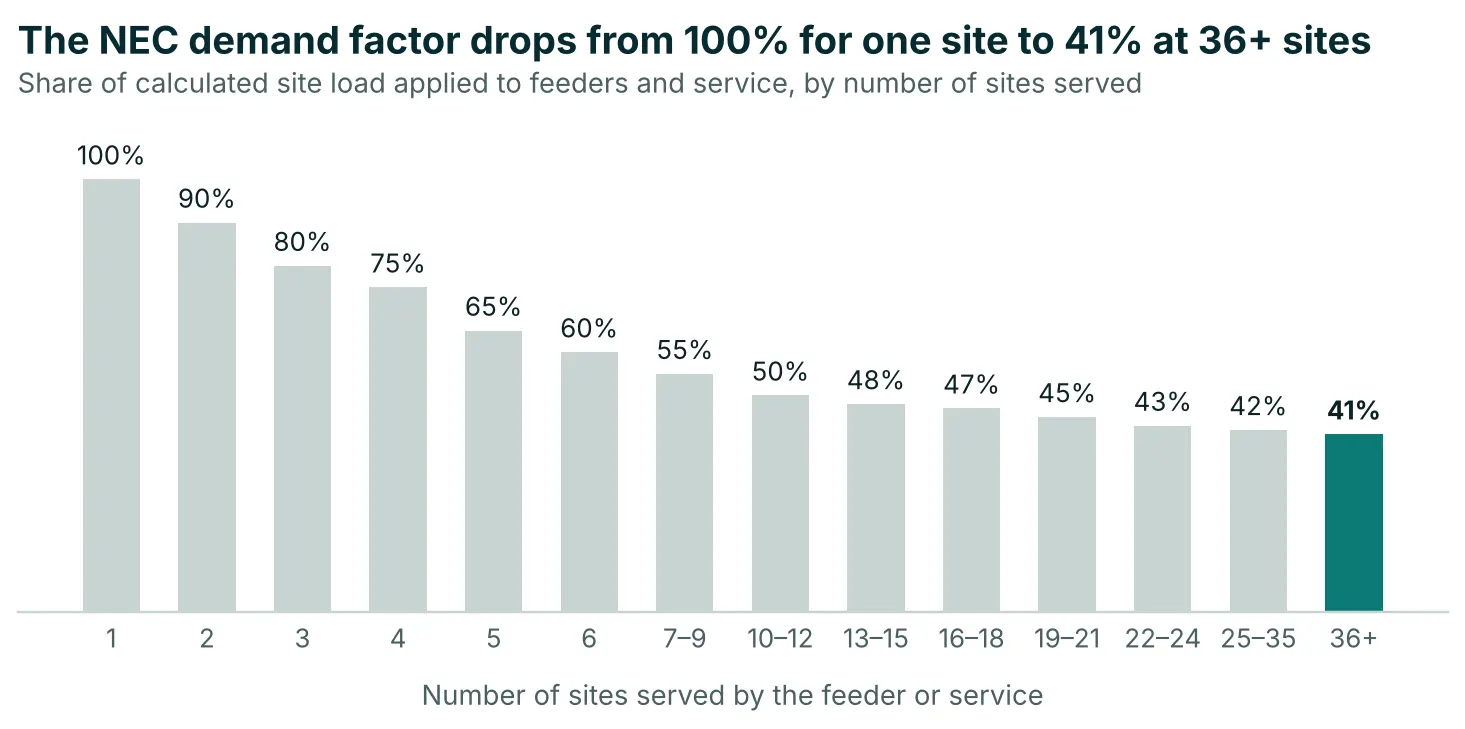
The factor applies to the sites each conductor serves. A feeder loop of six 50A sites is calculated at 60%, or 43,200 VA, not 41%. Mike Sokol argues the 41% factor wrongly assumes a park is never full and fully loaded, which holiday weekends disprove.
Illustrative example: 100 new sites
These figures are illustrative, assume unity power factor and 208Y/120V three-phase service, and are not a design.
Minimum 50A share (40 sites at 50A, 60 sites at 30A/20A)
40 × 12,000 VA = 480,000 VA
60 × 3,600 VA = 216,000 VA
696,000 VA × 41% = 285,360 VA, about 792 A at 208Y/120V
All-50A park (100 sites)
100 × 12,000 VA = 1,200,000 VA
1,200,000 VA × 41% = 492,000 VA, about 1,366 A at 208Y/120V
The all-50A design adds about 207 kVA, or 72%. Most of that cost sits in service equipment, feeders and transformer capacity, not in the trench. The trench is dug once either way.
Where summer HVAC and EVs break the average
At 41%, the code allows 4,920 VA per site. A big motorhome running two air conditioners draws 60 to 80 kWh a day. That averages 2.5 to 3.3 kW over 24 hours, with afternoon peaks well above it.
EVs push further. One vehicle at 32 A on a 208V pedestal (the service assumed above) draws about 6.7 kW, 1.4 times the per-site allowance, before the coach’s own load. If 20 of 100 guests charge on a summer evening, that adds about 133 kW, more than a quarter of the 492 kVA all-50A calculation.
Dedicated chargers are sized differently. EV equipment is a continuous load sized at 125%, and the 2026 NEC uses charger nameplate ratings, with 7,200 W as the fallback. Eight 7.2 kW Level 2 ports would need about 72 kVA of feeder capacity unless a power control system caps the total. Long park runs also call for upsized conductors to limit voltage drop.
Transformers, switchgear and the utility
Order early. Wood Mackenzie put distribution transformer waits at about 30 weeks in Q2 2025, down from roughly two years in 2024. It also estimated a 10% distribution transformer supply deficit for 2025. In 2026, one contractor’s reservations showed 40 to 65 weeks for pad-mounts and 52 to 80 weeks for medium-voltage switchgear. One supplier quotes 16 to 18 weeks for standard units.
Metering long-stay sites
Utilities run 14.5% of revenue at Newmark’s benchmark, but 30 to 35% at older non-submetered transient parks. MMCG Invest estimates submetering cuts consumption 20 to 40% at $15,000 to $30,000 per 100 sites. States generally allow pass-through at cost, not resale at a markup; confirm with the state utility commission.
What it costs and which incentives remain
Per-site electrical cost
Recent 2026 per-pad cost benchmarks put electrical at $3,000 to $7,000 per site, the largest utility line item, a range RoverPass also uses. The benchmarks estimate that 50-amp installations add 30 to 50% in wiring and panel costs over 30-amp. Pedestal replacement runs $1,000 to $2,500 per site, and a three-phase first-pole utility charge alone can run $26,000.
Applied to the 60 sites code would let stay at 30A, a 30 to 50% premium on a $4,000 budget line is at most $72,000 to $120,000. That is the price of avoiding a second trenching and re-cabling job once the park is open.
Equipment and material prices
Wood Mackenzie data show transformer prices up 45 to 95% since 2019, depending on type, with circuit breakers up 47% and medium-voltage switchgear up 50% since 2021. Tariffs add pressure. A 50% tariff on certain copper products, including wire, took effect August 1, 2025. On August 15, 2025, the 50% steel and aluminum tariff was extended to transformer cores and laminations. Lock pricing on wire, pedestals and gear as early as the schedule allows.
Tax credits and depreciation
The Section 30C credit for EV charging property ended for equipment placed in service after June 30, 2026. It paid 6% of cost, or 30% with prevailing wage and apprenticeship, up to $100,000 per item, in eligible low-income or non-urban census tracts. Chargers in a 2027 park will not qualify.
Depreciation still helps. Under the 2025 tax law and IRS Notice 2026-11, 100% bonus depreciation is permanent for property acquired and placed in service after January 19, 2025. A cost segregation study can move site electrical, pedestals and chargers into shorter-lived asset classes. Confirm classifications with a tax adviser.
Grants, solar and storage
Federal charging money under the 2021 infrastructure law, $5 billion for a national fast-charging network plus $2.5 billion for rural and urban communities, is aimed at public charging networks rather than campsites. Utility make-ready rebates and state EV grants vary by state and change often. Check the state energy office and the serving utility before final design.
Solar will not run a park. Mike Sokol notes its main value is trimming peak demand charges, which can reach tens of thousands of dollars a month. Battery storage paired with an EV hub serves the same goal. The 2025 tax law also changed energy credits, including new foreign-entity restrictions, so confirm eligibility before counting on any credit.
Electrical planning checklist for 2027 projects
Confirm the codes in writing. Get the AHJ to state which NEC edition and which NFPA 1194 edition apply, and its position on GFCI for 30A and 50A receptacles.
Plan 50A at every RV site. Treat the 40% minimum as a floor. Each 50A site also needs 30A and 20A receptacles, all weather-resistant.
Run two load calculations. Do the code calculation, then a scenario check for a full summer weekend with EVs charging. Size the service to the larger result or document why not.
Choose an EV model early. Decide between pedestal charging with a fee, metered EV outlets, a shared Level 2 hub or fast charging. Publish the policy online.
Install spare capacity underground. Lay empty conduit toward likely charger locations and upsize feeder conduit now.
Engage the utility at schematic design. Submit load letters, confirm who supplies and pays for transformers, and ask about rate schedules and demand charges.
Order long-lead equipment first. Allow up to 65 weeks for pad-mount transformers and up to 80 weeks for medium-voltage switchgear.
Meter long-stay sites. Submeter monthly and seasonal sites and bill at cost where state rules permit.
Test grounds before opening. Verify ground continuity at every pedestal so GMI-equipped coaches connect without faults.
Model taxes, not credits. Leave Section 30C out of 2027 pro formas and commission a cost segregation study.
Electrical design sets the ceiling on a park’s future revenue mix. InnoWave Studio approaches it as part of the site plan, alongside pad geometry and phasing, so capacity is in the ground before guests need it.
Sources
551.71(A)(B)(C)(F) Receptacle Requirements at RV Parks (Leviton Captain Code, 2023 NEC)
551 Recreational Vehicles and Recreational Vehicle Parks (myPDH, 2020 NEC)
NEC 2026 Adoption Review Committee: Summary of Significant 2026 NEC Changes (Minnesota DLI)
Marine Power Pedestals & RV Power Pedestals (Marine Fiberglass Direct)
NEC May Require Ground Monitoring Interrupters in 2026 (Woodall’s Campground Magazine)
RVIA Approves Revised Timeline for Grounding Monitor Interrupter Requirement (Modern Campground)
Grounding Monitor Interrupters on RVs and Its Impact on RV Campgrounds (RVIA)
NFPA 1194: Standard for Recreational Vehicle Parks and Campgrounds, 2026 edition
EV Charging at Campgrounds: What the Data Says and What Operators Should Do Now (Modern Campground)
This New Map Exposes Campsites That Ban EV Charging (InsideEVs)
Sizing RV-Park Electrical Services Using NEC Table (JADE Learning)
Table 551.73 Demand Factors for Site Feeders and Service-Entrance Conductors for Park Sites
Electricity Distribution Transformers: Supply, Tariffs, and Policy Options (CRS R48933)
Transformers in 2026: Shortage, Scramble, or Self-Inflicted Crisis? (POWER Magazine)
The Grid’s Bottleneck Isn’t Just Money, It’s Materials (Foley & Lardner, Spanish edition)
2026 U.S. RV Park Development Cost Benchmarks: Per-Pad Economics Across 50 States
Alternative Fuel Vehicle Refueling Property Credit (Argonne National Laboratory)
IRS Issues Interim Guidance on Bonus Depreciation Rules (BDO)
Feedback on Campground Power Metering (Mike Sokol, RVelectricity)