What changes a site plan in Nevada
Nevada has no statewide site plan review: counties and cities decide land use under NRS 278, and the state sets the appeal rules they must adopt [3]. Four Nevada conditions decide how a concept is drawn and checked before a hearing is scheduled.
Water comes before the buildings. The Las Vegas Valley Water District's Service Rules, effective January 1, 2026, say that "Before a new development can be approved for construction... a water commitment must" be obtained [1, 6]. The district is a member agency of the Southern Nevada Water Authority, and the document the approval waits on is the district's water commitment [1]. For lots in a subdivision other than single-family lots, the commitment is capped at one acre-foot per year per lot or one acre-foot per year per acre, whichever is less, and the applicant meets a minimum financial commitment of $5,000 per acre-foot of projected water use [7]. Landscape, amenities and any water feature are drawn against that budget from the first concept.
Only people on the record can appeal. NRS 278.3195 requires each governing body to adopt an ordinance that lets planning commission, board of adjustment and administrative decisions be appealed to the governing body, and from there to district court [3]. In a county of 700,000 or more people, which is Clark County, a person has standing to appeal only after appearing before the decision-maker in person, through a representative or in writing [3]. The record is made at the first hearing, which is where the site plan and any 3D renderings are first shown.
A drainage study on most sites. Clark County's Title 30 fee schedule prices drainage and traffic study review by acreage: $750 up to 5 acres and $2,000 over 5 to 40 acres [2]. Staff conditions recorded in the Clark County Zoning Commission minutes of December 2, 2020 include "Drainage study and compliance" [8]. The grading plan is one of the sheets the county's land use checklist lists [9], and it is drawn by the engineer of record.
The Strip is county land. Title 30 applies to "all use of property and all development in unincorporated Clark County," and the Las Vegas Strip area is unincorporated, so a Strip parcel goes to Clark County, not the City of Las Vegas [10]. The county is also where the growth is: unincorporated Clark County permitted 5,416 units in 2024, up from 3,251, according to the Census Bureau's building permits survey [11].
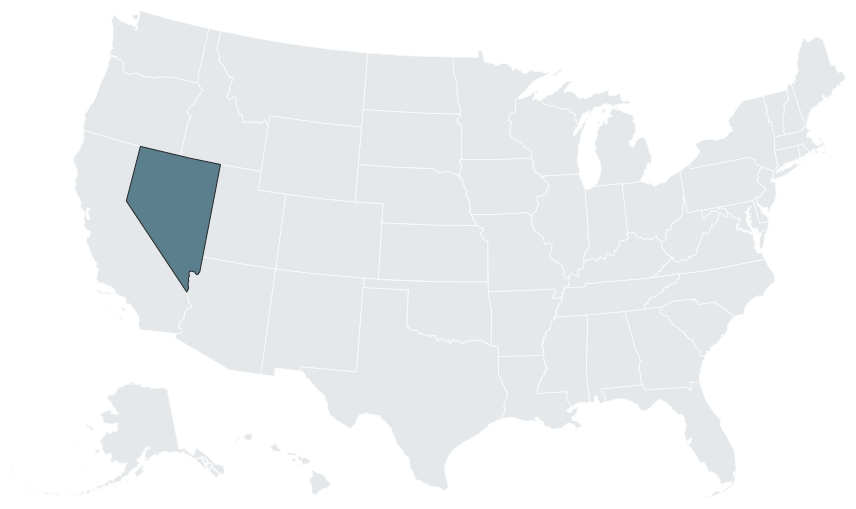

Who approves what in Nevada
| Approval | Who acts | Rule |
|---|---|---|
| Zoning, design review and land use applications, unincorporated county | Clark County | Title 30, Unified Development Code [10, 12] |
| Site plans inside a city | The city; Las Vegas runs Site Development Plan Review | LVMC 19.16.100 [13] |
| Hearings in Clark County | Town Advisory Board or Citizens' Advisory Council, then the Planning Commission and/or the Board | County submittal guidelines [14] |
| Appeals | The governing body, then district court | NRS 278.3195 [3] |
| Water | Las Vegas Valley Water District, before development approval | LVVWD Service Rules [1] |
| Civil improvement plans, North Las Vegas | City review against "NRS 278, Clark County Area Standard Drawings" | City civil improvement plan page [15] |
| RV parks and campgrounds | DPBH Environmental Health | NAC 444.5461 to 444.54675 [5] |
| State buildings | State Public Works | NAC 341.045 adopts the IBC [16] |
The jurisdiction row is the first line of a Nevada site data table: a parcel on the Strip answers to Title 30 and the county's hearing bodies, and a parcel in downtown Las Vegas to the city's Site Development Plan Review [10, 13].
Clark County, Las Vegas and North Las Vegas
Three jurisdictions publish the process, fees and conditions below in their own documents.
| Jurisdiction | Process | Fees | Notes |
|---|---|---|---|
| Clark County (unincorporated) | Design Review and Administrative Design Review under Title 30 Sec. 30.06.05 [12] | Design Review $500 application plus a $500 mailed notice fee; Administrative Design Review $300 [2] | Pre-review and an appointment before an application is accepted [9] |
| City of Las Vegas | Site Development Plan Review, Major or Minor, LVMC 19.16.100 [13] | $500, plus a notification fee if a public hearing is held [17] | Required for all development in the Downtown Las Vegas Overlay (19.09.030.G) [13] |
| North Las Vegas | Civil improvement plans with an assigned project leader [15] | Outsourced review $10,500 for 20 to 30 acres; revisions $50 per hour, 1 hour minimum [15] | Expedited review limited to projects "less than 40 acres" [15] |
Clark County's Title 30 fee schedule, as amended effective 07/01/25, lists these land use fees [2]:
| Clark County application | Fee |
|---|---|
| Pre-submittal Conference | $500 [2] |
| Design Review | $500 application plus a $500 mailed notice fee [2] |
| Administrative Design Review | $300 [2] |
| Special Use Permit | $500 plus $500 [2] |
| Waiver of Development Standards | $300 plus $500 [2] |
| Rezone | $500 plus $500, plus a $200 sign fee [2] |
| Tentative Map | $750 [2] |
| Drainage and traffic study review | $750 up to 5 acres; $2,000 over 5 to 40 acres [2] |
The schedule's header reads "Latest Amendment Effective 07/01/25" while its footer still reads September 19, 2024 [2]. The county's land use checklist opens with "Prior to acceptance of any application, materials shall demonstrate compliance with Title 30," and lists the Site Plan, Elevations, Floor Plan, Grading Plan, Landscape Plan and Cross Section among the materials [9]. The current Title 30 is the edition effective November 20, 2024 [12].
Water as a site plan constraint
| Rule | What it does to the plan |
|---|---|
| LVVWD water commitment | No approval for construction without it [1, 6] |
| Subdivision lots other than single-family | One acre-foot per year per lot or per acre, whichever is less; $5,000 per acre-foot minimum financial commitment [7] |
| AB 356 (81st Session, 2021) | No Colorado River water for nonfunctional turf on property not zoned exclusively single-family, from Jan. 1, 2027 [4] |
| Blue Diamond water system | Its service rules, effective January 1, 2026, say "With the exception of schools, Parks, and cemeteries, the District will not serve" customers who irrigate turf in new development [18] |
On the sheet, that means turf areas are labelled by use, decorative lawn is left out of any commercial or multifamily concept that would rely on Colorado River water from 2027 [4], and projected water use is stated in acre-feet beside the commitment cap [7]. The preliminary site plan carries those figures in its site data table; the water and sewer design behind them belongs to the engineer of record.
Who prepares what
Clark County's checklist names the sheets a land use application carries [9]. The preliminary site plan covers the site plan and the floor plans: disposition, buildings, drives and drive aisles, parking, pads, units and yield, with the site data table. The grading plan and the drainage study the county prices by acreage are engineering, and the engineer of record prepares them on top of the preliminary plan [2, 9]. In North Las Vegas the civil improvement plans are reviewed against NRS 278 and the Clark County Area Standard Drawings, which is the engineer of record's set [15]. See who prepares a site plan for the split between planner, architect and engineer, and preliminary versus final site plan for what changes between the two sets.
RV parks and campgrounds
Nevada regulates RV parks and campgrounds at the state level through the Division of Public and Behavioral Health, Environmental Health, under NAC 444.5461 to 444.54675 [5].
| Item | Rule |
|---|---|
| What counts as a camping vehicle | A travel trailer no more than 32 feet long and 8 feet wide, occupied for 30 days or less (NAC 444.5461) [19, 20] |
| Notice | The health authority is notified "at least 30 days before their intended use," with the number of spaces and the water, sewage, garbage and fire facilities [5, 19] |
| Permit | A permit before sanitation facilities operate (NAC 444.5463) [21] |
| Older parks | Facilities built or altered after November 21, 1970 must fully comply [19] |
Density is local. Wells allows a maximum of 25 spaces per gross acre and requires 1,000 sq ft net per space (Wells Code 10-10-9) [22]. Storey County requires a minimum space of 690 sq ft and a 2-acre minimum park (Storey County Code 8.24) [23]. The RV park site plan and campground site plan hubs carry the layout standards, and RV sites per acre compares density rules across states.
Law changes, 2021 to 2027
| Date | Change |
|---|---|
| 2021 | AB 356, 81st Session, enrolled: the nonfunctional turf rule with a Jan. 1, 2027 start [4] |
| Nov 20, 2024 | The current Clark County Title 30 takes effect [12] |
| July 1, 2025 | The latest Title 30 fee schedule amendment takes effect [2] |
| Jan 1, 2026 | LVVWD Service Rules and Blue Diamond Water System Service Rules take effect [1, 18] |
| Jan 1, 2027 | No Colorado River water for nonfunctional turf on property not zoned exclusively single-family [4] |
What the preliminary plan carries in Nevada
On a Nevada parcel the preliminary plan sets out the full program without the engineering layer, and its site data table is ordered by the gates above. It opens with the governing jurisdiction, then gives projected water use in acre-feet beside the LVVWD cap [7], marks turf areas by use against the AB 356 rule [4], and names the Clark County applications the package needs, from Design Review to a Waiver of Development Standards [2]. It is the drawing a developer brings to the pre-submittal conference [2], hands a lender or a general contractor, and finally passes to the engineer and architect of record, who build the permit set on it.
The Las Vegas metro page covers the valley in more depth. Nevada borders Utah, Idaho, Oregon, California and Arizona; every state page sits under service areas.
Frequently asked questions
Do I need a water commitment before Clark County approval?
Yes. The Las Vegas Valley Water District's Service Rules, effective January 1, 2026, require a water commitment before a new development can be approved for construction [1].
What does design review cost in unincorporated Clark County?
The Title 30 fee schedule effective 07/01/25 lists Design Review at a $500 application fee plus a $500 mailed notice fee, and Administrative Design Review at $300 [2].
Is a pre-submittal step required in Clark County?
Who can appeal a land use approval in Clark County?
In a county of 700,000 or more people, only a person who appeared before the decision-maker in person, in writing or through a representative counts as aggrieved under NRS 278.3195(1) [3].
How much water can a non-single-family subdivision lot get from LVVWD?
The lesser of one acre-foot per year per lot or one acre-foot per year per acre, with a minimum financial commitment of $5,000 per acre-foot of projected water use [7].
When does an RV park need state contact in Nevada?
Is Site Development Plan Review needed in downtown Las Vegas?
Yes. LVMC 19.09.030.G requires Site Development Plan Review, Major or Minor, for all development in the Downtown Las Vegas Overlay [13].
Can a new commercial site irrigate decorative lawn with Colorado River water?
Not from January 1, 2027. AB 356 bars Colorado River water for nonfunctional turf on property not zoned exclusively single-family [4].
Sources
- 1)Las Vegas Valley Water District Service Rules, effective January 1, 2026, Las Vegas Valley Water District. Accessed 2026-10-10.
- 2)Title 30 Fee Schedule, Department of Comprehensive Planning (latest amendment effective 07/01/25), Clark County, Nevada. Accessed 2026-10-10.
- 3)NRS 278.3195, appeals of land use decisions (2025 NRS), Nevada Legislature (text via Justia). Accessed 2026-10-10.
- 4)Assembly Bill No. 356, 81st Session (2021), enrolled, Nevada Legislature. Accessed 2026-10-10.
- 5)Camping and Recreational Vehicle Parks: Permits, Nevada Division of Public and Behavioral Health, Environmental Health (no longer online; accessed 2026-10-10).
- 6)Service Rules, chapter 2, Las Vegas Valley Water District. Accessed 2026-10-10.
- 7)To obtain a water commitment from LVVWD for projects within a county subdivision, Las Vegas Valley Water District. Accessed 2026-10-10.
- 8)Zoning Commission minutes, December 2, 2020, Clark County, Nevada. Accessed 2026-10-10.
- 9)Comprehensive Planning Land Use Submittal Requirements, Clark County, Nevada. Accessed 2026-10-10.
- 10)Title 30, Clark County Unified Development Code (adopted June 21, 2000), Clark County, Nevada. Accessed 2026-10-10.
- 11)Building Permits Survey, 2024 annual highlights, U.S. Census Bureau. Accessed 2026-10-10.
- 12)Title 30: Unified Development Code (effective November 20, 2024), Clark County, Nevada. Accessed 2026-10-10.
- 13)Unified Development Code 19.09, Form-Based Code (Ord. 6649, 10/17/2018), City of Las Vegas (text via enCodePlus). Accessed 2026-10-10.
- 14)How-to guide: submittal guidelines, Clark County, Nevada, Department of Comprehensive Planning. Accessed 2026-10-10.
- 15)Civil Improvement Plan Review, Mapping and Permitting, City of North Las Vegas. Accessed 2026-10-10.
- 16)NAC Chapter 341, State Public Works Division, Nevada Legislature. Accessed 2026-10-10.
- 17)Planning Fee Schedule, City of Las Vegas. Accessed 2026-10-10.
- 18)Blue Diamond Water System Service Rules, effective January 1, 2026, Las Vegas Valley Water District. Accessed 2026-10-10.
- 19)Environmental Health: Camping and Recreational Vehicle Parks, Nevada Division of Public and Behavioral Health. Accessed 2026-10-10.
- 20)NAC 444.5461, definitions, Nevada Division of Public and Behavioral Health (text via Cornell LII). Accessed 2026-10-10.
- 21)Camping and Recreational Vehicle Parks, frequently asked questions, Nevada Division of Public and Behavioral Health. Accessed 2026-10-10.
- 22)Wells City Code 10-10-9, park requirements, City of Wells, Nevada (via American Legal Publishing). Accessed 2026-10-10.
- 23)Storey County Code Chapter 8.24, Mobile Homes and Recreational Vehicles, Storey County, Nevada (via Municode). Accessed 2026-10-10.