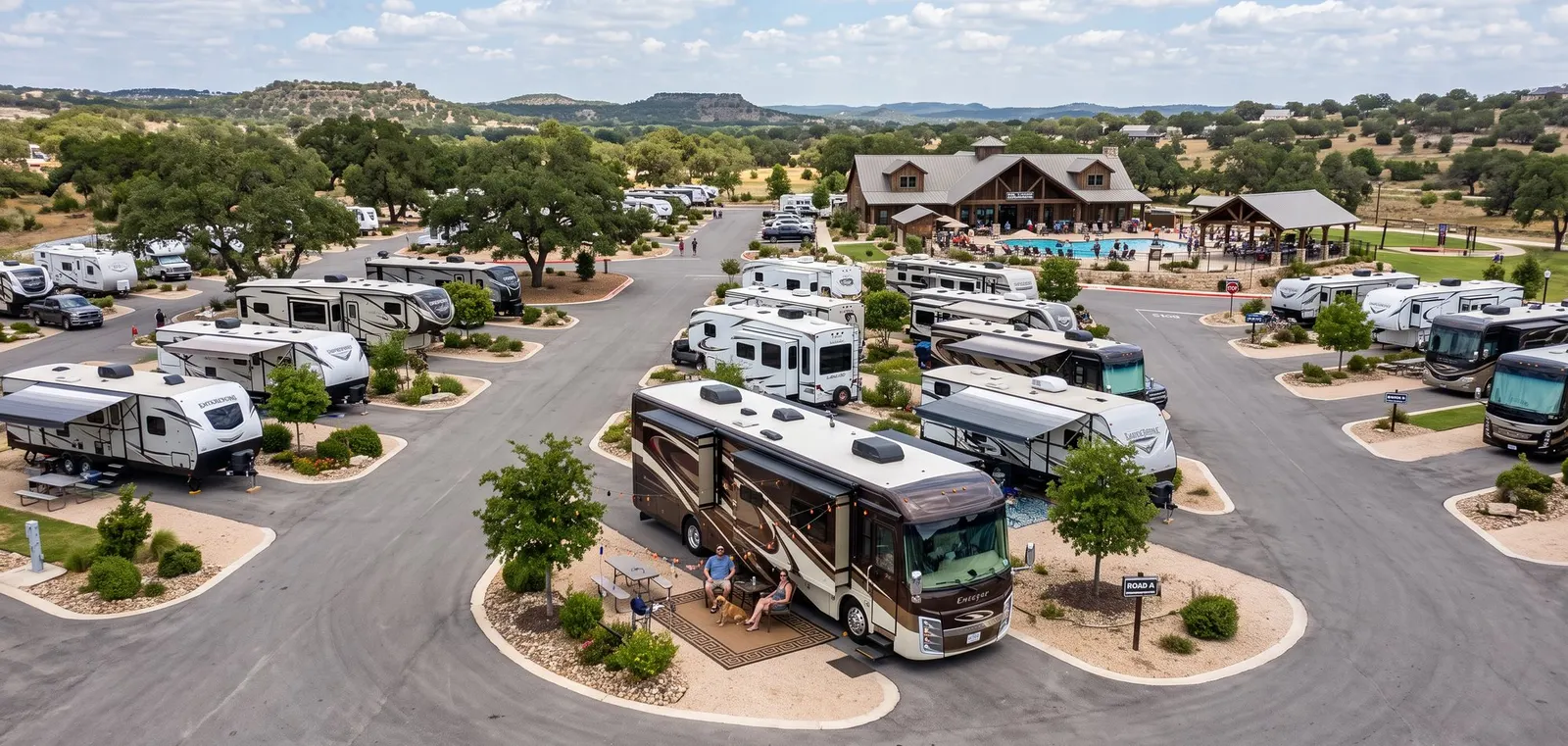
INNOWAVE STUDIO · DATA AS OF OCTOBER 2026
Annual RV income is now the part of the business that grows. At Equity LifeStyle Properties (ELS), core annual RV and marina base rent rose 5.3% in Q3 2026, while seasonal and transient rent fell 5.6%. Sun Communities saw transient RV revenue fall about 9% in 2025. The long-stay layer steadies cash flow, but it carries two costs.
First, federal 7(a) and 504 lending treats an RV park as eligible only if more than 50% of prior-year revenue comes from transients who stay 30 days or less. Second, state law can turn a guest into a tenant: after 30 days in California, after 180 consecutive days in Arizona, and by presumption after 6 months in Florida.
The tenure mix therefore sets the loan program, eviction rules, lodging tax and site plan at once. This article covers the latest tenure data, financing rules, state thresholds and planning choices for a hybrid park.
Tenure data: the annual layer grows, the transient layer swings
What the public REITs report
ELS splits RV and marina rent by tenure, so it gives the cleanest read. In Q1 2026, core annual base rent rose 4.2%, while seasonal rent fell 14.8% and transient rent fell 6.9%. Annual growth reached 5.4% in Q2. In Q3, annual rose 5.3% against declines of 4.4% (seasonal) and 5.8% (transient). Over nine months, seasonal and transient rent fell 9.3%, from $96.2 million to $87.2 million.
The annual line is speeding up. It grew 3.9% in Q3 2025, and ELS has already set 2027 rates on more than 95% of annual sites. Annual sites produced about 73% of core RV and marina base rent in Q3 2026 ($82.8 million of $113.1 million). Management also said 15% to 20% of its annual and seasonal guests first stayed as transients. The transient layer feeds the annual one.
Sun Communities shows the limits of conversion. CFO Fernando Castro-Caratini guided in February to a 1.5% transient decline in 2026, while planning about 600 transient-to-annual conversions in 2026, similar to 2025. In Q2 2026, same-property transient revenue fell 4.8%, while RV real property revenue excluding transient rose 3.8% and annual sites were 100% occupied. President John McLaren said Sun has converted over 8,000 sites since 2020, but “we went a little bit too far" at some properties and seasons. Sun now describes a “balanced optimization approach" across 32,510 annual and 22,760 transient RV sites.
What booking platforms and operators see
On RoverPass, stays of 28 nights or more rose 19.1% in 2025, lifting their share of bookings from 5% to 6%. Stays of 8 to 27 nights rose from 7% to 9%. Total reservations fell 1.0%, yet revenue rose 5.2%. Campspot reported transient site nights down 2.2% through May 2026, linked to gasoline at $4.49 a gallon in late May. Both datasets cover only each platform’s customers.
Workforce housing is a newer driver. Data center crews have made two Eastern Iowa parks “practically 100 percent full," against 20% to 30% winter occupancy before. Dwell Outdoor Hospitality now earns about 85% of revenue from long-term stays. Park model RV shipments rose 22.4% in Q1 2026, while traditional towables fell 13.2%, per RVIA data cited in the same report.
Financing: the 7(a) line sits at 30 days and 50 percent
What the SOP says
SOP 50 10 8 (effective June 1, 2025) states that “Hotels, motels, recreational vehicle parks, marinas, campgrounds, or similar types of businesses are eligible" if “more than 50% of the business’s revenue for the prior year is derived from transients who stay for 30 days or less at a time.” The park must also comply with zoning and other legal requirements. A start-up’s projections must show the same majority.
SOP 50 10 8.1 was published on September 25, 2026, effective for loans numbered on or after October 1. MMCG Invest’s summary of 8.1 states the same test. Confirm against the current SOP text with the lender.
Three details shape planning, per MMCG Invest’s 7(a) guidance:
The test counts revenue, not site counts.
A park at exactly 50% fails.
Seasonal contracts, six-in-six-out plans and annual leases are non-transient “however the guest is registered.”
A snowbird park can therefore be “transient” under Florida law and still fail. MMCG Invest’s October 2026 model of a 389-lot Weslaco, Texas resort found about 91.7% of revenue from stays over 30 days, plus a 77% manufactured-home and park-model share. It was underwritten with a conventional loan instead: 70% of price at 7.75%, with 1.66x coverage in Year 1.
Why 7(a) access still matters
The sector’s median 7(a) note rate rose from 5.25% in FY2021 to 9.87% in FY2024. For 7(a) loans over $350,000, the rate is capped at base rate plus 3.0 points, about 9.75% in 2026. The credit record is strong: RV parks charged off 0.91% of disbursed 7(a) loans, against 4.66% for the whole program (FY2010 through March 2026).
How other capital prices tenure
Newmark’s 2026 survey puts Class A and B RV parks at going-in cap rates around 8.0% and Class C closer to 9.0%. RV parks trade at a 50 to 150 basis-point premium over manufactured housing. MMCG Invest cites 5.25–6.00% for manufactured housing and annual communities. That gap is the valuation case for annual income, though no survey isolates it.
Debt is tight. Community and regional banks commonly underwrite to about 1.25x DSCR, with 25-year loan constants of 8.7% to 9.3%. The 10-year Treasury touched 5.23% on September 25, 2026. One broker’s guide adjusts cap rates by −0.25 to +0.50 points for revenue mix, because monthly guests renew. Public sources reviewed here do not quantify how CMBS or life-company lenders weigh annual against transient income. Borrowers should ask each lender how it haircuts trailing transient revenue.
State tenant law: when a guest becomes a tenant
State law draws its own lines, and they rarely match the 7(a) test’s 30 days. The table describes five states’ rules; it is not legal advice.
| State | Short-stay status | Long-stay threshold | What crossing it triggers | Lodging-tax line |
|---|---|---|---|---|
| California | “Occupant”: 30 days or less | “Tenant”: more than 30 consecutive days; “resident”: nine months or more | Residents get 60 days’ notice and listed grounds for termination | Local transient occupancy taxes; terms vary by city |
| Florida | “Transient guest”: registered 6 months or less | Over 6 months: rebuttable presumption of nontransient occupancy | Part II, Chapter 83 eviction instead of ejection notice | 6% state tax unless a written agreement exceeds 6 months |
| Arizona | Outside the Act | More than 180 consecutive days, same tenant | Good cause or 90-day non-renewal; cure periods | Exempt at 30+ consecutive days |
| Oregon | “Vacation occupancy”: up to 90 days, with conditions | Beyond that, or if conditions fail | ORS chapter 90 can apply | Exempt at 30+ consecutive days |
| Texas | Depends on the agreement | No statutory day count | Tenancy, license or other relationship | State tax defines a hotel as “a building”; 30-day exemption |
Oregon’s 90-day RV status requires a principal residence elsewhere, removal of the RV before a new stay, and a signed notice that the stay is not subject to ORS chapter 90. Arizona’s Act covers park models after 180 days whether or not a rental agreement exists. Texas Attorney General opinion KP-0222 (November 21, 2018) found that an RV park agreement may create a tenancy, a license or another relationship, depending on its terms.
Pricing near the thresholds
Tax lines and tenancy lines pull monthly pricing in opposite directions. A 28-night “monthly” rate stays inside the 7(a) transient bucket and below California’s tenant line. In Arizona and Oregon, though, it remains taxable lodging; Oregon’s tax expressly covers RV spaces. A 31-night month can drop those taxes, but it counts against the 7(a) test and can create a California tenancy. Arizona’s 1994 ruling also says a mixed park that does not separate transient and nontransient receipts risks tax on all of them.
Anti-evasion rules
States are watching stay-length workarounds. A Senate Judiciary analysis described the “RV Shuffle," where parks re-register guests to keep them under nine months. California law imposes a $500 civil penalty for forced reregistration, though only in Imperial Beach. Oregon’s exclusions do not apply if created to avoid the chapter. Some parks still cap stays in writing. Campland on the Bay in San Diego requires extended-stay guests to vacate on the 90th day and stay out until 2:00 p.m. the next day. Agreements, rules and stay limits should be drafted per state with counsel.
Site planning for zoned tenure
Two parks inside one boundary
A hybrid park works best when each tenure has its own zone. Transient sites belong near the entrance, office, dump station and pull-through loops, where turnover traffic stays short. Long-stay sites belong on quieter back loops with little through-traffic. Shared amenities, such as the clubhouse, pool and dog park, sit at the seam. Planted buffers between zones cost about $2,000 to $6,000 per site. Spacing rules still apply across both zones: Texas requires 16 feet.
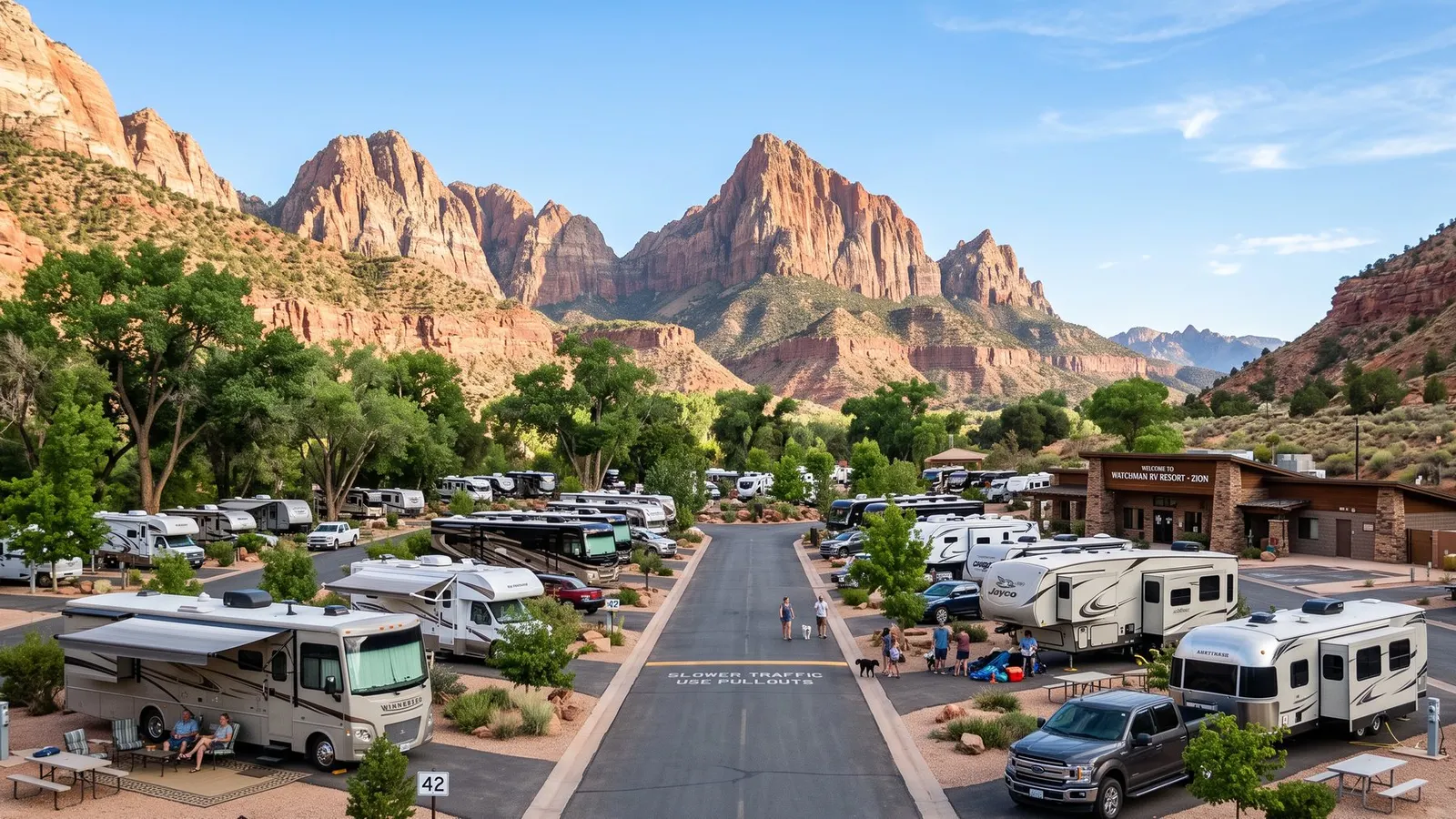
Long-stay site specifications
Long-stay guests treat the site as a yard, so pads and services need more capacity:
Pad and patio. A 16 × 40 ft concrete pad costs about $3,840, and patios and walkways about $3,200 per site. Common state minimums are 1,200 sq ft per site, while Virginia requires 1,600 sq ft and 25 ft of width.
Power. A 50-amp site carries 12,000 VA against 3,600 VA for 30-amp. Long-stay rigs run air conditioning and heat all season.
Metering. Utilities averaged 14.5% of revenue in Newmark’s expense sample. Individual electric meters let monthly rates exclude power, as in MMCG Invest’s Deming model (“plus metered electric”).
Parking and storage. Plan a second vehicle space; Campland includes one passenger vehicle and charges for a second. Add sheds where code allows.
Daily-life services. Mail and package lockers, laundry and a work-friendly Wi-Fi zone near the long-stay loop.
Extended-stay parks often run above the $40,000 to $70,000 per-pad range because of wider pads and heavier roads. Larger sites also cut density below the roughly 10 sites per developable acre used for feasibility.
Local stay caps
Zoning can decide tenure before the market does. Monroe County, Florida limits stays to under 28 days, and Pigeon Forge, Tennessee to 30 days. Orangeville, Utah’s code says a camper “cannot stay in a lot for longer than 30 days," a rule its council discussed in January 2026. Coconino County, Arizona limits RV spaces to 20% of campsites in residential zones, seasonal only. A 50-state site plan matrix tracks these rules by state and county.
Flex sites
A band of sites at the seam, built to long-stay spec and metered, lets the operator shift tenure without new construction. ELS’s funnel data and Sun’s overshoot both argue for this kind of reversible capacity. The reservation system should tag revenue by stay length. MMCG Invest’s buckets are 30 days or less, 31–180, 181–270 and over 270 days, which map to the 7(a) line, the Arizona and Florida lines, and California’s nine-month line.
Modeling the mix: three scenarios and a developer checklist
Three MMCG Invest model studies from 2026 give reference points. They model marketed or composite parks, not audited results; some ratios below are calculated from each study’s figures.
| Scenario | Model | Tenure mix | Revenue per site | Expense ratio | Financing | Stress result |
|---|---|---|---|---|---|---|
| Transient-heavy | 107-site park, Deming, NM | 73–82% transient revenue | ~$5,594 (Year 3) | 52.4% | 7(a) at 9.50% | DSCR 0.81x at 35% transient occupancy |
| Hybrid | 112-site composite | 48% annual and seasonal (trailing) | ~$12,857 (stabilized; site count includes 8 park-model cabins) | 52% | 7(a) at 9.25% | DSCR about 1.18x in bear case |
| Annual-heavy | 389-lot resort, Weslaco, TX | ~91.7% stays over 30 days | ~$4,139 (Year 1) | ~46.5% | Conventional, 70% at 7.75% | DSCR 1.10x in combined stress |
The pattern matches the wider benchmarks. MMCG Invest puts ELS’s annual-heavy expense ratio near 46.5%, against about 70% for transient-heavy franchise parks. MMCG Invest estimates revenue near $7,000 per site for a KOA-style park, against about $5,000 for ELS’s annual-heavy portfolio. In the hybrid composite, the annual and seasonal book covers 55% to 60% of each month’s debt service.
The hybrid case also shows the 7(a) squeeze. With 48% of trailing revenue from annual and seasonal guests, transient revenue is at most about 52%. Any further conversion, or one weak summer, could breach the test. A park on the 7(a) path needs a cushion above 50% that survives a weak transient year, not just the plan year.
Developer checklist
Pick the capital first. 7(a) and 504 and conventional debt each imply a different maximum long-stay share.
Model revenue by stay-length bucket, monthly, with a downside case for transient demand. MMCG Invest’s bear case cut transient revenue about 20%.
Map every threshold: the 7(a) 30-day line, the state tenancy line, the lodging-tax line and any local stay cap.
Draft agreements per state with counsel, noting that some statutes now target reregistration schemes.
Zone the site plan into transient and long-stay areas, with a metered flex band between them.
Spec long-stay sites fully: larger pads, patios, 50-amp service, meters, second-vehicle parking and package lockers.
Test the rate environment. Run debt service at today’s 8.7–9.3% loan constants and an exit cap of at least 8.0%.
Track the mix after opening. The 7(a) test uses prior-year revenue, so drift matters at refinancing or sale.
Per-pad cost assumptions for each zone can start from published 2026 development cost benchmarks. InnoWave Studio starts its RV park plans from this tenure map, since the layout of sites, roads and utilities follows from it.
Sources
Equity LifeStyle Properties, Inc. press release, Q1 2026 (SEC Exhibit 99.1)
Equity Lifestyle Properties Inc (ELS) Q2 2026 Earnings Call Transcript – Equibles
Sun Communities Reports Results for the Second Quarter and First Six Months of 2026
Earnings call transcript: Sun Communities tops core guidance in Q2 2026 – Investing.com
Sun Communities, Inc. Q2 2026 Earnings Call Summary – Yahoo Finance
Sun Communities (SUI) Q4 2025 Earnings Call Transcript – The Motley Fool
Why RV Parks Are Pivoting to Extended Stays and Park Models in 2026 – Modern Campground
‘We’re practically full’: Data center workers fill Eastern Iowa campgrounds – KCRG
SOP Update: SOP 50 10 8.1 Published with Technical Policy Updates – NAGGL
US RV Park and Campground Market Outlook 2026: Full Campgrounds, Unforgiving Math – MMCG Invest
7(a) Snowbird RV Resort, Weslaco, TX (Not Eligible) – MMCG Invest
Feasibility Case Study: Underwriting the RV Park After the Shipment Cliff – MMCG Invest
Hoffman: Impact of a 5% Treasury on Campground Values – Woodall’s Campground Magazine
Campground & RV Park Valuation Calculator (Risk-Adjusted) – Gather Grounds Resorts
Arizona RV Long-Term Rental Space Act Evictions – Arizona Judicial Branch
Arizona Department of Revenue, Transaction Privilege Tax Ruling TPR 94-5
Orangeville City Council meeting notice, January 8, 2026 – Utah Public Notice Website
2026 U.S. RV Park Development Cost Benchmarks: Per-Pad Economics Across 50 States – InnoWave Studio