What makes a West Virginia site plan different
West Virginia has no statewide zoning, no statewide mandatory building permit and, in many counties, no local building department. A commercial site plan therefore clears a state track (the State Fire Marshal, WVDEP and WVDOH) and, separately, whatever local track exists. Five conditions decide how the plan is drawn and approved.
1. Zoning is optional, and most counties have none
Under WV Code Chapter 8A a comprehensive plan must precede zoning (Article 3). A county then adopts zoning either through its governing body, after two public hearings and a Class II legal advertisement, or by referendum during a primary election [1, 7]. Zoning may cover all or part of a county; municipalities must zone their entire area [1, 7]. West Virginia has 55 counties, and only a handful have countywide zoning [1]. Jefferson County is the main exception. Berkeley County zones only two legacy districts, Monongalia County only the West Run district, and Putnam, Fayette and Raleigh run partial or ordinance-based systems [2]. Where a county has no zoning, the site answers to the subdivision regulations if adopted, the floodplain ordinance, the county health department, the State Fire Marshal and WVDOH [7]. A county may adopt and enforce building codes only for "specified areas" under WV Code 7-1-3v [8]. On an unzoned parcel the site data table has no zoning district to test against; the numbers that bind come from those other instruments.
2. The State Fire Marshal is often the only building plan reviewer
The State Fire Commission adopted the 2018 IBC, IRC, IMC, IPC and IEBC, the 2020 NEC and the 2015 IECC, effective August 1, 2022 [9]. Adoption and enforcement are optional for counties and municipalities, and enforcement is the local jurisdiction's responsibility under WV Code 15A-11-5 [10]. According to the State Fire Commission's office as reported by WVU LEAP, as of June 11, 2015, 9 counties and 52 cities and towns had adopted the code [11]. Monongalia County states that "there is no local enforcement of building code at this time" [12].
Where no local department exists, the Office of the State Fire Marshal is the building plan reviewer. It reviews architectural, mechanical, electrical, plumbing and fire-protection plans for most commercial, assembly and multifamily occupancies statewide, through a mandatory electronic Plan Review Request Portal since March 1, 2025; hard copies are no longer accepted [13]. Its architectural review fee is $1.00 per $1,000 of construction cost up to the first $1,000,000 and $0.80 per $1,000 thereafter, under 103 CSR 2, Section 6.14, revised August 6, 2025 [3].
3. The state controls the entrance
WVDOH issues the driveway and entrance (encroachment) permit for any access onto a state-maintained road, and it maintains most public roads, county roads included. Access permitting therefore runs through the ten WVDOH districts in most locations, with an electronic WVDOT Permit Portal [14]. District 5 covers the Eastern Panhandle (Berkeley, Jefferson, Morgan and others), District 1 covers Kanawha and Putnam, and District 9 covers Fayette [14]. The entrance on the plan is a state decision even where a county planning commission reviews the rest of the layout.
4. The flat land sits in the floodplain
River valleys hold most of the state's flat land, which places much developable ground inside the flood fringe. The WV model ordinance recommends 2 ft of freeboard above base flood elevation; in an AE zone without a floodway, development may cause no more than 1 ft of cumulative rise, and in an AE zone with a floodway a no-rise demonstration is required [5]. The reference event is the 2016 flood: 23 people died, more than 1,500 homes and businesses were destroyed and another 2,500 significantly damaged, and losses to highways and bridges totaled about $53 million [15]. In Fayette County the Floodplain Ordinance, revised July 2017, requires a site plan with elevation data approved by the Floodplain Administrator before development [16, 17].
5. Slopes and coal legacy decide where pads go
Buildable flat ground is the scarce resource across most of the state. Development concentrates in hollows and on ridge tops, and pads are made with cut and fill, benching and retaining structures. In the coalfields, the WVDEP Office of Abandoned Mine Lands and Reclamation addresses pre-August-3-1977 mining hazards: mine fires, subsidence, highwalls, open shafts and mining-impacted water [18]. The Voluntary Remediation Program (WV Code 22-22) supports redevelopment of contaminated sites, with remediation supervised by a Licensed Remediation Specialist and liability relief through a Certificate of Completion [19]. A preliminary plan in West Virginia places pads and units on the ground left after slope, flood fringe and mine history are mapped; the engineer of record's geotechnical and grading design then confirms them. For screening a former industrial or mining parcel, see Phase I and II assessments in the site plan.
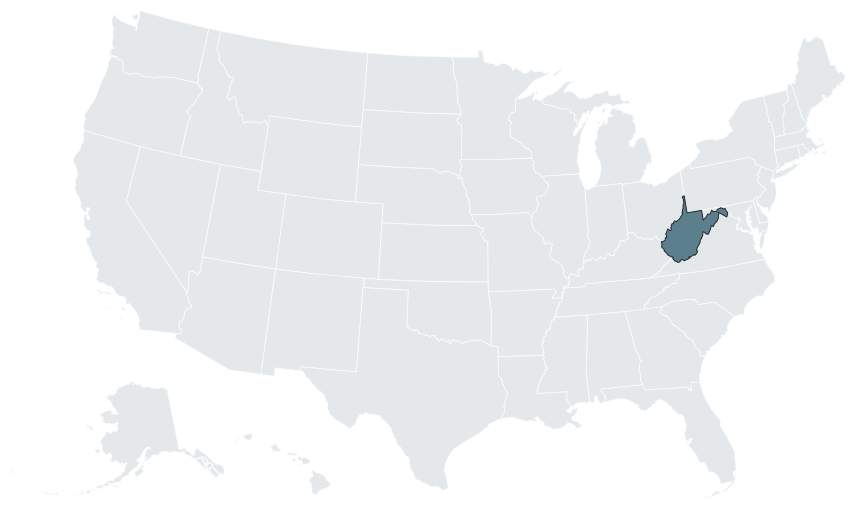

Approval layers: state, county and city
| Layer | Body | What it decides | Source |
|---|---|---|---|
| State | Office of the State Fire Marshal | Architectural, MEP and fire-protection plan review for most commercial, assembly and multifamily occupancies | [13] |
| State | State Fire Commission | Adopts the State Fire Code and State Building Code (WV Code 15A-11-3, 15A-11-5) | [20] |
| State | WVDEP | Construction stormwater permit; underground storage tanks; abandoned mine and remediation programs | [4, 21, 18] |
| State | WVDOH | Driveway and entrance (encroachment) permits | [14] |
| County | County health department, under the Bureau for Public Health | Septic, wells, and campground and recreational facility permits under 64 CSR 18 | [22] |
| County or city with zoning | Planning commission and board of zoning appeals | Site plans, subdivisions, conditional uses and variances under WV Code Chapter 8A | [1] |
| County without zoning | Subdivision regulations, floodplain ordinance, health department | The operative local rules | [7] |
A commercial plan typically moves in this order [1, 7, 13, 14]:
- Confirm the regime: zoned county, zoned city, or unzoned county.
- Meet the planning office where zoning exists, and check the subdivision regulations where it does not.
- Plan the WVDOH entrance permit with the layout.
- Take septic, wells or a campground permit to the county health department.
- File the floodplain permit where the site is flood-prone.
- Obtain WVDEP construction stormwater coverage at 1 acre of disturbance [4].
- Clear State Fire Marshal plan review, then the local building permit where the jurisdiction enforces the code.
For how the concept, preliminary and final stages differ, see preliminary vs final site plan.
Who prepares, seals and submits
| Profession | Statute and rule | What the seal covers | Source |
|---|---|---|---|
| Professional engineer | WV Code Chapter 30, Article 13; 7 CSR 1 | Only a registered PE may practice engineering (7 CSR 1, Section 6.1). Seal, signature and date go on the first or title page of all final and record documents presented to a client or public agency. A firm holds a Certificate of Authorization naming a PE in responsible charge | [23, 24] |
| Land surveyor | WV Code Chapter 30, Article 13A; 23 CSR 1 | A plat for all boundary or partition surveys and subdivisions (23 CSR 1, 7.3.g; WV Code 30-13A-26), with the surveyor's original signature and seal. Recorded plats are legal evidence of boundaries (WV Code 39-1-3) | [25, 26] |
| Architect | WV Code Chapter 30, Article 12 | Technical submissions for non-exempt buildings. WV Code 30-12-12 exempts detached single-family dwellings, multifamily structures not exceeding three stories, farm buildings for no more than ten persons, alterations that do not affect structural or safety features, and pre-engineered buildings | [27] |
Local submission rules add their own requirement. The City of Charleston Building Commission states: "Plans for commercial projects over $50,000 shall have the signature and seal of an architect or engineer registered by the state of WV who is responsible for the design in addition to the signature of the owner or his agent." Its commercial plan review fee is 0.00075 times total construction cost [6].
A preliminary site plan is the layout those professionals build on: the disposition, buildings, drives, parking, pads and units, and the yield, organized with a site data table against whatever rules govern the parcel. The studio holds no seal. The client's engineer of record adds the sealed civil set, the stormwater pollution prevention plan, floodplain elevations and any no-rise work, the WVDOH entrance design, the septic design for the health department and the geotechnical and retaining design; the surveyor adds the boundary and topographic survey and the plat. Who prepares a site plan sets out the split in more detail, and where unsealed site plans are accepted covers the stages at which a jurisdiction takes the plan before the sealed set exists.
Statewide overlays
| Overlay | Trigger | Agency | Fee or timeline |
|---|---|---|---|
| State Fire Marshal plan review | Most new and existing commercial, assembly and multifamily construction | Office of the State Fire Marshal | Portal only since March 1, 2025; $1.00 per $1,000 to the first $1,000,000, then $0.80 per $1,000 [13, 3] |
| State Building Code | Where a county or city has adopted it | Local building department | 2018 I-codes, 2020 NEC, 2015 IECC [9, 10] |
| Construction stormwater | 1 acre of disturbance, or a common plan of development | WVDEP | NOI 15 days before start for 1 to under 3 acres; Site Registration Application at 3 acres or more; SWPPP; WV Code 22-11-4 and 47 CSR 10 [4, 28] |
| Floodplain | Development in a flood-prone area | County or municipal floodplain administrator | 2 ft freeboard recommended; 1 ft cumulative rise limit; no-rise in a floodway [5] |
| Highway access | Any driveway or entrance onto a state-maintained road | WVDOH district office | Electronic WVDOT Permit Portal [14] |
| Underground storage tanks | Tanks storing petroleum or hazardous substances | WVDEP UST Section | Notify and register within 30 days of acquisition and before fuel delivery; annual registration fees [21, 29] |
| In-stream work | Stream and waterway activities | WVDEP Section 401 certification; U.S. Army Corps Section 404 permit | Floodplain permit first [5] |
Top jurisdictions: process, fees and timelines
| Jurisdiction | Zoning | Approval path | Fees and timing |
|---|---|---|---|
| Jefferson County | Countywide: Zoning and Land Development Ordinance amended January 22, 2026; Subdivision and Land Development Regulations amended May 7, 2026 | Office of Planning & Zoning and Office of Engineering review; the Planning Commission approves preliminary plats and site plans; a performance bond is posted before permits issue [30, 31] | Map amendment $1,500 + $75 per acre; conditional use permit $300 + $75 per acre; variance $150 ($200 if work commenced); zoning certificate $25; impact fees also apply [30] |
| Berkeley County | Only the Tuscarora and Windewald districts, adopted in the early 1970s | Subdivision regulations, floodplain ordinance, health department, State Fire Marshal and WVDOH elsewhere [2] | Not stated |
| Martinsburg | Citywide, transect and form-based | Site Plan Review under Zoning Ordinance Article VII for uses requiring a site plan, all development in business and industrial districts, and all development of 120 sq ft or more; Land Disturbance Permit under Codified Ordinances 1301.10 [32, 33] | Not stated |
| Kanawha County | Planning & Development enforces land use ordinances, zoning and floodplain rules | Site plan reviews and subdivision applications in unincorporated areas [34] | Not stated |
| Charleston | Citywide | Municipal Planning Commission of 16 members, meeting monthly; plans go to the Permit Review Coordinator; commercial projects file 3 sets of scaled plans [6, 35] | Seal over $50,000; plan review fee 0.00075 times total construction cost [6] |
| Monongalia County | Only the West Run Planning District | No county subdivision regulations and no local building code enforcement; Land Use Permit only in West Run [7, 12] | Not stated |
| Morgantown | Citywide, with building code enforcement | Building permit for erecting, enlarging, altering, moving or demolishing any building [36] | Not stated |
| Cabell County | No countywide zoning found | Building permit for all new development and substantial improvements, with a site plan, structural plans and septic or sewer proof [37] | Not stated |
| Huntington | Citywide (Huntington Development Ordinance) | Two-stage plan review: completeness, then code compliance [38] | Stormwater permit for projects of 5,000 sq ft or more; erosion and sediment control for 10,000 sq ft or more; building permit $20 application fee plus a cost-based fee [38, 39] |
| Parkersburg | Citywide | Municipal Planning Commission of 11 members, meeting the 3rd Friday monthly; reviews subdivisions, rezoning and annexations [40] | "Please allow 45 business days for an application to be processed and prepared for presentation to the Commission" [40] |
| Raleigh County | Planning & Zoning Ordinance, 2025 edition, with zoning maps and a BZA | Location Improvement Permit [41] | Not stated |
| Putnam County | Partial: the Putnam PSD sewer area in Teays Valley and the proposed US-35 corridor | Office of Planning & Infrastructure runs subdivision regulations, building and floodplain permits and zoning in the zoned portions [42] | Not stated |
| Fayette County | 2009 Unified Development Code | Zoning Department; Special Use Permits and rezoning go to the Planning Commission [16, 17] | Not stated |
| Fayetteville | Town zoning plan and map adopted 7/7/2022 | Separate municipal zoning, building and subdivision permits [43] | Not stated |
Charles Town and Ranson, inside Jefferson County, are incorporated municipalities with their own permitting, so a parcel's municipal status is checked before the county track is assumed.
Asset registries for the classes the studio plans
| Asset | State regime | What it means for the plan |
|---|---|---|
| RV parks and campgrounds | Recreational facilities under the General Sanitation Rule, 64 CSR 18, administered by county health departments. A campground is a tract offered to the public for two or more camping units. New, renovated or change-of-ownership campgrounds apply and pass a sanitarian inspection; food service, pools and bathing beaches take separate plan review [22, 44] | The health department permit and inspection gate the opening; where the county zones, its ordinance adds the use rules. RV sites per acre shows how other states cap density. |
| Glamping | The 2020 national park and preserve designation at New River Gorge is driving glamping, RV, cabin and short-term-rental development in Fayette and adjacent counties [45] | In Fayette County the 2009 Unified Development Code and the floodplain ordinance govern the site [16, 17]. |
| Gas stations and fuel | WVDEP UST Section. Owners notify and register within 30 days of acquisition and before fuel delivery, and pay annual registration fees; knowing failure to register carries a civil penalty up to $10,000 per violation [21, 29]. The WVDEP UST Section has held full EPA program approval since February 1988 [21] | The plan shows the tank field and dispensers; siting standards follow the local regime. |
| Car washes and hotels | State Fire Marshal plan review of the building, as for most commercial occupancies [13] | Stacking, setbacks and parking follow the local regime in the table above. |
| Self storage, industrial and warehouses | State Fire Marshal plan review [13]; WVDEP stormwater coverage at 1 acre of disturbance [4] | Use, setbacks and parking follow the local regime in the table above. |
| Marinas and waterfront | Floodplain permits, and often a U.S. Army Corps Section 404 permit and WVDEP Section 401 water quality certification for in-stream work [5] | The water-side layout waits on those approvals. |
| Manufactured housing | WV Manufactured Housing Construction and Safety Board, Division of Labor; WV Code 21-9; 42 CSR 19; installation per HUD 24 CFR Part 3285; installer or contractor license fee $500 [46, 47] | Licensing of the installer, not the layout. |
For fuel retail, the developer's guide to gas station permitting covers the tank and traffic questions that sit beside the WVDEP rules.
Timelines and bottlenecks
- State Fire Marshal. A mandatory gate for most commercial and multifamily projects, filed through the electronic portal since March 1, 2025. Resubmittals for "PR" projects are coordinated by phone, not uploaded [48].
- Local calendars. Parkersburg asks for 45 business days to prepare an application for its Planning Commission [40]. Jefferson County's Planning Commission meets monthly, so plat and site plan approval is paced by the meeting calendar and by bond posting [30, 31].
- Stormwater. An NOI 15 days before start for 1 to under 3 acres, or a Site Registration Application with SWPPP review at 3 acres or more [4, 28].
- Access. Because most roads, county roads included, are state-maintained, the WVDOH entrance permit belongs alongside the site plan, not after it [14]. It is one reason your permit clock starts later than you think.
- Unzoned counties. Where there is no local building department, as in unincorporated Monongalia County, there is no local plan-review queue, but the State Fire Marshal, WVDEP stormwater, WVDOH access and health department steps still apply [7, 12].
- Terrain. Slope stability, cut and fill and retaining design commonly drive the longest design iteration on a West Virginia site, so the engineer of record scopes them before pad geometry is fixed.
Proof points
- Bedington Campus, Berkeley County. The $4 billion, 548-acre, up-to-600 MW Bedington data center campus is West Virginia's first High Impact Intelligence Center, projected at approximately 1,000 construction jobs and 125 permanent positions [49]. For the wider market, state rankings for data center development compare incentives, power and connectivity.
- Kearneysville campus. A roughly 300-acre data center site split between Berkeley and Jefferson counties advanced through local planning review, and Berkeley County's planning commission approved a concept plan for the Berkeley portion [50]. That concept stage is where a preliminary plan does its work.
- New River Gorge. The gorge became a national park and preserve in 2020, catalyzing outdoor-hospitality development in Fayette County [45], the county with a Unified Development Code and a floodplain ordinance that asks for elevation data on the site plan [16, 17].
Where a preliminary plan fits in West Virginia
The first question on a West Virginia parcel is which regime governs it, and the answer changes the drawing. In Jefferson County, Martinsburg, Charleston or Parkersburg the plan is tested against a zoning district and goes to a planning commission. In an unzoned county it is tested against the subdivision regulations, the floodplain ordinance, the health department and the WVDOH entrance, and it often goes first to a lender or a general contractor rather than a board. Either way the site plan answers the same early questions: what fits on the flat ground, how many units or square feet, where the entrance goes, and what the flood fringe takes out. The site plan consultant and site plan architect pages explain how the studio works alongside the engineer and architect of record.
For an outdoor-hospitality project in mountain terrain, the Sevier County, Tennessee RV resort with cabins model project shows how a county's rules shape the layout, and the full set is on the case studies page. The neighboring states run their own regimes: Maryland, Virginia, Pennsylvania, Ohio and Kentucky. The full list of covered states is on service areas.
Frequently asked questions
Does my West Virginia county have zoning?
If there is no zoning, what governs my site?
The county subdivision regulations where adopted, the floodplain ordinance, the county health department for septic and wells, the State Fire Marshal and the WVDOH access permit [7].
Do I need a building permit in West Virginia?
When must an architect or engineer seal the plans?
An architect seals plans for non-exempt buildings; WV Code 30-12-12 exempts detached single-family dwellings, multifamily buildings of three stories or less, farm buildings for no more than ten persons and pre-engineered buildings [27]. Engineered site, civil and structural work presented to a client or public agency carries a PE seal under WV Code 30-13 and 7 CSR 1 [23, 24]. The preliminary plan is the layout the engineer and architect of record build that sealed set on.
What triggers a WVDEP construction stormwater permit?
1 acre of disturbance, or a smaller site that is part of a common plan of development [4].
What freeboard applies in a West Virginia floodplain?
The WV model ordinance recommends 2 ft above base flood elevation. In an AE zone with a floodway a no-rise demonstration is required, and in an AE zone without one development may cause no more than 1 ft of cumulative rise [5].
How do I permit an RV park or campground?
How long does local review take?
It varies. Parkersburg asks applicants to allow 45 business days for an application to be prepared for its Planning Commission, and monthly planning commission calendars pace approvals elsewhere [40].
Sources
- 1)West Virginia Code Chapter 8A, Land Use Planning, code.wvlegislature.gov, West Virginia Legislature. Accessed 2026-08-31.
- 2)Berkeley County FAQ: zoning, Berkeley County, West Virginia. Accessed 2026-08-31.
- 3)Fire Marshal Plan Review Fee Schedule, 103 CSR 2, Section 6.14, West Virginia Office of the State Fire Marshal. Accessed 2026-08-31.
- 4)Construction Stormwater General Permit, West Virginia Department of Environmental Protection (WVDEP). Accessed 2026-08-31.
- 5)Floodplain permits, West Virginia Department of Environmental Protection (WVDEP). Accessed 2026-08-31.
- 6)Building Commission, plans review, City of Charleston, West Virginia. Accessed 2026-08-31.
- 7)Monongalia County Planning Commission, Frequently Asked Questions, Monongalia County, West Virginia. Accessed 2026-08-31.
- 8)West Virginia Code 7-1-3v, county building codes, West Virginia Legislature. Accessed 2026-08-31.
- 9)West Virginia State Fire Commission adopted new codes, International Code Council (ICC-NTA). Accessed 2026-08-31.
- 10)West Virginia Code 15A-11-5, State Building Code enforcement, West Virginia Legislature. Accessed 2026-08-31.
- 11)Fundamental tools: building code, WVU Land Use and Sustainable Development Law Clinic (WVU LEAP). Accessed 2026-08-31.
- 12)Building enforcement, Monongalia County Planning Commission. Accessed 2026-08-31.
- 13)Plans Review division, West Virginia Office of the State Fire Marshal. Accessed 2026-08-31.
- 14)Encroachment Permits, West Virginia Division of Highways (WVDOH). Accessed 2026-08-31.
- 15)Flood of 2016, e-WV, The West Virginia Encyclopedia. Accessed 2026-08-31.
- 16)Zoning Department, Fayette County, West Virginia. Accessed 2026-08-31.
- 17)Building Department and Floodplain Management, Fayette County, West Virginia. Accessed 2026-08-31.
- 18)Office of Abandoned Mine Lands and Reclamation, West Virginia Department of Environmental Protection (WVDEP). Accessed 2026-08-31.
- 19)Office of Environmental Remediation, Voluntary Remediation and Brownfields, West Virginia Department of Environmental Protection (WVDEP). Accessed 2026-08-31.
- 20)West Virginia Code 15A-11-3, State Building Code, West Virginia Legislature. Accessed 2026-08-31.
- 21)Underground Storage Tanks, West Virginia Department of Environmental Protection (WVDEP). Accessed 2026-08-31.
- 22)W. Va. Code of State Rules 64-18-2, General Sanitation Rule (via Cornell LII), West Virginia Bureau for Public Health. Accessed 2026-08-31.
- 23)Professional Engineers Rule, 7 CSR 1 Series (2022 SB334 changes), West Virginia State Board of Registration for Professional Engineers. Accessed 2026-08-31.
- 24)West Virginia Code Chapter 30, Article 13, Engineers, West Virginia Legislature. Accessed 2026-08-31.
- 25)Land surveyor rule, 23 CSR 1, West Virginia Board of Professional Surveyors. Accessed 2026-08-31.
- 26)West Virginia Code Chapter 30, Article 13A, Land Surveyors, West Virginia Legislature. Accessed 2026-08-31.
- 27)West Virginia Code 30-12-12, architect exemptions, West Virginia Legislature. Accessed 2026-08-31.
- 28)RAPID Roadmap 6-WV-b, construction stormwater, OpenEI. Accessed 2026-08-31.
- 29)WV UST Notification Form, West Virginia Department of Environmental Protection (WVDEP). Accessed 2026-08-31.
- 30)Planning and Zoning Department, Zoning Fees, Jefferson County, West Virginia. Accessed 2026-08-31.
- 31)Engineering Department, Land Development Bonding, Jefferson County, West Virginia. Accessed 2026-08-31.
- 32)Planning Commission, site plans, City of Martinsburg, West Virginia. Accessed 2026-08-31.
- 33)Martinsburg Codified Ordinances (American Legal Publishing), City of Martinsburg, West Virginia. Accessed 2026-08-31.
- 34)Planning and Development, Kanawha County Commission, West Virginia. Accessed 2026-08-31.
- 35)Planning Department, City of Charleston, West Virginia. Accessed 2026-08-31.
- 36)Building Permits, City of Morgantown, West Virginia. Accessed 2026-08-31.
- 37)County Commission permits, Cabell County, West Virginia. Accessed 2026-08-31.
- 38)Planning and Zoning, City of Huntington, West Virginia. Accessed 2026-08-31.
- 39)Building permit fees, City of Huntington, West Virginia. Accessed 2026-08-31.
- 40)Municipal Planning Commission, City of Parkersburg, West Virginia. Accessed 2026-08-31.
- 41)Planning and Zoning Ordinance, 2025, Raleigh County, West Virginia. Accessed 2026-08-31.
- 42)Office of Planning and Infrastructure, Putnam County, West Virginia. Accessed 2026-08-31.
- 43)Zoning Department, Town of Fayetteville, West Virginia. Accessed 2026-08-31.
- 44)Campgrounds and organized camps, Putnam County Health Department, West Virginia. Accessed 2026-08-31.
- 45)The Outpost, New River Gorge, The Outpost NRG. Accessed 2026-08-31.
- 46)Board of Manufactured Housing information, West Virginia Division of Labor. Accessed 2026-08-31.
- 47)West Virginia Code 21-9-2, manufactured housing, West Virginia Legislature. Accessed 2026-08-31.
- 48)Frequently asked questions, West Virginia Office of the State Fire Marshal. Accessed 2026-08-31.
- 49)Governor Morrisey announces $4 billion private investment, West Virginia's first High Impact Intelligence Center, Office of the Governor of West Virginia. Accessed 2026-08-31.
- 50)West Virginia data centers push (December 18, 2025), WV Explorer. Accessed 2026-08-31.