Five conditions that shape an Illinois site plan
Illinois does not approve private site plans at state level. Approval is municipal or county, and state and regional agencies attach their own permits for highway access, stormwater discharge, floodways, sewer connections and tanks. The IDFPR Code Enforcement Manual tells code officials that before a permit issues, special permits may be needed from historic preservation authorities, US or Illinois EPA, US or Illinois DOT, the Army Corps of Engineers, IDNR, the Coast Guard or the FAA, and that the owner or design professional must find out which apply [1]. Five conditions decide how an Illinois plan is drawn and how long it takes.
1. The site plan carries a surveyor's seal when it carries the boundary. The Code Enforcement Manual states that if a site plan shows "any technical information, such as dimensions or bearings, relating to boundaries," it must be signed and sealed by a professional land surveyor as well as by the design professional responsible for the proposed conditions, and that this includes a boundary survey used as an underlay [1]. Nearly every commercial plan is drawn over a survey, so the permit-set site plan in Illinois is a two-seal sheet.
2. Population decides what a town may demand. Under Article VII, Section 6 of the 1970 Constitution, a municipality over 25,000 is a home rule unit automatically, and a smaller one becomes home rule by referendum [6]. A home rule unit may act without a statutory grant; a non-home rule municipality may act only where the Illinois Municipal Code (65 ILCS 5) grants the power [7]. Separately, a municipality's subdivision and comprehensive plan jurisdiction reaches unincorporated land within 1.5 miles of its corporate boundaries, unless another municipality already holds it [8]. A county parcel can need a village's plat approval even though the village has no zoning power over it, and home rule does not widen that reach [7].
3. Stormwater has a different owner on each side of a line. In Chicago, the Stormwater Management Ordinance (Chapter 11-18) governs development that disturbs 15,000 or more square feet or creates 7,500 or more square feet of at-grade impervious surface, and stormwater approval must be in hand before a building or sewer permit can issue [9]. In suburban Cook County, the Metropolitan Water Reclamation District (MWRD) is the stormwater authority under its Watershed Management Ordinance, with a permit triggered by disturbance of more than 0.5 acre [3]. DuPage, Kane, Lake, McHenry and Will hold countywide stormwater authority under 55 ILCS 5/5-1062 [10]. Even the rainfall data differs: the IDNR model ordinance references Illinois State Water Survey Bulletin 70, and MWRD requires Bulletin 75 [11, 3].
4. The state highway is usually the critical path. IDOT advises allowing 9 to 14 months from first submission to permit issuance for larger developments, subdivisions or permits with signals or turn lanes [2]. On a commercial site that takes access from a state route with a new signal or turn lane, the access permit sets the schedule, not the zoning hearing.
5. No part of the state is code-free. Public Act 103-0510 created the State Building and Residential Codes Act, effective 1 January 2025 [5]. Where a county or municipality has no building code, construction must still meet the Capital Development Board baseline, which includes the IBC with Appendix G (flood-resistant construction), and a qualified inspector must state that the building complies [12]. Every Illinois site plan is drawn against a code; the question is only who enforces it.
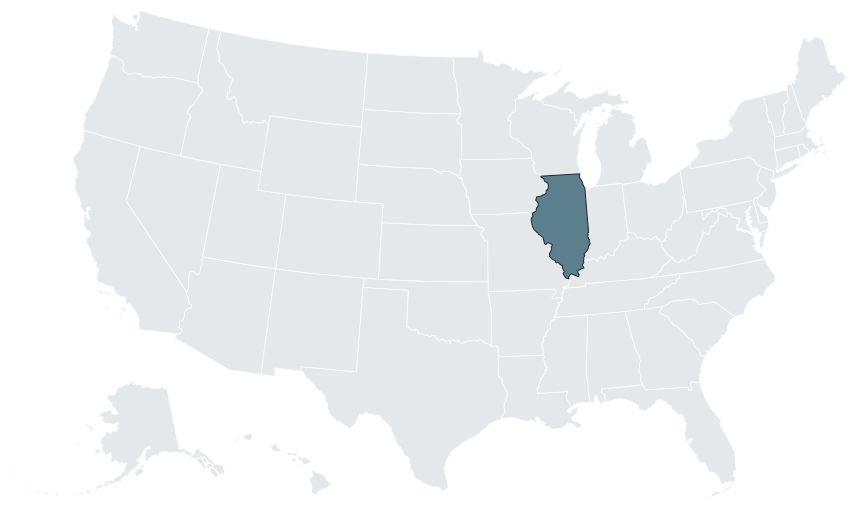

Approval layers: state, region, county and municipality
| Layer | Body | What it decides | Basis |
|---|---|---|---|
| State | Capital Development Board | Building code baseline; energy and accessibility codes | P.A. 103-0510; 71 Ill. Adm. Code 400 [12, 13] |
| State | Illinois EPA | Construction stormwater (ILR10); leaking tank cleanup | General NPDES Permit ILR10 [14] |
| State | IDOT district office | Access to Interstate, US and Illinois routes | 605 ILCS 5/9-113; 92 Ill. Adm. Code 550 [2] |
| State | IDNR Office of Water Resources | Construction in a regulatory floodway | 615 ILCS 5/18g [15] |
| State | Office of the State Fire Marshal | Underground storage tank permits | 430 ILCS 15/2; 41 Ill. Adm. Code 175 and 176 [16] |
| State | IDFPR | Who may prepare and seal drawings | 225 ILCS 305, 325, 330 and 340 [1] |
| Region | MWRD (Cook County) | Stormwater, floodplain, isolated wetlands, sewer | 70 ILCS 2605 [3] |
| County | Countywide stormwater authority | Stormwater, detention, floodplain | 55 ILCS 5/5-1062 and 5-1062.2 |
| County | County Board | County zoning and plats | 55 ILCS 5, Division 5-12 |
| County or township | County highway department or road district | Access to non-state roads | 605 ILCS 5 |
| Special district | Fire protection district | Fire access, hydrants, suppression | 70 ILCS 705 |
| Municipal | Plan Commission | Recommendation on plats, PUDs, plan amendments | 65 ILCS 5/11-12-4 et seq. |
| Municipal | Zoning Board of Appeals | Variations, special uses, appeals | 65 ILCS 5/11-13-3 et seq. |
| Municipal | City Council or Village Board | Rezoning, annexation, PUD ordinance | 65 ILCS 5 |
Local review runs on one of two tracks. By-right projects that meet every zoning standard go through staff review in a community development or building department, often with an internal committee drawing in engineering, fire and public works; that track is measured in weeks. Planned unit developments, special uses, variations, rezonings and annexations go to a Plan Commission recommendation and then a decision by the corporate authorities after a noticed public hearing; that track is measured in months.
Outside municipal fire departments, Illinois fire service is often delivered by independent fire protection districts, which are separate units of local government with their own review and fees. On rural and unincorporated commercial sites, district review commonly turns on turning radii, access width, hydrant spacing and fire lane geometry, so the district belongs on the first-week call list.
Land division runs under the Illinois Plat Act, 765 ILCS 205, whose exemptions decide whether a plat of subdivision is needed at all [17]. Only the professional land surveyor who signs a plat, or a person with that surveyor's written authorization, may record it [1].
Who prepares and seals what
Illinois licenses four design professions separately, each under its own Act: architects (225 ILCS 305), professional engineers (225 ILCS 325), structural engineers (225 ILCS 340) and professional land surveyors (225 ILCS 330), all regulated by IDFPR [1]. The Code Enforcement Manual draws the lines a permit set has to follow:
| Item on the plan set | Who seals it in Illinois |
|---|---|
| Boundary survey | Professional land surveyor only [1] |
| Site plan showing boundary dimensions or bearings | Professional land surveyor plus the design professional responsible for proposed conditions [1] |
| Retaining wall, any height | Structural engineer only; not a professional engineer or landscape architect [1] |
| Site grading and drainage | An architect may prepare them; a local jurisdiction may require a professional engineer's seal [1] |
| Architectural or structural drawings | Not a professional engineer (225 ILCS 325/47) [1] |
| Topographic map without a boundary survey | Surveyor, or a professional engineer for that engineer's own design project; it must name the source of the boundary information and state that the service is not a land survey [1] |
| Structural portions of a public swimming pool | Architect or structural engineer; mechanical and electrical systems by a professional engineer [1] |
The seal goes on the first sheet of any bound set and on every loose sheet. It must be reproducible (embossed seals do not satisfy the Acts), it may be applied electronically, and it carries the current date and the license expiration date. The cover sheet lists the project, the design firm and its Professional Design Firm registration number, every code used, a drawing index and which drawings each seal covers. Only Illinois licensees may seal Illinois work [1].
The retaining wall rule matters on almost any site with grade change, a loading dock or a detention basin: the wall detail belongs to a structural engineer, not to the civil engineer drawing the grading around it [1].
A preliminary site plan from the studio is the layout those seals sit on. It fixes site disposition, buildings, drive aisles, parking, pads and yield, with a site data table carrying acreage, zoning, setbacks and parking required against provided. Developers take it to early conversations with a municipality, to a lender and to a contractor for pricing; the client's Illinois engineer of record, structural engineer and surveyor then build the sealed permit set on it. The guide to who prepares a site plan sets out that division of work, and preliminary vs final site plan shows where the sheet changes hands. For an Illinois project that needs coordination across those disciplines, see the site plan consultant and site plan architect pages.
Statewide overlays
The building code baseline since 2025
From 1 January 2025, a local code must regulate the structural design of new non-residential buildings at least as stringently as the IBC, rehabilitation at least as stringently as the IEBC and residential structure at least as stringently as the IRC [5, 12]. In a jurisdiction with no code, a commercial building must meet the IEBC and IBC (1/1/25 edition, including Appendix G, excluding Chapters 11, 13 and 29), the NEC, the Illinois Energy Conservation Code, the Illinois Accessibility Code, the Illinois Plumbing Code and the Fire Prevention and Safety Rules including NFPA 101 [12].
Three timing rules follow. A municipality or county adopting or amending a code must notify CDB at least 30 days before the effective date. Once a permit issues, the code in effect on 1 January of the calendar year in which the permit was applied for governs for the life of the permit. From 1 January 2027, building inspectors must hold ICC certification [18]. Because the baseline allows the current edition or the most recent preceding one, two adjacent jurisdictions can reference different ASCE 7 editions and so different design loads [12]. CDB's directory of locally adopted codes is the first check for any project outside a major city [19].
Energy and accessibility
The Illinois Energy Conservation Code (20 ILCS 3125/15) applies statewide; the current edition is the 2024 IECC as amended, effective 30 November 2025 [20]. The Illinois Stretch Energy Code is mandatory for projects authorized or funded by CDB and optional for municipalities that adopt it [21].
The Illinois Accessibility Code (71 Ill. Adm. Code 400), adopted under the Environmental Barriers Act (410 ILCS 25), has the force of a building code [13]. It is a minimum that binds every governmental unit, home rule units included, and any of them may go stricter; where a permit is required for a public facility, a Statement of Compliance is part of the permit process [22]. Its defined accessible route expressly includes exterior routes: parking access aisles, curb ramps, crosswalks at vehicular ways, walks, ramps and lifts [23]. Accessible parking counts, access aisle geometry and the route from parking to the entrance are therefore set by a state code layered over the federal ADA, and a plan must satisfy both. The studio's note on ADA compliance in commercial site plans covers the federal side.
Construction stormwater: ILR10
| Item | Illinois rule |
|---|---|
| Permit | General NPDES Permit No. ILR10, effective 22 September 2023, expires 31 August 2028 [14] |
| Notice of Intent | At least 30 days before construction; coverage authorized 30 days after the NOI unless the Agency directs otherwise [4] |
| Filing path | Federal CDX / NeT system for NOIs, SWPPPs and Notices of Termination [4] |
| SWPPP | Developed before construction; site map and SWPPP modified within 7 days of a change [4] |
| Fee | $250 under 5 acres; $750 for 5 acres or more [4] |
| Clearances asked on the NOI | State historic preservation and endangered species compliance, through SHPO and IDNR [24] |
County stormwater outside Cook
The five collar counties (DuPage, Kane, Lake, McHenry and Will) received countywide stormwater powers under Public Acts 85-905 and 85-1266, codified at 55 ILCS 5/5-1062; each has a stormwater management planning committee with equal county board and municipal representation [10]. DuPage's ordinance, effective February 1992, supersedes less restrictive municipal rules, and where county and other rules differ the most restrictive controls [25]. In McHenry County, 21 of 30 municipalities are Certified Communities that enforce the county's Stormwater Management Ordinance within their limits [26]. The studio's note on stormwater as a site plan variable covers how detention and retention rules change a layout.
Floodways, wetlands and species
IDNR's Office of Water Resources permits construction in regulatory floodways under 615 ILCS 5/18g [15]. In Cook County, MWRD regulates isolated wetlands only and expressly leaves Corps-jurisdictional wetlands to the US Army Corps of Engineers under Section 404 [3]. Statewide, IBC Appendix G brings flood-resistant construction standards even to jurisdictions without a building department [12].
Underground storage tanks
The Office of the State Fire Marshal issues permits to install, repair, upgrade, close or remove a tank, and handles registration, contractor certification and UST Fund eligibility. A release is reported to the Illinois Emergency Management Agency; corrective action then runs through the IEPA Leaking UST Section, which issues the No Further Remediation letter [27, 28, 16]. The NFR letter must be filed with the county recorder within 45 days so that engineered barriers and institutional controls run with the land, and those controls limit where a new plan can excavate, plant or route utilities [27]. The UST Fund pays a maximum of $1,500,000 per occurrence, less a deductible of $5,000 to $100,000 set by OSFM [28].
State highway access
Work in the right of way of an Interstate, US route, Illinois route or other state-maintained road needs a permit under 605 ILCS 5/9-113, and access driveway standards sit at 92 Ill. Adm. Code 550. Applications go to the IDOT District office, not a central office, and requirements vary by District. The submittal is a letter of request with a description of work, location map, detailed drawings, traffic studies and a traffic control plan, and a bond is commonly required [2]. District access guidelines set the geometry that drives the plan: District 2's, for example, set intersection sight distance by design speed and crossing width, and clear storage distance near rail crossings [29].
Top jurisdictions
| Jurisdiction | Zoning and site plan | Stormwater authority | Published clock, fee or threshold |
|---|---|---|---|
| Chicago | Title 17; site plan review under 17-13-0800; DPD, Plan Commission, City Council [30, 31] | City ordinance, Chapter 11-18, via DOB and DWM [9] | Zoning Administrator decides within 30 days of a complete application [31] |
| Suburban Cook | Municipality | MWRD Watershed Management Ordinance [3] | 30 working days initial review, 15 per resubmittal; $500 Schedule R deposit [3] |
| DuPage | Municipality or county | Countywide ordinance; most restrictive rule controls [25] | Waiver Communities administer locally [32] |
| McHenry | Municipality or county | County ordinance, enforced locally [26] | 21 of 30 municipalities certified [26] |
| Will, Kane, Lake | Municipality or county | Countywide authority under 55 ILCS 5/5-1062 [10] | Set by each county |
Chicago
Chicago runs its own zoning, building and stormwater codes; the Chicago site plan page covers the city in depth. Chapter 17-13 of the Zoning Ordinance holds the review procedures, including Site Plan Review at 17-13-0800, and Chapter 17-8 sets Planned Development thresholds, mandatory at 17-8-0500 and elective at 17-8-0600 [30, 33]. A site plan review submittal includes a map of surrounding land uses and buildings for one block in all directions, elevations of every proposed facade and the specified materials; projects proposing alternative compliance with on-site open space standards also go through it [31].
Planned Developments run in two parts: Part I review (zoning plus Planning and Design Review by DPD, leading to the PD ordinance) and Part II review of construction plans for conformance with the approved PD [34, 35]. Later phases of a PD go through site plan review under 17-13-0800, review fees are paid in installments, and for some PDs site plan approval requires a courtesy presentation to the Chicago Plan Commission at a public meeting [36].
The building code is Title 14B, based on the 2018 IBC, applying to most permit applications started on or after 1 August 2020; the accessibility provisions of Chapter 14B-11 and Section 14R-3-305 apply to all applications started on or after 1 December 2019 [37, 38].
Chicago stormwater rules shape the plan directly. Land areas separated by public right of way at the end of development are not substantially contiguous. Rate control is not required for projects discharging directly to Lake Michigan, though every other standard still applies. Volume control applies to every regulated development except new roofs on a vertical addition. The initial submittal is signed by the applicant, sealed by a Professional Engineer and filed through the DOB Express Permit Program and E-Plan (ProjectDox) [9]. The Department of Water Management's 2026 Regulations for Sewer Construction and Stormwater Management are the current technical text [39]. Inside the city, an MWRD permit is required only for impacts to MWRD facilities [3]. For a sense of the scale of current city work, see the studio's notes on the United Center redevelopment and the North Michigan Avenue revamp.
Suburban Cook County and MWRD
| WMO item | Requirement |
|---|---|
| Scope | All development within Cook County, under 70 ILCS 2605; ordinance effective 1 May 2014 [3] |
| Permit trigger | Disturbance of more than 0.5 acre, or changes to a detention facility or its service area [3] |
| Runoff and volume control | Non-residential and multi-family parcels of 0.50 acre or more; residential subdivisions of 1.0 acre or more [3] |
| Detention | Non-residential and multi-family parcels of 3.0 acres or more, residential subdivisions of 5.0 acres or more, in each case once new development totals 0.50 acre or more in the aggregate [3] |
| Aggregation | All area developed since 1 May 2014 counts toward detention [3] |
| Volume control standard | One inch of runoff from all impervious areas [3] |
| Flood protection elevation | Two feet above base flood elevation [3] |
| Floodway | New commercial buildings are not an appropriate use [3] |
| Schedule R | Recorded maintenance covenant on file before permit; $500 recordation deposit [3] |
| Fee-in-lieu | None [3] |
| Portal | WPASS [3] |
Two Cook County conditions move the layout. MWRD's Technical Guidance Manual notes design constraints on retention practices "due to the prevalence of soils with poor infiltration rates throughout Cook County," and requires them to drain to two inches above the bottom of the practice within 72 hours [40]; volume control often has to come from storage, which takes land. And a municipality straddling Cook and a neighboring county remains under the full WMO in its Cook portion unless it holds an intergovernmental agreement with MWRD, even if it has adopted the neighbor county's ordinance [41]. Article 14 lets qualified Authorized Municipalities issue watershed permits locally [3].
Downstate and the Metro East
Rockford, Springfield, Champaign, Peoria and the Metro East counties of St. Clair and Madison lie outside the five collar counties that received countywide stormwater powers under 55 ILCS 5/5-1062 [10], and their review bodies, fees and clocks are set by each city and county. The same statewide rules still apply: the 25,000 home rule line [6], the 1.5 mile plat reach [8], ILR10 [14], the CDB baseline [12] and the IDOT District office for state routes [2]. The service areas page lists where the studio works.
Asset registries
| Asset | State layer | What binds the layout |
|---|---|---|
| RV parks and campgrounds | Campground licensing by the Illinois Department of Public Health, per the OHI and ARVC state rules list (secondary) [42] | Design numbers set locally, often through a county special use |
| Glamping | No state classification confirmed | Set locally by zoning and building permit |
| Car washes | No state car wash statute; sanitary discharge to MWRD pretreatment in Cook [43] | Local stacking and special use rules, such as St. Charles [44] |
| Fuel and c-stores | OSFM tank permits; IEPA Leaking UST program [16, 28] | Recorded NFR controls; IDOT or county access |
| Self storage | No state licensing layer | Cook detention at 3.0 acres or more, once new development since 2014 totals 0.50 acre or more [3] |
| Hotels | Group R-1 under the adopted IBC; Illinois Accessibility Code [13] | Accessible route; pool sealing split [1] |
| Marinas | IDNR Office of Water Resources; US Army Corps; MWRD outfall permits in Cook [15, 3] | Public waters permits; fuel dock tanks under OSFM |
| Industrial, warehouse, flex | No state licensing layer | Detention thresholds; IDOT access; fire district access |
RV parks, campgrounds and glamping. The OHI and ARVC state rules list, a secondary source, names the Illinois Department of Public Health as the campground licensing agency [42]. Locally, an Illinois RV park or campground is a zoning special use in most counties, frequently a discretionary approval. The same holds for tents, cabins and yurts on a glamping site plan: classification is a local zoning and building permit question. The studio's state-by-state RV park matrix sets Illinois beside the states that publish hard caps.
Car washes. Illinois has no car wash statute; the state-level constraint is discharge, not water supply. In Cook County, sanitary discharge falls under MWRD's Pretreatment and Cost Recovery program [43]. Local codes set the queue. In St. Charles, Table 17.24-3 of the zoning code requires 10 stacking spaces at 9 x 20 ft in a single line; a car wash is permitted in the BR district, but the drive-through component requires a Special Use under Sec. 17.04.330, with a public hearing, mailed notice and six findings of fact that must all be affirmative [44]. The Club Car Wash staff report of 5 May 2026 shows the plan at work: dual pay lanes each hold 12 to 13 cars before merging after the pay station, and the report counts 26 to 28 stacking spaces provided against a 10-space code minimum, with a projected 80 PM peak hour trips (40 in, 40 out), and staff reviewed the project against comprehensive plan policies "relevant to review of the Concept Plan" [44]. A car wash site plan for the Chicago suburbs starts from those facts; which stages take an unsealed concept plan is covered in where unsealed site plans are accepted.
Fuel, c-stores and truck stops. The sequence is the OSFM tank permit with a certified installation contractor, the canopy and dispenser layout under the local building code, the IDOT or county driveway permit, and the stormwater permit. Any site with tank history needs a check for a recorded NFR letter, because its engineered barriers fix where the new plan can dig [27]. See the gas station and truck stop hubs, and the studio's guide to gas station permitting, tanks and traffic.
Self storage and multifamily. No state licensing layer applies. In Cook County detention applies to a non-residential parcel of 3.0 acres or more once new development there totals 0.50 acre or more in the aggregate, counting everything developed since 1 May 2014 [3]. MWRD groups multi-family with non-residential at the 0.50 acre volume control and 3.0 acre detention parcel sizes, rather than the 1.0 and 5.0 acre subdivision thresholds [3]. An impervious-heavy self storage campus hits that line early.
Hotels. A hotel is Group R-1 under the IBC as adopted locally or under the CDB baseline, and its accessible route from parking to entrance falls under the Illinois Accessibility Code as well as the ADA [13]. If the program includes a public pool, only architects and structural engineers may design its structural portions, and professional engineers are required for its mechanical and electrical systems [1]. See the hotel site plan hub.
Marinas. Construction in public waters runs through IDNR's Office of Water Resources under 615 ILCS 5, alongside US Army Corps Section 404 and Section 10 permits; in Cook County, new or reconstructed outfalls to waterways or Lake Michigan need an MWRD permit, and MWRD operates the Chicago Area Waterway System [15, 3, 45]. Fuel dock tanks fall under OSFM [16]. See the marina site plan hub.
Industrial, warehouse and flex. No state licensing layer applies; the binding constraints are local zoning, the detention thresholds and IDOT access. See the industrial, warehouse and flex space hubs, and the small-bay industrial model project in Grove City, Ohio for a comparable Midwest layout.
Timelines and bottlenecks
| Step | Duration | Source |
|---|---|---|
| IDOT highway permit, large development with signals or turn lanes | 9 to 14 months from first submission | [2] |
| ILR10 Notice of Intent | At least 30 days before construction | [4] |
| MWRD initial review, projects with detention, flood protection areas, outfalls or direct connections | 30 working days | [3] |
| MWRD initial review, simpler permit types | 15 working days | [3] |
| MWRD resubmittal | 15 working days, every round | [3] |
| Chicago site plan review | Decision within 30 days of a complete application | [31] |
| SWPPP amendment after a design change | Within 7 days | [4] |
| NFR letter recording | Within 45 days of issuance | [27] |
| Local code adoption notice to CDB | At least 30 days before the effective date | [18] |
On a state route with a signal or turn lane, IDOT starts first and finishes last. Stormwater review runs in parallel but has its own loop, and in Cook County every MWRD resubmittal takes 15 working days [3]. The ILR10 Notice of Intent asks whether state historic preservation and endangered species compliance has been achieved, through coordination with SHPO and IDNR or through interagency agreements [24].
The review cycles that Illinois costs and most states do not:
- A site plan on a survey underlay without a professional land surveyor's seal [1].
- A retaining wall detail sealed by a professional engineer rather than a structural engineer [1].
- A missing Professional Design Firm registration number on the cover sheet [1].
- The wrong rainfall bulletin: Bulletin 75 for MWRD, Bulletin 70 in the IDNR model ordinance [3, 11].
- Cook County detention sized without the area developed since 1 May 2014 [3].
- Volume control designed around infiltration in Cook County soils [40].
- Multi-family treated as residential under the WMO [3].
- Schedule R not on file before MWRD permit issuance [3].
- A Chicago building or sewer permit sought before stormwater approval [9].
- A village's 1.5 mile plat jurisdiction missed on an unincorporated parcel [8].
- A municipality on the Cook line assumed to be outside the WMO [41].
- A rural site scoped as if no code applied [12].
Proof points
Population. Illinois had 12,719,141 residents on 1 July 2025, up 16,108 over the year and the third consecutive year of growth, with net domestic out-migration of 40,017, the lowest in 15 years [46]. Growth is concentrated: 15 of 102 counties gained population from 2020 to 2024, including Kendall, Champaign, Grundy, McHenry and Will [47].
Will County logistics. CenterPoint Intermodal Center at Joliet and Elwood is built on the former Joliet Army Ammunition Plant site [48, 49]. Will County holds countywide stormwater authority under 55 ILCS 5/5-1062 [10], and it is one of the counties that gained population [47]. The studio's notes on flex space and industrial trends cover the demand side.
Chicago planned development. The Planned Development application for 11400 to 11458 S. Halsted in the Chicago Plan Commission's published materials shows the PD sequence in practice, from the installment fee structure to the courtesy presentation before site plan approval [36].
Suburban car wash. In the Club Car Wash case before the St. Charles Plan Commission on 5 May 2026, the code required 10 stacking spaces, and staff accepted two lanes that each met the required count [44].
Working across the state line
Illinois projects often sit in a regional pipeline. The Iowa, Wisconsin, Indiana and Missouri pages set out the neighboring states' approval layers. For the full service, start at site plan services.
Frequently asked questions
Does an Illinois site plan need a surveyor's seal?
Yes, if it shows any technical information relating to boundaries, such as dimensions or bearings. That includes a plan drawn over a boundary survey used as an underlay. The sheet is then sealed by a professional land surveyor as well as by the design professional responsible for the proposed conditions [1].
Does Illinois have a statewide building code?
In effect, yes, since 1 January 2025. Public Act 103-0510 requires any local building code to meet baseline standards, and construction where no local code exists must meet the Capital Development Board baseline under 20 ILCS 3105/10.09-1, with a qualified inspector stating that the building complies [5, 12].
Who can design a retaining wall in Illinois?
Only a licensed structural engineer, regardless of the wall's height. A professional engineer or a landscape architect may not [1].
My site is outside city limits. Can a nearby city still review my plat?
What does Illinois construction stormwater coverage involve, and what does it cost?
Construction stormwater is covered under IEPA general permit ILR10, effective 22 September 2023 and expiring 31 August 2028. The Notice of Intent is filed at least 30 days before construction through the federal CDX system, and a SWPPP is developed beforehand. The Illinois EPA states a fee of $250 under 5 acres and $750 at 5 acres or more [14, 4].
Who reviews stormwater in suburban Cook County?
The Metropolitan Water Reclamation District of Greater Chicago under its Watershed Management Ordinance, in addition to the municipality. Volume control applies to non-residential and multi-family parcels of 0.50 acre or more. Detention applies on those parcels at 3.0 acres or more, once new development there totals 0.50 acre or more in the aggregate. Initial review runs 30 working days for projects with detention or flood protection areas, and each resubmittal 15 working days [3].
How long does an IDOT access permit take?
IDOT advises allowing 9 to 14 months from first submission to permit issuance for larger developments, subdivisions or permits with signals or turn lanes. Applications go to the district office, and requirements vary by district [2].
Who regulates underground storage tanks in Illinois?
Two agencies. The Office of the State Fire Marshal permits installation, repair, upgrade, closure and removal. The Illinois EPA runs the Leaking UST program after a release is reported to IEMA and issues the No Further Remediation letter, which must be filed with the county recorder within 45 days [27, 28].
Sources
- 1)Illinois Code Enforcement Manual (Rev. February 2026), Illinois Department of Financial and Professional Regulation. Accessed 2026-08-30.
- 2)Highway Permits, Illinois Department of Transportation. Accessed 2026-08-30.
- 3)Watershed Management Ordinance (WMO) Frequently Asked Questions, Metropolitan Water Reclamation District of Greater Chicago. Accessed 2026-08-30.
- 4)Construction Site Stormwater (NPDES), Illinois Environmental Protection Agency. Accessed 2026-08-30.
- 5)Public Act 103-0510 (State Building and Residential Codes Act), Illinois General Assembly. Accessed 2026-08-30.
- 6)Illinois Constitution of 1970, Article VII, Section 6, Illinois General Assembly. Accessed 2026-08-30.
- 7)Municipal Handbook, Chapter 2: Home Rule and Intergovernmental Cooperation, Illinois Municipal League. Accessed 2026-08-30.
- 8)65 ILCS 5/11-12-5 through 5/11-12-12, Illinois General Assembly. Accessed 2026-08-30.
- 9)Sewer Permits, Fees and Standards (Stormwater Management Ordinance), City of Chicago, Department of Buildings. Accessed 2026-08-30.
- 10)Will County Comprehensive Stormwater Management Plan, Will County Stormwater Management Planning Committee. Accessed 2026-08-30.
- 11)Illinois Model Stormwater Management Ordinance, Illinois Department of Natural Resources, Office of Water Resources. Accessed 2026-08-30.
- 12)Building Codes and Regulations, Illinois Capital Development Board. Accessed 2026-08-30.
- 13)Illinois Accessibility Code, Laws and Rules, Illinois Capital Development Board. Accessed 2026-08-30.
- 14)Stormwater General Permits, Illinois Environmental Protection Agency. Accessed 2026-08-30.
- 15)Rivers, Lakes and Streams Act, 615 ILCS 5/18g, Illinois General Assembly.
- 16)Underground Storage Tank rules, 41 Ill. Adm. Code 176, Office of the Illinois State Fire Marshal. Accessed 2026-08-30.
- 17)Illinois Plat Act, 765 ILCS 205, Illinois General Assembly. Accessed 2026-08-30.
- 18)Statewide Building Codes Effective January 1, 2025, Illinois Municipal League. Accessed 2026-08-30.
- 19)Illinois Municipal Code Directory (locally adopted codes), Illinois Capital Development Board. Accessed 2026-08-30.
- 20)Illinois Energy Conservation Code, Illinois Capital Development Board. Accessed 2026-08-30.
- 21)Illinois Energy Codes, Illinois Capital Development Board. Accessed 2026-08-30.
- 22)Illinois Accessibility Code, 71 Ill. Adm. Code 400, Appendix A (Capital Development Board rule, read via Cornell LII), Illinois Capital Development Board. Accessed 2026-08-30.
- 23)Environmental Barriers Act, 410 ILCS 25, Illinois General Assembly. Accessed 2026-08-30.
- 24)General NPDES Permit ILR10, public notice fact sheet, Illinois Environmental Protection Agency. Accessed 2026-08-30.
- 25)DuPage County Countywide Stormwater and Flood Plain Management Ordinance (as reproduced by the Village of Roselle), DuPage County. Accessed 2026-08-30.
- 26)Stormwater Management Ordinance, McHenry County Planning and Development. Accessed 2026-08-30.
- 27)An Introduction to Leaking Underground Storage Tanks, Illinois Environmental Protection Agency. Accessed 2026-08-30.
- 28)Leaking Underground Storage Tank Program, Illinois Environmental Protection Agency. Accessed 2026-08-30.
- 29)District 2 Access Guidelines, Illinois Department of Transportation. Accessed 2026-08-30.
- 30)Chicago Zoning Ordinance, Chapter 17-13, Review and Approval Procedures, City of Chicago (American Legal Publishing). Accessed 2026-08-30.
- 31)Chicago Zoning Ordinance, Section 17-13-0800, Site Plan Review, City of Chicago (American Legal Publishing). Accessed 2026-08-30.
- 32)Stormwater Certification, DuPage County Stormwater Management. Accessed 2026-08-30.
- 33)Chicago Zoning Ordinance, Chapter 17-8, Planned Developments, City of Chicago (American Legal Publishing). Accessed 2026-08-30.
- 34)Planned Development Part I Review, City of Chicago, Department of Planning and Development. Accessed 2026-08-30.
- 35)Zoning Ordinance Administration, City of Chicago, Department of Planning and Development. Accessed 2026-08-30.
- 36)Planned Development application, 11400 to 11458 S. Halsted (Chicago Plan Commission materials), City of Chicago. Accessed 2026-08-30.
- 37)Chicago Construction Codes, City of Chicago, Department of Buildings. Accessed 2026-08-30.
- 38)Chicago Building Code, Title 14B, City of Chicago (American Legal Publishing). Accessed 2026-08-30.
- 39)2026 Regulations for Sewer Construction and Stormwater Management, City of Chicago, Department of Water Management. Accessed 2026-08-30.
- 40)WMO Technical Guidance Manual, Article 5, Metropolitan Water Reclamation District of Greater Chicago. Accessed 2026-08-30.
- 41)WMO Technical Guidance Manual, Article 2, Metropolitan Water Reclamation District of Greater Chicago. Accessed 2026-08-30.
- 42)State Rules and Regulations Governing RV Parks and Campgrounds, Outdoor Hospitality Industry and ARVC (secondary list). Accessed 2026-10-09.
- 43)Pretreatment and Cost Recovery, Metropolitan Water Reclamation District of Greater Chicago. Accessed 2026-08-30.
- 44)Staff Report, Plan Commission Meeting, Club Car Wash (May 5, 2026), City of St. Charles, Illinois. Accessed 2026-10-09.
- 45)Chicago Area Waterway System, Metropolitan Water Reclamation District of Greater Chicago. Accessed 2026-08-30.
- 46)New US Census Bureau data shows third consecutive year of population growth for Illinois, Office of the Governor of Illinois. Accessed 2026-08-30.
- 47)County-level Census population figures for Illinois (news report), Yahoo News (secondary). Accessed 2026-08-30.
- 48)Development, Joliet Arsenal Development Authority. Accessed 2026-08-30.
- 49)CenterPoint Intermodal Center, Joliet and Elwood, CenterPoint Properties (developer). Accessed 2026-08-30.