The layout in one line: queue, pay, tunnel, vacuums
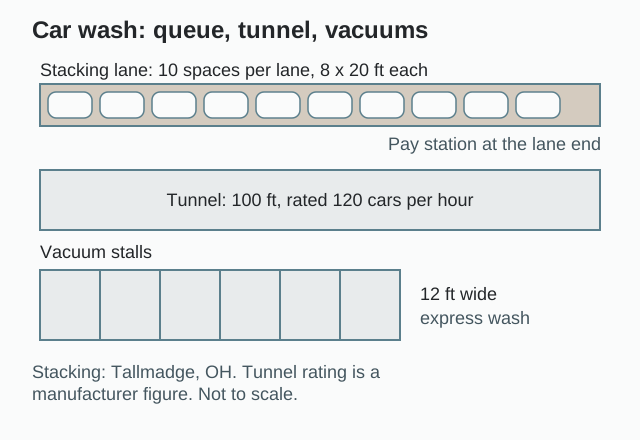
An express exterior car wash plan arranges four things in sequence: the stacking lanes that hold cars before the pay stations, the tunnel and its conveyor, the exit with its dryers, and the free vacuum field. Codes regulate the queue, the noise and the neighbors far more than the building, so the site is sized from the outside in.
A preliminary site plan from the studio draws all four at real dimensions and carries a site data table built for this use: acreage and zoning, tunnel length and rated throughput, stacking required against provided (with the code's per lane or per entrance wording), vacuum count, parking required against provided, setbacks, buffers, and the measured distance from the tunnel exit and vacuum field to the nearest residential line. That is the sheet a developer takes to a pre-application meeting, a lender or a contractor before the engineer of record builds the sealed set on it. The state by state regulations guide collects the state layer.
Tunnel length, throughput and land
Equipment makers publish the throughput that sets the program, and every figure in this section is a manufacturer or vendor rating, not a measured result. Sonny's published express layouts pair each tunnel length with a maximum hourly rating and a sample property [7, 8, 9]:
| Tunnel length | Manufacturer's maximum rating | Sample property area | Source |
|---|---|---|---|
| 50 ft | 60 cars per hour | 15,820 sf | Manufacturer layouts [7] |
| 60 ft | 70 cars per hour | 26,000 sf | Manufacturer layouts [7] |
| 80 ft | 90 cars per hour | 36,685 sf | Manufacturer layout via a distributor [8] |
| 100 ft | 120 cars per hour | 36,000 sf | Manufacturer layouts [7] |
| 120 ft | 140 cars per hour | 79,655 sf | Manufacturer layout via a distributor [9] |
| 130 ft | 150 cars per hour | 48,650 sf | Manufacturer layouts [7] |
Other vendors rate their systems in the same range, in cars per hour (cph):
| Tunnel or format | Vendor rating | Site or land | Source |
|---|---|---|---|
| 35 ft (minimum) | Not stated | Not stated | Vendor guide [10] |
| 18 m | 50 to 60 cph | About 33 m site | Vendors [11, 12, 13] |
| 24 m | About 100 cph | Not stated | Vendors [12, 13] |
| 30 m | 100 to 120 cph (KKE); 160 cph (PRO BRO PRO120) | 45 to 50 m site; 2,000 m² plot | Vendors [11, 13] |
| Tommy Mini | 90 cph | 0.75 acre | Vendor [14] |
| About 120 ft (industry average) | Up to 200 cph (marketing claim) | Not stated | Vendor guide [10] |
| In-bay automatic | 10 to 15 cph | Single bay | Vendor [15] |
A conveyor at 1 ft/s works out to about 180 cph, but a vendor notes that "no express site actually sustains that" [16]. Plan the queue for the rating you underwrite, not the brochure peak.
California filings, used here as illustrations of what the program needs on the ground, are out-of-state examples for most readers: a Mister Car Wash in Santa Maria on 0.92 acres with a 5,381 sf tunnel building (staff report, Sept. 6, 2023) [17]; Blue Wave Express in Pittsburg on 1.36 acres with a 100-ft tunnel, three pay lanes and 22 vacuum stalls [18]; Davis Express on 1.74 acres with a 5,758 sf building and 21 vacuum bays [19]; and a Fresno project that pairs a 3,500 sq ft tunnel with a 16-stall vacuum area and a 21 ft parapet [20]. The vendor's Tommy Express prototype calls for 1+ acre and a 135 x 40 ft building on a 130 ft tunnel [21]. In Richardson, Texas, an express wash of about 5,000 sf with one tunnel and 20 outdoor vacuum bays was denied by the City Council on Oct 9, 2023, with noise, neighborhood opposition and water use cited, after the City Plan Commission had "narrowly approved the request by a 3-2 vote" (news report) [22].
Stacking lanes and pay station math
Stacking is usually the standard that sets the length of the site. Express and automatic counts in the codes run from 3 per service position in Tyler, Texas to 10 per lane in Tallmadge, Ohio and St. Charles, Illinois, and full-service washes in Pembroke Pines, Florida need 18 entrance spaces [1, 2, 3, 23]. St. George, Utah requires 5 spaces before the pay point and no queuing on the right of way [24]. Where a code sets no count, the test is performance: Frisco, Texas makes on-site circulation that holds all stacking one of its SUP conditions [25].
| Jurisdiction | Code | Express or automatic | Other formats | Space size |
|---|---|---|---|---|
| Tyler, TX | UDC Sec. 10-389 | Automatic: 3 per service position plus 1 after [1] | Attendant: 10 per wash line plus 6 | 9 x 20 ft |
| Corpus Christi, TX | UDC Table 7.2.6.A | 4 per automated stall, measured from the entrance to the wash bay [26] | Hand-operated: 3; TRC may require more | Not stated |
| Cedar Hill, TX | Zoning Art. 5 | 3 per automated bay plus 1 exit space [27] | Full-service: 4 per vacuum or gas lane | Not stated |
| Grand Prairie, TX | UDC Art. 10 (11.04.25 edition) | Machine wash: two-thirds of the minimum as tandem spaces [28] | Self-serve: 2 tandem per bay | Not stated |
| Ogden, UT | Code 15-38-4 | 1 bay: 4; 2 bays: 3 per bay; 3 or more bays: 2 per bay [29] | Hours limit in C-1 | Not stated |
| St. Charles, IL | Ch. 17.24.100, Table 17.24-3 | 10 required; 28 provided in the May 5, 2026 case [3] | Drive-through component needs Special Use | 9 x 20 ft |
| Mayfield Heights, OH | §1171.09(e) | 8 per vehicle entrance [30] | Self-serve 2 per stall; lot at least 150 ft frontage x 300 ft depth | Not stated |
| Pembroke Pines, FL | LDC §155.508 | Automatic: 8 entrance + 3 exit [23] | Full-service: 18 entrance + 5 exit | Not stated |
| Tallmadge, OH | Ord. 2023-82, Sec. 1104.07 E(8) | 10 per car wash lane [2] | Not applicable | 8 x 20 ft |
| Frisco, TX (DFW benchmark) | §4.04 | Self service (automated): 3 per bay [31] | Full service: 6 per bay | Not stated |
| Charlotte, NC | UDO Art. 15.4 | General drive-through: 4 per lane [32] | Car wash count not stated | 9 x 18 ft |
| Houston, TX | Sec. 26-492, Class 9 (parking schedule) | 2.5 spaces per automated bay or stall [33] | Other washes: 1.0 per bay | Not stated |
Three rules turn the count into a drawing:
- Linear queue equals spaces times space length. 10 spaces at 20 ft is 200 ft (St. Charles, Tallmadge); 8 spaces at Charlotte's 18 ft general size is 144 ft [2, 3, 32].
- Per lane or per entrance. A code written per lane (Tallmadge) doubles the requirement when you add a second pay lane; a code written per entrance (Mayfield Heights) does not. In St. Charles, dual pay lanes each hold 12 to 13 cars before they merge after the pay station, 28 in total against a 10-space minimum, and the staff report projects 80 PM peak hour trips (40 in, 40 out) [3].
- Count exit spaces and vacuum parking separately. Pembroke Pines counts exit spaces on their own and requires 1 parking space per vacuum, separate from exit stacking [23].
In Mansfield, Texas, SUP finding (4) asks whether the driveways and parking are laid out so that cars and pedestrians move safely and conveniently without harming the public or neighboring sites (§155.080(F)(4)) [34]; the Mansfield model project shows how that finding shapes the queue.
Vacuum stall geometry
| Parameter | Value | Source |
|---|---|---|
| Vacuum space width | 12 ft express; 14 ft full-service lane | Consultant post, secondary [35] |
| Parking per vacuum | 1 per unit, separate from exit stacking | Pembroke Pines §155.508 [23] |
| Turbine sizing | 9 or 10 drops on a 25 hp turbine; 7 drops on 15 hp; 2 drops on 10 hp | Manufacturer layouts [7] |
| Published boom layouts | 14, 16, 19 and 28 stalls | Manufacturer layouts [7] |
| Placement | No vacuums on building sides facing residential; none along streets | St. George §10-17A-15; Tallmadge Ord. 2023-82 [24, 2] |
The vacuum producer is a noise source in its own right. Hillsborough County's EPC rule holds pumps and compressors to 55 dBA Leq, measured at least 40 ft across a residential property line [36]. A plan that puts the producer room and the vacuum canopies on the commercial frontage, behind the building from the nearest homes, avoids arguing how that rule classifies the equipment.
Water reclaim requirements
Of the state rules on record, only California sets a statewide reclaim floor. Water Code §10951 requires an in-bay or conveyor wash permitted and constructed after Jan 1, 2014 to recycle and reuse at least 60 percent of its wash and rinse water, or to take supplier recycled water for at least 60 percent; self-service wand washes are excluded, and §10953 leaves cities and counties free to require more [4, 5]. Elsewhere the rule is local.
| Jurisdiction | Code | Requirement |
|---|---|---|
| Hapeville, GA | §69-2-20 | New conveyor washes recycle and reuse at least 50 percent of wash and rinse water [37] |
| Georgia EPD | Rule Chapter 391-3-31 | Recommends that at least 50 percent of the water a conveyor wash uses be recycled, as recited in Hapeville's ordinance [37] |
| St. George, UT | §10-17A-15 | Recycling systems installed and kept in use permanently [24] |
| Florida DEP | Closed-loop recycle guidance | Spent process water from a closed-loop system goes to a permitted wastewater or pretreatment facility; the guidance does not cover truck or heavy equipment washes [38] |
In metro Atlanta the rule is close to regional: Hapeville's ordinance recites that the Metropolitan North Georgia Water Planning District "has mandated that all jurisdictions in the District's geographical area implement said model ordinance" [37]. The Atlanta metro page and the Georgia state page carry the local layer. Reclaim is real money on the pro forma: owners "have paid in excess of $100,000 for reclaim systems," per trade press [39], and a Minnesota Pollution Control Agency fact sheet puts recycling systems at $60,000 to $200,000 and plumbing modifications at $10,000 to $30,000 [40]. The plan reserves the reclaim tanks and equipment room; see also our post on water conservation in car wash design.
Wastewater pretreatment
The International Carwash Association's industry research reports that "Greater than 99 percent of professional car washes discharge effluent to a sanitary sewer" [41], so the local sewer use ordinance is the binding rule set. Expect device sizing with the plumbing plans, installation before the certificate of occupancy, and a pump-out schedule.
| Jurisdiction | Code or document | Requirement |
|---|---|---|
| Fulton County, GA | Commercial Pretreatment Plans checklist (rev. 03-06-2023) | Oil separator and/or sand trap; reclaim washes submit "manufacturer product sheets and sand trap sizing" [42] |
| Aubrey, TX | Ch. 13, Art. 13.06 | Installed and inspected before the certificate of occupancy; pump-out at 25% of wetted height; every 90 days by default, full evacuation at least every 180 days; pump-out manifests [43] |
| Texas (TCEQ) | RG-389 | "Grit traps are regulated under your local plumbing code, and by your local wastewater utility"; wet grit trap waste is pumped only by TCEQ-registered sludge transporters [44] |
| Palm Beach County, FL | Water Utilities pretreatment | Annual cleaning; interceptors inspected and sampled every six months; oil and grease 100 mg/L or less [45] |
| Lynchburg, VA | FOG Program | Grit interceptor ahead of the oil/water separator unless built in [46] |
| Washington Ecology | Pub. 95-056 | Pad at least 4 ft past the vehicle; grit traps inspected daily and cleaned at least weekly; clean API separators above 3 in of oil; clean coalescing plate separators when the gap is reduced 40 percent [47] |
| Spokane, WA | Car wash BMP manual | API separator residence time not less than 30 minutes at the highest expected flow [48] |
| Minnesota PCA | MS4 fact sheet | Wash water is a non-stormwater discharge [40] |
The preliminary plan locates the trap, separator and reclaim pit beside the tunnel; the engineer of record sizes them and designs the plumbing.
Dryer and vacuum noise
Few codes set car-wash-specific limits. Most apply the general property-line ordinance, so the operative document is the applicant's acoustic study, and the plan decides what that study can show: exit orientation, tunnel doors, wall heights and the distance to the nearest home.
| Jurisdiction | Limit or rule | Measured or modeled evidence |
|---|---|---|
| New Jersey | N.J.A.C. 7:29: 65 dBA day, 50 dBA night at the residential receiver | Blowers about 68 dBA at 50 ft from the entrance; an automatic door brings this to about 50 dBA (Cranford, Aug 4, 2025) [49] |
| Lawrence Twp, NJ | State standard; 65 dBA residential target | 15 hp dryer 95.8 dBA at 1 m; exits 91 to 92.6 dBA [6] |
| Los Angeles | LAMC §12.22 A.28(b)(13) keeps powered washes below Table II of Sec. 111.03 [50]: 60 dBA day (7 a.m. to 10 p.m.) and 55 dBA night in commercial zones, 50 and 40 in residential zones, at the property line, with measured ambient governing where it is higher [51, 52] | A-weighted, slow response; 5 dB adjustments for steady tones and repeated impulsive noise [51] |
| Anaheim, CA | 60 dBA at each property line used as the limit | Predicted 50.2 to 59.4 dBA with sound walls [53] |
| Taylorsville, UT | Dryer blowers ideally not to exceed 55 dB along the south property line | 8 ft precast wall [54] |
| West Linn, OR (CUP-25-03) | 60 dBA 7am to 10pm; 50 dBA 10pm to 7am at the property line | Predicted 50 to 54 dBA in the nearest backyard [55] |
| Hillsborough County, FL | EPC Ch. 1-10: 60 dBA day, 55 dBA night at a residential receiver | Equipment standard 55 dBA at 40 ft [36] |
| Mansfield, TX | §155.099(B)(17): no car wash whose operation causes obnoxious conditions noticeable at the abutting property lines | No decibel figure [56] |
Codes also regulate the layout directly. St. George requires tunnel sides facing residential to be fully enclosed [24]; Fort Worth provides that "No car wash dryer shall face a residential district or use" [57]; Tallmadge bans outdoor loudspeakers and menu board speakers [2]; Ogden orients tunnel and bay openings away from residential and bars operation from 8 p.m. to 8 a.m. in its C-1 zone [29]; Pembroke Pines bars a tunnel entrance or exit facing adjacent residential property [23]. Mitigation is measurable: in a Sherman Oaks (Los Angeles) study, VFD and plate features brought levels to 56 dBA at the entrance, a further 9 dBA reduction brought them to 47 dBA, and an 8 ft wall added about 4 dBA [52]. The drawing and the acoustic study must describe the same walls, doors and exit orientation.
Separation standards
| Jurisdiction | Standard |
|---|---|
| Tallmadge, OH (Ord. 2023-82) | At least 500 ft from a residential use, park or trail, school, or place of worship [2] |
| Frisco, TX (§4.21, DFW benchmark) | Vacuums, outdoor speakers and automotive structures at least 250 ft from any residential zoning district [58] |
| Fort Worth, TX (Ord. 25514-05-2022) | Automated washes within 200 ft of residential need a CUP; Fort Worth bars drying or vacuuming within 25 feet of a residential district; 6 ft screening wall [57] |
| Tyler, TX (UDC Sec. 10-389) | Service points and stacking lanes 80 ft from residential districts and 30 ft from office and mixed use, with a "B" bufferyard [1] |
| Ada County, ID (§8-13C-8-5 C) | 100 ft from residential districts [59] |
| Los Angeles (§12.22 A.28(a)(3)) | No openings facing a school or residential use within 100 ft [50] |
| Pembroke Pines, FL (§155.508) | No tunnel entrance or exit facing adjacent residential property, except across a street [23] |
| Ogden, UT (15-38-4(B)) | Tunnel or bay openings oriented away from residential [29] |
| Pasco County, FL (Ord. 24-42) | New car washes made a conditional use by a 5-0 vote in September 2024 [60, 61] |
The moratorium and cap wave, 2022 to 2026
Since 2023 the hardest constraint on new express washes has been saturation politics: moratoria, per-capita caps and spacing tests. The stated reasons repeat across the record: market saturation, queues spilling onto streets and pedestrian corridors, single-use buildings that are hard to reuse, codes with no use-specific standards and, in Mission, Texas, drought. Most rows below rest on news reports; the Avon and Warren rows rest on city documents.
| Jurisdiction | Action | Stated reason |
|---|---|---|
| Birmingham, AL | Moratorium on automated washes adopted Mar 5, 2024; a further extension of 120 days with an option of 90 more, then a 90-day extension on Jun 10, 2025 (news reports) [62, 63] | "Surge in applications" near homes and pedestrian corridors |
| Brook Park, OH | One-year moratorium May 2023, then a cap of 1 per 10,000 residents (news reports) [64, 65] | Flooded market |
| Parma Heights, OH | Cap of 1 per 12,000 residents (news report) [65] | Oversaturation |
| Perrysburg, OH | Moratorium Jan 2023 through Dec 31, 2024; extension Ord. 83-2024 defeated 5 to 1 on Dec 19, 2024 (news reports) [66] | "excessive number of car washes"; 7 washes in the city plus 5 within one mile, as reported [65] |
| Avon, OH | Ord. 65-24 (May 28, 2024), six months, car washes and self-storage; extended by Ord. 46-25 to Dec 23, 2025 [67] | Study and regulation |
| Toledo, OH | Permit moratorium from July 2024 until "the end of next January" (news report) [68] | Proliferation |
| Mentor, OH | Six-month pause on zoning, occupancy, special-use and building permits (Oct 2026, news report) [65] | Traffic backups, emergency access |
| Warren, MI | Moratorium of up to 8 months on car washes and gas stations, approved May 19, 2026; complete prior applications exempt [69] | 69 gas stations and 25 car washes in 35 sq mi; zoning rewrite |
| Roseville, MI | Moratoria on gas stations and car washes extended 180 days, May 2026 (news report) [70] | Proliferation |
| Mission, TX | Ord. 5794, 180 days, approved unanimously Mar. 24, 2026 and applied to pending applications (news report) [71] | Drought and water shortage; noise, congestion, property values |
| Hesperia, CA | 45-day moratorium approved unanimously Feb. 7, 2023 (news report) [72] | No citywide locational or operational standards; noise; traffic; scarce land |
| Whittier, CA | Nov. 18, 2025 direction to staff to study a moratorium; none in effect as of Jan. 2026 (news report) [73] | "way too many car washes" |
| Pasco County, FL | New car washes made a conditional use, 5-0 vote, September 2024 (news reports) [60, 61] | Saturation |
Construction has slowed but not stopped: the International Carwash Association puts new construction at "estimated to exceed 500 units per year" [74]. Professional Carwashing & Detailing reported builds "topping out at around 850-900 new stores in 2023," with annual builds now closer to 550, plus or minus 100, and express washes "well into 90%" of new builds; industry counts differ on whether the peak came in 2022 or 2023 [75]. Builder estimates, which are partly marketing material, put an all-in Texas express tunnel at $3.0M to $7.0M, with equipment at $1.4M to $2.1M [76]. Our post The tunnel boom has peaked maps where the pipeline went.
Hearing records show what this means for a plan. In Mansfield, Texas, the Planning and Zoning Commission denied SUP25-004, a tunnel car wash at 1561 E Broad St, on Feb 19, 2026 [77]. The Hillsborough County model project and the Tampa metro page carry the Florida record.
State rules that reach the plan
Stacking, noise, separation and moratoria are set city by city. A handful of state rules still reach the plan:
| State | Rule | Source |
|---|---|---|
| California | Water Code §10951: new in-bay and conveyor washes recycle, or use recycled water for, at least 60 percent of wash and rinse water; cities and counties may require more (§10953) | [4, 5] |
| Georgia | The Metropolitan North Georgia Water Planning District requires member jurisdictions to adopt its reclaim model ordinance; Georgia EPD Rule 391-3-31 recommends at least 50 percent recycling for conveyor washes | [37] |
| Texas | TCEQ RG-389: grit traps are regulated under the local plumbing code and by the local wastewater utility | [44] |
| Florida | An Environmental Resource Permit applies above 4,000 sq ft of impervious area subject to vehicular traffic (Rule 62-330.020(2), F.A.C.); FDEP closed-loop guidance sends spent process water to a permitted facility | [78, 38] |
| New Jersey | N.J.A.C. 7:29: 65 dBA day and 50 dBA night at the residential receiver | [49] |
| Washington | Ecology Pub. 95-056: grit traps inspected daily and cleaned at least weekly | [47] |
The combo pages carry Texas car washes and Florida car washes in depth.
Approval paths
| Path | Examples | What opens discretion |
|---|---|---|
| By right with use standards | Los Angeles C2 if compliant with §12.22 A.28: APCSV-2022-6080 was "permitted by right in the C2-1VL Zone" with a CUP for deviations [50, 79] | Any deviation from the standards |
| Specific or conditional use | Mansfield SUP decided against seven findings (§155.080) [34]; Frisco SUP, with Planning and Zoning recommending and the City Council deciding (§2.05.02 and §6.15) [80, 25]; St. Charles drive-through Special Use under Sec. 17.04.330, with a public hearing, mailed notice and six findings of fact that must all be affirmative [3]; Phoenix C-2 use permit (§623) [81]; San Bernardino CUP 23-17 [82] | District, adjacency, hours |
| Rezoning or planned development | Unincorporated Hillsborough County: Standard District rezoning $5,333.98 or Planned Development $9,643.80 [83] | The plan becomes a condition |
| No zoning | Unincorporated Texas counties regulate through platting, drainage and floodplain rules rather than use zoning [84]; see the truck stop hub | Plat and permit conditions |
| Moratorium | Warren's notice freezes "new site plan applications, special land use applications, or other zoning approvals" [69]; see the table above | Any new application |
In Mansfield the SUP fee is $2,500 plus $100 per acre, with a $7,500 maximum (OR-2379-24) [85].
Which stages take an unsealed plan. Mansfield's SUP submittal requires a seal only on the metes and bounds description, which a registered surveyor signs and seals (§155.080(D)(3)) [34]. The St. Charles staff report reviews the project against plan policies "relevant to review of the Concept Plan," so that city runs a concept stage [3]. In unincorporated Hillsborough County the Planned Development general site plan is certified by the county, and staff have required the applicant to "Remove the notating 'For Concept Purposes Only' from the PD site plan" (PD 24-0676) [86], so the preliminary plan becomes a binding exhibit and is drawn at final dimensions. Where a jurisdiction requires sealed civil and building sets, the preliminary plan is what the engineer of record builds them on. The preliminary versus final site plan guide sets out the split.
What the engineer of record adds
| Element | Preliminary site plan | Engineer or architect of record |
|---|---|---|
| Tunnel footprint, orientation, exit direction | Drawn and dimensioned | Structural and MEP design |
| Stacking lanes, bypass, pay stations | Drawn, counted against the code | Traffic study where the city requires one |
| Vacuum field, producer room, screen walls | Drawn | Acoustic study, wall design |
| Parking table, setbacks, buffers, landscape concept | Drawn, in the site data table | Landscape architect |
| Reclaim pit, sand trap, oil separator | Location reserved | Sizing and plumbing design |
| Grading, drainage, utilities, stormwater permits | Not included | Civil engineer; in Florida, an Environmental Resource Permit is triggered above 4,000 sq ft of impervious area subject to vehicular traffic [78] |
Renderings for the hearing
Boards that hear car washes ask for pictures of the queue and the neighbors' view. In Colonie, New York, a planning board asked for vacuum and mechanical sound data, stacking on the plan, turning templates, lower light poles with down-lighting, non-white fencing and street landscaping, and required elevations and renderings on resubmission [87]. Mansfield's SUP plan must include architectural renderings or elevations with all exterior materials labeled (§155.080(D)(8)(l)(2)) [34]. The car wash rendering page sets out the view set tied to the site plan.
State, metro and sibling pages
- Texas: the Texas car wash page, the Mansfield model project and the Texas gas station page.
- Florida: the Florida car wash page, the Hillsborough County model project and the Tampa metro page.
- Georgia: the Georgia gas station page and the Gwinnett County gas station model project.
- Fuel on the same pad: the gas station site plan hub, the truck stop site plan hub and the Waller County truck stop model project.
- Market context: car wash development in 2026.
Frequently asked questions
How many stacking spaces does a car wash need?
It depends on the city. Tyler, TX requires 3 per automatic service position plus 1 after, Mayfield Heights, OH 8 per vehicle entrance, Pembroke Pines, FL 8 entrance and 3 exit spaces for an automatic wash, and Tallmadge, OH (8 x 20 ft) and St. Charles, IL (9 x 20 ft) 10 per lane [1, 30, 23, 2, 3]. St. George, UT also bars queuing on the right of way [24].
Do two pay lanes double the stacking requirement?
Under per lane wording, yes; under per entrance wording, no. In St. Charles, IL, dual pay lanes each hold 12 to 13 cars before they merge after the pay station, 28 in total against a 10-space minimum [3].
Does California require car wash water recycling?
How far must a car wash be from homes?
How loud is a car wash dryer?
Are grit traps and oil separators required?
Are car washes being banned?
How big a site does an express tunnel need?
Sources
- 1)Tyler Unified Development Code Sec. 10-389, Drive-Through Stacking Requirements, City of Tyler, Texas (American Legal Publishing). Accessed 2026-10-10.
- 2)Ordinance 2023-82, Exhibit A (car wash standards), City of Tallmadge, Ohio. Accessed 2026-10-09.
- 3)Staff Report, Plan Commission Meeting, Club Car Wash (May 5, 2026), City of St. Charles, Illinois. Accessed 2026-10-09.
- 4)California Water Code, Recycled Water Usage by Car Washes (§§ 10950 to 10953), statute text mirror, Legalfina (secondary mirror of the California Legislature's code). Accessed 2026-10-09.
- 5)AB 2230 Senate Committee Analysis (June 22, 2012), California Legislature. Accessed 2026-10-09.
- 6)Car Wash Sound Study, Take 5 Express Car Wash, Block 2201, Lot 20, Lawrence Township, New Jersey. Accessed 2026-10-09.
- 7)Site Layouts (express tunnels), Sonny's (manufacturer). Accessed 2026-10-10.
- 8)Sonny's 80 EDT Exterior Detail Tunnel System, Mid Florida Car Wash (equipment distributor). Accessed 2026-10-10.
- 9)Sonny's 120 EDT Hybrid Tunnel System, Mid Florida Car Wash (equipment distributor). Accessed 2026-10-10.
- 10)Types of Car Wash Businesses, DRB (vendor). Accessed 2026-10-09.
- 11)Conveyor Car Wash Equipment, Tunnel Car Wash System, Car Wash Tunnels, KKE Wash Systems (vendor). Accessed 2026-10-09.
- 12)Best Tunnel Car Wash Machines 2026 Buyer's Guide, Starwash (vendor). Accessed 2026-10-09.
- 13)Tunnel systems, PRO BRO Car wash systems (vendor). Accessed 2026-10-09.
- 14)Site Models, Tommy Car Wash Systems (vendor). Accessed 2026-10-09.
- 15)Increase Vehicle Throughput With a Tunnel System Car Wash, Reliable Plus (vendor). Accessed 2026-10-09.
- 16)Car Wash Tunnel Design & Site Layout: A Spec Guide, Hytian (vendor). Accessed 2026-10-09.
- 17)PD2023-0008, U2023-0016, Mister Car Wash staff report (September 6, 2023), City of Santa Maria, California. Accessed 2026-10-10.
- 18)Blue Wave Car Wash (CEQA document), California CEQAnet. Accessed 2026-10-10.
- 19)Davis Express Car Wash (CEQA document), California CEQAnet. Accessed 2026-10-10.
- 20)Copper Express Car Wash (CEQA document), California CEQAnet. Accessed 2026-10-09.
- 21)Express (site model), Tommy Car Wash Systems (vendor). Accessed 2026-10-09.
- 22)Richardson car wash project put on hold by City Council, Community Impact (secondary). Accessed 2026-10-09.
- 23)Pembroke Pines Land Development Code § 155.508, Car Washes, City of Pembroke Pines, Florida (American Legal Publishing). Accessed 2026-10-09.
- 24)St. George City Code § 10-17A-15, Car Wash, City of St. George, Utah. Accessed 2026-10-09.
- 25)Frisco Zoning Ordinance Subsection 6.15, Specific Use Permit (SUP) Application and Review, City of Frisco, Texas (eCode360). Accessed 2026-10-09.
- 26)Corpus Christi Unified Development Code (Table 7.2.6.A), City of Corpus Christi, Texas (enCodePlus). Accessed 2026-10-10.
- 27)Cedar Hill Zoning Ordinance, Article 5, Development Standards, City of Cedar Hill, Texas (Municode). Accessed 2026-10-10.
- 28)Unified Development Code, Article 10 (11.04.25 edition), City of Grand Prairie, Texas. Accessed 2026-10-10.
- 29)Ogden City Code 15-38-4, Special Regulations, Ogden City, Utah (American Legal Publishing). Accessed 2026-10-10.
- 30)Mayfield Heights Codified Ordinances § 1171.09, Car Washes, City of Mayfield Heights, Ohio (American Legal Publishing). Accessed 2026-10-09.
- 31)Frisco Zoning Ordinance Subsection 4.04, Off-Street Parking and Loading Requirements, City of Frisco, Texas (eCode360). Accessed 2026-10-09.
- 32)Charlotte Unified Development Ordinance, Article 15, Use Regulations, City of Charlotte, North Carolina. Accessed 2026-10-09.
- 33)Houston Code Sec. 26-492, Parking spaces for certain types of use classifications, City of Houston, Texas. Accessed 2026-10-10.
- 34)Mansfield Code § 155.080, Specific Use Permit, City of Mansfield, Texas (American Legal Publishing). Accessed 2026-10-10.
- 35)Flex service site plan (consultant forum post, secondary), Carwash Forum. Accessed 2026-10-09.
- 36)Noise Program (EPC Rule Chapter 1-10), Environmental Protection Commission of Hillsborough County. Accessed 2026-10-10.
- 37)State of Georgia, City of Hapeville Ordinance (car wash water recycling, Code § 69-2-20), City of Hapeville, Georgia. Accessed 2026-10-10.
- 38)100% Closed-Loop Recycle Systems at Vehicle and Other Equipment Wash Facilities, Florida Department of Environmental Protection. Accessed 2026-10-10.
- 39)Choosing the right water recycling system, Professional Carwashing & Detailing (trade press, secondary). Accessed 2026-10-09.
- 40)MS4 fact sheet, Vehicle Washing, Minnesota Pollution Control Agency. Accessed 2026-10-10.
- 41)Water Effluent and Solid Waste Characteristics in the Professional Car Wash Industry, International Carwash Association. Accessed 2026-10-10.
- 42)Checklist/Guidelines for Commercial Pretreatment Plans Submittal (rev. 03-06-2023), Fulton County, Georgia, Public Works. Accessed 2026-10-10.
- 43)City of Aubrey, TX: Grease Traps/Interceptors, Grit Interceptors and Oil/Water Separators (Art. 13.06), City of Aubrey, Texas (eCode360). Accessed 2026-10-10.
- 44)Waste from Grease Traps, Grit Traps, and Septic Tanks (RG-389), Texas Commission on Environmental Quality. Accessed 2026-10-09.
- 45)Water Utilities: Learn About Pretreatment, Palm Beach County, Florida. Accessed 2026-10-10.
- 46)Fats, Oils and Grease Program, City of Lynchburg Department of Utilities, City of Lynchburg, Virginia. Accessed 2026-10-09.
- 47)Vehicle and Equipment Washwater Discharges Best Management Practices Manual (Pub. 95-056), Washington State Department of Ecology. Accessed 2026-10-10.
- 48)Vehicle and Equipment Washwater Discharges Best Management Practices Manual (car washes), City of Spokane, Washington. Accessed 2026-10-10.
- 49)Sound report to the Cranford project manager (August 4, 2025), Township of Cranford, New Jersey. Accessed 2026-10-09.
- 50)Los Angeles Municipal Code Sec. 12.22, Exceptions, City of Los Angeles (American Legal Publishing). Accessed 2026-10-09.
- 51)Official City of Los Angeles Municipal Code, noise provisions including Sec. 111.03 (EIR reference document I06), Los Angeles City Planning. Accessed 2026-10-10.
- 52)Operations Noise Study for a Proposed Automatic Car Wash, Sherman Oaks Neighborhood Council, Los Angeles. Accessed 2026-10-10.
- 53)Acoustical Analysis Report for Express Car Wash (planning attachment), City of Anaheim, California. Accessed 2026-10-10.
- 54)Taylorsville planning minutes (public notice file 934943), Utah Public Notice Website. Accessed 2026-10-10.
- 55)CUP-25-03 Staff Report Exhibit PC-3: Applicant Environmental Noise Impact Study, City of West Linn, Oregon. Accessed 2026-10-09.
- 56)Mansfield Code § 155.099, Special Conditions, City of Mansfield, Texas (American Legal Publishing). Accessed 2026-10-10.
- 57)Ordinance No. 25514-05-2022 Amending the Zoning Ordinance (car washes), City of Fort Worth, Texas. Accessed 2026-10-10.
- 58)Frisco Zoning Ordinance Subsection 4.21, Supplementary Regulations, City of Frisco, Texas (eCode360). Accessed 2026-10-09.
- 59)Ada County Code § 8-13C-8-5, Car Wash, Ada County, Idaho (American Legal Publishing). Accessed 2026-10-09.
- 60)Pasco County sets new rules for proposed car washes, citing large increase in locations, FOX 13 Tampa Bay. Accessed 2026-10-10.
- 61)After minor tweaks, Pasco car wash ordinance passes, Tampa Beacon (no longer online; accessed 2026-10-10).
- 62)Birmingham Again Says No to Automated Car Washes, BirminghamWatch. Accessed 2026-10-10.
- 63)Birmingham extends moratorium on automated car washes for 90 days, ABC 33/40. Accessed 2026-10-10.
- 64)Brook Park Joins Car Wash Moratorium Parade, Cleveland Scene (secondary). Accessed 2026-10-10.
- 65)Mentor Ohio Pauses New Car Wash Applications for 6 Months, Hoodline (secondary). Accessed 2026-10-09.
- 66)Perrysburg council votes 5-1 to halt car wash moratorium, WTOL. Accessed 2026-10-10.
- 67)Ordinance No. 46-25, Extending the Temporary Moratorium (car washes and storage), City of Avon, Ohio. Accessed 2026-10-09.
- 68)Too many Toledo car washes? Council resolution putting pause on new permits, 13abc (secondary). Accessed 2026-10-09.
- 69)Moratorium on Car Washes and Gasoline Stations (notice), City of Warren, Michigan. Accessed 2026-10-10.
- 70)Warren passes moratorium on approval of new gas stations, car washes (Detroit Free Press, syndicated), AOL (secondary). Accessed 2026-10-10.
- 71)Report on Mission Ordinance 5794 (March 25, 2026), The Monitor (secondary). Accessed 2026-10-10.
- 72)Hesperia places temporary ban on new car washes, Victorville Daily Press via Yahoo News (secondary). Accessed 2026-10-10.
- 73)Council member calls for pause as car washes spread across San Gabriel Valley, KTLA (secondary). Accessed 2026-10-10.
- 74)Carwash Industry Information, International Carwash Association. Accessed 2026-10-09.
- 75)2025 State of the Carwash Market: Growth and Opportunity, Professional Carwashing & Detailing (trade press). Accessed 2026-10-10.
- 76)Cost to build a car wash in Texas, Maxx Builders (builder estimate). Accessed 2026-10-10.
- 77)Planning and Zoning Commission Regular Meeting Minutes, February 19, 2026, City of Mansfield, Texas. Accessed 2026-10-10.
- 78)SWERP Training Overview, Applicant Handbook II and SWFWMD Specific Changes, Southwest Florida Water Management District. Accessed 2026-10-09.
- 79)APCSV-2022-6080-ZC-CU Staff Report (May 25, 2023), Los Angeles City Planning. Accessed 2026-10-09.
- 80)Frisco Zoning Ordinance Subsection 2.05, Special Zoning Districts, City of Frisco, Texas (eCode360). Accessed 2026-10-10.
- 81)Phoenix Zoning Ordinance Section 623, Commercial C-2 District, Intermediate Commercial, City of Phoenix, Arizona. Accessed 2026-10-09.
- 82)Quick Quack Car Wash (Store #44-325) Noise Impact Study, CUP 23-17, City of San Bernardino, California. Accessed 2026-10-09.
- 83)List of Zoning Fees, Hillsborough County, Florida. Accessed 2026-10-10.
- 84)Waller County Subdivision and Development Regulations (amended December 6, 2023), Waller County, Texas. Accessed 2026-10-09.
- 85)Ordinance No. OR-2379-24, Master Fee Schedule, City of Mansfield, Texas. Accessed 2026-10-10.
- 86)Rezoning Application PD 24-0676, Zoning Hearing Master Date July 22, 2024 (staff report), Hillsborough County, Florida (Legistar). Accessed 2026-10-09.
- 87)Planning Board Minutes, May 5, 2026 (amended), Village of Colonie, New York. Accessed 2026-10-07.