The Wyoming thesis: five conditions that shape the plan
Wyoming has no statewide site plan authority. Approval is local, and the state adds a thin set of overlays on top. Five conditions decide how a Wyoming site plan is drawn and which desk it lands on.
1. There is no general building code for private construction. Code adoption is local. The State Fire Marshal adopts codes that apply to "public buildings" and state buildings statewide, and for plan review submissions on or after June 28, 2024 those are the 2024 IFC, IBC, IFGC, IMC and IEBC [1]. W.S. 35-9-102(a)(viii) defines public buildings to include educational, institutional, assembly and state-owned or occupied buildings, and multi-family residential of three or more units [2]. Electrical is the only genuinely statewide construction code, and a local government may assume enforcement under W.S. 35-9-121 if it certifies inspectors and adopts codes at least as stringent [1, 2]. Fremont County shows the far end of the range: no county-wide zoning, no county building codes and no Certificates of Occupancy, with commercial construction following State Fire Marshal plan review under W.S. 35-9-108 [7]. The first question on any Wyoming parcel is therefore whether the building is a public building, and who, if anyone, enforces a code where it sits.
2. Parcels of 35 acres or more skip county subdivision review. W.S. 18-5-303(b) exempts parcels of 35 acres or larger from county subdivision regulation, provided binding, recordable 40-foot ingress, egress and utility easements run to a public road; lawfully adopted zoning still applies [3]. A county may elect under W.S. 18-5-316 to regulate divisions of 35 to 140 acres, and parcels lawfully recorded by July 1, 2008 can be divided into no more than 10 parcels, each at least 35 acres, over time [3]. A large share of rural Wyoming development sits on land that never passed through subdivision review, so the easement, the water source and the septic route are not settled by any earlier approval. A preliminary plan on exemption land shows the recorded easement to the public road and notes the water source and septic route that the engineer of record will design.
3. The architect line is drawn by stories and occupants. No architect is required for private residences, or for garages, commercial or industrial buildings, office buildings, pre-engineered metal buildings, farm-product buildings and warehouses that do not exceed two stories (exclusive of a one-story basement) and are not designed for occupancy by more than 10 persons (W.S. 33-4-117) [4]. The occupant trigger is low: most retail, assembly and lodging uses exceed 10 occupants and need an architect. A single-story self storage building, small office or metal warehouse can fall inside the exemption [4]. Wyoming requires a Wyoming license and seal; out-of-state architect seals are not accepted [4].
4. Water is a permit, and commercial use has no preferred right. A groundwater well needs an approved Application for Permit to Appropriate Ground Water (Form U.W. 5) before drilling [8]. Domestic and stock uses of 25 gpm or less hold a preferred right over other uses regardless of priority; commercial use is generally "miscellaneous" and does not receive that protection [8]. The permit fee is $50 for domestic, stock and springs and $75 for irrigation, municipal, industrial and miscellaneous uses [8]. Wastewater has its own map: DEQ permits small wastewater systems in Carbon, Niobrara, Platte and Weston counties and for commercial systems in Campbell County, while Big Horn, Fremont, Park and other counties run their own septic permitting under delegation agreements [9]. The permitting counterparty changes at the county line.
5. Federal land and sage grouse core areas reach into private projects. Federal ownership covers 48.19% of the state, 30,043,512 of 62,343,040 acres [6]. Executive Order 2019-3 covers about 15 million acres of Core Population Area; surface-disturbing activities in core areas must run the Density and Disturbance Calculation Tool and submit project footprints, under a disturbance cap of less than 5% of sagebrush habitat per 640 acres [10]. Non-core leks carry a 0.25-mile no-surface-occupancy buffer [10]. The order applies "to the extent the state has regulatory authority" and rests on executive order rather than statute, but it shapes federal stipulations, so a footprint near a lek needs checking before the layout is fixed [10].
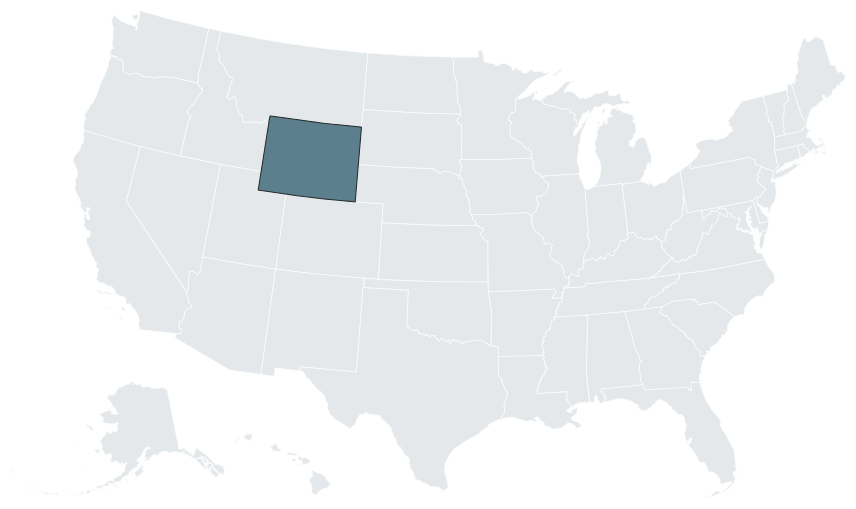

Approval layers: state, county and city
Wyoming splits sharply between incorporated municipalities, which act under Title 15, and unincorporated county land under Title 18. The state approves no site plans. Its gates are building safety for public buildings, water, wastewater, stormwater, tanks, highway access and licensed uses.
| Layer | Body | What it decides |
|---|---|---|
| State | State Fire Marshal (Department of Fire Prevention and Electrical Safety) | Plan review of public buildings before work starts; statewide electrical permits [1] |
| State | Department of Environmental Quality, Water Quality | Construction stormwater; permits to construct water and sewer works; small wastewater where DEQ holds authority [5, 9] |
| State | DEQ Solid and Hazardous Waste Division | Underground and aboveground storage tanks [11] |
| State | State Engineer's Office | Well permits, water rights, subdivision water supply adequacy [8] |
| State | WYDOT District Engineer | Access and encroachment permits on state highways [12] |
| State | Department of Agriculture, Consumer Health Services | Food and lodging sanitation licensing, including RV parks and campgrounds [13] |
| County | Planning and Zoning Commission, then Board of County Commissioners | Zoning where adopted, subdivision plats, conditional use permits, variances |
| City | Planning division, Planning Commission, City Council | Site plans, mostly administrative; rezonings, conditional or special use permits, PUDs, plats, variances |
In cities, most commercial site plans are administrative staff reviews under a unified development code or zoning code. Discretionary actions go to the Planning Commission, which recommends, and then to the City Council for final action after a public hearing with published, mailed and posted notice. Rock Springs, for example, requires site plan approval before any building permit and distinguishes major from minor site plans (Code of Ordinances 157.216) [14].
In unincorporated areas the county planning department administers zoning, where a county has adopted it, and subdivision regulations under Title 18, Chapter 5, Article 3 [3]. Many rural counties have no zoning at all, so outside subdivision, floodplain and small wastewater review the county step can be minimal [7]. In Fremont County, divisions of up to five lots are typically "simple" subdivisions and six or more are "regular" subdivisions with more stringent requirements [7].
Who prepares and seals what
Two boards govern design licensure: the Board of Professional Engineers and Professional Land Surveyors (W.S. Title 33, Chapter 29) and the State Board of Architects and Landscape Architects (W.S. Title 33, Chapter 4) [15, 4].
| Document | Who prepares and seals it | Rule |
|---|---|---|
| Final designs, specifications, maps, land surveys, reports, plats and plans filed or recorded | Licensed PE or PLS: seal, signature and date | W.S. 33-29-601 / 33-29-801 [15] |
| Plats, boundary work and land surveys | Licensed Professional Land Surveyor | W.S. 33-29 [15] |
| Architectural plans for non-exempt buildings | Wyoming-licensed architect | W.S. 33-4-112, 33-4-117 [4] |
| DEQ water and wastewater Permit to Construct | Design report and plans sealed by a Wyoming PE | Water Quality Rules Chapter 3 [9] |
| Drawings for exempt buildings | May be prepared without a license | W.S. 33-4-117 [4] |
Any business entity offering engineering or land surveying in Wyoming must register for a Certificate of Authorization, and the board may register an applicant licensed in another state with substantially similar requirements without examination; land surveyors must also pass the Wyoming-specific portion [15]. Electronic seals are permitted (W.S. 33-29-603) [15]. On the architecture side, title protection sits at W.S. 33-4-113, the seal requirement at W.S. 33-4-116, and the current board rules were filed December 17, 2025 [4].
The working split is simple. A drawing for an exempt building, or one prepared under the responsible charge of a licensed PE or architect, can be prepared without a license; a seal cannot [4]. Civil site engineering and plats carry a PE or PLS seal [15]. Innowave's preliminary site plan is the layout and yield study that comes first: disposition, buildings, internal roads, parking, pads and the site data table. The engineer of record adds grading, drainage, the SWPPP and the water and wastewater design, and the architect of record takes any building over the two-story or 10-person line. The guide to who prepares a site plan and the site plan architect page set out how those roles meet, and where unsealed site plans are accepted covers the stages at which a jurisdiction takes the plan before the sealed set exists.
Statewide overlays
| Overlay | Trigger | What it requires |
|---|---|---|
| Construction stormwater (WYPDES) | 1 acre or more of disturbance | Small Construction General Permit (WYR10A000) for 1 to under 5 acres; Large (WYR100000) for 5+ acres or common plans reaching 5 acres; SWPPP and a map showing access from a public road filed with the Notice of Intent [5] |
| Water and wastewater Permit to Construct | New or modified public water supply, sewerage system or treatment works | General permit, permit by rule or individual permit; PE-sealed design to the DEQ District Engineer [9] |
| Small wastewater | On-site systems under 2,000 gallons/day of domestic sewage | Chapter 25 standards; permitting by DEQ or the delegated county [9] |
| Groundwater well | Any new well | Form U.W. 5 approved before drilling; licensed driller and pump installer [8] |
| State highway access | Any approach to a state highway | W.S. 24-6-103, Wyo. Code R. 045.0003.13 and the WYDOT Access Manual (2014 Edition) [12] |
| Sage grouse core area | Surface disturbance in a core area | Density and Disturbance Calculation Tool, project footprint (EO 2019-3) [10] |
| Floodplain | Mapped flood hazard | Local administration; Fremont County keeps floodplain zoning near Lander, Riverton, Dubois and Hudson with no general zoning [7] |
The stormwater fee was raised July 1, 2020, is not prorated, and filings run through WYIMS, the preferred method since Spring 2023 [5]. Executive Order 2019-3 replaced EOs 2015-4 and 2017-2 [10].
Design loads are set by each jurisdiction's criteria rather than one state map. Casper's table for 1 and 2 family dwellings uses 93 mph fastest-mile and 115 mph 3-second gust, Exposure C, and a 30 psf ground and roof snow load for all structures below 6,000 ft; Natrona County above 6,000 ft uses 100 psf with no reduction for roof pitch [16]. On cabin and glamping layouts at elevation, those loads shape which unit types the plan can carry.
Top jurisdictions
| Jurisdiction | Process | Fees and clocks |
|---|---|---|
| Cheyenne and Laramie County | City site plans largely administrative under the Unified Development Code; pre-application encouraged; OpenGov portal [17]. County: staff review, Planning Commission recommends, Commissioners decide; 2025 Land Use Regulations with Conditional Use Permit Types A, B and C [18] | Site plan fee not published online [17, 18] |
| Casper and Natrona County | Dedicated Site Plan Application through the Planning Division; Planning and Zoning Commission meets the 2nd Thursday monthly; no expedited review [19] | Deadlines about 30 days before the meeting; fees in Resolution No. 17-220 [19] |
| Teton County and Town of Jackson | Development Plan plus a Basic or Conditional Use Permit; pre-application conference required for many types; dual public hearings for complex CUPs [20] | Workforce housing mitigation exaction on employee-generating development [20] |
| Laramie and Albany County | City Site Plan Review under LMC 15.06.060.O; all applications through Civic Access since October 8, 2024 [21]. County: site plan filed with a zoning certificate; Board of Commissioners approves [22] | City: decision within 30 days of a complete application [21]. County: zoning certificate $200; conditional use $300 plus $100 notice; $100 late fee if construction starts before approval [22] |
| Gillette and Campbell County | Planning Commission advisory (2nd and 4th Tuesday); City Council acts on subdivisions and zoning; published Development Review Schedule [23] | Standalone fee resolution effective July 1, 2026 [23] |
| Rock Springs and Sweetwater County | Site plan approval required before any building permit; major and minor site plans; paper submittal on 11x17 [14] | City runs its own electrical inspection [14] |
| Sheridan and Sheridan County | Multi-department staff review; hearings before Planning Commission or Council as required [24] | First-round comments within two weeks of a complete submittal; later rounds generally within one week [24]. County plan review 47% of the building permit fee [25] |
| Cody and Park County | Cody: staff review, Planning, Zoning and Adjustment Board, architectural review for commercial. Park County: dedicated Site Plan Review Application under the 2025 Development Standards and Regulations, effective October 1, 2025 [26] | Park County fees in Exhibits A and E of the Fee Schedule [26] |
| Fremont County | No county-wide zoning or county building codes; State Fire Marshal plan review for commercial; Riverton and Lander run their own review [7] | Subdivision and floodplain review through the Planning Department and Commissioners [7] |
| Uinta County | Land Use Certificate approved administratively (Resolution 23-02); ARD, R, C and I districts with FHO, APO and SOBOD overlays [27] | Subdivisions to the Planning Commission and Commissioners [27] |
Teton County is the outlier on every measure. Staff-reviewed applications have historically run 30 to 45 days from the date of sufficiency, with five application types extended to 60 days by a 2022 amendment to the Land Development Regulations [20]. Employee-generating development carries a workforce housing mitigation exaction, met by building units, conveying land, banking units, restricting existing units or paying an in-lieu fee (LDR 6.3.5.D) [20]. A Teton County plan has to carry the housing response from the first draft.
Asset registries in Wyoming
RV parks and campgrounds
RV parks and campgrounds are regulated for food and lodging sanitation primarily at the state level through the Department of Agriculture, Consumer Health Services Division, plus local zoning and DEQ small wastewater and WYPDES review; a few counties run their own environmental health programs [13]. The local zoning allowance and the septic and water capacity are the early checks [13]. Layout standards are on the RV park site plan and campground site plan hubs, and the state-by-state comparison is in the 50-state RV park regulatory matrix.
Glamping and cabins
Lodging uses are licensed through the Department of Agriculture's Consumer Health Services [13], and outfitter and guest ranch operations are regulated separately. Local zoning, where a county or city has adopted it, decides where tents, yurts and cabins may go. Any on-site septic system runs through DEQ or the delegated county [9]. See the glamping site plan hub for unit spacing and layout.
Fuel, truck stops and car washes
Fuel retail runs through the DEQ Storage Tank Program under Solid and Hazardous Waste Chapter 17 and the Storage Tank Act of 2007. Installers must be licensed (ICC exam; $80 exam fee), owners must notify DEQ within 30 days of bringing a tank into use (W.S. 35-11-1419), and fuel-dispensing aboveground tanks are also regulated [11]. Wyoming does not hold EPA state program approval but administers its own program, which reports the highest compliance rate in the country [11]. Trade reporting lists a Love's opening in Buffalo with 64 spaces [28]. A car wash needs water through the State Engineer's Office as a miscellaneous use with no preferred right, and discharge approval from DEQ through WYPDES or a Chapter 3 Permit to Construct; recycle systems reduce discharge volume and the permitting burden [8, 9]. The gas station, truck stop and car wash hubs carry the layout standards.
Hotels, storage, industrial and marinas
Hotels need state food and lodging licensing and State Fire Marshal plan review as a public building, and almost always exceed the architect exemption [13, 1, 4]. Self storage frequently sits inside the exemption when single-story and designed for 10 or fewer occupants, and still needs civil engineering, stormwater coverage at one acre and local site plan approval [4, 5]. Data center and industrial campuses cluster around Cheyenne (see proof points). Marina and shoreline work meets local floodplain administration and federal wetlands jurisdiction where waters or wetlands are present. The hotel and self storage hubs cover layout.
Timelines and bottlenecks
| Step | Clock | Source |
|---|---|---|
| Laramie site plan review | Decision within 30 days of a complete application | LMC 15.06.060.O [21] |
| Sheridan staff review | First comments within two weeks; later rounds generally within one week | City of Sheridan [24] |
| Teton County staff review | 30 to 45 days from sufficiency; 60 days for five application types | Teton County LDRs [20] |
| Casper hearing items | Filed about 30 days before the monthly meeting | City of Casper [19] |
| Domestic or stock well permit | Typically 1 to 2 weeks; complex permits several months | State Engineer's Office [8] |
| WYDOT access permit | Normally within four weeks of a complete application | WYDOT [12] |
In a county with no zoning, such as Fremont, the schedule is set by State Fire Marshal plan review and the DEQ, State Engineer and WYDOT overlays [7]. Teton County runs several months or longer for commercial work that needs a Development Plan, a Conditional Use Permit and dual public hearings [20].
The bottlenecks recur. Commercial water, as a miscellaneous use, and water-supply adequacy review for subdivisions can gate buildability, and the State Engineer's statement-of-completion review carries a backlog [8]. Small wastewater permits need a PE-sealed design and District Engineer review, and soil testing is seasonal [9]. Denied access permits go to the Access Review Committee [12]. Where the commission meets monthly, as Casper's does, a missed filing deadline costs a full cycle [19].
Proof points: where Wyoming is building
- Meta's "Project Cosmo" in the High Plains Business Park south of Cheyenne is a 715,000-square-foot, 960-acre facility, Meta's 21st US data center; Meta said it "will represent an investment of more than $800 million and support approximately 100 jobs" [29].
- Laramie County Commissioners unanimously approved the Tallgrass "Project Jade" site plans on January 6, 2026 [30].
- Related Digital "broke ground last fall on a 302-megawatt campus" in Cheyenne [31].
- The Tax Foundation counts 2.55 data centers per 100,000 people in Wyoming against 0.83 in California [32].
Working on a Wyoming site
The useful first drawing for a Wyoming parcel answers four questions together: is the site incorporated, and is there zoning; did the parcel come through the 35-acre exemption, and where is its easement; is any building a public building or over the two-story or 10-person line; and where do water and wastewater come from. Innowave's site plan work answers those in a preliminary plan with a site data table, and the 3D views tie to the same layout. Developers take it to a pre-application meeting, to a lender, to a general contractor to price, and then to the surveyor, engineer and architect of record who build the sealed set on it. The difference between that plan and the sealed set is set out in preliminary vs final site plans, and the site plan consultant page covers the service.
Neighboring states draw their lines differently: see Montana, South Dakota, Nebraska, Colorado and Utah. The full list is on service areas.
Frequently asked questions
Does Wyoming have a statewide building code?
What is the 35-acre exemption?
Under W.S. 18-5-303(b), parcels of 35 acres or larger are exempt from county subdivision regulation, provided binding, recordable 40-foot ingress, egress and utility easements run to a public road. The grantee can waive the easement in a recordable document, and lawfully adopted zoning still applies [3].
Can I keep dividing land under the 35-acre exemption?
A county may elect under W.S. 18-5-316 to regulate divisions of 35 to 140 acres. For parcels lawfully recorded by July 1, 2008, the exemption allows division into no more than 10 parcels, each at least 35 acres, over time [3].
Do I need an architect for a small commercial building in Wyoming?
Not if it is a listed building type of two stories or less, exclusive of a one-story basement, designed for occupancy by no more than 10 persons (W.S. 33-4-117). Most retail, assembly and lodging uses exceed 10 occupants and need an architect, and structural work still needs a PE [4].
When do I need a construction stormwater permit?
When construction disturbs one or more acres, or a common plan of development reaches that size. The SWPPP goes in with the Notice of Intent; the fee is $200 per 12 months, with a $1,000 maximum for a five-year term [5].
Who permits a septic system in Wyoming?
It depends on the county. DEQ is the permitting authority in Carbon, Niobrara, Platte and Weston counties and for commercial systems in Campbell County; Big Horn, Fremont, Park and other counties run their own septic permitting under delegation agreements. Systems under 2,000 gallons/day of domestic sewage are small wastewater systems [9].
How long does a WYDOT access permit take?
The District Engineer normally approves or denies within four weeks of a complete application, weighing access spacing, sight distance, land use and safety. Denials go to the Access Review Committee [12].
Sources
- 1)State Fire Marshal Plan Review page (public buildings; adopted codes), Wyoming Department of Fire Prevention and Electrical Safety.
- 2)W.S. Title 35, Chapter 9 (fire prevention and electrical safety; W.S. 35-9-102, 35-9-108, 35-9-121), Wyoming Legislature.
- 3)W.S. 18-5-303 and 18-5-316 (county subdivision regulation and exemptions), Wyoming Legislature.
- 4)W.S. Title 33, Chapter 4 (architects, W.S. 33-4-110 to 33-4-117) and Board Rules, Wyoming Legislature; Wyoming State Board of Architects and Landscape Architects.
- 5)WYPDES Construction General Permits (Water Quality Rules Chapter 2), Wyoming Department of Environmental Quality.
- 6)Federal land ownership by state (CRS data), Ballotpedia.
- 7)Fremont County planning, zoning and floodplain information, Fremont County Planning Department. Accessed 2026-09-01.
- 8)Application for Permit to Appropriate Ground Water (Form U.W. 5) and permit fees, Wyoming State Engineer's Office.
- 9)Water Quality Rules Chapter 3 (permits to construct) and Chapter 25 (small wastewater systems), Wyoming Department of Environmental Quality.
- 10)Executive Order 2019-3, Greater Sage-Grouse Core Area Protection, Office of the Governor of Wyoming (administered with Wyoming Game and Fish Department).
- 11)Storage Tank Program (Solid and Hazardous Waste Rules Chapter 17; W.S. 35-11-1419), Wyoming Department of Environmental Quality, Solid and Hazardous Waste Division.
- 12)WYDOT Access Manual (2014 Edition); Wyo. Code R. 045.0003.13; W.S. 24-6-103, Wyoming Department of Transportation.
- 13)Consumer Health Services (food and lodging licensing), Wyoming Department of Agriculture.
- 14)Rock Springs Code of Ordinances 157.216 (site plans), City of Rock Springs. Accessed 2026-09-01.
- 15)W.S. Title 33, Chapter 29 (professional engineers and land surveyors, W.S. 33-29-601, 33-29-801), Wyoming Legislature; Wyoming Board of Professional Engineers and Professional Land Surveyors.
- 16)Casper and Natrona County building design criteria (wind and snow), City of Casper; Natrona County.
- 17)Unified Development Code and site plan review, City of Cheyenne. Accessed 2026-09-01.
- 18)Laramie County Land Use Regulations (adopted August 2025), Laramie County Planning and Development. Accessed 2026-09-01.
- 19)Site Plan Application; Community Development Fee Schedule (Resolution No. 17-220), City of Casper Planning Division. Accessed 2026-09-01.
- 20)Teton County Land Development Regulations, Teton County. Accessed 2026-09-01.
- 21)Laramie Municipal Code 15.06.060.O, Site Plan Review, City of Laramie. Accessed 2026-09-01.
- 22)Albany County planning and zoning fee schedule, Albany County. Accessed 2026-09-01.
- 23)Development Review Schedule and fee resolution, City of Gillette Development Services. Accessed 2026-09-01.
- 24)Development review process, City of Sheridan. Accessed 2026-09-01.
- 25)Land Use Fee Schedule (adopted June 6, 2023), Sheridan County Planning Office. Accessed 2026-09-01.
- 26)Development Standards and Regulations (2025) and Site Plan Review Application, Park County Planning and Zoning. Accessed 2026-09-01.
- 27)Uinta County Resolution 23-02 (Land Use Certificates), Uinta County Planning Department. Accessed 2026-09-01.
- 28)Impressive Love's Travel Stops expansion (secondary), tanktransport.com. Accessed 2026-10-09.
- 29)Cheyenne Data Center announcement (July 2, 2024), Meta Data Centers.
- 30)Laramie County Commissioners approve Project Jade site plans (Jan. 6, 2026), Oil City News.
- 31)Related Digital Cheyenne campus reporting, WyoFile.
- 32)Data centers per capita by state, Tax Foundation.