The Massachusetts thesis: five conditions that shape the plan
Massachusetts site planning turns on five conditions that do not travel from other states. Each one changes what goes on the sheet or how the board may treat it.
1. Site plan review is judge-made, and an as-of-right use is conditioned, not denied. The Zoning Act does not create site plan review as an independent method; courts recognized it as a device towns graft onto their bylaws. Y.D. Dugout v. Board of Appeals of Canton, 357 Mass. 25 (1970), called it "regulation of a use rather than its prohibition" [7]. SCIT v. Planning Board of Braintree, 19 Mass. App. Ct. 101 (1984), held that a use allowed as of right cannot be made subject to a special permit [8]. Prudential v. Board of Appeals of Westwood, 23 Mass. App. Ct. 278 (1986), held that once the bylaw's area and use criteria are met the board is "limited to imposing reasonable terms and conditions" [1]. Osberg (1997) confirmed the board applies only substantive criteria consistent with Prudential [9], and Muldoon (2008) allowed stricter dimensional requirements as a condition of approval [10]. The drawing consequence: the plan set should state which relief is sought under which bylaw section, and answer the bylaw's criteria for circulation, parking layout, drainage, lighting, landscaping and screening sheet by sheet, so the record supports conditions rather than denial.
2. The wetland line usually binds before the zoning table. The Wetlands Protection Act puts a 100-foot buffer zone on most resource areas, and the Rivers Protection Act adds a 200-foot Riverfront Area on perennial streams, reduced to 25 feet in 14 named municipalities: Boston, Brockton, Cambridge, Chelsea, Everett, Fall River, Lawrence, Lowell, Malden, New Bedford, Somerville, Springfield, Winthrop and Worcester [2, 3]. The local Conservation Commission is the first-line reviewer, and a decision under a stricter local wetlands bylaw is appealable only to Superior Court, not to MassDEP [2]. The Rivers Protection Act alone protects nearly 9,000 miles of riverbanks [3].
3. Stormwater is permitted by EPA, not the state. Massachusetts is a non-delegated NPDES state: EPA Region 1 issues the Construction General Permit for disturbance of one or more acres, under the 2022 CGP that took effect February 17, 2022 [4]. MassDEP attaches its conditions through a 401 Water Quality Certification, and through the ten Stormwater Standards enforced by Conservation Commissions near resource areas [11]. Shallow ledge and dense glacial till limit infiltration across much of the state, which makes recharge compliance a layout question, not only an engineering one [12].
4. The town's energy code tier moves the parking field, the roof and the transformer pad. The 780 CMR 10th edition has been in sole effect since June 30, 2025 [12]. Per DOER's tracker as of June 4, 2026, 242 municipalities have adopted the Stretch Code (59.26% of the population) and 60 municipalities have adopted the Specialized Code (33.41%), including Boston, Cambridge, Somerville, Brookline, Watertown, Newton, Lexington, Concord, Northampton, Amherst and Worcester [5]. The Specialized Code requires mixed-fuel buildings to be pre-wired for electrification and to install on-site renewable equipment, which puts EV charging parking and conduit, solar-ready roof area, larger service and transformer and switchgear pads onto the site plan [5].
5. Boston and Cape Cod run their own regimes. Boston is exempt from MGL c. 40A and reviews projects under Article 80 of the Boston Zoning Code, adopted in 1996 [13]. Cape Cod adds a regional Development of Regional Impact review by the Cape Cod Commission [14], and since July 7, 2023, Title 5 nitrogen rules that designate 14 Cape Cod towns covering 31 watersheds as Nitrogen Sensitive Areas, where septic systems generally must move to Best Available Nitrogen Reducing Technology unless the town holds a Watershed Permit [15].
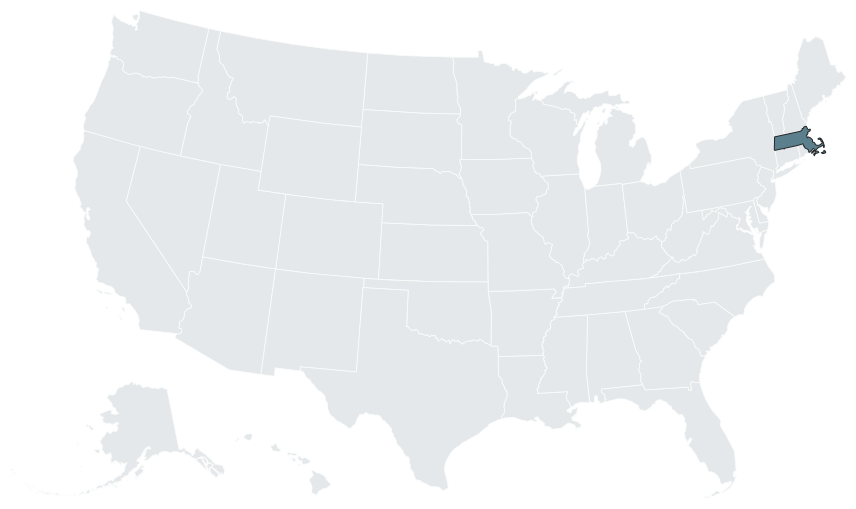

Approval layers: municipal, regional, state and federal
Massachusetts is a strong home-rule state: most site plan approval power sits with the municipality, layered under state environmental and infrastructure permits.
| Layer | Body | What it decides |
|---|---|---|
| Municipal | Planning Board | Site plan review in most towns; Subdivision Control Law (MGL c. 41 ss. 81K-81GG); special permits where it is the SPGA [16] |
| Municipal | Zoning Board of Appeals | Variances (c. 40A s. 10), many special permits (c. 40A s. 9), and 40B comprehensive permits [6, 17] |
| Municipal | Conservation Commission | Wetlands Protection Act and any local wetlands bylaw [2] |
| Municipal | Board of Health | Title 5 septic approval and campground licenses [15, 18] |
| Municipal | Building Commissioner | Building permits, first-instance zoning enforcement, construction control under 780 CMR 107 [12] |
| Regional | Cape Cod Commission, Martha's Vineyard Commission | Developments of Regional Impact [14] |
| State | MassDEP, MEPA Office, MassDOT, NHESP | Superseding wetlands orders, Title 5, Chapter 91, MEPA review, state highway access, Priority Habitat [19, 20, 21, 22] |
| Federal | EPA Region 1 | Construction General Permit and MS4 permits [4] |
The relief type sets the legal standard. A variance requires hardship owing to soil, shape or topography; a special permit is discretionary, needs a supermajority (typically two-thirds) and may be denied; site plan review of an as-of-right use is regulatory [6]. On special permits, the hearing must open within 65 days of filing and the decision issue within 90 days of the close of the hearing, or the permit is constructively granted [6]. A division of land is either an ANR plan, endorsed without a hearing where each lot has adequate frontage, or a definitive subdivision with a hearing, engineered plans and a performance guarantee under s. 81U; a definitive plan not acted on in time is constructively approved [16].
Two state housing tools change the path for multifamily. In a municipality below 10% on the Subsidized Housing Inventory, a 40B developer files one comprehensive permit with the ZBA that overrides inconsistent local zoning [17]. The MBTA Communities Act requires 177 designated communities to zone for multifamily housing as of right near transit; the Supreme Judicial Court upheld it on January 8, 2025 in Attorney General v. Town of Milton, 495 Mass. 183, and permanent regulations at 760 CMR 72.00 were published April 11, 2025 [23, 24]. A multifamily project inside a compliant district inherits the as-of-right posture described in the thesis above.
Who prepares and seals what
| Work on the plan | Who seals it | Rule |
|---|---|---|
| Property lines, ANR and subdivision plans, Registry and Land Court plans | Massachusetts Professional Land Surveyor | 250 CMR 5.01; a PE "cannot make property line determinations" (MGL c. 112 s. 81D) [25] |
| Grading, drainage, stormwater, utilities, pavement, septic design | Professional Engineer | 250 CMR 5.01 [25] |
| Building design | Registered Architect | MGL c. 112 s. 60A [26] |
| Planting and hardscape | Landscape architect | MGL c. 112 ss. 98-107 [26] |
| Any non-exempt building of 35,000 cubic feet or more of enclosed space | Registered design professional, with construction control affidavits | 780 CMR 107.6 and 107.6.1 [12] |
The 35,000 cubic foot exemption line is low: roughly a 40-foot by 60-foot single-story building with a 15-foot ceiling [12]. Retaining walls under ten feet, one- and two-family dwellings and agricultural buildings are exempt [12].
A preliminary site plan from Innowave Studio carries the program: building footprints, drive aisles, parking against the bylaw count, pads or units, amenities and the site data table. It holds no stamp. Your surveyor of record supplies the boundary base, and your engineer of record takes the preliminary plan as the layout brief and prepares the sealed grading, drainage, utility and stormwater set under the "Direct Charge and Supervision" standard of 250 CMR 5.04 [25]. For the division of labor in more depth, see who prepares a site plan.
Statewide overlays and their thresholds
| Overlay | Trigger or standard | What the plan shows |
|---|---|---|
| Wetlands Protection Act | 100-foot buffer; Riverfront Area 200 feet (25 feet in 14 cities) [2, 3] | Flag lines and numbers, buffer offset, limit of work, erosion controls |
| MEPA (301 CMR 11.03) | ENF at 25 or more acres of land alteration, 5 or more acres of new impervious area, 1,000 or more new daily trips, 300 or more new parking spaces, 500 or more square feet of vegetated wetland; mandatory EIR at 50 or more acres [19] | Impervious and parking totals in the site data table |
| Chapter 91 | Filled tidelands outside Designated Port Areas reach the first public way or 250 feet from mean high water; license recorded within 60 days [20] | Tideland lines and water-dependent uses |
| Title 5 (310 CMR 15.00) | Where no municipal sewer: percolation tests and deep-hole observation [15] | Leach field area and setbacks to wells, wetlands and lot lines |
| MESA (321 CMR 10.00) | Mapped Priority Habitat [22] | Habitat limits from the Natural Heritage Atlas |
| MassDOT (700 CMR 13.00) | Any state highway curb cut; determination of need within ten business days [21] | Access geometry; a Transportation Impact Assessment on larger projects |
| Chapter 61, 61A, 61B | Conversion of classified land triggers a 120-day municipal right of first refusal [27] | Parcel status at concept |
| Article 97 | Conservation land disposal needs a two-thirds vote of the Legislature [27] | Excluded from the developable area |
Climate inputs are code-table values: design frost depth commonly 4 feet; ground snow load 40 psf in Boston, 50 psf in Worcester, 60 psf in the Berkshire and north-central highland towns, 25 to 30 psf on Cape Cod and the Islands; wind 128 mph in Boston and 138 to 140 mph on Cape Cod and the Islands [12]. Those wind values govern fuel canopies and storage buildings near the coast.
Top jurisdictions
| Jurisdiction | Review path | Verified fees and timelines |
|---|---|---|
| Boston | Article 80: Small Project Review for 20,000 to 50,000 square feet or 15 to 20 dwelling units; Large Project Review at 50,000 square feet or more, with Boston Civic Design Commission review [13] | Small Project Review typically 2 to 4 months; Large, 6 to 12-plus months; Zoning Board of Appeal fee $150 for residential buildings of three units or fewer [13] |
| Worcester | Planning Board site plan review, OpenGov portal [28] | Definitive Site Plan $250 plus $77 per unit or bed (residential), or $250 plus $0.33 per square foot of floor area over 10,000 square feet (non-residential); Preliminary Site Plan $330; Parking Plan $250 plus $6.50 per space; $5,000 cap on combined Planning Board filings [28] |
| Quincy | Site plan review as a special permit from the Planning Board; triggers include multifamily of three or more units, new nonresidential of 5,000 to 9,999 gross square feet, and parking expansions over ten spaces [29] | ISD takes a "Preliminary Site Plan / Zoning Review" request online [29] |
| Cambridge, Newton, Somerville | Planning Board review; Specialized Code in force (Cambridge and Somerville July 1, 2023; Newton January 1, 2024) [5] | Set by each city's schedule |
| Barnstable and Cape Cod | Town review plus Cape Cod Commission DRI above 10,000 square feet of commercial floor area or 30 or more dwelling units [14] | Barnstable raised commercial thresholds to 20,000 square feet in economic centers and R&D to 40,000 square feet in designated areas [14] |
Springfield runs a two-tier system, Tier 1 administrative review and Tier 2 Planning Board review, and Lowell, Framingham and Plymouth review site plans through their Planning Boards. On Cape Cod, the Regional Policy Plan 2025 Update took effect December 29, 2025 (Barnstable County Ordinance 25-13), and a Development of Regional Impact is triggered by wireless towers exceeding 35 feet and land divisions of 30 or more acres as well [14]. Boston's Zoning Commission approved Article 80 modernization amendments on August 13, 2025 [13].
Asset registries for the classes developers build
| Asset | State hook | What it puts on the plan |
|---|---|---|
| RV parks and campgrounds | 105 CMR 440.000, licensed by the local Board of Health; the original license application files a plan of buildings, water supply and sewage works, with wastewater under Title 5 [18]. Tent-only and backpacker campgrounds are exempt if they have an approved water supply, and a safari field is limited to 60 camping units per acre and to overflow use (105 CMR 440.06) [18] | Bathhouse and septic locations, water supply, camping unit sites, any overflow field |
| Glamping | 105 CMR 440.000 regulates family-type campgrounds and defines a camping unit broadly, to include travel trailers and self-powered camping units [18]; no separate glamping category was confirmed | Unit type by local definition |
| Fuel retail | MassDEP UST program and 527 CMR, with local fire permits; the state UST program operates under EPA State Program Approval (40 CFR Part 282) [30, 31] | Tank locations, setbacks, canopy, vent piping, spill and overfill containment |
| Car washes | No state license; local zoning and site plan review, plus an industrial sewer discharge permit, and an MWRA permit in its service area [32] | Reclaim system and discharge connection |
| Self storage | No state operating license; local zoning and building and fire code, typically Group S-1 [12] | Fire access and separation |
| Hotels and lodging | Innholder and lodging-house licensing by the Select Board or City Council; short-term rentals register with the state | Building, parking and access per bylaw |
| Marinas | Chapter 91 license (310 CMR 9.00), Division of Marine Fisheries, and Army Corps Section 10 and 404 for in-water work [20] | Tideland lines and structures |
| Industrial and cannabis | Cannabis Control Commission licensing (935 CMR 500 and 501) with municipal siting; Host Community Agreement mandatory; statutory default buffer 500 feet from a K-12 school; Community Impact Fee capped at 3% of gross sales [33] | Industrial-district siting outside layered buffers |
For each class, the hub pages carry the national layout standards: campground site plans, RV park site plans, glamping site plans, gas station site plans, car wash site plans and marina site plans. The marina permitting stack is covered in marina development in America.
Timelines and bottlenecks
| Scenario | Typical concept-to-approval time |
|---|---|
| Simple as-of-right site plan review, no wetlands, municipal water and sewer | Roughly 3 to 6 months |
| Site plan review plus special permit and a wetlands Notice of Intent | Roughly 6 to 12 months |
| MEPA with an ENF only | Add roughly 2 to 4 months |
| MEPA with an EIR | Add 12 months or more |
| 40B comprehensive permit | Often 12 to 24-plus months including appeals |
| Boston Article 80 Large Project Review | 6 to 12-plus months on top of design |
The choke points are specific. Conservation Commission hearings open within 21 days of filing, and continuances for revised plans, peer review and site walks typically cost a month each [2]. MEPA's ENF and EIR sequence gates many state permits [19]. Sewer moratoria and water capacity stop projects on Cape Cod and in built-out suburbs [15]. And the 20-day appeal window, with de novo review in the Land Court or Superior Court, lets an abutter with standing delay a project [6]. The stormwater side is treated in stormwater as a site plan variable, and code editions in the IBC and IECC adoption map.
Proof points
- Prudential v. Westwood concerned a 285,000-square-foot office complex, an as-of-right use, on 4.2% of a 39.5-acre parcel; the court limited the board to conditions [1].
- Per EOHLC on April 14, 2025, 68 MBTA communities were deemed compliant or conditionally compliant, with 119 having adopted or submitted multifamily zoning [24].
- Massachusetts authorized roughly 14,078 housing units by building permit in 2023 and 14,490 in 2024, down from 18,940 in 2022 [34], against a state plan that calls for at least 222,000 more year-round units from 2025 to 2035 [35].
- Boston's Article 80, unchanged in structure since 1996, received its first major streamlining package on August 13, 2025 [13].
Where the preliminary plan fits in Massachusetts
The preliminary plan does its work before the sealed set exists: at the pre-application meeting, in Worcester's Preliminary Site Plan filing, in Quincy's preliminary zoning review, with a lender, with a general contractor pricing the job, and in the decision whether to close on the land. The preliminary vs final site plan guide sets out what changes between the two. For the full service, see site plans and the site plan consultant and site plan architect pages. Boston's recent residential towers, such as the Hacin midrise in the Wharf District, show the Article 80 scale in practice.
Neighboring states run different regimes: New Hampshire puts a statutory clock on its planning boards, Vermont layers Act 250 over the town, Maine adds a state Site Law, and Rhode Island, Connecticut and New York have their own pages. Which review stages in other states take an unsealed concept plan is set out in where unsealed site plans are accepted. The full list is on service areas.
Frequently asked questions
Can a Massachusetts town deny my site plan if my use is allowed by right?
Generally no. Where the plan meets the bylaw's area and use criteria, the board is limited to imposing reasonable terms and conditions (Prudential v. Westwood, 23 Mass. App. Ct. 278, 1986) [1]. The exception is the rare plan so intrusive that no reasonable condition could cure the problem [1]. Site plan review attached to an as-of-right use does not need a special permit supermajority unless the bylaw says so (Osberg, 1997) [9].
Who has to stamp a site plan in Massachusetts?
A Massachusetts Professional Land Surveyor for property lines and any recordable plan, since even a Professional Engineer cannot make property line determinations (250 CMR 5.01; MGL c. 112 s. 81D) [25]. A Professional Engineer for grading, drainage, stormwater, utilities and septic design [25]. Any non-exempt building of 35,000 cubic feet or more of enclosed space needs registered design professional documents under 780 CMR 107.6 [12].
How close can I build to a wetland in Massachusetts?
The state buffer zone is 100 feet from most resource areas, and the Riverfront Area is 200 feet from perennial streams, 25 feet in 14 densely developed municipalities [2, 3]. Many towns impose stricter no-disturb zones through local wetlands bylaws, and decisions under those bylaws are appealable only to court, not to MassDEP [2].
Do I need an EPA stormwater permit in Massachusetts?
What triggers MEPA review?
A state permit, state funding or state land transfer combined with a review threshold under 301 CMR 11.03: for example 5 or more acres of new impervious area, 1,000 or more new average daily trips, or 300 or more new parking spaces at one location [19].
Do I need Cape Cod Commission review?
If the project crosses a Development of Regional Impact threshold: commercial, retail, office or industrial development greater than 10,000 square feet of gross floor area, or 30 or more dwelling units, among others [14]. Barnstable raised its commercial threshold to 20,000 square feet in economic centers [14].
How long does a Massachusetts site plan approval take?
A simple as-of-right site plan with no wetlands and municipal water and sewer runs roughly 3 to 6 months; adding a special permit and a wetlands Notice of Intent, roughly 6 to 12 months. MEPA with an EIR adds 12 months or more. The statutory appeal period is 20 days from filing with the municipal clerk [6, 19].
Sources
- 1)Prudential Insurance Co. of America v. Board of Appeals of Westwood, 23 Mass. App. Ct. 278 (1986), Massachusetts Appeals Court. Accessed 2026-08-31.
- 2)MGL c. 131 s. 40 (Wetlands Protection Act) and 310 CMR 10.00, Massachusetts Department of Environmental Protection. Accessed 2026-08-31.
- 3)Rivers Protection Act (St. 1996 c. 258): Riverfront Area and the 14 reduced-width municipalities, Massachusetts Department of Environmental Protection. Accessed 2026-08-31.
- 4)2022 NPDES Construction General Permit (effective February 17, 2022), U.S. Environmental Protection Agency, Region 1. Accessed 2026-08-31.
- 5)Stretch and Specialized Energy Code adoption tracker (as of June 4, 2026); 225 CMR 22 and 225 CMR 23, Massachusetts Department of Energy Resources. Accessed 2026-08-31.
- 6)MGL c. 40A, the Zoning Act (ss. 9, 10 and 17), Massachusetts General Court. Accessed 2026-08-31.
- 7)Y.D. Dugout, Inc. v. Board of Appeals of Canton, 357 Mass. 25 (1970), Massachusetts Supreme Judicial Court. Accessed 2026-08-31.
- 8)SCIT, Inc. v. Planning Board of Braintree, 19 Mass. App. Ct. 101 (1984), Massachusetts Appeals Court. Accessed 2026-08-31.
- 9)Osberg v. Planning Board of Sturbridge, 44 Mass. App. Ct. 56 (1997), Massachusetts Appeals Court. Accessed 2026-08-31.
- 10)Muldoon v. Planning Board of Marblehead, 72 Mass. App. Ct. 372 (2008), Massachusetts Appeals Court. Accessed 2026-08-31.
- 11)Massachusetts Stormwater Standards; 401 Water Quality Certification for the CGP; 314 CMR 4.06, Massachusetts Department of Environmental Protection. Accessed 2026-08-31.
- 12)780 CMR, Massachusetts State Building Code, 10th edition (107.6 construction control; Chapter 51 climatic data), Board of Building Regulations and Standards. Accessed 2026-08-31.
- 13)Boston Zoning Code, Article 80 (Development Review), the August 13, 2025 amendments, and Zoning Board of Appeal fees, Boston Planning Department; City of Boston. Accessed 2026-08-31.
- 14)Cape Cod Commission Enabling Regulations, Chapter A (DRI thresholds) and Chapter H; Regional Policy Plan 2025 Update (Barnstable County Ordinance 25-13), Cape Cod Commission. Accessed 2026-08-31.
- 15)310 CMR 15.00 (Title 5) and 314 CMR 21.00 (Watershed Permit regulations), effective July 7, 2023, Massachusetts Department of Environmental Protection. Accessed 2026-08-31.
- 16)MGL c. 41 ss. 81K to 81GG, Subdivision Control Law; Craig v. Planning Board of Haverhill, 64 Mass. App. Ct. 677 (2005), Massachusetts General Court; Massachusetts Appeals Court. Accessed 2026-08-31.
- 17)MGL c. 40B ss. 20 to 23 and 760 CMR 56.00 (comprehensive permits), Massachusetts General Court; Executive Office of Housing and Livable Communities. Accessed 2026-08-31.
- 18)105 CMR 440.000, State Sanitary Code Chapter VI (developed family-type campgrounds), Massachusetts Department of Public Health. Accessed 2026-08-31.
- 19)301 CMR 11.00, MEPA regulations (review thresholds at 301 CMR 11.03), Executive Office of Energy and Environmental Affairs, MEPA Office. Accessed 2026-08-31.
- 20)MGL c. 91 and 310 CMR 9.00, Waterways regulations (effective January 5, 2024), Massachusetts Department of Environmental Protection. Accessed 2026-08-31.
- 21)700 CMR 13.00, State Highway Access Permits; State Highway Access Permit System (SHAPS), Massachusetts Department of Transportation. Accessed 2026-08-31.
- 22)MGL c. 131A and 321 CMR 10.00, Massachusetts Endangered Species Act; Natural Heritage Atlas, MassWildlife, Natural Heritage and Endangered Species Program. Accessed 2026-08-31.
- 23)Attorney General v. Town of Milton, 495 Mass. 183 (2025), Massachusetts Supreme Judicial Court. Accessed 2026-08-31.
- 24)MGL c. 40A s. 3A and 760 CMR 72.00 (MBTA Communities); compliance status of April 14, 2025, Executive Office of Housing and Livable Communities. Accessed 2026-08-31.
- 25)250 CMR 5.01 and 5.04; MGL c. 112 ss. 81D to 81T, Board of Registration of Professional Engineers and Professional Land Surveyors. Accessed 2026-08-31.
- 26)MGL c. 112 ss. 60A to 64 (architects) and ss. 98 to 107 (landscape architects), Board of Registration of Architects; Board of Registration of Landscape Architects. Accessed 2026-08-31.
- 27)MGL c. 61, 61A and 61B (classified forest, agricultural and recreational land) and Article 97, Massachusetts General Court. Accessed 2026-08-31.
- 28)Planning Board and Zoning Board of Appeals fee schedule, City of Worcester. Accessed 2026-08-31.
- 29)Site plan review special permit triggers and ISD online permitting, City of Quincy. Accessed 2026-08-31.
- 30)527 CMR (fire code: fuel storage and dispensing) and the Underground Storage Tank program, Department of Fire Services; Massachusetts Department of Environmental Protection. Accessed 2026-08-31.
- 31)40 CFR Part 282, Approved Underground Storage Tank Programs, eCFR. Accessed 2026-10-09.
- 32)Industrial discharge permits in the MWRA service area, Massachusetts Water Resources Authority. Accessed 2026-08-31.
- 33)MGL c. 94G ss. 3(d) and 5(b)(3); 935 CMR 500 and 501; Chapter 180 of the Acts of 2022, Cannabis Control Commission. Accessed 2026-08-31.
- 34)Building Permits Survey, Massachusetts (2022 to 2024), U.S. Census Bureau. Accessed 2026-08-31.
- 35)A Home for Everyone, statewide housing plan (February 6, 2025), Commonwealth of Massachusetts, Healey-Driscoll Administration. Accessed 2026-08-31.