What shapes a site plan in metro Chicago
Two lines on the map decide the approval path in metro Chicago: the city limit, which separates Chicago's own zoning and stormwater codes from the suburbs', and the Cook County line, which separates the regional watershed permit from the collar counties' ordinances. Five conditions follow from them, and each one changes what a preliminary site plan has to show.
- Program size sets the city path. The Chicago Zoning Ordinance sends a retail building of 75,000 sf or more in a B or C district to planned development (PD) review under §17-8-0510-A, and §17-8-0510-B does the same for any commercial development on a net site of 4 acres or more [1, 2].
- Industrial thresholds move with the neighbors. On M-zoned land, §17-8-0511-A requires PD review for industrial development of 5 acres or more within 100 ft of a residential district, and of 10 acres or more elsewhere [2].
- A smaller site can opt in. §17-8-0600 allows an elective PD, where its criteria are met, on a site of at least 12,500 sf in a D district or 21,875 sf in any other district [1].
- Two stormwater regimes meet at the city limit. MWRD states that its Watershed Management Ordinance (WMO) "applies to all development within the boundaries of Cook County" [5]. Inside Chicago, though, MWRD issues a permit only where a project touches MWRD facilities, and development stormwater runs through the city's own ordinance, Chapter 11-18 [6, 4].
- Beyond Cook, the county writes the stormwater rules. Each of the five collar counties, DuPage, Kane, Lake, McHenry and Will, has run its own stormwater program since Public Acts 85-905 and 85-1266 gave it countywide authority, now 55 ILCS 5/5-1062, through a committee on which county board members and municipal representatives sit in equal numbers [7].
The statewide seal, code and permit layers that sit under all five are on the Illinois page. This page covers what changes inside the metro.
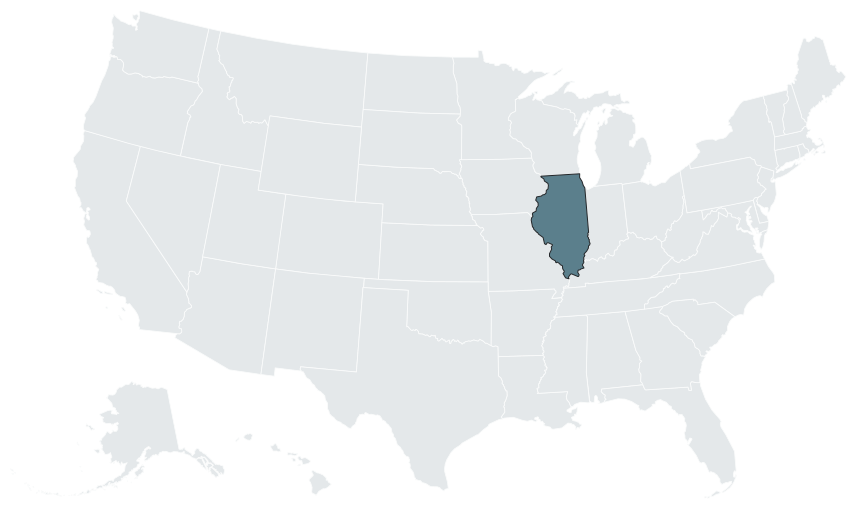

Jurisdiction map: who governs where
A site data table in this metro starts with the jurisdiction, because the city, suburban Cook and each collar county answer to a different stormwater authority.
| Jurisdiction | Zoning and site plan | Stormwater authority |
|---|---|---|
| City of Chicago | Title 17, administered by the Department of Planning and Development under Chapter 17-14; PD procedures sit in §17-13-0600 [8, 9] | The city's Chapter 11-18 ordinance, through the Department of Buildings and the Department of Water Management [4] |
| Suburban Cook County | Each municipality's own zoning code | The MWRD WMO; under Article 14 an authorized municipality may issue watershed permits itself [6] |
| DuPage County | Municipal or county zoning | A countywide ordinance effective since February 1992 that overrides less restrictive municipal rules; Waiver Communities administer it locally [10, 11] |
| McHenry County | Municipal or county zoning | The county Stormwater Management Ordinance, enforced inside their limits by the 21 of 30 municipalities certified to do so [12] |
| Will, Kane and Lake counties | Municipal or county zoning | Countywide stormwater authority under 55 ILCS 5/5-1062 [7] |
Naperville, Joliet, Aurora and the other suburbs run their own zoning codes inside those counties, so their review steps are confirmed city by city before a layout is fixed.
Chicago: when a project becomes a planned development
The thresholds below decide whether a Chicago project goes through PD review or proceeds under its base district.
| Program | PD threshold | Section |
|---|---|---|
| Retail building in a B or C district | 75,000 sf or more | §17-8-0510-A [1, 2] |
| Commercial development | Net site of 4 acres or more | §17-8-0510-B [2] |
| Industrial on M land within 100 ft of an R district | 5 acres or more | §17-8-0511-A [2] |
| Industrial on M land elsewhere | 10 acres or more | §17-8-0511-A [2] |
| Residential | Height or unit-count thresholds in the district tables | §17-8-0512 and §17-8-0513 [2] |
| Elective PD | 12,500 sf in D districts; 21,875 sf in other districts | §17-8-0600 [1] |
The city's review procedures all sit in Chapter 17-13: text and map amendments, industrial corridor map amendments, the Special Character Overlay, planned developments, Planned Manufacturing Districts, Site Plan Review, special uses, administrative adjustments, variations, appeals and zoning certification [13].
| PD step | What happens | Source |
|---|---|---|
| Part I | Zoning review plus Planning and Design Review by the Department of Planning and Development, ending in the PD ordinance | [14, 8] |
| Part II | Construction plans are checked for conformance with every aspect of the approved PD before construction | [14, 8] |
| Later phases | Each subsequent phase of a PD goes through Site Plan Review under §17-13-0800 | [15] |
| Fees | Paid in installments: the first at the PD application, or at site plan review filing for a later phase, and the second at Part II review | [15] |
| Plan Commission | For some PDs, site plan approval needs a courtesy presentation to the Chicago Plan Commission at a public meeting before the Commissioner approves | [15] |
The application for 11400 to 11458 S. Halsted, in the Plan Commission's published materials, is the record behind those last three rows [15]. Discretionary decisions in the city rest with the Chicago Plan Commission, the Committee on Zoning, Landmarks and Building Standards, the Zoning Board of Appeals and the City Council [8].
Chicago: site plan review, building code and city stormwater
Site Plan Review under §17-13-0800 is the administrative check. The Zoning Administrator has 30 days from a complete application to determine whether the plan may be approved (§17-13-0803), and the filing shows land uses and buildings for a block in every direction, the elevations of each proposed facade and the building materials specified [16]. A project that proposes alternative compliance with the on-site open space standards is routed through the same review [16].
Chicago keeps its own construction codes, enforced by the Department of Buildings, in Titles 14A through 14X; Title 14 itself is reserved [17].
| Title | Covers | Source |
|---|---|---|
| 14B | The Building Code, based on the 2018 IBC, for most permit applications started on or after August 1, 2020 | [17, 18] |
| 14B-11 and 14R-3-305 | Accessibility provisions that apply to all permit applications started on or after December 1, 2019, whichever code governs the rest of the project | [17] |
| 14E, 14G, 14M and 14P | Electrical, fuel gas, mechanical and plumbing | [17] |
| 14F | Fire prevention (interim) | [17] |
| 14N | Energy Transformation | [17] |
| 14R and 14X | Building rehabilitation and existing buildings | [17] |
The fuel gas basis is the 2000 International Fuel Gas Code, at Chapter 18-28, Article XIV [17].
City stormwater review is its own permit, and it comes first.
| Chapter 11-18 item | Rule | Source |
|---|---|---|
| Regulated Development | Construction, excavation or grading starting on or after January 1, 2008 that disturbs 15,000 sq ft or more of substantially contiguous land in the aggregate, creates 7,500 sq ft or more of at-grade impervious surface, or discharges stormwater to waters or a separate sewer | [4] |
| Residential | Detached single-family and two-family subdivisions are outside the ordinance, and residential development is left out of the threshold calculation | [4] |
| Rate control | More than 7,500 sq ft of contiguous at-grade area created or reconstructed, or disturbance over 15,000 sq ft; waived for direct discharge to Lake Michigan, with every other standard still in force | [4] |
| Volume control | All regulated developments, new roofs on a vertical building addition excepted | [4] |
| Sequence | Stormwater approval before any building or sewer permit can issue | [4] |
| Initial submittal | Signed by the applicant and sealed by a Professional Engineer, filed through the DOB Express Permit Program and E-Plan (ProjectDox) | [4] |
| Technical text | The Department of Water Management's 2026 Regulations for Sewer Construction and Stormwater Management, with the August 2024 Stormwater Management Ordinance Manual | [19, 20] |
Suburban Cook: the MWRD watershed permit
Outside the city, a Cook County site answers to two reviewers: the municipality for zoning and MWRD for stormwater. The WMO took effect on May 1, 2014 [21], and MWRD's WMO and Technical Guidance Manual page states that "The WMO was last amended on January 9, 2025," posting the amended ordinance alongside a redline copy [22]. The permit itself is a Watershed Management Permit under WMO §201 [5].
| Permit item | Rule | Source |
|---|---|---|
| Triggers | Disturbance of more than 0.5 acre; development in a floodway, floodplain, wetland or riparian environment; reconfiguring stormwater systems so a detention facility's service area changes, or modifying the facility | [3, 6] |
| Issuer | MWRD Engineering, or an authorized municipality | [5, 6] |
| Checklists | MWRD publishes a minimum submittal checklist and an issuance checklist | [23] |
| Filing | The WPASS portal, with resubmittals through the unique link issued during review | [6] |
| First review | 30 working days where detention, flood protection areas, outfalls, direct connections or District real estate are involved; 15 working days for the simpler permit types | [6] |
| Each resubmittal | 15 working days | [6] |
| Early start | An Earthwork/Foundation Limited Permit allows disturbance before the full permit, which must follow within 90 days; no floodplain work | [24] |
| Notice | The Local Sewer Systems field office is notified at least 2 days before work starts | [5] |
| Maintenance covenant | Schedule R on file before issuance and recorded at completion, with a $500 recordation deposit refunded on proof of recording | [6] |
| Fee-in-lieu | MWRD has no fee-in-lieu program for its stormwater requirements | [6] |
For detention, MWRD adds up all area developed on the property since May 1, 2014, whether or not the earlier work needed a WMO permit [6]. Volume control starts at a parcel of 0.50 acre for non-residential and multi-family development, 1.0 acre for residential subdivisions and 1.0 acre of new impervious area for rights of way, and the standard is capture of one inch of runoff from all impervious areas, about 90 percent of rainfall events in northeastern Illinois, designed to mimic a 0.04 cfs per acre release at the 2-year event [6]. A municipality that straddles Cook and a neighboring county remains under every provision of the WMO in its Cook portion unless it holds an intergovernmental agreement with MWRD to enforce the neighbor's ordinance there [25].
Asset rules in metro Chicago
Most asset-level rules in the metro come from the PD thresholds in the city and from MWRD's grouping of uses in suburban Cook.
| Asset | Rule | Source |
|---|---|---|
| Retail centers, c-stores and drive-throughs (city) | PD review for a retail building of 75,000 sf or more in a B or C district, or a commercial net site of 4 acres or more | [1, 2] |
| Industrial, warehouse and outdoor storage (city) | PD review on M land at 5 acres within 100 ft of an R district, otherwise at 10 acres | [2] |
| Multifamily (city) | PD review at the height or unit-count thresholds of §17-8-0512 and §17-8-0513 | [2] |
| Multifamily (suburban Cook) | Grouped with non-residential use, so volume control starts at a 0.50 acre parcel, not at the 1.0 acre residential subdivision line | [6] |
| Self storage and other impervious-heavy campuses (suburban Cook) | Volume control from a 0.50 acre parcel; detention counts all area developed since May 1, 2014 | [6] |
| Single-family homes (suburban Cook) | Exempt from WMO stormwater requirements, except permits for flood protection areas or sewer extensions | [6, 26] |
| Car washes (Cook County) | Sanitary discharge falls under MWRD's Pretreatment and Cost Recovery program, including the User Charge Program | [27] |
| Waterfront and marinas (Cook County) | MWRD operates the Chicago Area Waterway System, including the Lockport Powerhouse and the SEPA stations; new commercial buildings are not an appropriate use in a regulatory floodway | [28, 6] |
Layout standards for each class are on the retail, industrial, warehouse, industrial outdoor storage, multifamily, self storage, car wash and marina hubs.
Growth and proof points
Growth around the city is uneven: Kendall, Grundy, McHenry and Will were among the 15 of 102 Illinois counties that gained population between 2020 and 2024 [29]. McHenry and Will are collar counties, so a site there is drawn to the county stormwater ordinance rather than to MWRD's [7, 12]. Inside the city, the S. Halsted PD application shows the two-installment fee structure and the courtesy presentation at work [15], and the scale of current city projects shows in the studio's notes on the United Center redevelopment, the North Michigan Avenue revamp and a new Jahn tower. For a comparable Midwest small-bay layout, see the small-bay industrial model project in Grove City, Ohio.
Site factors
- Soils. MWRD's Technical Guidance Manual flags poor infiltration rates across Cook County as a design constraint on retention practices, and requires those practices to drain from high water to two inches above the bottom within 72 hours [30]. Volume control on a Cook site therefore often needs storage area on the plan.
- Floodplain. Floodplain and compensatory storage fall under WMO Article 6 [21], and the flood protection elevation is two feet above base flood elevation [6].
- Wetlands. MWRD regulates isolated wetlands only and leaves Corps-jurisdictional wetlands to the US Army Corps of Engineers; development that drives wetland hydrology below 80 percent or above 150 percent of existing-conditions runoff volume for the 2-year, 24-hour event is an indirect wetland impact [6].
- Rainfall data. MWRD hydrology uses Illinois State Water Survey Bulletin 75, while the IDNR model ordinance that many counties follow references Bulletin 70 [6, 31].
- Open space. Open space developments are exempt from WMO volume control and detention [6].
- Street-split sites in the city. Land areas separated by public right of way at the end of development are not substantially contiguous under Chapter 11-18, so each side is measured on its own [4].
How detention and retention rules reshape a layout is covered in this post on stormwater as a site plan variable. The stormwater design itself belongs to the engineer of record.
What the preliminary plan carries in Chicago
In the city, the site data table carries the numbers the PD thresholds test: net site area against the 4 acre commercial line, retail building area against 75,000 sf, and, on industrial land, the distance to the nearest residential district against 100 ft [2, 1]. It also shows disturbed area against the 15,000 sq ft trigger of Chapter 11-18 and new at-grade impervious area against 7,500 sq ft [4], or, in suburban Cook, disturbed area against MWRD's 0.5 acre line [3].
That is the preliminary site plan: site layout, buildings, drive aisles, parking, pads and yield, organized with a site data table. Developers use it to test a program against the PD thresholds before Part I review, to brief a lender and to have a general contractor price the work. The engineer of record then builds the sealed Chapter 11-18 or WMO submittal on it. The site plan consultant and site plan architect pages explain how the studio works alongside the engineer and architect of record, the where unsealed site plans are accepted guide covers the concept stage, and the Indianapolis and Kansas City pages cover the neighboring Midwest metros. Service areas lists every metro covered.
Frequently asked questions
When is a planned development mandatory in Chicago?
Can a smaller site choose planned development review?
Yes, where the criteria are met, on a site of at least 12,500 sf in a D district or 21,875 sf in any other district (§17-8-0600) [1].
Does an industrial project in Chicago need a planned development?
On M-zoned land it does at 5 acres or more within 100 ft of a residential district, and at 10 acres or more anywhere else (§17-8-0511-A) [2].
Does MWRD review stormwater for a project inside Chicago?
What triggers an MWRD permit in suburban Cook County?
Can grading start before the WMO permit is issued?
Under an Earthwork/Foundation Limited Permit it can, provided the full permit follows within 90 days; no floodplain work is allowed under that permit [24].
How long does MWRD take to review a permit?
30 working days for a first submittal that involves detention, flood protection areas, outfalls, direct connections or District real estate; 15 working days for simpler permit types; and 15 working days for every resubmittal [6].
How long does Chicago take to decide a site plan review?
The Zoning Administrator determines within 30 days of a complete application whether the site plan may be approved (§17-13-0803) [16].
Sources
- 1)Chicago Zoning Ordinance 17-8-0700, Measurement of planned development thresholds, City of Chicago (via American Legal Publishing). Accessed 2026-10-10.
- 2)Chicago Zoning Ordinance 17-8-0500, Mandatory planned development thresholds, City of Chicago (via American Legal Publishing). Accessed 2026-10-10.
- 3)Watershed Management Ordinance: Summary, Metropolitan Water Reclamation District of Greater Chicago. Accessed 2026-10-10.
- 4)Sewer Permits: Fees and Standards (Stormwater Management Ordinance, Chapter 11-18), City of Chicago, Department of Buildings. Accessed 2026-08-30.
- 5)Watershed Management Ordinance and Infiltration/Inflow, Metropolitan Water Reclamation District of Greater Chicago. Accessed 2026-10-10.
- 6)Watershed Management Ordinance (WMO) Frequently Asked Questions, Metropolitan Water Reclamation District of Greater Chicago. Accessed 2026-10-10.
- 7)Will County Comprehensive Stormwater Management Plan, Will County Stormwater Management Planning Committee. Accessed 2026-08-30.
- 8)Zoning Ordinance Administration, City of Chicago, Department of Planning and Development. Accessed 2026-08-30.
- 9)Chapter 2: Zoning Districts Overview (Zoning Design Guidelines), City of Chicago. Accessed 2026-10-10.
- 10)DuPage County Countywide Stormwater and Flood Plain Management Ordinance (as reproduced by the Village of Roselle), DuPage County. Accessed 2026-08-30.
- 11)Stormwater Certification, DuPage County Stormwater Management. Accessed 2026-08-30.
- 12)Stormwater Management Ordinance, McHenry County, Planning and Development, Water Resources. Accessed 2026-08-30.
- 13)Chicago Zoning Ordinance, Chapter 17-13, Review and approval procedures, City of Chicago (via American Legal Publishing). Accessed 2026-08-30.
- 14)Part I Review (planned developments), City of Chicago, Department of Planning and Development. Accessed 2026-08-30.
- 15)Planned Development application, 11400 to 11458 S. Halsted (Chicago Plan Commission materials), City of Chicago, Department of Planning and Development. Accessed 2026-08-30.
- 16)Chicago Zoning Ordinance 17-13-0800, Site Plan Review, City of Chicago (via American Legal Publishing). Accessed 2026-08-30.
- 17)City of Chicago Construction Codes, City of Chicago, Department of Buildings. Accessed 2026-08-30.
- 18)Chicago Building Code, Title 14B, City of Chicago (via American Legal Publishing). Accessed 2026-08-30.
- 19)2026 Regulations for Sewer Construction and Stormwater Management, City of Chicago, Department of Water Management. Accessed 2026-08-30.
- 20)Stormwater Management Ordinance Manual (August 2024), City of Chicago, Department of Water Management. Accessed 2026-08-30.
- 21)Watershed Management Ordinance, effective May 1, 2014, as amended May 16, 2019, Metropolitan Water Reclamation District of Greater Chicago. Accessed 2026-10-10.
- 22)Watershed Management Ordinance and Technical Guidance Manual (program page, with the amended WMO and a redline copy), Metropolitan Water Reclamation District of Greater Chicago. Accessed 2026-10-10.
- 23)WMO Permit Checklists, Metropolitan Water Reclamation District of Greater Chicago. Accessed 2026-10-10.
- 24)Earthwork/Foundation Limited Permit, Watershed Management Ordinance, Metropolitan Water Reclamation District of Greater Chicago. Accessed 2026-10-10.
- 25)Technical Guidance Manual, Article 2, Metropolitan Water Reclamation District of Greater Chicago. Accessed 2026-08-30.
- 26)Managing Stormwater: the WMO homeowner brochure, Metropolitan Water Reclamation District of Greater Chicago. Accessed 2026-10-10.
- 27)Pretreatment and Cost Recovery, Metropolitan Water Reclamation District of Greater Chicago. Accessed 2026-08-30.
- 28)Chicago Area Waterway System (CAWS), Metropolitan Water Reclamation District of Greater Chicago. Accessed 2026-08-30.
- 29)County-level Census population figures for Illinois (news report), Yahoo News. Accessed 2026-08-30.
- 30)Technical Guidance Manual, Article 5, Metropolitan Water Reclamation District of Greater Chicago. Accessed 2026-08-30.
- 31)Illinois Model Stormwater Management Ordinance, Illinois Department of Natural Resources, Office of Water Resources. Accessed 2026-08-30.