What shapes a site plan in metro Austin
In metro Austin the city's review tracks, state preemption on commercial land and the Edwards Aquifer rules decide how a preliminary site plan is drawn. Five conditions stand out.
- Review runs through many hands. A McKinsey review reported by the Austin Monitor in August 2023 counted 1,470 steps, 11 departments and more than 250 staff in Austin's site plan review [7].
- Small multifamily has its own track. Site Plan Lite covers 5 to 16 units on infill lots of up to 1 acre; Phase 2 was adopted on March 6, 2025, and the city began accepting applications on June 16, 2025 [1, 2].
- Commercial zones carry housing rights. City staff read SB 840 as allowing residential use by right in every commercial base zone, and the city's SB 840 page dates that right from Sept. 1, 2025 [5, 8].
- The aquifer rules reach three counties. Travis, Williamson and Hays are among the counties where the Edwards Aquifer rules of 30 TAC Chapter 213 apply, with a WPAP over the recharge zone and a Contributing Zone Plan upstream [6].
- Population climbs while permits fall. The metro grew from 2,283,391 residents in 2020 to 2,620,945 on July 1, 2025, about 14.8%, yet it authorized 32,294 housing units in 2024 against 38,773 in 2023, and the City of Austin 9,444 against 13,684 [3, 4].
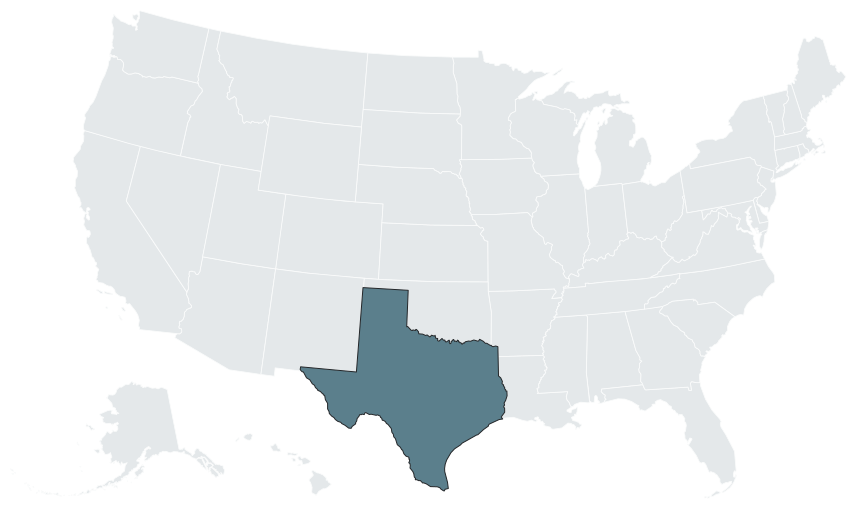

Jurisdiction map: who governs where
| Jurisdiction | What governs a site plan there | Source |
|---|---|---|
| City of Austin | Site plans under the Land Development Code, the Site Plan Lite track for 5 to 16 units, and SB 840 housing in all commercial base zones | [1, 5] |
| Austin's ETJ | City platting until release; by December 15, 2023 the city had received 191 direct-release petitions and released 74 properties | [9] |
| Travis, Williamson and Hays counties | Edwards Aquifer counties under 30 TAC Chapter 213; TCEQ approval before soil disturbance for regulated activities | [6, 10] |
| Williamson County | 609,059 residents in 2020 and 752,827 in 2025 | [3] |
| City of Round Rock | Listed with Austin among the SB 840 cities in a law firm summary | [11] |
| City of San Marcos | Data centers barred through a zoning change in 2026 | [12] |
Rules for Georgetown, Pflugerville, Kyle, Leander and the counties' subdivision regulations are confirmed with each jurisdiction before a layout is fixed. The Dallas-Fort Worth, Houston and San Antonio pages cover the other Texas metros, and site plans in Texas sets out the statewide rules.
Site plan process: City of Austin
Austin sorts a residential project into a review track by unit count, lot size and impervious cover.
| Track or rule | What it does | Source |
|---|---|---|
| Site plan | Review under the Land Development Code | [1] |
| Site Plan Lite, Phase 2 (C20-2023-045) | 5 to 16 units on a lot, infill up to 1 acre; applications from June 16, 2025 | [1, 2, 13] |
| Small project status | Granted where the modified drainage criteria are met; no drainage or water quality review for the tier | [13] |
| Detention | None on site below 8,000 sq ft of impervious cover for the tier | [13] |
| Modified drainage standard | LDC Sec. 25-7-67, set out on the HOME Amendments page | [1] |
| Infill plat (resubdivision) | Drainage review threshold raised from 11,500 sq ft to 17,780 sq ft | [14] |
| SB 840 housing | By right in all commercial base zones; heavy industrial zones excluded | [5] |
The two thresholds work together on a small infill site: below 8,000 sq ft of impervious cover a Site Plan Lite project carries no onsite detention, and a resubdivision now reaches drainage review only above 17,780 sq ft [13, 14].
SB 840 on Austin commercial land
City staff briefed the Codes and Ordinances Joint Committee on SB 840 on September 24, 2025, reading the law as putting residential use by right in all commercial base zones, with heavy industrial zones excluded [5]. The city's SB 840 page treats the by-right path as available since Sept. 1, 2025 [8]. On a covered Austin tract the density is 36 units per acre minimum, higher where the city allows more [5, 15].
Rezoning has not disappeared. A Chambers practice guide notes that SB 840 made some Austin rezoning cases unnecessary [16]. AEI's SB 840 report records the other choice as well: the applicant in case C14-2025-0089 sought a negotiated rezoning rather than the by-right path [17].
NAIOP reports that Austin repealed parking minimums for all uses citywide under Ordinance C20-2023-010 in 2023 (secondary) [18]. Layouts for these programs are on the multifamily and mixed-use hubs, and apartment renderings show the massing a by-right scheme produces.
Edwards Aquifer review
In Travis, Williamson and Hays counties, regulated activities over the Edwards Aquifer need TCEQ approval before soil is disturbed [10]. The plan follows the zone: a WPAP over the recharge zone and a Contributing Zone Plan upstream [6]. Once an Edwards application is administratively complete, TCEQ's technical review is 90 days under 30 TAC 213.4(e); that is the agency's review of the aquifer plan, not a city site plan approval [19].
Asset rules in metro Austin
| Asset | Rule in metro Austin | Source |
|---|---|---|
| Small multifamily, 5 to 16 units | Site Plan Lite on infill lots up to 1 acre; no onsite detention below 8,000 sq ft of impervious cover | [1, 13] |
| Multifamily and mixed use, Austin | By right in all commercial base zones under SB 840, at 36 units per acre minimum, higher where the city allows more | [5, 15] |
| Parking, all uses, Austin | No citywide minimums since Ordinance C20-2023-010 (2023), per NAIOP (secondary) | [18] |
| Data centers, San Marcos | Barred by a zoning change; The Texas Tribune reported on June 30, 2026 that the City Council voted 4-3 on June 16 | [12] |
| Travel centers, San Marcos | A Buc-ee's of 74,000 sf with 128 fueling positions | [20] |
| Any regulated activity over the aquifer | TCEQ approval before soil disturbance; a WPAP or a Contributing Zone Plan by zone | [10, 6] |
Layouts for these assets are on the industrial, truck stop and gas station hubs, with state rules on gas station site plans in Texas.
Growth corridors and proof points
The metro gained 337,554 residents between its 2020 base of 2,283,391 and July 1, 2025 [3]. Williamson County went from 609,059 residents in 2020 to 752,827 in 2025 [3]. Building slowed against that growth: the Austin metro's 32,294 authorized units in 2024 were fewer than the 38,773 of 2023, and inside the city the count fell to 9,444 from 13,684 [4].
By December 15, 2023, under SB 2038, the City of Austin had received 191 direct-release petitions and had released 74 properties from its ETJ [9]. In San Marcos, the City Council's 4-3 vote of June 16 barred data centers through a zoning change, and Sen. Paul Bettencourt has said he will challenge it, The Texas Tribune reported on June 30, 2026 [12]. On the same corridor, CBS Austin reported a 74,000 sf Buc-ee's travel center in San Marcos with 128 fueling positions [20]. Construction innovation in the region is covered in this post on 3D printed homes in Wimberley.
Site factors
- Recharge or contributing zone. The zone decides whether the aquifer plan is a WPAP or a Contributing Zone Plan, and TCEQ approval comes before any soil disturbance [6, 10].
- Impervious cover. The 8,000 sq ft detention line for Site Plan Lite and the 17,780 sq ft infill plat drainage threshold are measured from the first layout [13, 14].
- Lot size. Site Plan Lite stops at infill sites of 1 acre [1, 2].
- Parking. With no citywide minimums, parking count is a program decision; NAIOP reports the repeal (secondary) [18].
- Use limits on the corridor. San Marcos has barred data centers by zoning [12].
What the preliminary plan carries in Austin
On an Austin site the preliminary site plan is drawn against the thresholds above: unit count against the 5 to 16 unit Site Plan Lite band, lot area against the 1 acre infill limit and impervious cover against the 8,000 sq ft detention line [1, 13]. On commercial land the site data table sets a by-right residential yield beside the commercial scheme [5]. The sheet carries building footprints, drives, parking, open space and yield, and it goes to a lender, to a general contractor for pricing and to the partners raising equity; the engineer of record then designs drainage, water quality, utilities and access and seals the construction set.
The site plan consultant and site plan services pages explain how the studio works with the engineer and architect of record, where unsealed site plans are accepted covers the concept stage, the case studies show the method on model projects, and service areas lists every metro covered.
Frequently asked questions
What is Site Plan Lite in Austin?
Is drainage review required for 5 to 16 units in Austin?
Not for the Site Plan Lite tier when the modified drainage criteria are met, and no onsite detention is required below 8,000 sq ft of impervious cover [13].
Can I build multifamily on commercial land in Austin?
Is TCEQ approval needed before building over the Edwards Aquifer?
Yes. Regulated activities need TCEQ approval before soil is disturbed [10].
Does Austin set minimum parking?
Not citywide: NAIOP reports that Ordinance C20-2023-010 repealed parking minimums for all uses in 2023 (secondary) [18].
Can land leave Austin's ETJ?
Yes, by petition under SB 2038; by December 15, 2023 the city had received 191 direct-release petitions and released 74 properties [9].
Sources
- 1)HOME Amendments, City of Austin. Accessed 2026-10-10.
- 2)Site Plan Lite and Infill Plat Ordinance Implementation (June 2, 2025), City of Austin Development Services Department. Accessed 2026-10-10.
- 3)Slow Growth Impacts Nation's Largest Counties Hardest (CB26-56, Vintage 2025 estimates), U.S. Census Bureau. Accessed 2026-10-10.
- 4)2024 Annual Building Permits highlights, U.S. Census Bureau. Accessed 2026-10-10.
- 5)SB 840, Codes and Ordinances Joint Committee briefing, September 24, 2025, City of Austin. Accessed 2026-10-10.
- 6)Marked Agenda, commissioners' work session (Edwards Aquifer rule counties), Texas Commission on Environmental Quality. Accessed 2026-10-10.
- 7)Council hears plan to overhaul site plan review process, Austin Monitor. Accessed 2026-10-10.
- 8)Effects of Senate Bill 840 in Austin, City of Austin (SpeakUp Austin). Accessed 2026-10-10.
- 9)Implementation of ETJ release bill (SB 2038), City of Austin. Accessed 2026-10-10.
- 10)Edwards Aquifer Protection Plans, Texas Commission on Environmental Quality. Accessed 2026-10-10.
- 11)Texas Senate Bill 840: By-Right Multifamily Development Now in Effect, Haynes Boone. Accessed 2026-10-10.
- 12)Report on the San Marcos data center zoning change, June 30, 2026, The Texas Tribune. Accessed 2026-10-10.
- 13)C20-2023-045 Site Plan Lite Phase 2 and Infill Plat Process, City of Austin (SpeakUp Austin). Accessed 2026-10-10.
- 14)City Council approves phase two of 'site plan lite', Austin Monitor. Accessed 2026-10-10.
- 15)Client Briefing: Texas Senate Bill 840 and Texas Senate Bill 2477 (89th Legislature, 2025 Session), Foley and Lardner. Accessed 2026-10-10.
- 16)Real Estate: Zoning/Land Use 2026, USA: Texas, Trends and Developments, Chambers and Partners. Accessed 2026-10-10.
- 17)Texas (SB 840), American Enterprise Institute. Accessed 2026-10-10.
- 18)Eliminating Parking Mandates to Tackle the Housing Crisis (Fall 2025), NAIOP Development Magazine. Accessed 2026-10-10.
- 19)Edwards Aquifer application cover page (30 TAC 213.4(e)), Texas Commission on Environmental Quality. Accessed 2026-10-10.
- 20)Buc-ee's to open new 74,000-square-foot travel center in San Marcos August 12, CBS Austin. Accessed 2026-10-10.