What the plan has to fit
A gas station and convenience store site carries six pieces: fueling positions under a canopy, the store, the tank field, parking, the access points, and the buffers to the neighbors. The fire code fixes the distances between them; local zoning fixes where the canopy, the lights and the store may sit; the state tank program governs what goes in the ground.
A preliminary site plan from the studio draws the whole forecourt at real dimensions, with a site data table built for fuel: fueling positions and dispensers, store floor area, canopy footprint and its setback to the street, parking required against provided, lot coverage, buffer widths, and the measured fire code distances (dispenser to lot line, EV charger to dispenser, emergency shutoff to island). Developers take that sheet to the pre-application meeting, the lender and the contractor; the engineer of record builds the sealed set on it. The state by state regulations guide collects the state layer.
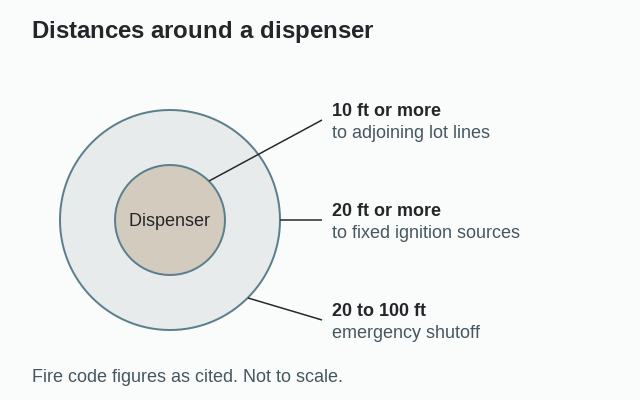
Fueling position geometry and fire code distances
IFC Section 2303.1 reaches the site through state and local fire codes, with local amendments; NFPA 30A itself is paywalled, so its figures below come from committee documents and state adoptions, and the plan is checked against the edition the fire marshal has adopted.
| Provision | Requirement | Source |
|---|---|---|
| Dispenser to lot lines (IFC 2303.1 item 1, as adopted in Seattle, North Carolina and Virginia) | 10 ft or more from adjoining buildable lot lines | [2, 1] |
| Nozzle reach (IFC 2303.1 items 3 and 4) | The fully extended hose may not reach within 5 ft of building openings; the vehicle is fueled wholly on the premises | [2] |
| Dispenser to buildings with combustible or non-rated walls (IFC 2303.1 item 2) | 10 ft or more | [5] |
| Dispenser to fixed ignition sources (IFC 2303.1 item 5) | 20 ft or more | [5] |
| Smoking and open flames (IFC 2305.4, Virginia text) | Prohibited within 20 ft of dispensers | [1] |
| Physical protection (13VAC5-52-280) | Dispensers within 10 ft of vehicle traffic sit on a 6 in concrete island or get Section 312 protection | [1] |
| Vapor processing (IFC 2306 as amended in Virginia) | 10 ft from buildings or buildable lot lines; 20 ft from dispensers | [1] |
| Emergency shutoff (NFPA 30A §6.7, 2021 edition as adopted in NH; IFC 2303.2) | Not less than 20 ft nor more than 100 ft from dispensers, with an added device per island group | [4, 5] |
| Portable extinguishers (NFPA 30A, 2021 edition as adopted in NH) | 75 ft maximum travel | [4] |
| EV charging outdoors (NFPA 30A §15.3.2, second-draft revision; adopted edition text not confirmed) | 20 ft or more in all directions from a dispensing device; the revision moved distances to property lines and buildings out of the chapter | [3] |
| Ignition sources (NFPA 30A First Revision; adopted edition text not confirmed) | Not within 20 ft of fueling areas | [11] |
| Mobile fueling (NFPA 30A Ch. 14, 2018 cycle committee document) | 10 ft from property lines; hose 50 ft maximum | [12] |
| Seattle local amendment (2021 Seattle Fire Code) | Tanks and dispensers 20 ft from the public way and any lot line | [2] |
A committee memo describes the charger distances as "consistent with maximum separation distances for dispensers in NFPA 30A 6.2.1" [13]; the edition each state has adopted still governs. On the plan, that 20 ft distance keeps chargers out of the island zone.
Local reviews test the fuel truck path. In Gwinnett County case CIC2023-00020, a 0.99 ac C-2 site with a 7,200 SF multi-tenant building and 4 pumps proposed a 37.5 ft pump aisle, and staff wrote that "the site offers limited maneuverability for any fuel truck entering the site" before recommending denial [14]. Fuel truck circulation from the street to the tank fill and back out is drawn on the plan, not assumed.
Access and circulation
On Georgia state routes, GDOT's driveway regulations set commercial driveway widths of 16 to 20 ft one-way and 24 to 40 ft two-way [15], recommend a minimum signal spacing of 1,000 ft [16], and, at 65 mph, a right-turn deceleration lane of 350 ft plus a 100 ft taper [17]. GDOT also requires that "The distance between the roadway traffic and the first internal movement shall be a minimum of 200 feet," with 100 ft for lots less than 500 ft deep (Section 3A-3) [18]. That internal throat is a hard constraint on small corner parcels. County staff condition access as well: the conditions staff drafted for RZC2023-00002, in case the Board approved it, limited access to right-in only on the arterial and added right-turn deceleration lanes at the entrances [19]. Inside Gwinnett's Gateway 85 Overlay, "Driveways may not be located on a Priority Corridor when vehicular access is available from a right-of-way that is not classified as a Priority Corridor" (UDO 220-50.8.A) [20]. Corner sites are drawn from the permitted driveway locations inward.
Canopy and lighting
Codes regulate three things under the canopy: recessed or flush lenses, no illuminated fascia, and a footcandle cap. The caps found run from 20 to 35 fc; vendor guidance of 30 to 50 fc exceeds most of them [21].
| Jurisdiction | Code | Standard |
|---|---|---|
| SeaTac, WA | Ch. 17.36 | 1.0 to 5.5 fc minimum; 4:1 uniformity; 22 fc maximum; cutoff at 85 degrees; no fascia lights [22] |
| Dyer, IN | §10-148.6 | 22.0 fc average maximum; existing stations conform on remodel [23] |
| Raleigh, NC | Lighting ordinance guide | Under 24 maintained fc; 0.5 fc at residential lines [24] |
| Provo, UT | §15.21 | Fully recessed; 1 to 5.5 fc minimum; 4:1 [25] |
| Hartland Twp, MI | Amendment 18-001 (2018) | Fuel canopy maximum raised from 10 fc to 20 fc [7] |
| Waukee, IA | §160.06 | 35 fc average; 2 fc maximum at property lines [8] |
| Franklin, MI | Lighting ordinance (Aug 24, 2023) | 0.2 fc at residential lines; fully recessed [26] |
| Gwinnett County, GA | Architectural Design Standards 4.3.2.B | Under-canopy lighting at gas and service islands must use fully recessed fixtures [27] |
Canopy placement and form are regulated too. A Gwinnett County handout says pumps and canopies are allowed in front yards in commercial districts, a secondary paraphrase of UDO Sec. 230-120 [28]. Gwinnett's Architectural Design Standards set a fully pitched canopy roof of at least 4 in 12 in Design Category 2 (ADS 5.3.2.A), and in Category 3 a pitch of at least 4 in 12 or a continuous cornice projecting at least 1 ft (ADS 6.3.2.A) [29]. The Raleigh-Durham metro page and the Iowa state page carry the local layers for two of the jurisdictions above.
Store size and parking
Recent filings in unincorporated Gwinnett County ran from 0.94 to 3.61 acres [14, 19, 30, 31, 32]. RZC2023-00002 proposed a 4,800 SF multi-tenant building, 8 fuel pumps, a 24 x 118 ft canopy and 13 spaces on 1.50 ac [19]; CIC2023-00020 a 7,200 SF multi-tenant building with 4 pumps and 23 spaces on 0.99 ac [14]; the RaceTrac application SUP2025-00011 covered 3.61 ac [32]. Gwinnett requires at least 1 parking space per 500 SF of store floor area (Table 240.1), with standard stalls of 9 ft x 18 ft [33]. Staff have criticized sub-1-acre sites for poor fuel truck maneuvering [14].
State UST programs
The federal floor is 40 CFR 280. Under its Subpart H, petroleum marketers carry $1 million per occurrence in financial responsibility; Missouri DNR states it as "typically $1 million per occurrence and $1 million annual aggregate," with $500,000 for non-marketers under 10,000 gallons per month and $2 million aggregate for owners of more than 100 USTs [34]. Under 40 CFR Part 282 an approved state program operates "in lieu of" the federal one [35], and EPA reports that "As of September 2021, 39 states plus the District of Columbia and the Commonwealth of Puerto Rico have approved programs" [36]. Cross-checking reserved eCFR sections against EPA's count, eleven states do not hold State Program Approval: Alaska, Arizona, California, Florida, Illinois, Michigan, New Jersey, New York, Ohio, Wisconsin and Wyoming [35, 36]. The table shows the states where the agency, rule and fees were read from primary sources; elsewhere fees are confirmed per project.
| State | Agency and rule | Fees | Timing and fund |
|---|---|---|---|
| Texas | TCEQ, 30 TAC Ch. 334 | $0 since September 1, 2007; $650 per tank facility plan fee in Edwards Aquifer zones [9, 37] | Construction notice at least 30 days before [9]; installer or on-site supervisor license number on Form TCEQ-00724 [38] |
| Florida | DEP, Ch. 62-761 F.A.C. | $50 initial, $25 annual renewal due July 1, $20 late fee, per tank [39, 40] | Inland Protection Trust Fund |
| Georgia | EPD, Rule 391-3-15 | No per-tank fee found; Environmental Assurance Fee $0.0075/gal [41] | GUST Trust Fund, $10,000 deductible [41]; Form 7530 within 30 days of adding tanks; annual registration August 1 to December 31 [42, 43] |
| North Carolina | DEQ UST Section | $420 per tank or compartment per year [10] | Commercial and Noncommercial Funds |
| Ohio | BUSTR; PUSTRCB | $100 per tank per year; program-year fund fee $350 per tank ($55,000 deductible) or $550 per tank ($11,000 deductible) [44, 45] | Mandatory financial assurance fund |
| Pennsylvania | DEP, 25 Pa. Code Ch. 245 | USTIF throughput fee $0.011 per gallon delivered [46, 47]; capacity fee $0.0825 per gallon; a flat tank fee is authorized but not imposed [48]; DEP-certified installers (§245.110) [49], $1,000 annual TIIP fee [46, 47] | USTIF, mandatory; $1.5M per tank per occurrence [48] |
| Kentucky | EEC, 401 KAR 42:020 | $30 per year per tank (KRS 224.60-150) [50, 51] | PSTEAF |
| Rhode Island | DEM | $100 per tank per year; $35 late fee [52] | Not stated |
| Iowa | DNR UST Section | $10 one-time per tank plus $65 per year for tanks of 1,100 gal or more; $250 late fee [53, 54] | Not stated |
| Nebraska | State Fire Marshal; Department of Water, Energy, and Environment (fund) | Up to $60 per tank per year plus $90 per tank for the fund [55] | Petroleum Release Remedial Action Fund |
| Alabama | ADEM, Ala. Admin. Code 335-6-15 and 335-6-16 | Trust Fund tank fee $0 (cap $150) plus $0.01 per gallon charge [56] | Alabama Underground and Aboveground Storage Tank Trust Fund; owner covers $5,000 per occurrence [56] |
| Colorado | CDLE Division of Oil and Public Safety, 7 CCR 1101-14 (revised effective Jan. 1, 2025) | $35 per tank; $150 installation plan review [57] | Petroleum Storage Tank Fund |
| District of Columbia | DOEE | $130, $390 or $650 per tank by capacity, prorated monthly; $200 per tank installation review; contractor registration $200 first time, a separate fee [58] | Not stated |
| Indiana | IDEM Office of Land Quality | Not stated | Excess Liability Trust Fund; $1M for 1 to 100 systems, $2M over 100 [59] |
| Vermont | DEC, Vermont UST Rules | Not stated | State Petroleum Cleanup Fund; $500,000 or $1M per occurrence by throughput [60] |
Fund terms vary more than registration fees: Ohio's fund offers an $11,000 or a $55,000 deductible, and Pennsylvania's USTIF is mandatory [45, 46]. The Georgia state page, Tennessee, Rhode Island and Nebraska pages carry each state's wider approval layer. See also our post on tanks, traffic and regulations.
Separation from homes, schools and corridors
| Jurisdiction | Rule |
|---|---|
| Prince George's County, MD | Zoning Sec. 27-358(a), special exception: nearest pump 300 ft from any lot with a school, outdoor playground, library, hospital or residence; 150 ft frontage on a 70 ft right-of-way [6] |
| Rome, GA | Development standards: 600 ft from schools, day cares and churches (reducible to 300 ft in planned centers); 1,000 ft from other convenience gas stations; 300 ft from single-family zoning [61] |
| Montgomery County, MD | ZTA 12-07 (2012): large stations (over 3.6M gallons per year) 300 ft from listed sensitive lots [62] |
| Los Angeles | LAMC §12.24 W.2: fueling stations in C1.5 and C4 are conditional uses, and the site must abut a major or secondary highway [63] |
| Phoenix | ZO §623: tractor-trailer stacking and loading docks at least 60 ft from residential zoning [64] |
| Frisco, TX (DFW benchmark) | §4.21: buildings, gasoline pump islands and fuel storage tanks at least 250 ft from any residential zoning district [65] |
| Gwinnett County, GA | C-2 buffer of 75 ft next to residential (Table 610.1, 2014 edition) [66]; case records show 50 to 75 ft undisturbed buffers to single-family zoning [19, 14] |
| Petaluma, CA | Citywide ban on new stations [67] |
Nearby stations count against an application even where no spacing rule exists: Gwinnett staff cite them in denial recommendations ("Existing convenience stores with fuel pumps are located approximately less than one mile...") [19]. Buffer cuts are the most visible failure: RZC2023-00002 (1.50 acres) asked to reduce its buffer to 0 ft and drew a denial recommendation [19].
EV charging at fuel sites
Petaluma, California adopted ordinances on Mar 1, 2021 that prohibit new gas stations and new pumps while letting existing stations add EV chargers; the city cited its climate emergency and a goal of carbon neutrality by 2030, and had 16 stations at the time [67, 68]. New Jersey's P.L. 2021, c.171 (effective Sept. 1, 2021) makes EVSE or make-ready parking spaces at new parking lots a condition of preliminary site plan approval, so it reaches fuel sites that add parking [69]. California Gov. Code 65850.7 (AB 1236) requires administrative approval of EV charging permits, and the Attorney General's Legal Alert OAG-2025-01 reminds localities that they must comply [70, 71]. Federally funded corridor sites under 23 CFR Part 680 (NEVI, Feb. 28, 2023) need at least four networked DC fast charging ports, each able to deliver 150 kW simultaneously, maintained for 5 years [72]. Warren, Michigan's moratorium covers gas stations, though pumps may still be added to an existing station with site plan approval [73]. No local ordinance requiring EV chargers at gasoline stations specifically was located in these sources. Gwinnett County gives a 5% building permit fee reduction for EV charger installations (Fee Schedule effective July 1, 2024) [74]. On the plan, chargers sit at least 20 ft from dispensers under the NFPA 30A second-draft revision [3].
Approval paths
| Path | Example | What opens discretion |
|---|---|---|
| By right | Gwinnett C-3: the use table lists "Convenience Store, with Fuel Pumps" as permitted [75] | Design standards and overlay rules |
| Special use permit | Gwinnett C-2 (UDO 270-30): $1,000 for 0 to 5 acres, $100 per concurrent variance or waiver, $250 sign (Fee Schedule effective July 1, 2024) [74]; required even in C-3 inside the Gateway 85 Overlay (UDO 220-50.4.G) [20] | Planning Commission and Board of Commissioners hearings |
| Special exception | Prince George's County Sec. 27-358, with frontage, right-of-way and 300 ft separation tests [6] | Locational findings |
| Conditional use | Los Angeles C1.5 and C4 zones (§12.24 W.2) [63] | Highway frontage, adjacency |
| Not permitted | Gwinnett C-1 [75]; new stations citywide in Petaluma [67] | Rezoning, where available |
| Moratorium | Warren, MI approved an up to 8-month moratorium on gas stations and car washes on May 19, 2026, freezing "new site plan applications, special land use applications, or other zoning approvals" [73]; Roseville, MI extended its gas station and car wash moratoria 180 days in May 2026 (news report) [76] | Any new application |
| No zoning | Unincorporated Texas counties regulate through platting, drainage, floodplain and fire code; see the truck stop hub | Plat and permit conditions |
The hearing record decides how hard the special use path is. In unincorporated Gwinnett, the Board of Commissioners denied SUP2024-00015 (3.12 acres) on June 25, 2024 and SUP2025-00010 (0.94 acre) on May 20, 2025, both 5-0 [30, 31], and the Board hears no more than 8 special use permit requests a month [77]. The Gwinnett County model project, the Georgia gas station page and the Atlanta metro page carry that record in full.
Which stages take an unsealed plan. Gwinnett's pre-application meeting takes a concept plan uploaded to the county portal, and zoning site plans are conceptual: the RZC2023-00002 plan is marked "NOT RELEASED FOR CONSTRUCTION" [19, 77]. The zoning submittal still needs a registered surveyor's boundary survey and a Traffic Impact Study by a GDOT-prequalified engineer in Area Class 3.06 [77]. Development and building permit drawings come from the engineer and architect of record, built on the preliminary plan.
What the engineer of record adds
| Element | Preliminary site plan | Engineer, architect or surveyor of record |
|---|---|---|
| Boundary, setbacks, buffers, landscape strips | Drawn from the survey | Boundary survey by a registered surveyor |
| Canopy, dispensers, store, fire code distances | Drawn and dimensioned | Canopy structure, electrical, fire protection |
| Driveways, parking with calculations, dumpster | Drawn | Access design, deceleration lanes, Traffic Impact Study |
| Lot coverage, floor area ratio, heights | In the site data table | Not applicable |
| Floodplain, wetlands, state waters | From mapped data | Field delineation |
| Stormwater facilities | Location and type | Sizing, grading, hydrology, erosion control |
| Tank field | Location | Tank and piping design, leak detection; in Georgia, Form 7530 and the EPD installation checklist [78] |
| Elevations of store and canopy | Massing and 3D views | Architect of record |
Renderings for design review
Canopies get reviewed as architecture. In Sturbridge, Massachusetts, a review committee assessed renderings, a photo of existing conditions and a site plan, then approved a 48 x 48 ft canopy without logo or lettering [79]. In Pleasanton, California, staff recommended denial of a station rebrand because about 66% of the canopy fascia carried franchise colors; the Planning Commission approved it with the color band capped at 50% of fascia height and canopy lighting off at 10 p.m. [80]. Gwinnett requires color elevations of every side of the store, and "Elevations meeting these requirements are also required for proposed canopies" [77]. The studio's 3D rendering service builds those views from the site plan.
Related pages
- The car wash site plan hub, for washes that share a fuel pad.
- The truck stop and travel center hub, for diesel lanes and truck parking, and the Waller County truck stop model project.
- Fuel by state: the Texas gas station page and the Georgia gas station page.
- Posts: gas station site plan standards and designing high-throughput gas stations.
Frequently asked questions
How far must an EV charger be from a gas dispenser?
20 ft or more in all directions from a dispensing device, under NFPA 30A §15.3.2 as revised in the committee's second draft; that revision moved distances to property lines and buildings out of the chapter [3]. The adopted edition's text is not confirmed, so check which edition the fire marshal has adopted.
How far must a fuel dispenser be from the property line?
At least 10 ft from adjoining buildable lot lines under IFC 2303.1 as adopted in Seattle, North Carolina and Virginia, and the fully extended hose may not reach within 5 ft of building openings [2, 1]. Seattle's local amendment sets 20 ft from the public way and any lot line for tanks and dispensers [2].
Where does the emergency shutoff go?
How far must a gas station be from a school?
How bright can gas station canopy lighting be?
What does UST registration cost?
Can I build a gas station by right in Gwinnett County?
Do new fuel sites have to include EV chargers?
Sources
- 1)13VAC5-52-280, IFC Chapter 23 Motor Fuel-Dispensing Facilities and Repair Garages, Virginia Administrative Code (Virginia Law Library). Accessed 2026-10-10.
- 2)Seattle Fire Code 2021, Chapter 23, Motor Fuel-Dispensing Facilities and Repair Garages, City of Seattle. Accessed 2026-10-10.
- 3)Second Revision No. 1, NFPA 30A (Second Draft Report), National Fire Protection Association. Accessed 2026-10-09.
- 4)REM-41 (2025): Additional Operating Requirements for Unattended Self-Service Motor Fuel Dispensing Facilities, New Hampshire Department of Environmental Services. Accessed 2026-10-09.
- 5)Fuel dispensing operations code checklist (2018 handout), NFBOA (building officials' handout). Accessed 2026-10-10.
- 6)Prince George's County Code Sec. 27-358, Gas station, Prince George's County, Maryland (Municode). Accessed 2026-10-10.
- 7)Hartland Township Planning Commission packet, August 27, 2018 (Amendment 18-001), Hartland Township, Michigan. Accessed 2026-10-09.
- 8)Waukee Code § 160.06, Lighting Standards, Design Guidelines, City of Waukee, Iowa (American Legal Publishing). Accessed 2026-10-09.
- 9)Petroleum Storage Tanks Registrations: Am I Regulated?, Texas Commission on Environmental Quality. Accessed 2026-10-10.
- 10)NC DEQ Permit Directory: Underground Storage Tank operating permit, North Carolina Department of Environmental Quality. Accessed 2026-10-09.
- 11)First Revision No. 30, NFPA 30A (First Draft Report), National Fire Protection Association. Accessed 2026-10-09.
- 12)NFPA 30A Second Draft supplemental agenda (mobile fueling, Chapter 14), National Fire Protection Association. Accessed 2026-10-09.
- 13)Memorandum to the Technical Committee on Automotive and Marine Service Stations (TIA ballot, NFPA 30A), National Fire Protection Association. Accessed 2026-10-09.
- 14)Case report CIC2023-00020, Planning Commission public hearing August 1, 2023, Gwinnett County Planning and Development, Georgia. Accessed 2026-10-10.
- 15)Regulations for Driveway and Encroachment Control, Chapter 4, Georgia Department of Transportation. Accessed 2026-10-09.
- 16)Regulations for Driveway and Encroachment Control (manual copy), Georgia Department of Transportation (via LCPC) (no longer online; accessed 2026-10-09).
- 17)Access Management Standards Policy (SR 400/SR 365 study, Appendix G), Georgia Department of Transportation. Accessed 2026-10-09.
- 18)Regulations for Driveway and Encroachment Control, Chapter 3, Georgia Department of Transportation. Accessed 2026-10-10.
- 19)Case report RZC2023-00002, Gwinnett County Planning and Development, Georgia. Accessed 2026-10-10.
- 20)UDOA2023-00002 (Gateway 85 Overlay and Chapter 270 amendments, adopted June 27, 2023), Gwinnett County Board of Commissioners. Accessed 2026-10-10.
- 21)Gas Station Lighting (vendor guidance, secondary), LED Lighting Supply. Accessed 2026-10-09.
- 22)SeaTac Municipal Code Chapter 17.36, Gasoline/Service Station and Convenience Store Lighting, City of SeaTac, Washington (Code Publishing). Accessed 2026-10-09.
- 23)Dyer Code Sec. 10-148.6, General Lighting Design Requirements, Town of Dyer, Indiana (American Legal Publishing). Accessed 2026-10-09.
- 24)A Guide to the Raleigh Lighting Ordinance, City of Raleigh, North Carolina. Accessed 2026-10-09.
- 25)Provo City Code 15.21.060, Lighting of Gasoline Station/Convenience Store Canopies, Provo City, Utah. Accessed 2026-10-09.
- 26)Village of Franklin lighting ordinance (revision prepared August 24, 2023), Village of Franklin, Michigan. Accessed 2026-10-09.
- 27)Gwinnett Architectural Design Standards § 4.3.0, Commercial and Non-Residential Canopy Structures (code mirror), Gwinnett County, Georgia (eLaws). Accessed 2026-10-09.
- 28)Commercial common code violations (revised 8.31.23), Gwinnett County Planning and Development, Georgia. Accessed 2026-10-10.
- 29)Gwinnett UDO Appendix, Architectural Design Standards, Gwinnett County, Georgia. Accessed 2026-10-10.
- 30)Official Public Hearing Minutes, June 25, 2024, Gwinnett County Board of Commissioners, Georgia. Accessed 2026-10-10.
- 31)Official Public Hearing Minutes, May 20, 2025, Gwinnett County Board of Commissioners, Georgia. Accessed 2026-10-10.
- 32)Amended Public Hearing Agenda, July 22, 2025, Gwinnett County Board of Commissioners, Georgia. Accessed 2026-10-09.
- 33)Gwinnett UDO § 240-20, Parking Space Requirements (code mirror), Gwinnett County, Georgia (eLaws). Accessed 2026-10-09.
- 34)Underground Storage Tank Financial Responsibility, Missouri Department of Natural Resources. Accessed 2026-10-10.
- 35)40 CFR Part 282, Approved Underground Storage Tank Programs, Electronic Code of Federal Regulations. Accessed 2026-10-09.
- 36)List of States With Approved UST Programs and Respective Federal Register Notices, US Environmental Protection Agency. Accessed 2026-10-09.
- 37)Underground Storage Tank Facility Plan (Edwards Aquifer), Texas Commission on Environmental Quality. Accessed 2026-10-09.
- 38)TCEQ-00724, Underground Storage Tank Registration and Self-Certification, Texas Commission on Environmental Quality. Accessed 2026-10-10.
- 39)Fla. Admin. Code R. 62-761.400, Facility Registration, Florida Department of Environmental Protection (eLaws mirror). Accessed 2026-10-09.
- 40)Florida Statutes § 376.303, Florida Legislature. Accessed 2026-10-09.
- 41)What is the GUST Trust Fund?, Georgia Environmental Protection Division. Accessed 2026-10-10.
- 42)Ga. Comp. R. & Regs. Subject 391-3-15, Underground Storage Tank Management, Georgia Secretary of State. Accessed 2026-10-09.
- 43)UST Tank Registration, Georgia Environmental Protection Division. Accessed 2026-10-10.
- 44)Tips From Frank the Tank: What Does Ohio Law Say About Owning/Operating USTs, Ohio Petroleum Underground Storage Tank Release Compensation Board. Accessed 2026-10-09.
- 45)Financial assurance fund coverage, Ohio Petroleum Underground Storage Tank Release Compensation Board. Accessed 2026-10-10.
- 46)25 Pa. Code Chapter 977, Underground Storage Tank Indemnification Fund, Pennsylvania Code and Bulletin. Accessed 2026-10-09.
- 47)2024 USTIB Fee Evaluation, Pennsylvania Underground Storage Tank Indemnification Fund. Accessed 2026-10-09.
- 48)Owner and Operator Fees, Pennsylvania Underground Storage Tank Indemnification Fund. Accessed 2026-10-10.
- 49)25 Pa. Code Chapter 245, Administration of the Storage Tank and Spill Prevention Program, Pennsylvania Code and Bulletin. Accessed 2026-10-09.
- 50)401 KAR 42:020, UST system requirements, notification, registration, and annual fees, Kentucky Administrative Regulations (via Cornell LII). Accessed 2026-10-09.
- 51)Underground Storage Tank Branch, Administrative Services Section, Kentucky Energy and Environment Cabinet. Accessed 2026-10-09.
- 52)DEM Underground Storage Tank Registration, State of Rhode Island. Accessed 2026-10-09.
- 53)Underground Storage Tank FAQ (updated May 2025), Iowa Department of Natural Resources. Accessed 2026-10-09.
- 54)UST Section Registration Form, DNR Form 542-3266, Iowa Department of Natural Resources. Accessed 2026-10-09.
- 55)Underground Storage Tanks, Nebraska State Fire Marshal. Accessed 2026-10-09.
- 56)Alabama Underground and Aboveground Storage Tank Trust Fund guidance (February 2024), Alabama Department of Environmental Management. Accessed 2026-10-10.
- 57)Ownership and operation (storage tanks), Colorado Department of Labor and Employment, Division of Oil and Public Safety. Accessed 2026-10-10.
- 58)DC Underground Storage Tank Program Fine and Fee Structure, District of Columbia Department of Energy and Environment. Accessed 2026-10-10.
- 59)Financial Responsibility, Storage Tanks, Indiana Department of Environmental Management. Accessed 2026-10-10.
- 60)UST Newsletter (December 20, 2024), Vermont Department of Environmental Conservation. Accessed 2026-10-10.
- 61)Convenience Store and Gas Station Development Standards, City of Rome, Georgia. Accessed 2026-10-10.
- 62)PHED Committee memorandum, July 5, 2012 (ZTA 12-07), Montgomery County Council, Maryland. Accessed 2026-10-10.
- 63)Los Angeles Municipal Code Sec. 12.24, Conditional Use Permits and Other Similar Quasi-Judicial Approvals, City of Los Angeles (American Legal Publishing). Accessed 2026-10-09.
- 64)Phoenix Zoning Ordinance Section 623, Commercial C-2 District, Intermediate Commercial, City of Phoenix, Arizona. Accessed 2026-10-09.
- 65)Frisco Zoning Ordinance Subsection 4.21, Supplementary Regulations, City of Frisco, Texas (eCode360). Accessed 2026-10-09.
- 66)UDOA2014-00002, Table 610.1 Minimum Buffer Requirements, Gwinnett County Board of Commissioners, Georgia. Accessed 2026-10-09.
- 67)RCPA Board Item 4.6, Local Gas Station Land Use Prohibition (July 2021), Sonoma County Regional Climate Protection Authority. Accessed 2026-10-09.
- 68)Petaluma becomes first city in the U.S. to ban new gas stations, KTVU (secondary). Accessed 2026-10-10.
- 69)EVSE requirements for new multi-unit dwelling construction (MUD toolkit), New Jersey Department of Environmental Protection. Accessed 2026-10-10.
- 70)Legal Alert OAG-2025-01, California Department of Justice, Office of the Attorney General. Accessed 2026-10-10.
- 71)AB 1236 Senate Floor Analysis (September 3, 2015), California Legislature. Accessed 2026-10-10.
- 72)National Electric Vehicle Infrastructure Standards and Requirements (23 CFR Part 680), Federal Register. Accessed 2026-10-10.
- 73)Moratorium on Car Washes and Gasoline Stations (notice), City of Warren, Michigan. Accessed 2026-10-10.
- 74)Planning and Development Fee Schedule (effective July 1, 2024), Gwinnett County, Georgia. Accessed 2026-10-10.
- 75)Gwinnett County UDO Title 2, Land Use and Zoning (amended October 2025), Gwinnett County, Georgia. Accessed 2026-10-10.
- 76)Warren passes moratorium on approval of new gas stations, car washes (Detroit Free Press, syndicated), AOL (secondary). Accessed 2026-10-10.
- 77)Procedures and Instructions: Rezoning, Change in Conditions and Special Use Permit, Gwinnett County Planning Division, Georgia. Accessed 2026-10-10.
- 78)Georgia EPD Checklist for New UST Installations, Georgia Environmental Protection Division. Accessed 2026-10-09.
- 79)Design Review decision, Lucky Mart, 122 Main Street, Town of Sturbridge, Massachusetts (no longer online; accessed 2026-10-07).
- 80)Pleasanton council to review proposed gas station rebrand near downtown, Pleasanton Weekly. Accessed 2026-10-07.