What changes a site plan in Wisconsin
Five conditions specific to Wisconsin change how a site plan is drawn or approved here. Each is set by statute or state code before any local checklist applies.
1. The state review trigger is building volume, not floor area. DSPS plan review is required for commercial, industrial and other public buildings of 25,000 cubic feet or larger, and for a school, a high-hazard occupancy or a residential building of three or more units at any size [1]. Total building volume is the space within the outer surfaces of the enclosing walls, between the uppermost surface of the roof and the underside of the lowest floor. Where a structure has no enclosed walls, its outer surface is set by projecting vertical planes from the exterior supports or columns; roof overhangs less than 24 inches from a vertical wall are left out, and dormers, penthouses, vaults, pits and enclosed porches are counted [6]. Open-sided structures carry volume too, so footprint and height on the site plan decide the review track.
2. The 50,000 cubic foot line decides who prepares the plans. Under Wis. Stat. 443.15(2), nothing in chapter 443 prevents any person, firm or corporation from making plans and specifications for a new building of less than 50,000 cubic feet total volume, or for an addition or structural alteration that leaves the building under that volume [7]. Above it, the DSPS commercial checklist requires plans prepared, signed, sealed and dated by a Wisconsin-registered engineer, architect or designer under SPS 361.31(1), with original signatures and seals [2]. Buildings over 50,000 cubic feet total volume also need supervising professionals who file compliance statements with DSPS and the local code officials before occupancy (SPS 361.40(4)) [8]. For this count, a multiple family building with a common roof and party walls is one building (443.15(3)) [7].
3. State approval of the building is not approval of the site. The commercial code says so directly: departmental review under SPS 361.60(5)(e) does not satisfy any need for municipal review of the plans for conformance with local requirements [9]. The exemptions from state submittal do not stop a municipality from requiring its own submission, review and approval of plans, and do not replace local building permits [10]. A Wisconsin project therefore carries two approvals that proceed separately: the building with DSPS or its delegated agent, and the site with the local government. In unincorporated territory the town and the county review separately. Waukesha County staff review a Site Plan and Plan of Operation within three weeks of a complete packet and fee, and the applicant files an identical packet with the Town Planning Commission for its own agenda [11].
4. Conditional uses are decided on substantial evidence, and local rules freeze at filing. Under 2017 Wisconsin Act 67, if an applicant meets or agrees to meet all of the requirements and conditions in the ordinance or imposed by the zoning board, the municipality shall grant the conditional use permit. Each condition must relate to the purpose of the ordinance, rest on substantial evidence, and be reasonable and, to the extent practicable, measurable [12]. The applicant must show that all requirements and conditions are or shall be satisfied, and the decision to approve or deny must itself be supported by substantial evidence [12]. The rule runs through county, town and city law at Wis. Stat. 59.69(5e), 60.61(4e) and 62.23(7)(de) [13]. Separately, Wis. Stat. 66.10015, in effect since 14 December 2013, locks the local land use rules for a project as of the owner's first application for a local approval, and an amendment effective 27 April 2016 bars down zoning without a two-thirds vote of the governing body or the landowner's consent [14]. A site plan that answers each ordinance standard on the sheet is the evidence the applicant files, and an early complete filing fixes the rules it is measured against.
5. Access to a state trunk highway is decided at platting. No driveway permit under Trans 231 may issue for a private road or driveway that connects directly with a state trunk highway and serves a land division, unless the land division was created before 1 February 1999 or meets Trans 233. If the land division as built differs substantially from the map reviewed, any permit issued for it is void and may be summarily canceled [15]. Direct access needs a special exception under Trans 233.11, with a restriction on the face of the land division map that access is confirmed only through the driveway permitting process. WisDOT may not issue a permit under Wis. Stat. 86.07 before favorable review of the preliminary plat, and denial of a special exception is appealable only by certiorari under Wis. Stat. 236.13(5) [16].
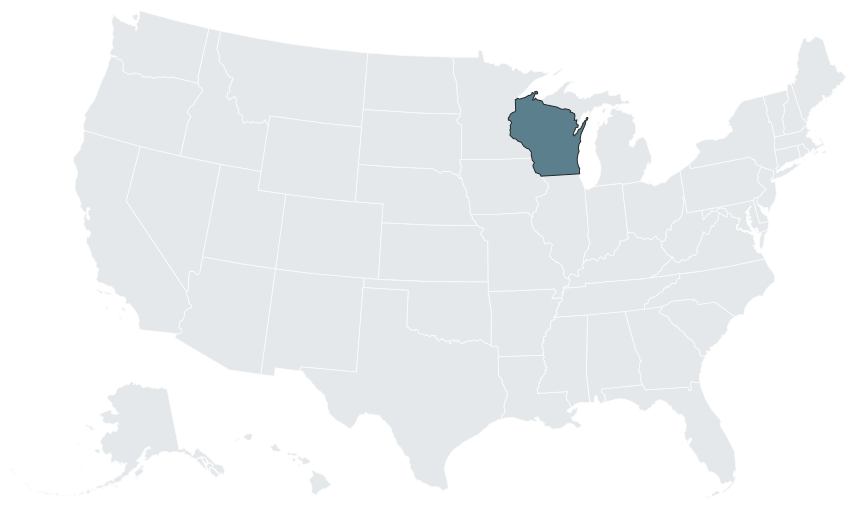

Approval layers: state, county, town and municipality
| Layer | Body | What it decides |
|---|---|---|
| State | DSPS Division of Industry Services | Commercial Building Code, chapters SPS 361 to 366; plan review at 25,000 cubic feet; submittals through eSLA only [1, 17] |
| State, delegated | City of Milwaukee, many second class cities, certified municipalities | Building plan review inside their boundaries; outside Milwaukee the submitter may choose the municipality or DSPS [17] |
| State | Department of Health Services | Hospitals, nursing homes and CBRFs [17] |
| State | DNR | Construction stormwater (NR 216), post-construction standards (NR 151), wetlands (Wis. Stat. 281.36), waterways (ch. 30) and shoreland minimums [18, 19, 20, 21, 3] |
| State | WisDOT | Driveways onto state trunk highways (Trans 231) and access from land divisions (Trans 233) [15, 16] |
| State | DATCP | Campgrounds (ATCP 79), hotels and tourist rooming houses (ATCP 72), fuel and storage tanks (ATCP 93) [22, 23, 24] |
| County | Planning and zoning office, zoning committee | County zoning and shoreland zoning on unincorporated land; conditional uses under 59.69(5e) [3, 13] |
| Town | Town plan commission and town board | Town zoning and conditional uses under 60.61(4e) and 60.62(4e); its own review of the site plan packet [13, 11] |
| City or village | Plan commission, common council or village board | Zoning, site plan review and conditional uses under 62.23(7)(de) [13] |
Delegation sets the speed of the building track. DSPS defines the small commercial envelope a certified municipality can review: a new building of less than 50,000 cubic feet; an addition containing no more than 2,500 square feet and one floor level, with the largest roof span not over 18 feet and exterior walls not over 12 feet; and an alteration in a building of less than 100,000 cubic feet [25]. An appointed agent under Wis. Stat. 101.12(3g) reviews commercial buildings without size limitation [26]. Under 2017 Wisconsin Act 330 and Wis. Stat. 101.02(7r)(g)2., no county, city, village or town may enforce an ordinance more restrictive than the department in administration of the code, which covers the permit process for a public building or place of employment [10]. That limit reaches building permit procedure, not zoning or site plan rules.
Who prepares and seals a Wisconsin site plan
The building and the site carry different seal rules. On the building side, the 50,000 cubic foot line governs: below it, Wis. Stat. 443.15(2) leaves plan preparation open; above it, a Wisconsin-registered engineer, architect or designer prepares, signs, seals and dates the plans, and the designer named on the DSPS form is responsible for the plans' compliance under SPS 361.20(2) and 361.31(1) [7, 2]. A registrant may not seal documents not prepared by the registrant or under his or her direction and control (Wis. Stat. 443.17(1)) [27].
On the site side, municipalities set the rule. Appleton's Sec. 20-321 requires a post-construction runoff permit for any land disturbing construction activity other than one- and two-family lots; the application carries a stormwater management plan, grading plan, utility plan, landscape plan and an operation and maintenance agreement, and the initial submittal and the final approved plan are stamped by an engineer licensed in Wisconsin [28]. Land divisions run under Wis. Stat. ch. 236, and certified survey maps are prepared under 236.34; Waukesha County also requires a Certification of Compliance from its Land Resources Division under the county stormwater ordinance [29].
That is the frame for a preliminary site plan in Wisconsin. It carries the layout, buildings with their footprints and heights, internal roads, drive aisles, parking and the site data table, drawn without the engineering layer. The engineer of record designs the stormwater, grading and utility sheets and seals them; the architect, engineer or designer of record seals the building set where volume requires it. The guides on who prepares a site plan and preliminary versus final site plans set out that division, and the site plan architect page covers how the studio works with the professionals of record. For the stages at which jurisdictions take a plan before the sealed set exists, see where unsealed site plans are accepted.
Statewide overlays
| Overlay | Rule | Authority |
|---|---|---|
| Shoreland zoning | Unincorporated land within 1,000 feet of a navigable lake, flowage or pond or 300 feet of a navigable stream; 75-foot setback from the OHWM; no clear-cutting to 35 feet inland; access and viewing corridor no more than 30 percent of frontage or 200 feet; impervious surface up to 15 percent, or 30 percent with mitigation; sewered lots 65 feet wide and 10,000 SF, unsewered 100 feet and 20,000 SF. Cities and villages regulate shoreland wetlands under NR 117 | [3] |
| Lower St. Croix Riverway | NR 118 ordinances along the 52 miles from St. Croix Falls to Prescott, covering land division, uses, design and construction | [3] |
| Construction stormwater | NR 216: one acre of disturbance; erosion control and stormwater plans complete before the NOI; reapply when disturbance runs longer than 3 years | [4, 30, 18] |
| Post-construction | NR 151.12: 80 percent TSS reduction for new development, 40 percent for redevelopment. NR 151.124: infiltration of 75 percent of pre-development volume at more than 40 and up to 80 percent connected imperviousness, 60 percent above 80 percent, with no more than 2 percent of the site required as effective infiltration area | [31, 19] |
| Municipal stormwater | A municipality may adopt TSS standards stricter than NR 151 under Wis. Stat. 281.33(6)(a)2. | [32] |
| Wetlands | General permits WDNR-GP1-2023 (commercial and industrial) and WDNR-GP4-2023 (recreational) cover fill of no more than 10,000 square feet; DNR may require an individual permit under 281.36(3g)(i) | [20, 33] |
| Waterways | Ch. 30 general permits generally take 30 days through Water ePermitting; a Section 401 water quality certification is reviewed in parallel | [21, 34] |
| Private onsite wastewater | Wis. Stat. 145.195: no building permit for a structure needing a private sewage system until a compliant system exists or all permits to install one are obtained (SPS 383) | [35] |
| Snow drift on adjacent roofs | SPS 362.1608(2): a taller new structure within 20 feet of an existing roof on the same property triggers IBC 1608.1 analysis and strengthening if inadequate; on an adjoining property, the owner must notify the neighbor | [36] |
| Frost depth, dwellings | SPS 321.16: footings at least 48 inches below adjacent grade or below frost penetration, whichever is deeper; frost-protected shallow foundations to ASCE-32 | [37] |
The shoreland, stormwater and snow rules each fix ground that cannot be built on, so they belong on the concept sheet rather than in the permit set. The post on stormwater as a site plan variable covers how detention and infiltration areas reshape yield, and the IBC and IECC adoption map places Wisconsin's 2021 ICC edition against other states.
Top jurisdictions: process, fees and clocks
| Jurisdiction | Review body and path | Notes | Fees and clocks |
|---|---|---|---|
| Milwaukee | The city conducts its own building plan review, other than state-owned projects [17] | A planned development needs public hearings before the City Plan Commission and the Zoning, Neighborhoods and Development Committee, then goes to the full Common Council [38] | Planned development about 3 to 3.5 months [38]; Development Center fee schedule current as of 1 January 2026, under Chapter 81 and MCO 200-33 [39] |
| Madison | Plan Commission decides most land use applications; rezoning, annexation and subdivision go to the Common Council [40] | A rejection by any one agency sends revised plans back to all agencies, with a resubmittal fee [41] | 30-day written notice to the alder and associations before filing [41]; sign posted 21 days before the hearing, mailed notice within 200 feet [40] |
| Waukesha County | County Planning and Zoning Division plus the town plan commission [11] | A conditional use needs both the County Park and Planning Commission and the Town Planning Commission [42] | Staff review within three weeks of a complete packet [11]; zoning permit about two weeks after a complete packet, with a sanitary permit or preliminary site evaluation in it [43] |
| Green Bay | Commercial site plan review, summarized in the Site Plan Information Guide [44] | Lighting of more than 1,100 lumens per bulb needs an approved lighting plan [44] | Site statistics on the plan: site coverage, green and landscaped coverage, impervious against pervious coverage [44] |
| Appleton | The Planning Program administers site plan review and staffs the Plan Commission [45] | Post-construction runoff permit under Sec. 20-321, stamped by a Wisconsin-licensed engineer [28] | $100 non-refundable fee applied to actual review costs, billed about quarterly [28] |
| Oshkosh | Fully delegated for building, HVAC, plumbing, fire alarm and fire sprinkler plans of unlimited size, through E-Plan Exam [46] | A scanned stamped and signed title sheet goes with the upload [46] | 15 days turnaround guaranteed from a full and complete submission including fee [46] |
| Kenosha | E-Plan Exam for commercial building, HVAC and plumbing review [47] | Kenosha County runs site plan review inside its rezoning and conditional use process [48] | City review directly for new construction under 5,000 SF or alterations under 10,000 SF [47] |
| Wisconsin Dells and Lake Delton | Dells Plan Commission acts on the CUP and site plan together, then the Common Council [49]; Lake Delton's Zoning Administrator decides administrative approval or Village Board review [50] | Architectural Design and Landscape review in Lake Delton's overlay districts [51] | Lake Delton CUP deadlines 20 to 30 days earlier; staff documents due 4:30 p.m. the Wednesday before the meeting [50] |
| Eau Claire | Plan Commission of nine members has final review of site development plans and CUPs [52] | No council step for site plans or CUPs [52] | 7 business day completeness check before review starts; paper applications not accepted [53] |
| Eau Claire County | Planning and Development Committee grants CUPs after a public hearing, with Town Board input [54] | The applicant asks the Town Clerk separately for a Town Board agenda slot [54] | File by noon, three weeks before the committee hearing [54] |
Madison publishes its zoning fees under Sec. 28.206, current as of 12 February 2026 [55]:
| Madison application | Fee |
|---|---|
| Site plan review | $100, plus $50 per acre over 1 acre, up to a maximum of 5 acres or $300 |
| Reject or redraft resubmittal | 50 percent of the original fee |
| Conditional use, all other | $600 plus $100 per acre over 1 acre, maximum 20 acres or $2,500 |
| Zoning map amendment, PD(GDP) or PD(SIP) | $1,500 plus $200 per acre over 1 acre, maximum 20 acres or $5,300 |
| Certified survey map or land division | $250 plus $200 per lot or outlot |
| Variance | $500 |
State plan review fees sit in SPS 302 and are computed on gross square footage, not volume [56]:
| DSPS item | Fee |
|---|---|
| Plan entry fee, per separate submission | $100.00 |
| Permission to start construction | $75.00 |
| Revisions to previously approved plans | $75.00 |
| Resubmission within 8 months following denial | $250.00 per plan |
| Extension of plan approval | $120.00 |
| Petition for variance, SPS 361 to 366 | $550.00 per petition |
The code note works an example: a 15,000 square foot building with building, HVAC, fire alarm and fire suppression plans totals $1,750 under Table 302.31-1 [57]. Cities and counties not shown here run their own process; confirm the current checklist, fee schedule and portal with each before the first submittal. Statewide coverage is on the service areas page.
Asset registries
Wisconsin routes asset-specific approvals through DATCP, DSPS and DNR. These are the state layers for the classes the studio plans.
| Asset | State rule | Effect on the site plan |
|---|---|---|
| RV parks and campgrounds | Plan approval from DATCP or its agent before construction, or before changing the number or type of a campground attribute (ATCP 79.04) [58]; determination within 30 days after receipt of requested information [59] | No more than 20 sites per acre, 6 campers or one family per site (ATCP 79.11(5)) [60]; a campground building at least 10 feet from a camping unit; rustic campsites no more than one per acre and 400 feet apart; an RV up to 45 feet long [22] |
| Glamping and cabins | A camping cabin is 400 SF or less, including a yurt (ATCP 79.03(4)) [22] | An operator-provided unit over 400 sq ft needs a tourist rooming house license under ATCP 72 (ATCP 79.13(3)) [22] |
| Seasonal and event camping | Seasonal RVs carry an NFPA 1192 or ANSI 119.5 label and keep chassis and axles (ATCP 79.13(2)(a)); special event campsites at least 800 SF, license up to 14 days [22] | DSPS reviews a separate Campground and Recreational Vehicle Park plumbing plan [1] |
| Hotels | Licensed under ATCP 72 by DATCP or an agent county; Waukesha County, for example, administers ATCP 72 for hotels, motels and tourist rooming houses [23] | The building goes to DSPS or its delegated agent at 25,000 cubic feet or larger [1] |
| Gas stations and c-stores | ATCP 93.100 plan review and written approval, triggered among others by converting from fuel with 10 percent or less ethanol to more than 10 percent, or 5 percent or less biodiesel to more than 5 percent [24]; form TR-WM-126 with each installation application, plus the groundwater fee under Wis. Stat. 168.23 [61] | The program moved from DSPS to DATCP under 2013 Wisconsin Act 20, so older documents cite SPS 310, ILHR 10 or COMM 10 [62] |
| Car washes | DSPS plumbing plan review type "Car Wash Interceptor Only" [1] | A plumbing submittal of its own, beside the building plans and the local site approval |
| Marinas and waterfront | Ch. 30 waterway permits: general permit $350; individual permit for marina condos and dredging $900; boathouse certification $600; bulkhead line under Wis. Stat. 30.11 $900 [63] | Shoreland setbacks and impervious caps apply on unincorporated frontage [3] |
| Pools and water attractions | DSPS plan review categories Standard, Alternate, Experimental and Virginia Graeme Baker; a separate Waterslide-Structural commercial building submittal [1] | Separate submittals from the site approval |
| Self storage, industrial and warehouse | Local zoning, NR 216 and NR 151 stormwater, and DSPS building review at 25,000 cubic feet [1, 18, 19] | Building spacing within 20 feet of an existing roof brings the snow drift rule into the layout [36] |
The 50-state RV park site plan matrix compares Wisconsin's state campground code with states that leave density to local zoning, and the gas station permitting guide covers the tank and traffic layer.
Timelines and bottlenecks
| Step | Published timing | Source |
|---|---|---|
| DSPS commercial building plan review | 34 business days, DSPS published estimate | [1] |
| E-Plan Exam review in Oshkosh | 15 days guaranteed from a full and complete submission | [46] |
| DNR construction stormwater NOI | At least 14 working days before construction; fee refunded if no determination within 45 business days of receiving the information | [5, 64] |
| DNR waterway general permit | Generally 30 days after submission | [21] |
| DATCP campground plan approval | Within 30 days after receipt of requested information | [59] |
| Waukesha County site plan | Written staff review within three weeks | [11] |
| Eau Claire completeness check | 7 business days | [53] |
| Madison pre-application notice | 30 days before filing | [41] |
| Milwaukee planned development | About 3 to 3.5 months | [38] |
Five points hold Wisconsin schedules:
- The same drawings, two or three reviewers. DSPS or its agent reviews the building, the municipality reviews the site, and in unincorporated areas the town and the county each review a complete packet [11].
- Completeness gates. Eau Claire will not process an incomplete application, and its review period begins only on the date deemed complete [53]. At DSPS, missing information requested must arrive within 5 business days of the request, or the plan is subject to denial and a $60.00 fee [2].
- The all-agency reset. In Madison, one agency's rejection sends revised plans back for a new review by all agencies, with a resubmittal fee [41].
- Access at platting. A driveway permit onto a state trunk highway depends on the land division clearing Trans 233 first [15, 16].
- Septic before the building permit. On unsewered sites Wis. Stat. 145.195 bars the building permit until a compliant system exists or its permits are in hand [35], and Waukesha County requires a sanitary permit or a preliminary site evaluation in a complete zoning permit packet [43].
Proof points
Wisconsin Dells. A proposed amusement park on roughly 70 acres off Grand Cambrian Drive cleared the Plan Commission on a combined conditional use permit and phase 1 site plan approval on 8 March, with the Common Council scheduled one week later on 15 March [49]. The city spans two counties: one set of Plan Commission minutes records a multi-family CUP at 2960 Wisconsin Dells Parkway on a Sauk County parcel zoned C-4 Commercial Large Scale and a tourist rooming house CUP at 815 Church St on a Columbia County parcel zoned C-2 Commercial Downtown [65]. A Dells parcel may sit in either county, and the parcel number shows which.
Lake Delton. Plan Commission minutes record separate Architectural Design and Landscape review actions in the Waterfront Zoning and Overlay District and the Commercial Zoning and Parkway Overlay District, for a boat house addition, a hotel patio addition, and a waterpark addition with an outdoor waterslide, a concessions building and nine cabanas [51]. Overlay design review is its own action, separate from the site plan.
Dane County growth. The Regional Data Group projects Dane County at 887,000 by 2050, and Capital Area RPC puts the need at approximately 160,000 additional housing units by 2050 [66]. In 2025, Dane County drew $2.5 billion of direct visitor spending across 9.6 million visitors, and Wisconsin tourism reached $27 billion of economic impact on more than 118 million visits [67].
Where the preliminary plan fits
A Wisconsin project usually needs one drawing that answers four audiences before engineering is ordered: the town, county or city at pre-application, the lender, the general contractor pricing the work, and the engineer and designer of record who build the sealed sets. The volume of each building, the shoreland line and the highway access belong on that first sheet, with room left for the stormwater practices the engineer of record designs. The studio's site plan service draws that preliminary plan, and the site plan consultant page covers jurisdiction research and the approval path. Across the borders, the Minnesota, Iowa, Illinois and Michigan pages set out the neighboring regimes, and the Michigan RV park page covers that state's campground rules.
Frequently asked questions
Does the State of Wisconsin review my commercial site plan?
No. DSPS reviews buildings: commercial, industrial and other public buildings of 25,000 cubic feet or larger, plus any school, high-hazard occupancy or residential building of three or more units [1]. Departmental review does not satisfy any need for municipal review of the plans for conformance with local requirements, so zoning and site plan approval stay with the city, village, town or county [9].
Do I need a licensed architect or engineer to prepare Wisconsin plans?
Only above the volume line. Wis. Stat. 443.15(2) lets any person make plans and specifications for a new building of less than 50,000 cubic feet total volume [7]. Above it, plans must be prepared, signed, sealed and dated by a Wisconsin-registered engineer, architect or designer under SPS 361.31(1) [2]. A preliminary site plan is the drawing the registrant or engineer of record then builds the sealed set on.
Can a Wisconsin registrant stamp a set someone else produced?
No. Wis. Stat. 443.17(1) bars a registrant from impressing a seal on documents not prepared by the registrant or under his or her direction and control [27]. Above 50,000 cubic feet, the sealed work has to be produced under the registrant's direction.
How long does state building plan review take?
DSPS publishes estimated response times on its plan review page: 34 business days for commercial building, 35 for plumbing, 13 for POWTS and 22 for elevators, as of the page accessed 30 August 2026 [1]. In Oshkosh, E-Plan Exam guarantees 15 days turnaround from a full and complete submission including fee payment [46].
My site is near a lake. What changes?
On unincorporated land within 1,000 feet of a lake, pond or flowage, or 300 feet of a river or stream or the landward side of the floodplain, county shoreland zoning applies. Statewide minimums include a 75-foot setback from the ordinary high water mark, a 35-foot no-clear-cut buffer, an impervious cap of 15 percent or 30 percent with mitigation, and a 35-foot height limit within 75 feet of the OHWM; many counties add more [3].
When do I need a DNR construction stormwater permit, and what does it cost?
At one acre or more of land disturbance, or as part of a common plan of development or sale that will disturb one acre or more [4]. File the Notice of Intent at least 14 working days before construction [5]. Fees run from $250 under 2 acres to $800 at 25 acres or more, and they double if disturbance starts before DNR receives the NOI [18].
Can a town or county deny my conditional use permit because neighbors object?
Not on that basis alone. Under 2017 Wisconsin Act 67, if the applicant meets or agrees to meet all requirements and conditions, the municipality shall grant the permit, and any decision must rest on substantial evidence, meaning facts and information other than merely personal preferences or speculation [12].
If the municipality changes its zoning while my project is in process, which rules apply?
The rules in effect at your first application. Wis. Stat. 66.10015 locks the local land use regulations that apply to a project as of the owner's first application for a local approval, and a down zoning ordinance needs a two-thirds vote of the governing body or the landowner's consent [14].
Sources
- 1)Plan Review program page, Wisconsin Department of Safety and Professional Services. Accessed 2026-08-30.
- 2)Commercial Building Plan Review Checklist, Wisconsin Department of Safety and Professional Services. Accessed 2026-08-30.
- 3)Shoreland zoning program management, Wisconsin Department of Natural Resources. Accessed 2026-08-30.
- 4)RAPID Roadmap 6-WI-b, construction stormwater permit (secondary summary of NR 216), OpenEI. Accessed 2026-08-30.
- 5)Construction site stormwater overview, Wisconsin Department of Natural Resources. Accessed 2026-08-30.
- 6)Wis. Admin. Code SPS 361.31, total building volume, Wisconsin Legislature. Accessed 2026-08-30.
- 7)Wis. Stat. 443.15, exemptions, Wisconsin Legislature. Accessed 2026-08-30.
- 8)Sample conditional approval letter, commercial building plans, Wisconsin Department of Safety and Professional Services. Accessed 2026-08-30.
- 9)Wis. Admin. Code SPS 361.60, submittal and review note, Wisconsin Legislature. Accessed 2026-08-30.
- 10)Wis. Admin. Code SPS 361.30(2), plan review exemptions and local review, Wisconsin Legislature. Accessed 2026-08-30.
- 11)Site Plan and Plan of Operation, Waukesha County Department of Parks and Land Use. Accessed 2026-08-30.
- 12)2017 Wisconsin Act 67, conditional use permits, Wisconsin Legislature. Accessed 2026-08-30.
- 13)2017 Wisconsin Act 67, Wisconsin Legislature. Accessed 2026-08-30.
- 14)Legal update LU1708 on Wis. Stat. 66.10015 (secondary), Wisconsin REALTORS Association. Accessed 2026-08-30.
- 15)Wis. Admin. Code ch. Trans 231, driveways and highway alterations, Wisconsin Legislature. Accessed 2026-08-30.
- 16)Wis. Admin. Code ch. Trans 233, land division abutting state trunk highways, Wisconsin Legislature. Accessed 2026-08-30.
- 17)SBD-10115, commercial building plan review, Wisconsin Department of Safety and Professional Services. Accessed 2026-08-30.
- 18)NR 216 revisions, Wisconsin Department of Natural Resources. Accessed 2026-08-30.
- 19)Wis. Admin. Code NR 151.124, infiltration, Wisconsin Legislature. Accessed 2026-08-30.
- 20)WDNR-GP1-2023, wetland general permit for residential, commercial and industrial development (form 3500-005), Wisconsin Department of Natural Resources. Accessed 2026-08-30.
- 21)Waterway and wetland permit process, Wisconsin Department of Natural Resources. Accessed 2026-08-30.
- 22)Wis. Admin. Code ch. ATCP 79, campgrounds, Wisconsin Legislature. Accessed 2026-08-30.
- 23)Food and recreational licensing, Waukesha County Environmental Health Division. Accessed 2026-08-30.
- 24)Wis. Admin. Code ATCP 93.100, plan review, Wisconsin Legislature. Accessed 2026-08-30.
- 25)Delegated agent application, Wisconsin Department of Safety and Professional Services. Accessed 2026-08-30.
- 26)Commercial building delegation, City of Manitowoc, Wisconsin Department of Safety and Professional Services. Accessed 2026-08-30.
- 27)Wis. Stat. 443.17, seals, Wisconsin Legislature. Accessed 2026-08-30.
- 28)Appleton Municipal Code Sec. 20-321, post-construction runoff permit, City of Appleton.
- 29)Certified Survey Map, Waukesha County Department of Parks and Land Use. Accessed 2026-08-30.
- 30)Wis. Admin. Code NR 216.46, erosion control and stormwater plans, Wisconsin Legislature. Accessed 2026-08-30.
- 31)Wis. Admin. Code NR 151.12, post-construction performance standards (Wisconsin Department of Natural Resources rule, read via Cornell LII), Cornell Law School Legal Information Institute. Accessed 2026-08-30.
- 32)Wis. Admin. Code NR 152, model ordinances, Wisconsin Legislature. Accessed 2026-08-30.
- 33)WDNR-GP4-2023, wetland general permit for recreational development (form 3500-148), Wisconsin Department of Natural Resources. Accessed 2026-08-30.
- 34)Waterway recreation projects, Wisconsin Department of Natural Resources. Accessed 2026-08-30.
- 35)Wis. Admin. Code SPS 361.36, with Wis. Stat. 145.195, Wisconsin Legislature. Accessed 2026-08-30.
- 36)Wis. Admin. Code SPS 362.1608(2), snow loads on existing roofs, Wisconsin Legislature. Accessed 2026-08-30.
- 37)Wis. Admin. Code SPS 321.16, frost protection, Wisconsin Legislature. Accessed 2026-08-30.
- 38)Planned Development zoning, City of Milwaukee Department of City Development. Accessed 2026-08-30.
- 39)Development Center fee schedule, City of Milwaukee Department of Neighborhood Services. Accessed 2026-08-30.
- 40)Land Use Application process document, City of Madison (Legistar). Accessed 2026-08-30.
- 41)Conditional use, City of Madison Development Services Center. Accessed 2026-08-30.
- 42)Conditional Use Permit, Waukesha County Department of Parks and Land Use. Accessed 2026-08-30.
- 43)Zoning permits for construction activities, Waukesha County Department of Parks and Land Use. Accessed 2026-08-30.
- 44)Site Plan Information Guide, City of Green Bay. Accessed 2026-08-30.
- 45)Planning, City of Appleton Community Development. Accessed 2026-08-30.
- 46)Commercial Plan Review, City of Oshkosh Inspection Services. Accessed 2026-08-30.
- 47)Plan review applications, City of Kenosha Building Inspection. Accessed 2026-08-30.
- 48)Site Plan Review, Kenosha County. Accessed 2026-08-30.
- 49)Wisconsin Dells commission approves plans for new amusement park (secondary, local news), WiscNews. Accessed 2026-08-30.
- 50)Zoning and Planning, Village of Lake Delton. Accessed 2026-08-30.
- 51)Plan Commission minutes, Village of Lake Delton. Accessed 2026-08-30.
- 52)Plan Commission, City of Eau Claire. Accessed 2026-08-30.
- 53)Applications, Planning Division, City of Eau Claire. Accessed 2026-08-30.
- 54)Conditional Use Permits, Eau Claire County Land Use Controls Division. Accessed 2026-08-30.
- 55)Zoning fees, City of Madison Development Services Center. Accessed 2026-08-30.
- 56)Wis. Admin. Code ch. SPS 302, fees, Wisconsin Legislature. Accessed 2026-08-30.
- 57)Wis. Admin. Code SPS 302.33, note to Table 302.31-1, Wisconsin Legislature. Accessed 2026-08-30.
- 58)Wis. Admin. Code ATCP 79.04, plan approval (Department of Agriculture, Trade and Consumer Protection rule, read via a secondary reproduction), Justia Regulations. Accessed 2026-08-30.
- 59)Wis. Admin. Code ATCP 79.05(2)(a), Wisconsin Legislature. Accessed 2026-08-30.
- 60)Wis. Admin. Code ATCP 79.13(2)(a)1.a., Wisconsin Legislature. Accessed 2026-10-09.
- 61)Form TR-WM-126, tank system plan review application, Wisconsin Department of Agriculture, Trade and Consumer Protection. Accessed 2026-08-30.
- 62)ATCP 93 rule document for the DATCP Board, Wisconsin Department of Agriculture, Trade and Consumer Protection. Accessed 2026-08-30.
- 63)Waterway and wetland permit fees, effective 1 July 2023, Wisconsin Department of Natural Resources. Accessed 2026-08-30.
- 64)Wis. Admin. Code NR 216.456, NOI review and fee refund, Wisconsin Legislature. Accessed 2026-08-30.
- 65)Plan Commission minutes, City of Wisconsin Dells. Accessed 2026-08-30.
- 66)Regional Data Group releases new Dane County population projections, Capital Area Regional Planning Commission. Accessed 2026-08-30.
- 67)Wisconsin tourism economic impact, 2025 (news report), WMTV15 News. Accessed 2026-08-30.