What changes a site plan in New York
Five New York conditions decide how a concept is drawn and what a town or village board will ask of it.
SEQR rides inside the site plan statute. Town Law § 274-a(10) requires the board that acts on a site plan to comply with SEQR under ECL Article 8 [1]. Because environmental review is a condition of the board's action, the environmental assessment form drives the site plan rather than following it [1]. Disturbed acreage, impervious area and traffic are the questions that form asks, so they belong on the sheet from the first draft.
The local law defines the drawing. Section 274-a(2) leaves it to each town's local law to say which uses need site plan approval and which elements the plan must show [2]. The same RV resort can need a different set of sheets in two adjacent towns, so the checklist is read town by town, not statewide [2].
Campground geometry comes from the State Sanitary Code. Under 10 NYCRR § 7-3.8 a new or modified campsite needs at least 1,250 sq ft, a pre-existing one 1,500 sq ft, and each unit keeps 5 ft of clearance to its campsite boundary, which yields 10 ft between units [3]. Those two numbers set a campground's density ceiling before zoning is applied [3].
Area variances can run alongside the plan. Under § 274-a(3) an applicant may go directly to the zoning board of appeals for an area variance without first being denied by the enforcement official [4]. A concept plan can therefore show the variance it needs at the first meeting instead of waiting for a refusal [4].
Seal limits set in square feet and dollars. New York draws its architect and engineer exemptions by floor area and cost: residences of 1,500 sq ft, and alterations of $10,000 or $20,000 depending on the profession and on whether the work is inside New York City [5].

Approval layers: state, county, town and village
Town Law § 274-a authorizes the town board, or a body it designates, to approve, approve with modifications or disapprove site plans [2, 1]. The statute treats a site plan as a rendering, drawing or sketch, prepared to the specifications in the local zoning ordinance or local law, that shows the arrangement, layout and design of the proposed use of a single parcel [2, 1, 6].
| Layer | Who acts | Rule |
|---|---|---|
| Town | Town board, or the body it designates | Reviews site plans and approves, approves with modifications or disapproves them (§ 274-a) [2, 1] |
| Village | "The village board of trustees may… authorize the planning board or such other administrative body that it shall so designate, to review and approve, approve with modifications or disapprove site plans" | Village Law § 7-725-a(2)(a) [7] |
| Environmental review | The SEQR lead agency | The board that acts on the plan must comply with SEQR under ECL Article 8 (§ 274-a(10)) [1] |
| Construction stormwater | New York State Department of Environmental Conservation | SPDES GP-0-25-001 [8] |
| Campgrounds | New York State Department of Health, with local health units as permit-issuing officials | 10 NYCRR Subpart 7-3 [9] |
| Subdivision | The board reviewing the plat | Plats reviewed as subdivisions under § 276 are not also reviewed as site plans (§ 274-a(1)) [2] |
Two town codes show how much the local law carries. The Town of Riverhead's Article LVI sets a presubmission conference intended to produce "a site plan which shall be acceptable for formal application and review," a concept stage that comes before the formal submittal [10]. In the Town of LeRay, Article XX provides that if the board fails to make and notice a decision within the prescribed period, the preliminary site plan is "to be considered approved and ready for final site plan review" [11].
Who prepares and seals what
New York's seal rules sit in the Education Law, and NYSED's Office of the Professions quotes both exemptions on one page [5].
| Profession | Work that needs no seal | Statute |
|---|---|---|
| Architect | Residence buildings of 1,500 sq ft gross area or less (garages, carports, porches, cellars, uninhabitable basements and attics excluded); farm buildings; alterations costing $10,000 or less in New York City and $20,000 or less outside it that do not affect structural or public safety [5] | Education Law § 7307(5) [5] |
| Engineer | Alterations costing $10,000 or less that do not affect structural or public safety; residence buildings of 1,500 sq ft gross floor area or less [5] | Education Law § 7209(7)(b) [5] |
The two sections set different alteration limits outside New York City. NYSED states that, until they are amended, "the determination as to whether the seal of a licensee is needed is determined by the authority having jurisdiction" and that "the dollar limitations alone do not determine whether the seal or signature of a licensee are required" [5].
For the site plan itself, § 274-a does not require a seal; the local law sets what the plan must carry [2]. Engineering content such as stormwater design brings in Education Law § 7209 unless an exemption applies [5]. The preliminary site plan is the unsealed first draft that comes before that work: disposition, buildings, drives, parking, pads, campsites and yield, organised with a site data table. Where the town's local law or the building permit calls for a licensed design professional, the architect or engineer of record seals that set and builds it on the preliminary plan. Grading, drainage, stormwater, water and sewer design belong to the engineer of record; who prepares a site plan sets out the split.
Statewide overlays
| Overlay | Current rule |
|---|---|
| Building and energy code | 2025 Uniform Code (19 NYCRR Parts 1219 to 1229) and 2025 Energy Conservation Construction Code (Part 1240), effective December 31, 2025, based on the 2024 ICC books with New York amendments [12, 13, 14] |
| Construction stormwater permit | SPDES GP-0-25-001, effective January 29, 2025 and expiring January 28, 2030; it replaced GP-0-20-001 [8, 15] |
| Coverage trigger | Coverage applies to "one or more acres; or less than one acre which are part of a common plan of development or sale that will ultimately disturb one or more acres" [16] |
| Construction inspections | The qualified inspector "must conduct a site inspection at least once every seven (7) calendar days"; where more than five acres are disturbed, two inspections every seven calendar days, at least two full calendar days apart [16] |
| SEQR status of the permit | GP-0-25-001 is an Unlisted Action with a Negative Declaration on file; coordinated review was not performed, per 6 NYCRR 617.6(b)(4) [8] |
The disturbed acreage on a concept therefore answers two state questions at once: whether the project needs GP-0-25-001 coverage at all, and whether construction falls into the twice-weekly inspection tier above five acres [16].
Asset rules that reach the plan
New York's verified state registry for the classes the studio plans is the campground code; it also decides when a glamping unit stays a campground unit.
| Campgrounds and RV parks | Rule under 10 NYCRR Subpart 7-3 |
|---|---|
| Threshold | The Subpart applies at 5 or more campsites (§ 7-3.2) [9] |
| Campsite area | 1,250 sq ft minimum for new or modified campsites; 1,500 sq ft for pre-existing ones (§ 7-3.8) [3] |
| Separation | 5 ft clearance to the campsite boundary, producing 10 ft between units (§ 7-3.8) [3] |
| Notice and plans | Written notice at least 30 days before construction, plus plans as required (§ 7-3.7) [17] |
| Water | One water spigot per 10 campsites that lack individual spigots (§ 7-3.13) [18] |
| Toilets | A minimum of four toilets, per the Suffolk County health department copy of the Subpart [19] |
| Authority and fee | Subpart 7-3 took effect March 7, 2001 under Public Health Law § 225; the permit-issuing official is the state or a county or city health officer, and the Subpart sets no state fee [20] |
| Glamping units | Rule |
|---|---|
| Camping cabin | A hard-sided tent or shelter under 400 sq ft, on skids or readily movable, with no cooking, sinks, showers, laundry or toilets (§ 7-3.1(c)) [21] |
| Plumbing or cooking | Any plumbing or cooking takes a unit out of the camping cabin definition [21] |
| Size | A cabin of 400 sq ft or more is treated as a lodging unit, not a camping unit [21] |
| Cabins that are not camping units | Structures offered for overnight transient occupancy must meet the Subpart 7-1 fire safety rules (§ 7-3.9) [22] |
Two local signals reach other classes. For self storage, the New Windsor town board adopted a 6-month moratorium, as reported in trade press [23]. For multifamily parking, Buffalo was the first major U.S. city to abolish parking minimums, in 2017, according to the National Apartment Association [24].
Layout standards by class sit on the asset pages for campgrounds, glamping, RV parks, self storage and multifamily, and glamping and campground regulations by state compares New York's cabin test with other states.
Law changes, 2025 and 2026
| Date | Change |
|---|---|
| January 29, 2025 | GP-0-25-001 takes effect, replacing GP-0-20-001; coverage moves to a new eNOI with no automatic carryover [8, 25] |
| Within 30 calendar days | Permittees covered under GP-0-20-001 had to request continued coverage [8, 15] |
| December 31, 2025 | The 2025 Uniform Code and Energy Conservation Construction Code take effect on the 2024 ICC base [12, 14] |
A building permit filed in New York in 2026 is therefore reviewed under the 2025 Uniform Code [26].
What the preliminary plan carries in New York
For a New York parcel the studio draws the whole project short of engineering: layout, buildings and floor plans, internal roads, parking, pads, campsites and units, with the yield count. The site data table puts disturbed acreage beside the one acre GP-0-25-001 trigger and the five acre inspection tier [16]. On a campground it shows each campsite's area against the 1,250 sq ft minimum and the 10 ft unit separation [3], and it lists any area variance the concept asks for under § 274-a(3) [4]. Developers take that sheet to the town's planning staff, to lenders and to contractors, then hand it to the architect or engineer of record for the sealed set. Preliminary versus final site plan follows that handoff, and a 3D rendering tied to the plan shows a board the layout in context.
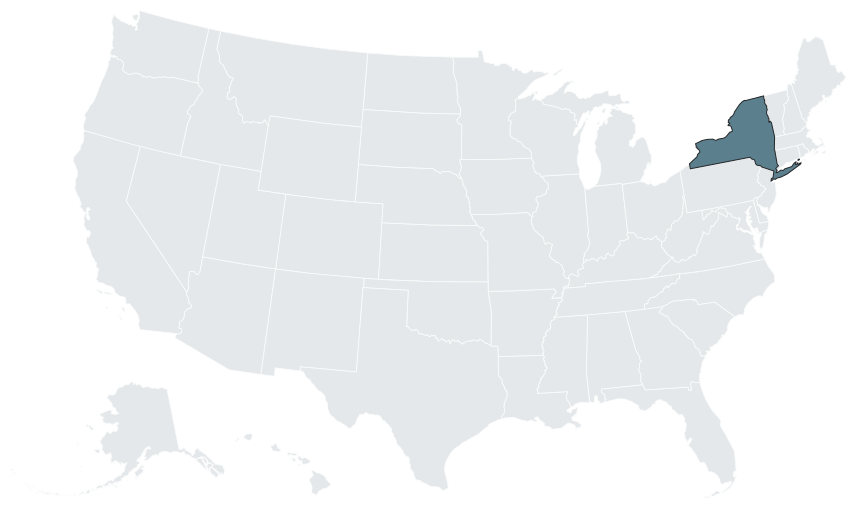
New York borders New Jersey, Pennsylvania, Vermont, Massachusetts and Connecticut; the service areas index lists every state the studio covers.
Frequently asked questions
Does a site plan need a PE seal in New York?
What size house can be designed without an architect in New York?
A residence building of 1,500 sq ft gross area or less, not counting garages, carports, porches, cellars or uninhabitable basements and attics, under Education Law § 7307(5) as NYSED quotes it [5].
Which construction stormwater permit applies in New York now?
SPDES GP-0-25-001, effective January 29, 2025 and expiring January 28, 2030 [8].
Did coverage under the old New York CGP roll over?
What is the minimum campsite size for a new RV park in New York?
1,250 sq ft for a new or modified campsite under 10 NYCRR § 7-3.8; the figure for a pre-existing campsite is 1,500 sq ft [3].
How much notice is needed before building a campground in New York?
At least 30 days of written notice to the permit-issuing official before construction, with plans as required (10 NYCRR § 7-3.7) [17].
Do glamping cabins follow New York campground rules?
Sources
- 1)Town Law § 274-a, site plan review (text last updated January 1, 2026), New York State Legislature (text via FindLaw). Accessed 2026-10-10.
- 2)Town Law § 274-a, Site Plan Review (2025 text), New York State Legislature (text via Justia). Accessed 2026-10-10.
- 3)10 NYCRR § 7-3.8, campsite space requirements (State Sanitary Code, Subpart 7-3), New York State Department of Health (text via elaws). Accessed 2026-10-10.
- 4)Town Law § 274-a, area variances (§ 274-a(3)), New York State Legislature (text via public.law). Accessed 2026-10-10.
- 5)When an architect's seal and signature are not required (Education Law §§ 7307(5) and 7209(7)(b)), NYSED Office of the Professions. Accessed 2026-10-10.
- 6)James A. Coon Local Government Technical Series, Site Plan Review, New York State Department of State.
- 7)Village Law § 7-725-a, site plan review, New York State Senate.
- 8)SPDES General Permit for Stormwater Discharges from Construction Activity, GP-0-25-001 (Environmental Notice Bulletin, January 29, 2025), New York State Department of Environmental Conservation. Accessed 2026-10-10.
- 9)10 NYCRR § 7-3.2, campgrounds, applicability, New York State Department of Health (text via Justia). Accessed 2026-10-10.
- 10)Town Code Article LVI, Site Plan Review, Town of Riverhead (eCode360). Accessed 2026-10-10.
- 11)Town Code Article XX, Site Plan Review, Town of LeRay (eCode360). Accessed 2026-10-10.
- 12)Division of Building Standards and Codes, Frequently Asked Questions, New York State Department of State. Accessed 2026-10-10.
- 13)Adopted Changes to NYS Building Code, Village of Croton-on-Hudson. Accessed 2026-10-10.
- 14)Amended Notice of Adoption, Rule Amending and Updating the Uniform Code, New York State Department of State. Accessed 2026-10-10.
- 15)New York Releases Draft SPDES Construction General Permit (GP-0-25-001) for Public Comment, Walden Environmental Engineering. Accessed 2026-10-10.
- 16)SPDES General Permit for Stormwater Discharges from Construction Activity, GP-0-25-001 (permit text), New York State Department of Environmental Conservation.
- 17)10 NYCRR § 7-3.7, campgrounds, notice and plans, New York State Department of Health (text via Justia). Accessed 2026-10-10.
- 18)10 NYCRR § 7-3.13, campgrounds, water supply, New York State Department of Health (text via Justia). Accessed 2026-10-10.
- 19)Part 7, Subpart 7-3 Campgrounds (State Sanitary Code copy), Suffolk County Department of Health Services. Accessed 2026-10-10.
- 20)Subpart 7-3 Campgrounds (Statutory authority: Public Health Law, § 225), Cortland County. Accessed 2026-10-10.
- 21)10 NYCRR § 7-3.1, campgrounds, definitions, New York State Department of Health (text via Justia). Accessed 2026-10-10.
- 22)10 NYCRR § 7-3.9, campgrounds, structures other than camping units, New York State Department of Health (text via Justia). Accessed 2026-10-10.
- 23)Zoning recent news (self storage zoning index), Inside Self Storage. Accessed 2026-10-10.
- 24)Eliminating Parking Minimums, National Apartment Association. Accessed 2026-10-10.
- 25)General Construction Permit Update for 2025, Walden Environmental Engineering. Accessed 2026-10-10.
- 26)Adopted Changes to NYS Building Code (memo from Michael Preziosi, P.E., Director), Town of Cortlandt. Accessed 2026-10-10.