What makes a Colorado site plan different
A Colorado site plan answers to a constitution that hands land use to home rule cities, a water system built on prior appropriation, and a licensing statute that draws the seal line by building type. These conditions change what the plan shows and who signs what.
- The seal line follows the building, not the plan. Colorado does not require every site plan to be stamped. Under C.R.S. 12-120-403(1), any person, firm or corporation may prepare plans for one-, two-, three- and four-family dwellings, and for garages, industrial buildings, offices, farm buildings and warehouses that do not exceed one story and are not designed for occupancy by more than ten persons [1]. Above that line an architect's seal is mandatory, and home rule status does not change it: 12-120-403(2) lets a jurisdiction adopt building codes, not waive professional seals [1]. A one-story warehouse or storage building can sit inside the exemption. A two-story office cannot.
- Water decides feasibility before zoning does. Prior appropriation, augmentation plans, water court decrees and will-serve letters routinely gate entitlement [6, 7]. Augmentation plans require water court approval, and substitute water supply plans are approved by the State Engineer as a bridge while a water court application is pending [7]. Tap fees compound the timing risk: Denver Water raised its single-family tap fee 32% effective July 1, 2026, to $10,450 in-city (from $7,930) and $14,680 suburban (from $11,100), and Castle Rock's single-family tap fee is $45,760 [6].
- No statewide building code, but a July 2026 inflection. Colorado has no general statewide building code; each municipality and county adopts its own, typically a version of the IBC and IRC [8]. Two state overlays cut across that. The Model Low Energy and Carbon Code, published September 2, 2025, became the state minimum on July 1, 2026, and any jurisdiction updating any building code after that date must adopt it or a code achieving greater efficiency and pollution reduction [4]. The 2025 Colorado Wildfire Resiliency Code (8 CCR 1507-39) was adopted July 1, 2025; wildland-urban interface jurisdictions had to adopt it by April 1, 2026 and comply by July 1, 2026 [9].
- Home rule and 1041 powers multiply the procedures. Home rule cities and counties, including Denver, Colorado Springs, Aurora, Boulder and Fort Collins, take their authority from Article XX of the Colorado Constitution and adopt their own land use codes and procedures, which is why review steps, submittal contents and fees vary widely city to city [1]. Counties and municipalities also hold 1041 powers under C.R.S. 24-65.1 to regulate designated areas and activities of state interest [10].
- Geology and the 35-acre line shape the parcel map. Parcels of 35 or more acres are exempt from county subdivision review. Splitting into lots under 35 acres triggers full subdivision and a 21-day Colorado Geological Survey review per submittal under C.R.S. 30-28-136, and resubmittals extend it [5]. The Survey catalogues rockfall, landslide, debris flow, subsidence over abandoned coal mines and evaporite karst, and radon zones [5].
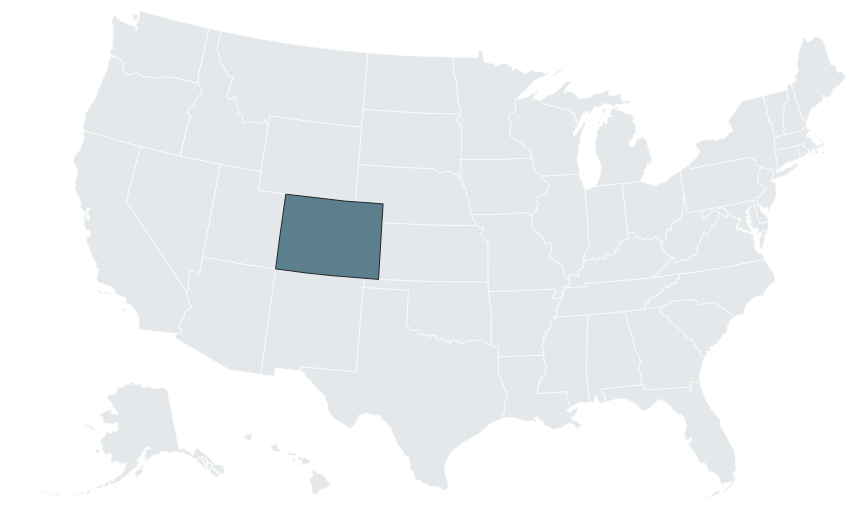

Approval layers: county, municipal and home rule
Counties regulate unincorporated land under C.R.S. Title 30, Article 28. The Board of County Commissioners is the ultimate authority for rezonings, subdivisions and special or conditional uses, typically on a Planning Commission recommendation, and administrative site plan approvals are commonly delegated to staff. Weld County delegates Site Plan Review entirely to its Department of Planning Services, and Jefferson County's Site Development Plan is administrative and non-discretionary [11, 12].
| Layer | Authority | Who decides the site plan |
|---|---|---|
| County | C.R.S. Title 30, Article 28 | Planning staff for administrative plans; BOCC for rezonings, subdivisions and conditional uses [11, 12] |
| Statutory municipality | C.R.S. Title 31, Article 23 | Staff review; larger projects to planning commission or council |
| Home rule city or county | Colorado Constitution, Article XX | Its own code and procedures; licensure statutes still apply [1] |
| Referral agencies | Statute or local rule | CGS, CDOT, fire, water and sanitation districts, schools, utilities, county health. Weld gives referral agencies 28 days; Larimer site plans carry a minimum 60-day referral [11, 13] |
Three instruments recur. A subdivision creates lots and draws the most review: plat, referrals and often BOCC or council action. A site development plan, site improvement plan or site plan review governs the layout of a single development parcel and is frequently administrative. A use by special review or conditional use needs a hearing, because the use is only conditionally permitted in the zone. Knowing which instrument a parcel needs is the first line of the site data table.
Who prepares and seals what
The preliminary site plan is the planning layer: layout, buildings, internal roads, parking, pads and the site data table. Colorado's licensing statutes assign each engineered or surveyed document to a licensed professional, and the engineer and architect of record build the sealed set on the preliminary plan.
| Document | Prepared or sealed by | Rule |
|---|---|---|
| Concept layout for conceptual or scoping review | Unsealed preliminary plan | Fort Collins Conceptual Review is free; Greeley starts with a Scoping Review [14, 15] |
| Building plans above the 12-120-403(1) limits | Colorado-licensed architect | C.R.S. 12-120-403 [1] |
| Grading and drainage, detention, structural, traffic, utility design, retaining walls (typically over 4 feet), floodplain analysis | Colorado PE | C.R.S. Title 12, Article 120, Part 2 |
| State highway signal or operations study | Colorado PE | The State Highway Access Code requires the study to carry a Colorado registered professional engineer's seal (2 CCR 601-1) [16] |
| Engineered septic design | Colorado PE | Regulation 43 [17] |
| Monumented survey, Improvement Survey Plat, subdivision plat | Professional Land Surveyor | C.R.S. Title 38, Article 51 [18] |
| Improvement Location Certificate | PLS certificate, not a survey | C.R.S. 38-51-108 [18] |
An Improvement Survey Plat shows all visible improvements on the parcel and within 5 feet of the boundaries and can be relied on for setbacks and encroachments; an ILC cannot [18]. For commercial acquisitions and lender files, the ALTA/NSPS survey is the usual base. The who prepares a site plan guide sets this split against other states, where unsealed site plans are accepted covers the concept stage, and the site plan architect and site plan consultant pages explain the handoff to the professionals of record.
Statewide overlays that reach the site plan
| Overlay | Rule | What it puts on the plan |
|---|---|---|
| Construction stormwater | CDPS General Permit COR400000, CDPHE Water Quality Control Division | 1 acre or more of disturbance, or less within a larger common plan; current term April 1, 2024 to March 31, 2029; SWPPP before applying; final stabilization at 70% of native vegetative cover [3] |
| Highway access | State Highway Access Code, 2 CCR 601-1 | Permit to construct, relocate, close or modify a state highway access; each segment holds one of eight access categories (2 CCR 601-1A, updated June 14, 2023) [19, 16] |
| Septic | Regulation 43, 5 CCR 1002-43 | Systems of 2,000 gpd or less; updated rule effective June 15, 2025, with counties given up to 12 months to adopt conforming rules [17] |
| Energy | HB22-1362 tiers | 2021 IECC baseline, then the Model Electric Ready and Solar Ready Code, then the MLECC [4] |
| Wildfire | 8 CCR 1507-39 | Fire Intensity Classification map from Colorado State Forest Service data; Larimer County declared its entire unincorporated area a wildfire risk area [9, 20] |
| Geologic hazards | C.R.S. 30-28-136 | 21-day CGS referral per submittal for lots under 35 acres [5] |
| Metro districts | Title 32 | Service plans submitted on or after January 1, 2024 must state the maximum mill levy and maximum debt (2023 Ch. 52) [21] |
On state-reviewed school and healthcare work, separate plan sheets are already required for Electric Ready, Solar Ready and EV Ready [9]. For private commercial projects, the code that applies is the one the local jurisdiction has adopted, so the site data table should name it.
Top jurisdictions: process, pre-application and fees
On the State Demography Office's Vintage 2025 estimate, Colorado reached 6,012,561 people by July 1, 2025, and the strongest positive net migration went to Douglas, Larimer and Weld counties, the areas with the most residential construction [22]. These are the review paths in the jurisdictions where most applications land.
| Jurisdiction | Site plan path | Pre-application | Clock and fees |
|---|---|---|---|
| Denver (home rule) | Site Development Plan for commercial construction, 3+ residential units and some change-of-occupancy tenant finish; CPD staff, administrative [23] | Not stated | Accela ePermit portal [23] |
| Aurora (home rule) | Administrative and Planning Commission tracks; most applications need a public hearing [24] | Required, "not optional" [24] | DevPortal launched July 11, 2025 [24] |
| Colorado Springs | Administrative, or Planning Commission and City Council; administrative decisions appealable within 10 days [25] | Free; formal submittal within 6 months [25] | Fee schedule adopted November 25, 2025, effective January 1, 2026 [25] |
| El Paso County | EDARP portal [26] | Generally required [26] | Early Assistance meeting $437; Administrative Relief $587; Board of Adjustment $1,037 (2019 schedule) [26] |
| Douglas County | Site Improvement Plan, approved by Planning Services staff [27] | Optional, free [27] | Accela ACA retired March 13, 2026 [27] |
| Arapahoe County | Current Planning staff [28] | Required (presubmittal or waiver) [28] | Variances to the Board of Adjustment [28] |
| Adams County | Development Review Team, administrative [29] | Required (conceptual review) [29] | Resubmittal review period 21 days [29] |
| Weld County | Site Plan Review, delegated to Planning Services [11] | Required [11] | 28-day referral; 120-day correction window; SPR under 10,000 sq ft $1,500, 10,000-25,000 sq ft $3,200, over 25,000 sq ft $6,000; amendment $550; recording $43 [11] |
| Greeley (home rule) | Community Development staff [15] | Scoping Review and pre-application [15] | Reviews usually within 2-3 weeks; 3 review rounds included [15] |
| Larimer County | Administrative decision [13] | Required, free, Thursday mornings, scheduled 2-3 months out [13] | Minimum 60-day referral; fee schedule effective January 2, 2024, CPI-adjusted [13] |
| Fort Collins (home rule) | Staff or Planning and Zoning Commission [14] | Conceptual Review (free) or Preliminary Design Review ($500) [14] | Neighborhood meeting 10+ days before application for larger projects [14] |
| Jefferson County | Site Development Plan, administrative, non-discretionary [12] | Optional, recommended [12] | Fees cover the request and first revision (Res. CC25-165) [12] |
| City of Boulder (home rule) | Staff, Planning Board or both [30] | Required before a form-based code review [30] | Fee covers up to 3 reviews; comments about 3 weeks; 60-day revision window [30] |
| Boulder County | Site Plan Review, administrative [31] | Pre-application Conference required [31] | $103.83 per hour for less-predictable reviews [31] |
| Summit County | Six review classes; Class 3 and up to Planning Commission and BOCC [32] | Pre-submittal meeting expected [32] | $210 per hour concurrent review; appeal $2,385 [32] |
Weld County's Site Plan Review fee scales with building area, so the building footprint on the preliminary plan is a fee input [11].
Asset registries in Colorado
| Asset | State layer | Numbers that shape the layout | Local layer |
|---|---|---|---|
| RV parks | CDPHE, 6 CCR 1010-9, under C.R.S. 25-1-107, 25-1-108 and 25-13-104 [2] | No more than 25 campsites per acre excluding roads, buildings and common use areas (s. 5.4); 900 sq ft per campsite (s. 5.3); 25 ft from public highway right-of-way (s. 5.2); 3 ft from campsite lot lines (s. 5.10); roads with 13 ft overhead and 3 ft side clearance [2] | Mineral County caps RV parks at 12 per gross acre and campgrounds at 15 [33] |
| Campgrounds | Same rule; classes run from primitive to modern [2] | Where dependent units and tents are accepted, one toilet and one lavatory per sex per 15 campsites and one shower per sex per 30 campsites (s. 12.3); sewage to public sewer or an approved private system [2] | Chaffee County: Conditional Use, 20 campsites or camp cabins per acre [34] |
| Glamping | No glamping license; tents treated as camping units [35] | Camping vehicles and tents at least 10 ft from buildings and other camping units [2] | County conditional use; Park County 20CUP-08 rested on fire district approval of cleared areas around fire rings [36] |
| Fuel and USTs | Division of Oil and Public Safety, 7 CCR 1101-14 and C.R.S. 8-20.5 [37] | Application at least 20 working days before construction, $150 review fee; $35 per tank per year; releases reported within 24 hours; tank fund deductible $10,000 [37] | Pitkin County lumen allowance per fuel pump side [38] |
| Car washes | No statewide reclamation mandate located | Set by jurisdiction and district | Recycling, pretreatment and industrial discharge rules are local |
| Storage, warehouses, industrial | One-story buildings not designed for more than ten persons sit inside 12-120-403(1) [1] | Set locally | Weld SPR fees scale by building area [11] |
| Hotels | Parking set by the local code | Keystone: hotel, motel or lodge 1.0 space per room plus other uses; lodge room 0.5 [39] | Set locally |
The state campground cap is net of roads, buildings and common areas, so gross yield after a typical road share falls well below 25 [2]. The Colorado layer for RV parks is set out in RV park site plans in Colorado and for campgrounds in campground site plans in Colorado, and the yield arithmetic in RV sites per acre. The campground, glamping, gas station, truck stop, car wash, self storage and hotel hubs carry the national standards for each asset. For car wash water design, see water conservation in car wash design.
Climate and site factors
- Snow load. The authoritative resource is the 2016 Colorado Design Snow Loads, used with ASCE 7. Representative ground snow: Mount Crested Butte ski area base 155 psf, Monarch 135 psf, Arapaho 125 psf, against roughly 43 psf on the Front Range [40]. Larimer County sets a 35 psf minimum design roof snow load and uses the SEAC map at and above 10,000 feet [13]. The local value is legally controlling.
- Hail. The Front Range averages 7 to 9 hail days per year. Colorado's average hail losses run about $151 million per year, second highest of any state, and the May 8, 2017 Front Range storm cost $2.3 billion [41].
- Wildfire. The 2025 code map classifies fire intensity from Colorado State Forest Service data, and the Colorado Wildfire Risk Public Viewer provides mapping [20].
- Geologic hazards. Rockfall, landslide, debris flow and mine subsidence areas are mapped by the Colorado Geological Survey and reach the plan through its referral [5].
Timelines and bottlenecks
Small administrative site plans commonly run 1-3 months; large projects that need subdivision, rezoning or hearings run 7-9 months or more [25]. The recurring stalls:
- Water proof. Will-serve letters, augmentation plans, dedication requirements and tap fee timing [7, 6].
- CGS review. 21 days per submittal, extended by resubmittals [5].
- CDOT access. Higher access categories restrict spacing and turning movements and can trigger auxiliary lanes and PE-sealed signal or operations studies, adding months [19].
- Fire access and drainage. Turnaround radii, aerial apparatus access and hydrant spacing follow the adopted IFC; detention and water quality follow local criteria, such as Mile High Flood District criteria on the Front Range. The preliminary plan reserves the areas; the engineer of record designs them.
- Metro district formation. Service plan approval by council or BOCC adds lead time [21].
Proof points: recent Colorado projects
- Ramble Outdoors, Pine Creek, Chaffee County (June 9, 2026). As the Chaffee County Times and The Mountain Mail reported, the commissioners unanimously denied the campground conditional use permit after staff recommended approval with 10 conditions. One commissioner cited demonstrated need and wildlife mitigation; another, as reported, objected to a requested 100 ft creek setback where code requires 300 ft and Colorado Parks and Wildlife recommended 500 ft [42, 43].
- Cottonwood Creek, Chaffee County (2026). The Chaffee County Times reported that staff rejected a request to reduce the historic high water mark setback minimum from 300 feet to 100 feet, and that the decision stood because the Board of Adjustment could not reach a unanimous vote to overturn it [44].
- Applejack RV Park, Salida. A public notice set a Limited Impact Review hearing for April 5, 2022 on 29 RV-only spaces in two phases with a commercial well and two OWTS [45].
- Lake City glamping. A May 2026 conditional use application proposed four glamping tents [35].
- Front Range travel centers. Love's Brighton pairs a store of 13,500+ sf with 5 diesel bays and 89 truck parking spaces [46]; Pilot Hudson carries 117 truck parking spaces on 8 diesel lanes [47].
The Chaffee County campground model project shows how these rules size a 60 to 120 site campground with cabins: at 50 gpd per campsite under Regulation 43, a program of that size crosses the 2,000 gpd line that moves the septic system out of county OWTS permitting and into CDPHE Regulation 22 site location approval [48, 49].
Where the preliminary plan fits
Aurora, Arapahoe, Adams, Weld and Larimer require a pre-application or conceptual review before a formal submittal, so the first drawing a Colorado developer needs is a dimensioned concept: buildings, drives, parking, pads, water and wastewater areas, and a site data table that states zoning, density against the cap, setbacks and parking [24, 28, 29, 11, 13]. The same plan goes to the lender and the general contractor, and then to the engineer and architect of record. Our site plan services cover the asset classes above; service areas lists the states we draw in, including neighbouring Wyoming, Nebraska, Kansas, New Mexico, Arizona and Utah.
Frequently asked questions
Do I need a stamped site plan in Colorado?
Not always. Under C.R.S. 12-120-403(1), any person may prepare plans for one- to four-family dwellings and for one-story garages, industrial buildings, offices and warehouses not designed for occupancy by more than ten persons [1]. Above that line an architect's seal is mandatory, and engineered documents such as a state highway signal or operations study carry a Colorado PE seal [1, 16].
What is an Improvement Location Certificate?
A certificate by a Professional Land Surveyor showing visible improvements relative to deed lines, used by title companies and lenders. It is not a survey: property corners are not set, and it does not resolve boundary issues (C.R.S. 38-51-108) [18].
Do I need a will-serve letter for a Colorado project?
Plan on it. Will-serve letters, augmentation plans, dedication requirements and tap fee timing are the single most common entitlement stall in Colorado, and augmentation plans require water court approval [7].
What is a 1041 permit?
A local permit for a designated area or activity of state interest under C.R.S. 24-65.1, named for House Bill 74-1041. Common triggers include major new or extended water and sewer systems and new communities [10].
Can I build on 35 acres without a subdivision?
Parcels of 35 or more acres are exempt from county subdivision review and typically qualify for an exempt domestic well. Splitting into lots under 35 acres triggers full subdivision and Colorado Geological Survey review [5].
When is a construction stormwater permit required?
When construction disturbs 1 acre or more, or less than 1 acre as part of a larger common plan: CDPS General Permit COR400000, with a SWPPP prepared before applying [3].
How many campsites fit on an acre in Colorado?
6 CCR 1010-9 allows no more than 25 campsites per acre excluding roads, buildings and other common use areas, with at least 900 sq ft per campsite [2]. Counties can be stricter: Mineral County caps RV parks at 12 per gross acre, and Chaffee County caps campgrounds at 20 campsites or camp cabins per acre [33, 34].
What snow load does a Colorado site plan assume?
The value adopted by the local building authority, which references the 2016 Colorado Design Snow Loads. Mountain ski-base areas run from roughly 125 to 155 psf ground snow [40].
Sources
- 1)C.R.S. 12-120-403, architectural practice exemptions (law.justia.com), Colorado Revised Statutes (via Justia). Accessed 2026-08-02.
- 2)6 CCR 1010-9, Campgrounds and Recreation Areas, Colorado Department of Public Health and Environment (via Colorado Secretary of State). Accessed 2026-10-09.
- 3)CDPS General Permit COR400000, construction stormwater summary (summitservicesgroup.com; backeddyengineering.com), summitservicesgroup.com and backeddyengineering.com (secondary). Accessed 2026-08-02.
- 4)Colorado energy codes under HB22-1362, Model Low Energy and Carbon Code (energyoffice.colorado.gov), Colorado Energy Office. Accessed 2026-08-02.
- 5)Land use review and geologic hazards, C.R.S. 30-28-136 (coloradogeologicalsurvey.org), Colorado Geological Survey. Accessed 2026-08-02.
- 6)Denver Water and Castle Rock tap fees, June 19, 2026 (coloradosun.com), The Colorado Sun. Accessed 2026-08-02.
- 7)Augmentation plans, substitute water supply plans and will-serve timing (watereducationcolorado.org), Water Education Colorado. Accessed 2026-08-02.
- 8)Building codes in Colorado (aiacolorado.org), AIA Colorado. Accessed 2026-08-02.
- 9)2025 Colorado Wildfire Resiliency Code, 8 CCR 1507-39, and Electric Ready and Solar Ready Code (dfpc.colorado.gov), Colorado Division of Fire Prevention and Control. Accessed 2026-08-02.
- 10)C.R.S. 24-65.1, areas and activities of state interest (colorado.public.law), Colorado Revised Statutes (via colorado.public.law). Accessed 2026-08-02.
- 11)Site Plan Review, referral periods and fees (weld.gov), Weld County. Accessed 2026-08-02.
- 12)Site Development Plan and fee policy, Res. CC25-165 (jeffco.us), Jefferson County. Accessed 2026-08-02.
- 13)Site plan review, pre-application meetings and snow load (larimer.org; larimer.gov), Larimer County. Accessed 2026-08-02.
- 14)Conceptual Review and Preliminary Design Review (fcgov.com), City of Fort Collins. Accessed 2026-08-02.
- 15)Scoping Review and development review (greeleyco.gov), City of Greeley. Accessed 2026-08-02.
- 16)2 CCR 601-1-3, State Highway Access Code (law.cornell.edu), Colorado Department of Transportation (via Cornell LII). Accessed 2026-08-02.
- 17)Regulation 43, On-Site Wastewater Treatment Systems, 5 CCR 1002-43 (cdphe.colorado.gov), Colorado Department of Public Health and Environment. Accessed 2026-08-02.
- 18)Improvement Location Certificates and Improvement Survey Plats, C.R.S. 38-51-108 (coloradols.com; copls.com), coloradols.com and copls.com. Accessed 2026-08-02.
- 19)Access permits and the State Highway Access Category Assignment Schedule, 2 CCR 601-1A (codot.gov), Colorado Department of Transportation. Accessed 2026-08-02.
- 20)Colorado Wildfire Resiliency Code map and Wildfire Risk Public Viewer (coresiliency.colorado.gov), State of Colorado (coresiliency.colorado.gov). Accessed 2026-08-02.
- 21)Title 32 special district service plans, 2023 Ch. 52 (law.justia.com), Colorado Revised Statutes (via Justia). Accessed 2026-08-02.
- 22)Colorado population estimates, press release of January 27, 2026 (cdola.colorado.gov), Colorado Department of Local Affairs, State Demography Office. Accessed 2026-08-02.
- 23)Site Development Plan review (denvergov.org), City and County of Denver. Accessed 2026-08-02.
- 24)Development review and pre-application (auroragov.org), City of Aurora. Accessed 2026-08-02.
- 25)Land Use Review, pre-application and fee schedule (coloradosprings.gov), City of Colorado Springs. Accessed 2026-08-02.
- 26)Planning and Community Development fee schedule (planningdevelopment.elpasoco.com), El Paso County. Accessed 2026-08-02.
- 27)Site Improvement Plan (douglas.co.us), Douglas County. Accessed 2026-08-02.
- 28)Current Planning applications (arapahoeco.gov), Arapahoe County. Accessed 2026-08-02.
- 29)Development review and conceptual review (adamscountyco.gov), Adams County. Accessed 2026-08-02.
- 30)Development review and 2026 Schedule of Fees (bouldercolorado.gov), City of Boulder. Accessed 2026-08-02.
- 31)Site Plan Review, Docket DC-24-0003 (bouldercounty.gov), Boulder County. Accessed 2026-08-02.
- 32)Development review classes and fees (summitcountyco.gov), Summit County. Accessed 2026-08-02.
- 33)Mineral County Mobile Home Park/RV Park and Campground Regulations, Mineral County. Accessed 2026-10-09.
- 34)Chaffee County Land Use Code (adopted 11-19-2024, effective 1-1-2025), Chaffee County. Accessed 2026-10-09.
- 35)Conditional Use Permit Application, Proposed Glamping Tent Sites, Town of Lake City. Accessed 2026-10-09.
- 36)Planning Commission Staff Report (20CUP-08), Park County. Accessed 2026-10-09.
- 37)Petroleum storage tanks, 7 CCR 1101-14 and C.R.S. 8-20.5 (ops.colorado.gov), Colorado Division of Oil and Public Safety. Accessed 2026-08-02.
- 38)An Ordinance of the Board of County Commissioners of Pitkin County (text amendment), Pitkin County. Accessed 2026-10-09.
- 39)Keystone Fig. 3.7, Parking Requirements, Keystone, Colorado (keystone.colorado.gov). Accessed 2026-10-10.
- 40)2016 Colorado Design Snow Loads (seacolorado.org), Structural Engineers Association of Colorado. Accessed 2026-08-02.
- 41)Colorado hail losses, Rocky Mountain Insurance Information Association figures (denver7.com), Denver7. Accessed 2026-08-02.
- 42)Commissioners deny permit for Pine Creek campground (June 9, 2026), Chaffee County Times (secondary). Accessed 2026-10-09.
- 43)Chaffee commissioners deny permit for Ramble campground, The Mountain Mail (secondary). Accessed 2026-10-09.
- 44)Chaffee County commissioners meeting: Board of Adjustment and the 300 ft creek setback, Chaffee County Times (secondary). Accessed 2026-10-09.
- 45)Public notice, Applejack RV Park Limited Impact Review (March 16, 2022), Chaffee County Times. Accessed 2026-10-09.
- 46)What's In Store: Love's Travel Stops, Parker's Kitchen and Pilot, csnews.com. Accessed 2026-10-09.
- 47)New Pilot Travel Center Brings More Truck Parking and Amenities to Colorado, Truck Drivers USA. Accessed 2026-10-09.
- 48)5 CCR 1002-43.6, Wastewater Flow and Strength (Table 6-2), Colorado Water Quality Control Commission, CDPHE (text via Cornell LII). Accessed 2026-10-09.
- 49)5 CCR 1002-22.2, Definitions (Regulation 22), Colorado Water Quality Control Commission, CDPHE (text via Cornell LII). Accessed 2026-10-09.