The answer, and why there are three numbers
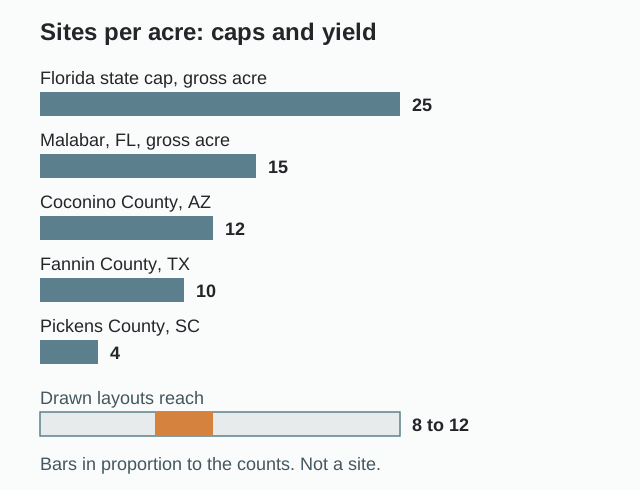
There are three numbers, and they answer different questions. The legal cap is what a code allows: Florida caps RV parks at 25 units per acre of gross site, and Colorado's campground rule caps density at 25 campsites per acre "excluding roads, buildings, and other common use areas" [1, 2]. The local cap is often lower: Malabar, Florida allows 15 RV sites per gross acre, Coconino County, Arizona 12 per acre, Fannin County, Texas 10 per acre, and Pickens County, South Carolina 4 [7, 8, 9, 4]. The achieved yield is what a drawn layout reaches once roads, utilities, stormwater and amenities are on the sheet: a development guide (secondary, not a code) puts it at 8 to 12 sites per acre [6].
Many states set no state cap. Utah, Arizona, Georgia and Tennessee regulate sanitation and spacing and leave density to local zoning. Michigan sets no numeric cap and limits a campground to its licensed site count (R 325.1556(8)) [10]. No state RV park density rule was found for Texas, North Carolina or South Carolina, so their caps come from county and city codes. The state rules are compared side by side in RV park regulations by state.
Gross versus net: the same 25 is not the same cap
A cap counted on gross acreage includes the land that roads, the office, the bathhouse and the stormwater pond take. A cap counted on net acreage excludes it. Florida's text is gross: "The density shall not exceed 25 recreational vehicle units per acre of gross site" [1, 11]. Colorado's is net, because it excludes "roads, buildings, and other common use areas" (6 CCR 1010-9, s. 5.4) [2]. A Colorado plan that reaches 25 on its net campsite area holds fewer sites across the whole tract, so a site data table states which basis it reports.
Local codes use the net basis too. The Town of Parker, Arizona sets a "maximum density of twenty (20) spaces per net acre," with spaces of 1,250 sq ft and 30 ft wide (Town Code 10-11-16) [12]. How "gross" is measured can also be written into a local code: Polk County, Florida's density computation counts "all public and institutional land areas (e.g. internal streets, sewer plants, schools, and parks) located within a site, as well as one-half of the right-of-way area for perimeter local streets" [13]. That text sits in the county's residential density rule.
| Jurisdiction | Cap | Basis as written | Source |
|---|---|---|---|
| Florida (state) | 25 RV units per acre | Gross site | 64E-15.002(3)(b) [1] |
| Colorado (state) | 25 campsites per acre | Net of roads, buildings and common use areas | 6 CCR 1010-9, s. 5.4 [2] |
| Wisconsin (state, campgrounds) | 20 sites per acre | Per acre | ATCP 79.11(5) [3] |
| Michigan (state) | No numeric cap; the licensed site count | Not applicable | R 325.1556(8) [10] |
| Malabar, FL (RVP district) | 15 RV sites per acre, 5 acre minimum | Gross | Ord. 2021-09 [7] |
| Town of Parker, AZ | 20 spaces per acre | Net | Town Code 10-11-16 [12] |
| El Campo, TX | 20 units per acre | Per acre | Article 10.15 [5] |
| Fannin County, TX | 10 recreational vehicles per acre | Per acre | Order of November 14, 2023 [9] |
| Mineral County, CO | 12 per acre for RV parks; 15 for campgrounds | Gross | County regulations [14] |
| Coconino County, AZ | 12 per acre unless the Board approves a master plan | Per acre | ZO 3.18 [8] |
| Duncan, SC | 12 units per acre, 5 acre minimum | Physical acre | Town ordinance [15] |
| Pickens County, SC | 4 sites per acre, 690 sq ft per site, 5 acre minimum | Per acre; site area net | Article 3 [4, 16] |
Florida adds a time dimension. Once a park is permitted, F.S. 513.1115 supersedes any later county, city or special district rule on lot size, density, separation or setback [17]. A town cap like Malabar's governs a new park; it cannot cut the density of one already approved.
Minimum site areas and the arithmetic they allow
The second constraint is the smallest legal site:
| Rule | Minimum site area | Source |
|---|---|---|
| Florida | 1,200 sq ft per RV space; 500 sq ft per tent space | 64E-15.002(3) [1] |
| Michigan | 1,200 sq ft and 15 ft of road frontage | R 325.1556(1) [10] |
| Ohio | 1,000 sq ft | OAC 3701-26 [18] |
| Colorado | 900 sq ft | 6 CCR 1010-9, s. 5.3 [2] |
| Town of Parker, AZ | 1,250 sq ft and 30 ft wide | Town Code 10-11-16 [12] |
| Holtville, CA | 1,250 sq ft spaces | Chapter 17.50 [19] |
| Pickens County, SC | 690 sq ft net | County standards [4] |
| Mohave County, AZ (RV subdivision lot) | 2,500 sq ft | Section 37.K.4 [20] |
| Garfield County, UT (glamping) | 2,000 sq ft of lot per unit | Ord. 2019-2 [21] |
The arithmetic shows why the site minimum and the density cap are different limits. One acre is 43,560 sq ft, so a 1,200 sq ft site minimum allows 36 sites before any roads. The Florida cap of 25 per gross acre therefore implies at least about 1,742 sq ft of gross land per site, including roads and amenities [1]. Put another way, at the state cap 80 sites need at least 3.2 gross acres and 150 sites at least 6.0 gross acres, and on 20 gross acres the state would permit up to 500 RV units [1].
Real sites are also larger than the minimum. A 2026 construction guide (secondary) sizes RV sites from 30 x 50 ft back-in to 45 x 70 ft pull-through [22]. Where pads are drawn at those sizes, the pad mix rather than the code minimum sets the land per site; the standards behind each pad type are on the RV park site plan page.
Tract minimums: the acreage a park needs before density
A cap per acre only matters once the tract qualifies. Several codes set a minimum park size:
| Jurisdiction | Minimum tract | Source |
|---|---|---|
| Parker County, TX | 5.0 acres | County requirements [23] |
| Malabar, FL | 5 acres (RVP district) | Ord. 2021-09 [7] |
| Duncan, SC | 5 acres | Town ordinance [15] |
| Pickens County, SC | 5 acres | Article 3 [4, 16] |
| Savannah, GA | 5 acres, with stays capped at 90 days | City zoning [24] |
| Holtville, CA | 3 acres | Chapter 17.50 [19] |
| Cherokee County, GA | 10 acres | County zoning [25] |
A parcel under the minimum does not qualify there at any density, so the tract test comes before the yield study.
What real layouts achieve, and what takes the land
The published yield for working layouts is a rule of thumb, and it sits well below the caps: 8 to 12 sites per acre in a development guide (secondary, not a code) [6]. What closes the gap between 25 and the achieved yield is drawn on the plan:
- Roads. On an illustrative 200-site plan with roughly 8,000 linear feet of lanes, a 60 ft public road corridor consumes about 11 acres, while a 24 ft private lane consumes about 4.4 acres [26]. Which standard the county applies to internal lanes is settled before the loops are drawn.
- Stormwater. In Florida, a project area over 5 acres needs an environmental resource permit, and the stormwater system it permits takes land no site can use [27].
- Wastewater. In North Carolina a local health department can approve systems up to 1,500 gpd; above that a PE designs the system, and the drain field or plant takes its own area [28]. Pickens County, South Carolina bars individual septic systems per site and requires master-metered utilities [4, 16].
- Setbacks and buffers. Pickens County requires a 100 ft perimeter setback [4], and Newberry County, South Carolina allows parks by special exception in R2 with 100 ft setbacks [29].
- Separation. Colorado requires 10 ft between units, counting awnings as part of the unit, and Callahan County, Texas 25 ft between RVs [2, 30]. Every foot of separation is land between pads.
Tent and glamping layouts run lower again. A Mendocino County, California campground renewal recorded 73 sites on 65 acres, 1.12 per acre; a Valley County, Idaho campground of yurt and RV sites, approved by conditional use permit, works out to 3.1 units per acre in its first phase if tents count as dwelling units; Tropic, Utah caps glamping at 5 per acre and Garfield County, Utah at 10 [31, 32, 33, 21]. The glamping site plan and campground site plan pages carry those programs.
From the number to a plan
Density questions end the same way: the parcel, the road standard and the utility path set the count, and the count is only real once it is drawn. A preliminary site plan puts the yield, the density against the cap on its own basis, and the land each constraint takes into one site data table. For resort programs with cabins, park models and phased amenity cores, see RV resort site plans.
State detail for RV parks is on the combo pages for Florida RV parks, Colorado RV parks, Texas RV parks, Arizona RV parks, North Carolina RV parks and Michigan RV parks, with the state context on the Texas, Florida, Arizona and North Carolina pages. The model projects show the caps at work: Polk County, Florida under the gross 25 per acre cap, Bandera County, Texas where wastewater and water set the count, and Chaffee County, Colorado under the net campground cap. For land needs across asset classes, see the acre test, and for design standards in long form, RV park design standards.
Frequently asked questions
How many RV sites per acre are allowed?
Where a state sets a cap, Florida allows 25 RV units per acre of gross site and Colorado 25 campsites per acre excluding roads, buildings and common use areas [1, 2]. Many local codes set lower caps: Malabar, Florida allows 15 per gross acre, Coconino County, Arizona 12 per acre, Fannin County, Texas 10 per acre and Pickens County, South Carolina 4 per acre [7, 8, 9, 4].
Is the 25 per acre cap gross or net?
How many acres does an RV park need?
Tract minimums set a floor: Parker County, Texas requires 5.0 acres, Duncan and Pickens County, South Carolina 5 acres, Savannah, Georgia 5 acres, Holtville, California 3 acres and Cherokee County, Georgia 10 acres [23, 15, 4, 24, 19, 25]. At Florida's state cap, 80 sites need at least 3.2 gross acres and 150 sites at least 6.0 [1].
What is the minimum size of an RV site?
Can a Texas county limit RV sites per acre?
Sources
- 1)Fla. Admin. Code R. 64E-15.002, Sites: Mobile Home, Lodging, and Recreational Vehicle Parks, Florida Department of Health (via Cornell LII). Accessed 2026-10-09.
- 2)6 CCR 1010-9, Colorado campground and recreation area regulations, Colorado Department of Public Health and Environment (Colorado Secretary of State). Accessed 2026-10-09.
- 3)Wis. Admin. Code ch. ATCP 79, Campgrounds, Wisconsin Legislature. Accessed 2026-10-09.
- 4)Pickens County Planning Commission workshop packet, Pickens County, South Carolina. Accessed 2026-10-09.
- 5)Article 10.15, Recreational Vehicle Parks, City of El Campo, Texas (eCode360). Accessed 2026-10-09.
- 6)How to Start an RV Park from Scratch: Complete Development Guide, rvpark.world. Accessed 2026-10-09.
- 7)Ordinance 2021-09, Recreational Vehicle Park (RVP) Zoning, Town of Malabar, Florida. Accessed 2026-10-09.
- 8)Zoning Ordinance Section 3.18, RV Parks in Commercial Zoning Districts, Coconino County, Arizona. Accessed 2026-10-09.
- 9)Order Adopting Recreational Vehicle Park Regulations (approved November 14, 2023), Fannin County, Texas. Accessed 2026-10-10.
- 10)Mich. Admin. Code R 325.1556, campground sites, Michigan Department of Environment, Great Lakes, and Energy (via Cornell LII). Accessed 2026-10-09.
- 11)Chapter 64E-15, F.A.C., Mobile Home, Lodging, and Recreational Vehicle Parks and Recreational Camps (2018 version), Florida Department of Health. Accessed 2026-10-09.
- 12)Town Code 10-11-16, Recreational Vehicle Parks, Town of Parker, Arizona (American Legal Publishing). Accessed 2026-10-10.
- 13)Polk County Land Development Code, Chapter 2, Land Use Districts and Regulations (2019), Polk County, Florida. Accessed 2026-10-09.
- 14)Mineral County Mobile Home Park/RV Park and Campground Regulations, Mineral County, Colorado. Accessed 2026-10-09.
- 15)Town of Duncan campground and RV park ordinance (Spartanburg County), Town of Duncan, South Carolina. Accessed 2026-10-09.
- 16)Article 3, Standards for Certain Uses, Pickens County, South Carolina. Accessed 2026-10-09.
- 17)Chapter 513, 2025 Florida Statutes, Mobile Home and Recreational Vehicle Parks, The Florida Senate. Accessed 2026-10-09.
- 18)Ohio Admin. Code Chapter 3701-26, Recreational vehicle parks and camps, Ohio Laws (Legislative Service Commission). Accessed 2026-10-09.
- 19)Municipal Code Chapter 17.50, RV Parks, City of Holtville, California (Code Publishing). Accessed 2026-10-10.
- 20)Section 37.K, Establishment of Recreational Vehicles and Park Model Units, Mohave County, Arizona. Accessed 2026-10-09.
- 21)Garfield County, Utah Glamping Ordinance No. 2019-2, Garfield County, Utah (Utah Public Notice Website). Accessed 2026-10-09.
- 22)RV Park Construction and Development Guide for 2026, propertybuild.com. Accessed 2026-10-09.
- 23)Parker County Infrastructure Requirements for Recreational Vehicle Parks (December 2024), Parker County, Texas. Accessed 2026-10-09.
- 24)Ordinance of June 22, 2017 (RV park zoning), City of Savannah, Georgia (enCodePlus). Accessed 2026-10-10.
- 25)Zoning FAQ: Recreational Vehicles, Cherokee County, Georgia. Accessed 2026-10-10.
- 26)Bandera County Subdivision and Land Development Regulations (revised through August 25, 2022), Bandera County, Texas. Accessed 2026-10-09.
- 27)Fla. Admin. Code 62-330.020, Regulated Activities, Florida Department of Environmental Protection (via elaws). Accessed 2026-10-09.
- 28)RV park wastewater guidance, On-Site Water Protection Branch (August 21, 2024), North Carolina Department of Health and Human Services. Accessed 2026-10-09.
- 29)Code of Ordinances s. 153.141, Campgrounds and Recreational Vehicle (RV) Parks, Commercial, Newberry County, South Carolina (American Legal Publishing). Accessed 2026-10-10.
- 30)Callahan County Infrastructure Requirements for Recreational Vehicle Parks, Callahan County, Texas. Accessed 2026-10-10.
- 31)Planning Commission staff report, use permit renewal, Wildwood Campground (November 20, 2025), Mendocino County, California (CEQAnet). Accessed 2026-10-09.
- 32)Valley County Planning and Zoning Commission minutes (C.U.P. 22-32), Valley County, Idaho. Accessed 2026-10-09.
- 33)Glamping Ordinance 2020-3, Tropic Town, Utah. Accessed 2026-10-09.
- 34)105 CMR 440.000, State Sanitary Code Chapter VI: Minimum Standards for Developed Family Type Camp Grounds, Massachusetts Department of Public Health. Accessed 2026-10-10.
How these sources were chosen and when the page is reviewed: how we research.