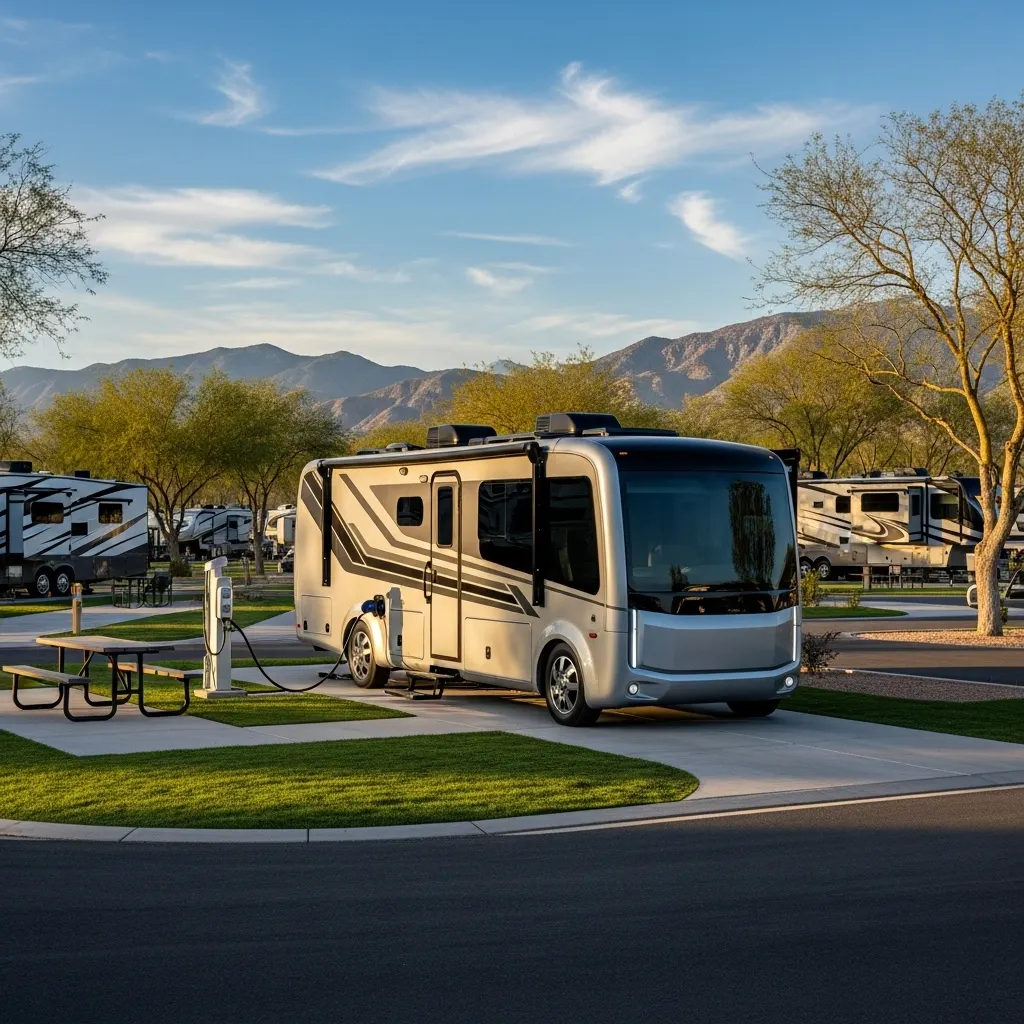
Electric vehicles (EVs) are no longer a niche in the camping world – they’re becoming mainstream. In the United States, nearly one-fourth of active campers (24%) now own an EV, compared to only about 4% of other leisure travelers. This means campers are adopting EVs at a much higher rate than the general traveling public. Crucially, these EV-driving campers care about charging access: four out of ten say they are more likely to choose campgrounds that offer EV charging stations. In other words, having EV charging capability on-site can directly influence where this growing segment of campers decides to stay. For campground owners and developers, this shift in traveler preferences signals a clear opportunity to attract a high-value demographic by accommodating their charging needs.
EV Travelers Seek Charging-Friendly Campgrounds
EV owners planning road trips have unique needs – namely, reliable places to plug in. Unlike traditional travelers who might worry about gas stations, EV travelers carefully plan routes around charging availability. Campgrounds and RV parks that provide charging give these guests peace of mind. They know they can reserve a site and recharge overnight while they camp, instead of hunting for a public charger en route. As one EV infrastructure expert noted, RV parks are ideal for overnight charging because their existing 240-volt hookups mirror home charging setups, allowing an EV to add roughly 20+ miles of range per hour – easily 150+ miles overnight. This means by morning, an EV-driving camper can wake up to a refreshed battery, ready for the next day’s adventure without detouring to find a fast charger.
From a campground’s perspective, catering to these needs can yield big benefits. EV drivers tend to be planners and will go out of their way to book a site that meets their charging requirements. They’re also often willing to pay a bit more for the convenience. Some parks bundle electricity into the nightly fee, while others charge an extra $10–$20 per night for EV charging access. Either way, offering charging can become both a customer draw and a modest new revenue stream. As an EnergySage report highlights, many parks are now evolving to add dedicated EV chargers or upgrade their electrical systems to handle the demand – parks gain a new income source, and travelers gain thousands of additional charging locations across America. In short, installing EV charging is a win-win that enhances guest satisfaction and can boost the park’s bottom line.
The Current Gap: Few Campgrounds Offer EV Charging (So Far)
Despite growing demand, the vast majority of campgrounds today lack EV charging stations. Adoption of this amenity is still nascent – only about 8% of U.S. RV parks currently offer EV charging at campsites, and roughly 5% have standalone charging stations in a common area. In other words, over 90% of parks have no dedicated EV charging infrastructure on-site. This presents a glaring gap between the needs of EV-owning campers and the amenities available at most parks. Travelers with electric cars or trucks often have to improvise, sometimes using a campground’s regular RV electrical hookup with their own portable charger (if the park even allows it). Some older parks outright prohibit EV charging from campsite pedestals due to fear of overloading their electrical system, leaving guests in a bind if they arrive with an EV.
The low current adoption isn’t due to lack of interest, however – it’s largely about infrastructure challenges and cost. Many campgrounds operate on legacy electrical systems designed decades ago for lights and RV appliances, not high-draw EV chargers. Upgrading a park’s power supply (transformers, wiring, etc.) to support multiple EVs charging simultaneously can be expensive and technically complex. Understandably, park operators have been cautious, waiting to see how big the EV trend becomes in camping. But things are quickly changing. Industry surveys show rising interest among park owners to add chargers as they see more EVs pulling in. What was a rare novelty a few years ago is poised to become a standard offering in the coming years.
Electric Trucks and RVs Are Here – And They Need Power
One big factor driving this change is the wave of electric tow vehicles and RVs hitting the market. Already, many campers are towing travel trailers with electric pickup trucks like the Ford F-150 Lightning or Rivian R1T, or they bring an EV as a runabout vehicle in addition to their motorhome. Towing a heavy RV can significantly reduce an electric truck’s driving range – often by 30-50% – meaning these travelers need to charge more frequently on long trips. They will actively seek out campgrounds where they can plug in both to recharge their vehicle’s battery and avoid “range anxiety” during their journey.
Looking ahead, the RVs themselves are beginning to go electric. Major RV manufacturers have unveiled prototype electric campervans and even battery-augmented motorhomes that promise cleaner, quieter camping experiences. For example, Thor Industries (one of the world’s largest RV makers) is developing the Entegra “Embark” – a Class A motorhome with an electric-drive range extender – aiming for hundreds of miles of range. Smaller startup companies are rolling out all-electric camper vans and towable trailers with built-in battery packs. While many of these electric RVs are just entering the market, it’s clear the future of RVing will involve plug-in power. This means tomorrow’s campgrounds must be ready not just for cars and trucks charging, but potentially for guests plugging in their entire electric RV rig. Forward-thinking park developers are taking note of this trend now, to avoid being caught unprepared later.
Why RV Parks Are Installing EV Charging Stations
Early-adopter RV resorts and campgrounds are already capitalizing on the EV movement. They understand that installing charging stations today can set them apart from competing parks and bring in new customers. There are several compelling benefits for park investors and developers to integrate EV charging:
- Attract a Growing Customer Segment: EV ownership among campers is climbing every year, and these travelers are actively seeking out “EV-friendly” campgrounds. Advertising that your park has charging stations can draw in EV-driving guests who might otherwise skip your location. It’s a way to tap into a higher-spending segment of campers that’s only going to grow. Many EV owners have above-average incomes and are willing to pay for convenience and green amenities, making them an attractive demographic for upscale RV resorts.
- Competitive Differentiation: Right now, offering EV charging is a distinctive perk – with only ~8% of parks doing so, you immediately stand out in the market. As EV travel blogs, apps, and word-of-mouth spread the news, your park can become known as a convenient stop for electric travelers. This differentiation can boost your occupancy rates, especially off-season or mid-week when locals with EVs might take spontaneous trips knowing they can charge on-site.
- Longer Stays & Increased Revenue: When guests can charge their vehicle at their campsite, they’re more inclined to stay longer or explore the local area while charging. For instance, an EV truck towing a trailer might arrive nearly empty and need a good part of a day to recharge on Level 2 – during which time the campers are likely to remain on the property, patronize on-site facilities (store, cafe, etc.), or even add an extra overnight stay. Some parks are also implementing fees for EV charging (either a flat nightly surcharge or metered per kWh) which can provide additional income. While electricity costs need to be accounted for, a well-managed charging amenity can be a modest revenue center on its own.
- Future-Proofing and Sustainability: Installing EV infrastructure now “future-proofs” a campground for the coming electric transition. It’s much easier and cheaper to lay conduit and designate EV-capable sites during initial construction or major upgrades, rather than retrofitting later. By building with EV charging in mind, new parks set themselves up to handle the rising electric demand over the next 5–10 years. There’s also a PR and branding benefit: offering EV charging positions your campground as an eco-conscious, innovative business. In an era of increasing focus on sustainability, having chargers sends a message that your park is aligned with cleaner transportation and responsible travel. This can enhance your brand image and appeal to not just EV owners but the broader public who value green initiatives.
- Access to Incentives: Both government and private programs are helping offset the cost of installing charging stations. In the U.S., federal tax credits are available to businesses that invest in EV charging infrastructure – covering 30% of the installation cost (hardware and labor) up to $100,000 per charger. Many states and utilities likewise offer grants, rebates, or special rates for commercial EV charger installations. Early adopters can leverage these incentives to significantly reduce their upfront costs. Essentially, there’s free money on the table to encourage you to build charging now. Investors who take advantage can improve their ROI and potentially pay back the investment faster. (In fact, one industry analysis suggests that even with higher-power “pull-through” fast chargers, site hosts could recoup their investment within a few years due to the steady usage by travelers.)
Designing New Parks with High-Amperage Charging in Mind
For developers planning new RV resorts or major renovations, incorporating EV charging from the ground up is quickly becoming the new standard. Rather than treating chargers as an afterthought, savvy park designers are including them as a core utility – much like water, sewer, and traditional electric hookups. This involves some strategic design decisions:
Electrical Infrastructure Upgrades: EV charging (even Level 2 at 40–50 amps) adds substantial electrical load to a campground. New parks are being built with beefier electrical systems – larger capacity transformers, higher-gauge wiring, and smart load management – to handle dozens of vehicles charging each night. In the long run, it can be more cost-effective to install sufficient power capacity from the start than to retrofit and rewire later. Many park operators are phasing in upgrades in anticipation that EV usage will keep rising. High-amperage service to each site (e.g. 100A circuits) might become the norm so that an RV and an EV can plug in together without tripping breakers.
EV Charging Station Placement: There are a couple of models to consider. Some resorts install dedicated Level 2 charging stations at each RV site (often using a pedestal that has both RV hookups and an EV J1772 plug). This is very convenient for guests – they can charge right where they park – and it future-proofs every site for an electric RV or tow vehicle. For example, a new campground in Texas (Skye Texas Hill Country Resort) was the first built with EV charging at every single site as a key feature when it opened in 2024. Similarly, a park in California is retrofitting to become the first in that state to offer EV connections at all sites.
Other parks opt for a central charging area – a bank of chargers in the parking lot or near the entrance – where any guest (or even the public) can charge their car. This approach can be useful if you want to also attract pass-through EV drivers for quick charges, or if powering a few centralized stations is more feasible than wiring every campsite. It does, however, require guests to leave their RV spot to charge and may work better for towed cars than for electric motorhomes. Park owners will need to weigh which approach (or a mix of both) fits their layout and budget. In either case, clear signage and easy access are important. Some properties are installing pull-through charging sites that can accommodate a car or truck with a trailer attached, so EV drivers don’t have to unload or park awkwardly to plug in. The RV Industry Association has been actively advocating for more of these pull-through EV charging designs along travel corridors and in campgrounds, recognizing the unique needs of RVers with trailers.
Level 2 vs. DC Fast Charging: Most campgrounds are focusing on Level 2 chargers (240V, up to ~11 kW) for now, which are cost-effective and work well for overnight charging. A Level 2 charger can fully recharge many EVs over 6–8 hours, which aligns perfectly with typical camping activities (relax for the evening while the vehicle charges). DC fast chargers (50+ kW) are relatively rare at RV parks currently, because they are expensive to install and provide more power than needed for an overnight stay. However, a few high-end resorts or ones near major highways are exploring adding a DC fast charger to serve both campers and general EV traffic. This could be a differentiator and an additional revenue source (fast charging sessions for a fee), but it requires heavy-duty infrastructure and often partnerships with charging networks or utilities. For most park developers, the priority is wiring the park for ample Level 2 capacity, as that covers the majority of use cases for overnight guests. Fast charging might be an add-on for the future as EV adoption grows.
Smart Energy Management: As multiple EVs charge alongside RVs running air conditioners, the peak electrical load of a campground can spike sharply. To prevent outages or demand charges, new systems are emerging that allow smart load balancing. For instance, a campground could use networked charging stations that communicate and reduce power if the grid load is too high, or have scheduling to encourage charging in off-peak times. Incorporating solar panels (perhaps as carport canopies over the charging area) and battery storage on-site is another forward-thinking strategy. In fact, the Kings River RV resort in California installed EV chargers under a large solar canopy (pictured below), marrying renewable energy with their charging infrastructure. This kind of integrated approach not only supplies free solar power for charging but also provides shade and showcases the park’s commitment to sustainability.
Kings River RV Resort in California built a solar-covered charging area with EV hookups at every site, one of the first of its kind. Parks that integrate charging infrastructure early gain a reputation as modern, forward-thinking destinations.
Overcoming Challenges: Costs and Considerations
Understandably, campground owners might be concerned about the costs and challenges of adding EV charging. It’s true that upgrading electrical infrastructure can be a significant investment – running new power lines, installing heavy-duty circuits, purchasing charging units, etc. However, as mentioned earlier, generous tax credits (30% federal) and grants can offset a large portion of these costs. Many early adopters have successfully obtained state energy grants or partnered with companies that subsidize chargers in exchange for shared use or branding. Additionally, the technology costs are gradually coming down: basic commercial-grade Level 2 chargers are becoming more affordable, and software can help manage usage to avoid costly peak demand fees.
Another consideration is setting appropriate usage policies. If a campground provides charging, will it be included free for guests or as a paid add-on? Clear communication is key so that EV guests know what to expect and non-EV guests understand any impacts (for example, ensuring an EV isn’t hogging a spot just to charge). Some parks designate certain sites as “EV sites” and charge a premium for them, while others keep it first-come first-serve but monitor electricity use. There’s also the aspect of electrical load management – encouraging guests to charge vehicles during off-peak hours or asking them to throttle to lower amperage if the park is near capacity. Fortunately, many EV drivers are tech-savvy and understand these constraints, and as long as the park staff is knowledgeable and helpful, most will gladly cooperate (after all, they’re grateful just to have a place to charge while camping).
It’s worth noting the safety and liability angle too. Installing proper, purpose-built EV charging stations is safer than having guests jury-rig solutions with extension cords. Modern chargers have built-in protections, and when installed by certified electricians to code, the risk of electrical fires or overload is minimal. This is another reason to invest in doing it right, rather than risking someone plugging into a standard outlet incorrectly. By upgrading, you also avoid the scenario of guests tripping breakers or accidentally knocking out power to neighboring sites because an EV was plugged into an old pedestal not rated for that sustained load.
Early Adopters Gain a Competitive Edge
Forward-thinking RV park investors and developers who embrace EV charging now are positioning themselves at the forefront of a major trend. In the near future, having EV charging might shift from a niche perk to an expected amenity – much like Wi-Fi or hot showers. Those who get ahead of the curve stand to reap significant rewards. A campground industry analysis summed it up well: amenities like EV charging, alongside connectivity and glamping facilities, are shaping the next generation of RV parks – those that stay ahead of these trends are poised to capture the growing and higher-spending segment of campers. In practical terms, that means better occupancy rates, the ability to charge premium nightly fees, and a loyal customer base that returns because they know your park accommodates their needs.
We’re already seeing success stories. Some Kampgrounds of America (KOA) locations have installed chargers and reported positive feedback and increased bookings from EV-driving campers. KOA’s network has at least 28 campgrounds in North America equipped with EV charging, with more planned. Independent resorts like the aforementioned Skye Resort in Texas made headlines by opening with full EV capability, which in turn attracted media attention and eco-minded travelers. And as EV adoption accelerates nationwide, the general awareness of “EV-friendly” camping will only grow. Soon, travel apps and campground directories will routinely flag which parks have charging stations – a filter EV owners will use to plan their trips. Being on those lists early means extra visibility.
For investors, there’s also a broader strategic angle: adding EV charging can tie into environmental, social, and governance (ESG) goals or sustainable investment criteria. An RV park that actively supports electric vehicles sends a message about embracing innovation and reducing carbon emissions from travel. This can open doors to marketing opportunities, partnerships (e.g. with EV clubs or vehicle manufacturers for rallies/events), and even new revenue channels like hosting public charging accessible to locals. Some campgrounds might evolve into dual-purpose sites that serve both overnight guests and day-trippers needing a charge, further monetizing their location especially if near highways or tourist attractions.
As Jason Rano of the RV Industry Association put it, “If you build it, they will come.” EV campers are planners and will seek out places that accommodate them, so “site hosts that cater to RVers with [EV charging] will reap the financial rewards”. In essence, installing EV chargers is not just a nod to tech trendiness – it’s a savvy business move to capture an emerging market of travelers. Early adopters are establishing their reputation now, and that goodwill and brand loyalty will be hard for latecomers to buy once EV-friendly camping becomes the norm.
Conclusion: Charging Ahead to the Future
The electrification of transportation is rewriting the playbook for many industries – and outdoor hospitality is no exception. RV parks and campgrounds that adapt by integrating EV charging infrastructure position themselves as leaders in a new era of camping. The data is clear: more campers are driving EVs, more electric RVs are on the horizon, and these guests will choose destinations that welcome their vehicles with open arms (and open outlets). While only a small percentage of parks today offer charging, this will change rapidly as awareness and demand grow. For U.S. campground investors and developers, the message is simple: embrace the electric revolution to stay competitive and capture a lucrative, growing customer base.
Planning for high-amperage EV charging in new park designs is likely to become standard practice – much like designing pull-through RV sites or installing modern Wi-Fi. It’s an upfront investment that can pay dividends in guest satisfaction, increased bookings, and ancillary revenue. Moreover, it’s an investment in staying relevant as vehicle technology evolves. By installing charging stations, parks not only attract EV-driving campers now but also set themselves up for the influx of electric trucks and motorhomes in the coming years. Early movers are already seeing the benefits in terms of market differentiation and positive buzz.
In the end, the goal of any hospitality business is to anticipate guest needs and delight customers. EV charging is quickly moving from a novelty to an expectation for a significant segment of travelers. Parks that charge ahead – literally – will be the ones that thrive in this new landscape. The road trip isn’t going away; it’s just getting a jolt of electricity. Forward-thinking campground owners are making sure that when these new-age adventurers hit the road, they’ll find a place to recharge both their vehicles and their spirits at an EV-ready campground. By doing so, they’re not just keeping up with the times, they’re setting the pace for the future of outdoor recreation travel.