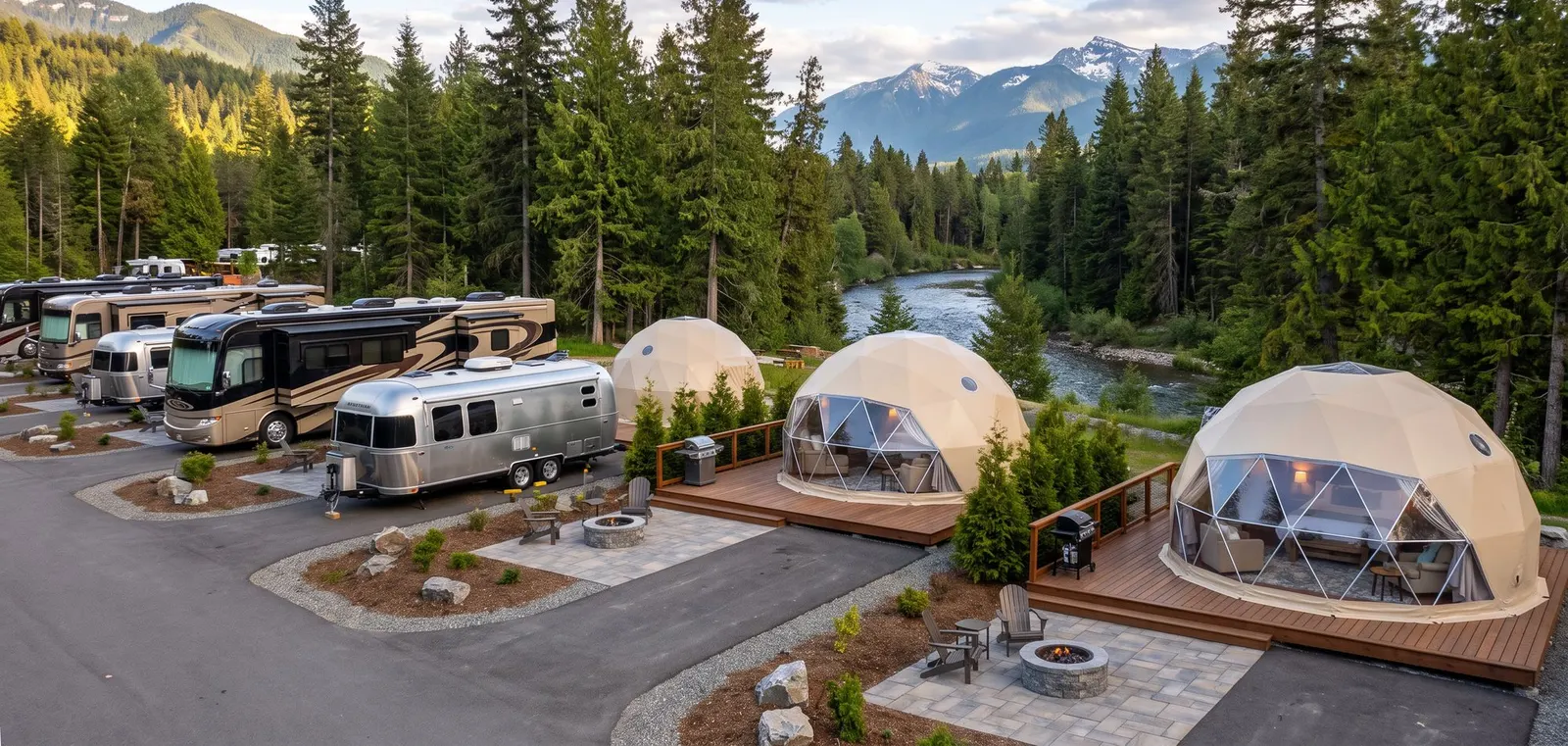
INNOWAVE STUDIO · DATA AS OF OCTOBER 2026
Premium lodging units do two jobs in an RV park. They earn more per night, and they reach guests who never search for an RV site. In April 2026, cabins and other on-site lodging carried an average advertised rate of $193.14 a night against $73.47 for RV sites, according to the Insider Perks pricing index. That is about 2.6 times the RV rate. Lodging units also open channels that RV pads cannot use. RoverPass states: “Cabins, glamping domes, and unique accommodations can be listed directly on Airbnb, Booking.com, and Expedia." Traditional RV sites cannot.
The demand signal is real but smaller than survey headlines suggest. KOA’s survey puts glamping at 29% of all camping experiences in 2025. Yet glamping was only 0.3% of RoverPass bookings, and cabins 6.8%. For most RV parks, the sound response is a measured premium layer of roughly 10–20% of sites. That layer should be designed and permitted as lodging, not bolted onto an RV loop.
This article covers how to size that layer, which unit types follow which permitting path, how to place and service the units, and how to test payback.
Demand: fast growth from a small base
Survey data vs. booking data
KOA’s 2026 report rests on 4,088 surveys of US and Canadian households. It found glamping made up 29% of camping in 2025. It also found that 54% of campers plan to glamp in 2026 and that 31% of new campers chose glamping accommodations. RV preference stood at 47%, tied for the lowest level in the report’s history.
Booking platforms show a smaller segment that is growing faster. On RoverPass, glamping bookings rose 43.6% in 2025 but reached only 0.3% of reservations. Cabins grew 15.3% to 6.8% of reservations, while RV site bookings slipped 0.9% and tent sites 3.8%. Campspot reported lodging at 14% of how campers camped in 2025, across more than 3,500 parks.
The gap is mostly about what is counted. KOA measures self-reported experiences across all settings, and three in 10 camper nights were spent at a private campground or glamping resort. RoverPass and Campspot count reservations at parks that use their software, which skews toward RV parks and campgrounds. Survey intent also runs ahead of booked nights. Use booking data for underwriting and survey data for direction.
2026 signals
In Campspot’s same-store data through May 2026, glamping resorts were up 10.9% year over year. Parks with at least 20% of inventory in cabins, cottages or glamping structures were up 0.8%. Campspot called that the only site-type segment in positive territory (glamping resorts are a separate park-category measure), while transient bookings fell 2.2%. Northgate Resorts described the same split: “largely flat year-over-year on the RV side, while lodging is trending up."
Holiday data is flatter. Cabins held at 8.3% of RoverPass July 4 bookings in both 2025 and 2026. Lodging is outperforming RV sites, but it is not booming at every park.
Who books premium units
Premium units bring in guests who do not own an RV. Hipcamp reported family glamping bookings growing 50% faster than glamping trips without kids, and searches for luxury amenities up 87%. Both figures were released in January 2025 and likely reflect 2024 activity. KOA found 17% of new campers had their first camping experience at a resort designed for glamping.
The distribution advantage: lodging reaches the OTAs
What the platforms accept
General online travel agencies (OTAs) sell accommodation, not parking pads. RoverPass states: “Traditional RV sites, by contrast, cannot be listed on general OTAs." Campspot’s Airbnb connection has the same limit: “Only Lodging Site Types can be listed on Airbnb." Airbnb’s campsite category shows tents, campers, tiny homes, yurts and cabins rather than bare hookups. Booking.com’s campground pages are built around rentable mobile homes and caravans.
RV sites still sell through camping marketplaces. RoverPass’s OTA channel, which includes Google and camping marketplaces, carried 11% of reservations in 2025, up from 10%. Within it, Booking.com’s share rose from 7% to 21% and Expedia’s from 3% to 9%. Airbnb’s share fell from 55% to 48% even as its volume grew 36%. Most guests still book direct: 64% of campers in an RMS survey book through the campground’s website.
Channel managers and fees
The connection runs through the park’s reservation system. RoverPass says its channel manager syncs to Airbnb, Hipcamp, Expedia, Booking.com, Vrbo and Spot2Nite. Campspot charges $10 a month per park for select integrations, plus the park’s usual online booking fee. Airbnb’s host-only fee is 15.5% for most hosts and mandatory for hosts using property management software. Treat commission as the cost of reaching a new guest, then convert that guest to direct repeat bookings.
The rate premium
Insider Perks’ January 2026 report put the median cabin or lodging unit at $154.50 a night against $62.10 for an RV site, about 2.5 times. Among glamping types, it listed domes at $185.32, yurts at $146.93, safari tents at $136.43 and bell tents at $107.28. Its April index, drawn from more than 16,000 properties, shows a similar ratio.
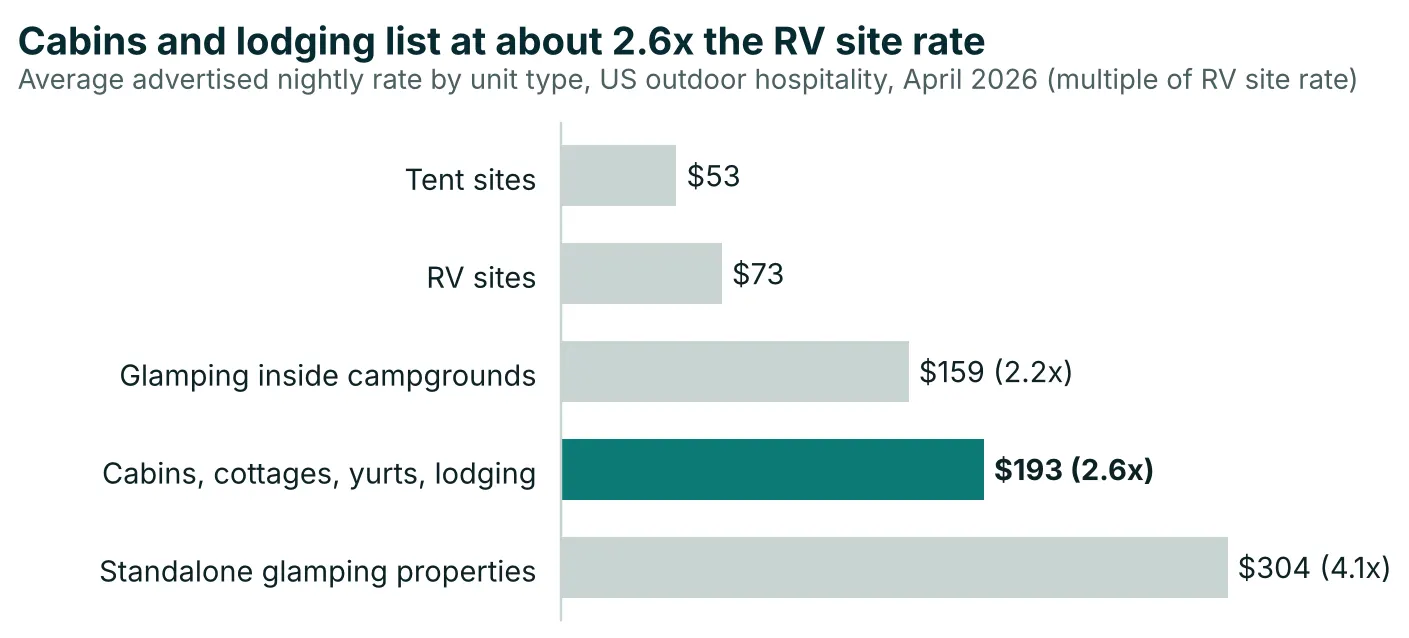
The gap between glamping inside campgrounds and standalone glamping properties explains why sources disagree. Cairn Consulting Group, presenting at Glamping Show Americas, put 2025 glamping ADR at $251, up 21% from 2023. An RV park should underwrite to the in-campground figure, not the resort figure.
Ancillary revenue
Lodging guests arrive without gear, which opens room for add-on sales. RoverPass reported store and add-on revenue up 47.3% in 2025, though it was still only 1.4% of revenue. MMCG Invest estimates ancillary revenue at 15% to 30% of total at well-run glamping properties. Packaged extras work: Camp Aramoni’s manager says guests “are willing to pay a higher sticker price for the picnics."
Unit types and the codes behind them
Park model RVs
Park model RVs are built to the ANSI/RVIA A119.5 standard, now in its 2025 edition, with electrical work under NEC Article 552. Florida’s motor vehicle statute defines a park trailer as up to 14 feet wide, with a setup area that does not exceed 400 square feet when built to ANSI A-119.5. Federal rules exempt these units from the HUD code only if they are “designed only for recreational use and not as a primary residence or for permanent occupancy." That limits how a park can market them for long stays.
Park models hook up to site electricity, sewer and water like any RV, so they fit a full-hookup pad. Supply is growing: RVIA data cited by Modern Campground show park model shipments up 22.4% in Q1 2026 while towable shipments fell 13.2%.
Cabins and tiny homes
Cabins on foundations are buildings. They need a building permit under the state’s adopted code, or state approval for factory-built modular units. The path is slower, but it allows larger plans and full bathrooms.
Safari tents, yurts and domes
Soft-sided units sit in a gray zone. MMCG Invest notes that glamping “fits no existing use category," which can force a permit fight or a text amendment. Some states are explicit: Virginia’s campground rules list tents, yurts and cabins as “camping units”. Expect the fire official to ask for flame-resistance test documentation on fabric, and the building official to review decks and platforms. Specify frames engineered for local wind and snow loads. Stout Tent warns buyers to expect a single season from unshaded canvas in hot, sunny regions unless a rainfly or sunshade is used.
Factory prices understate real cost. One manufacturer lists PVC domes at $2,000–$4,000 ex-works, excluding shipping, installation and accessories. Platforms, utilities, interiors and bathrooms drive the installed figures below.
| Unit type | Typical cost per unit | Permitting path | Durability or use note | OTA listing |
|---|---|---|---|---|
| Park model RV | $35,000–$80,000 average unit cost, before site work | RV standard (ANSI A119.5); placed on a campground site | Recreational use only, per HUD exemption | Yes, as lodging |
| Cabin / tiny home | $50,000–$200,000 installed | Building permit or state modular approval | Fund a 3–5% revenue reserve | Yes |
| Safari tent / yurt | $25,000–$75,000 installed (safari tent) | Campground or local use review; fabric and platform review | Canvas wears fast in sun and humidity | Yes |
| Geodesic dome | $15,000–$60,000 installed | Same as tents, plus frame engineering | Cover and frame rated for site loads | Yes |
| RV site (reference) | $30,000–$40,000 per site, land excluded | Campground permit | Pedestals last 15–25 years | No; camping marketplaces only |
Site design: build premium units as their own neighborhood
Placement and separation
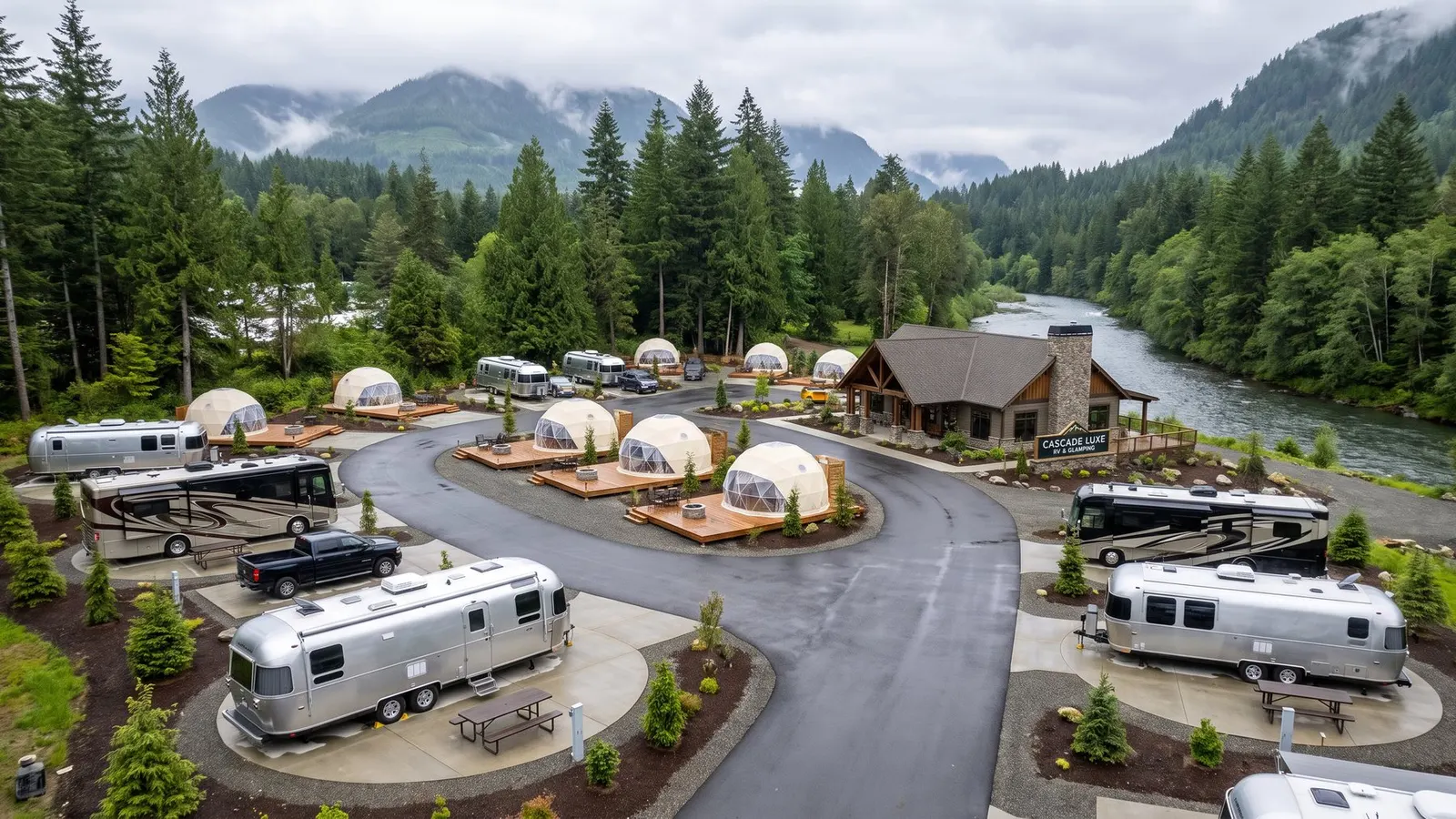
Give premium units the best views, tree cover and quiet, and keep them out of the RV traffic stream. North Haven Campground in Bonners Ferry, Idaho, which mixes RV sites, glamping wagons and cabins, stresses privacy, buffers and trees as part of the product. Cluster units in a pod with its own spur road. That keeps big-rig turns, diesel noise and generators away from guests paying two to three times the RV rate.
A common minimum is 10 feet between camping units, with some states requiring more, such as Tennessee’s 15 feet. Fire officials may want more for tents and cabins, so confirm before fixing the layout. NFPA 1194 covers parks for “RVs, recreational park trailers, and other camping units." Texas now requires campgrounds to meet its 2021 edition and to install an emergency roof-access ladder in every campground cabin in a floodplain. Keep premium pods out of floodplains.
Utilities
A park model can share the RV pad standard, including a 50-amp pedestal. A 50-amp receptacle supplies 12,000 VA against 3,600 VA for 30-amp. That headroom matters when a unit runs a heat pump, water heater and cooktop at once. Cabins built as buildings may need separate metered service. Size transformers for the full pod at design stage, even if units arrive in phases.
NFPA 1194 designs potable water at about 100 gallons per day per site. Cabins with full kitchens and showers can exceed that, so check septic or sewer capacity early.
Tents and domes without plumbing depend on a bathhouse. Virginia, for example, requires sanitary facilities no farther than 500 feet from the campsites they serve and no closer than 30 feet. Cabins with individual sewer connections drop out of Virginia’s fixture count. Private baths are also becoming standard: Cairn found operators prioritizing in-suite bathrooms as the most common amenity among glamping operators.
Accessibility
The Access Board’s camping scoping has “no legal effect on State and local governments and private entities," but they may use it as guidance. It applies “to each type of camping unit provided": 2 accessible units for 2–25 units and 3 for 26–50. A 20-cabin layer would plan 2 accessible cabins. Cabins also fit the 2010 ADA Standards’ definition of transient lodging, “primarily short-term in nature,” so design routes, parking and bathrooms to lodging standards. Confirm scoping with counsel.
Parking and service access
Non-RV guests arrive by car, so each unit needs a defined parking space and a short, firm path to the door. Housekeeping needs a cart route that does not cross guest decks. Virginia requires linens to be freshly laundered between occupants, so place laundry and clean-linen storage near the pod.
Economics, phasing and a developer checklist
Sizing the layer
Ten to twenty percent of sites is a practical range. Campspot classes parks with at least 20% of inventory in lodging as “lodging-significant”. MMCG Invest’s illustrative 150-site park carries twenty cabins, about 13% of sites. Cabins are 6.8% of RoverPass bookings, so going above 20% needs a demand driver such as a national park, lake or nearby metro.
Illustrative payback
MMCG Invest’s composite prices cabins at $150 a night at 55% occupancy. By the author’s calculation, that yields about $30,100 a year per cabin. MMCG Invest cites glamping NOI margins of 40% to 60%, or $12,000 to $18,100 per cabin. A cabin installed at $100,000, inside MMCG Invest’s $50,000–$200,000 range, would pay back in roughly 5.5 to 8.3 years. In MMCG Invest’s composite, the twenty cabins produce about 36% of site revenue on 13% of sites (author’s calculation, assuming year-round operation).
Compare a standard pad. Operating parks earn $5,000 to $10,000 per site per year, and Newmark puts expenses at 53.7% of revenue. By the author’s calculation, one cabin can out-earn three to six RV sites.
Net down that revenue before approving a build:
OTA fees: 15.5% on Airbnb bookings, plus software fees.
Insurance: MMCG Invest’s composite loads hard-market insurance at 3.5% of revenue. Brokers flag the light structures common in parks as vulnerable to wind and hail. MMCG Invest also notes FEMA’s flood program does not insure RVs as buildings, which matters for park models.
Reserves: 3–5% of revenue for cabin replacement.
Housekeeping: every turn needs cleaning and laundered linens, which RV sites do not.
Tax can shorten payback. IRS Notice 2026-11 confirms a permanent 100% first-year depreciation deduction for qualified property acquired after January 19, 2025. Whether a unit qualifies depends on how it is classified, so confirm with a tax adviser.
Phasing
Entitle the full premium pod in the master site plan, with utilities stubbed to every unit pad.
Open with a first cluster of one proven type, usually park models or cabins with private baths.
Collect a full season of booking data across direct and OTA channels.
Add tents or domes only where data show unmet weekend and shoulder demand.
Checklist
Confirm with the AHJ how each unit type is classified and which NFPA 1194 edition applies.
Get insurance quotes per unit type before ordering units.
Plan accessible units per unit type.
Size electrical for 50-amp or separate service at every premium pad.
Set up the channel manager, photos and OTA listings before opening.
Budget housekeeping, laundry and linen stock in the operating plan.
InnoWave Studio’s 50-state regulatory matrix and per-pad cost benchmarks provide a starting point for planning the pod.
Sources
2026 RoverPass Outdoor Hospitality Report: The Quality Shift
KOA 2026 Camping and Outdoor Hospitality Report press release
KOA: Camping Participation Builds on Post-Pandemic Gains (SGB Media)
KOA Outdoor Hospitality Report: 52M Americans Camped in 2025 (RV PRO)
Early Booking Data Suggests a ‘Relatively Stable’ 2026 (RVBusiness)
Rise of ‘Glamping’ Among Hipcamp’s Predictions for 2025 (RVBusiness)
Report: Glamping Breaks the ‘Canvas Ceiling’ as Demand Matches Tents (RV PRO, RMS survey)
Insider Perks Publishes ‘2026 Outdoor Hosp. Pricing Report’ (Woodall’s Campground Magazine)
Insider Perks Launches the Outdoor Hospitality Pricing Index (Modern Campground)
Glamping ADR Hits $251/Night as Guest Stays Lengthen (Modern Campground)
The U.S. Glamping Industry Enters Its Institutional Era (MMCG Invest)
Why Campground Operators Are Rethinking the RV Park Playbook in 2026 (Modern Campground)
Why RV Parks Are Pivoting to Extended Stays and Park Models in 2026 (Modern Campground)
12VAC5-450-100, Sanitary Facilities (Virginia Administrative Code)
12VAC5-450-115, Cabins and Other Rental Units (Virginia Administrative Code)
From RV Park to Glamping: The Lowest-Cost Conversion (Plus Glamping)
Texas SB 1 Bill Analysis, 89th Legislature, 2nd Called Session
NFPA 1194: Standard for Recreational Vehicle Parks and Campgrounds, 2026 Edition
2026 U.S. RV Park Development Cost Benchmarks: Per-Pad Economics Across 50 States (InnoWave Studio)
Guide to the ABA Standards: Chapter 10 Outdoor Developed Areas (U.S. Access Board)
IRS Notice 2026-11, Interim Guidance on Additional First Year Depreciation
The Real Reason Your RV Park Premiums Keep Going Up (Leavitt Recreation & Hospitality)