INNOWAVE STUDIO · DATA AS OF OCTOBER 2026
The 2027 model codes are out, but for most US projects that start design in 2027, they will not govern the permit. The International Code Council (ICC) released the 2027 International Building Code (IBC) in digital form, with print due in late October 2026. The 2027 International Energy Conservation Code (IECC) is final, with no appeals filed. Yet model codes carry no legal force until a state or city adopts them, and adoption runs years behind publication.
That gap does not make the new editions irrelevant to owners. Several 2027 changes, notably the move of flood rules to the 500-year floodplain, could start to inform insurance, lending and resale decisions even before adoption. Federal energy incentives have also ended for most new starts, while local building performance standards (BPS) run on their own clocks. This article sets out what changes, when it binds, and what owners should do now.
What the 2027 IBC changes, and what it costs
ICC’s 2027 IBC product page lists the main changes. The items below have the clearest effects on cost, layout or insurance. All are final model-code text, not proposals, but none binds a project until local adoption.
Flood rules move to the 500-year line
The 2027 IBC expands flood hazard areas to include the 500-year floodplain and ties elevation and load requirements to risk category. It does so by referencing ASCE 24-24. That standard extends the regulated area from the 100-year Special Flood Hazard Area to the mapped Shaded X Zone. It also requires most commercial and residential buildings (Flood Design Class 2) to be elevated to the 500-year flood level. Class 3 buildings go to the 750-year level and Class 4 to the 1,000-year level.
Once adopted, this rule could add elevation or floodproofing costs on sites outside the federal mandatory flood insurance zone. The Association of State Floodplain Managers calls the upfront costs “modest” and expects lower premiums over time. The National Association of Home Builders (NAHB) opposed the change. Neither group published a cost figure.
Batteries and energy storage
The code adds provisions for battery manufacturing, recycling, energy storage systems and EV battery work. It also states where sprinklers are required for lithium-ion and lithium metal battery storage. For industrial owners, tenant use becomes a fire-protection input. A warehouse re-leased to a battery-storing tenant may need sprinkler upgrades, so leases should define permitted battery storage and assign upgrade costs.
Multifamily layouts
Proposal E24-24 lets some four-story Group R-2 buildings use a single exit, up from three stories. Conditions include a 4,000-square-foot net floor area cap per story and NFPA 13 sprinkler coverage in the stair. A manual fire alarm and smoke detection in common areas are also required. On small infill lots, one stair instead of two frees floor area and allows dual-aspect units. Jurisdictions can adopt this section before the rest of the 2027 code.
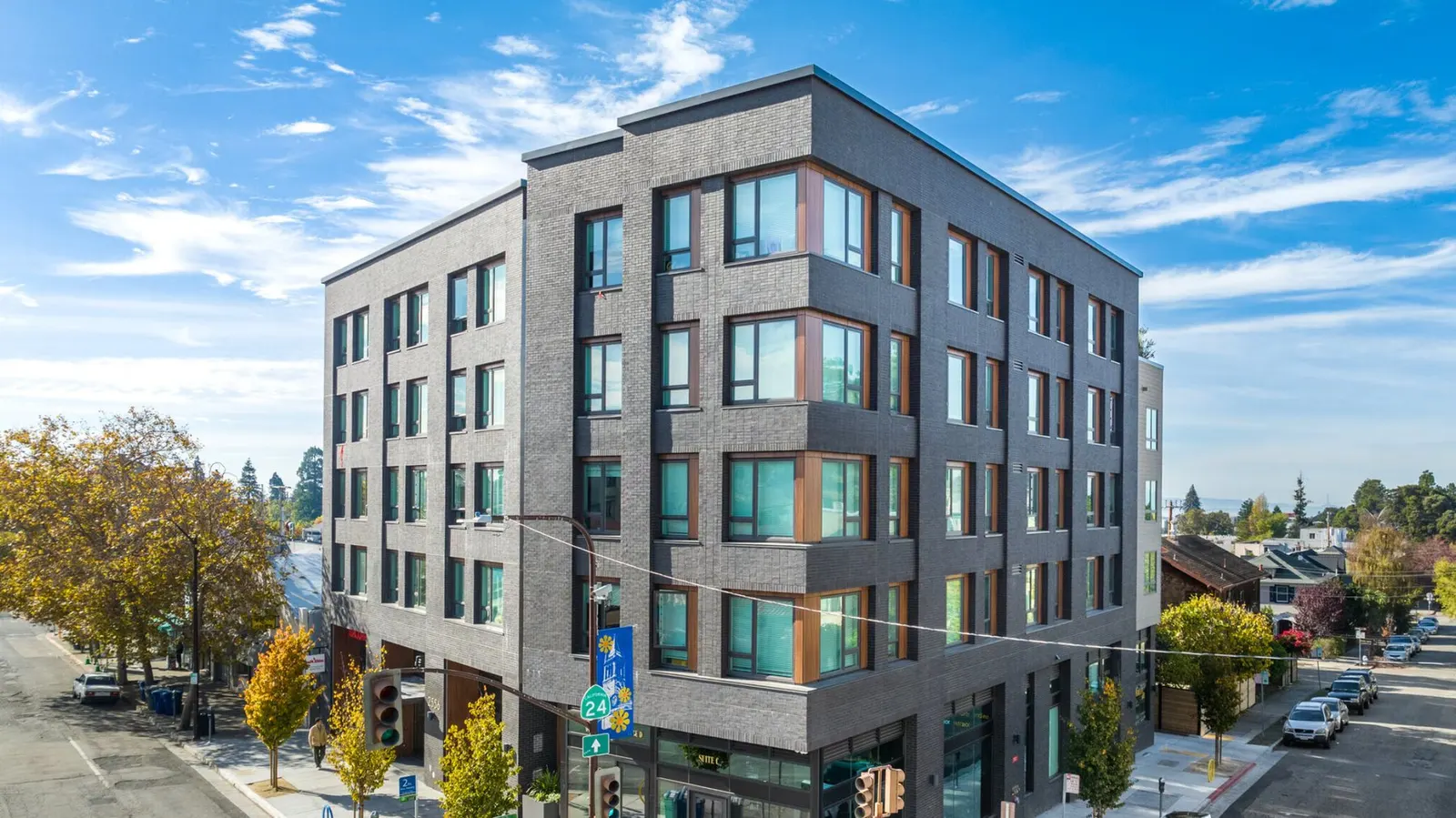
Two other items add constraints. NAHB reports approval of natural light requirements for multifamily units with living, dining or sleeping rooms of 70 square feet or more. That matters for deep floor plates and office conversions. The code also updates occupant load factors for several space types, which can change egress widths and fixture counts in test fits.
Other changes with a budget line
The table summarizes further changes from the ICC list. The consequences are this article’s assessment.
| 2027 IBC change | Main asset types | Business consequence |
|---|---|---|
| Classroom and occupiable-room doors lockable from inside the room | Schools, offices, labs | Larger door hardware and security scope |
| Construction documents list design criteria for systems designed by others | Projects with delegated design | Earlier engineering decisions, fewer late redesigns |
| Registered design professional prepares bracing plans for trusses spanning 40 ft or more | Retail, worship, light industrial, apartment roofs | Added engineering fee, lower erection risk |
| Impact-resistant glazing or protection for essential facilities in tornado-prone regions | Hospitals, emergency facilities | Higher glazing cost |
| Higher-education classrooms with 50+ occupants classified as Group A-3 | Universities | Assembly-level egress and fire protection |
The 2027 IECC: final, modest and fuel-neutral
Status and content
No appeals were filed against the residential or commercial provisions, and ICC targets December 1, 2026 for the final document. The Energy Efficient Codes Coalition expects both parts to meet or exceed 2024 efficiency levels. It still calls the gains “the smallest in recent memory.”
On the commercial side, a new trade-off backstop limits how far U-factors can drift, and prescriptive R-values and U-factors changed in several climate zones. Residential Energy Rating Index thresholds drop one point in every climate zone. No DOE savings estimate for the 2027 edition was posted on DOE’s determinations page at the time of writing. For owners, envelope budgets should look much like 2024 IECC projects.
Fuel-neutral by design
ICC’s Board set the 2027 scope. It states the code “is not intended to eliminate any fuel type” and limits greenhouse gas measures to optional appendices or optional compliance paths. Existing mandatory renewable requirements in 2024 IECC Section C405.15 may stay, but cannot be expanded. Electrification and EV readiness will therefore come from local amendments, BPS and tenant demand, not the base model code.
The 2030 split
The 2030 cycle changes more. The ICC Board issued final guidance on the 2030 scope on April 30, 2026. On June 29, 2026, it renamed the expanded tier “IECC Stretch”, separate from a core IECC; jurisdictions choose which to adopt. The January 2026 draft proposed a simple-payback test, with a seven-year maximum for multifamily. Expect more divergence between cities that adopt the stretch tier and those that do not.
ASHRAE 90.1 and federal benchmarks
ASHRAE has published Standard 90.1-2025. DOE’s determinations page still lists no 90.1-2025 determination. The latest commercial determination covers 90.1-2022, issued March 6, 2024, with estimated savings of 9.8% site energy and 8.9% energy cost; state certifications were due March 6, 2026. In May 2026, DOE opened a request for information on its cost-effectiveness method, citing housing affordability, with comments due August 3, 2026.
ASHRAE is also moving carbon provisions, including Addenda M and N, out of 90.1 into a separate publication. ASHRAE/ICC Standard 240P would quantify embodied and operational emissions over a building’s life cycle. Its second public review closed July 21, 2025; this research found no announcement of final publication.
When the new codes actually bind a project
How adoption works
A model code becomes law only when a state or local government adopts it, usually with amendments. Some states enforce one statewide code; others leave adoption to cities and counties. ICC’s own chart notes that the effect of state adoptions on local requirements “varies by state.”
Where states stand
ICC’s April 2026 chart shows how far adoption trails publication. California, Georgia and New York are among the states on the 2024 IBC statewide. Kentucky remained on 2015, Indiana and Texas on 2012, and Arizona, Colorado and Illinois had no single statewide IBC standard for all buildings.
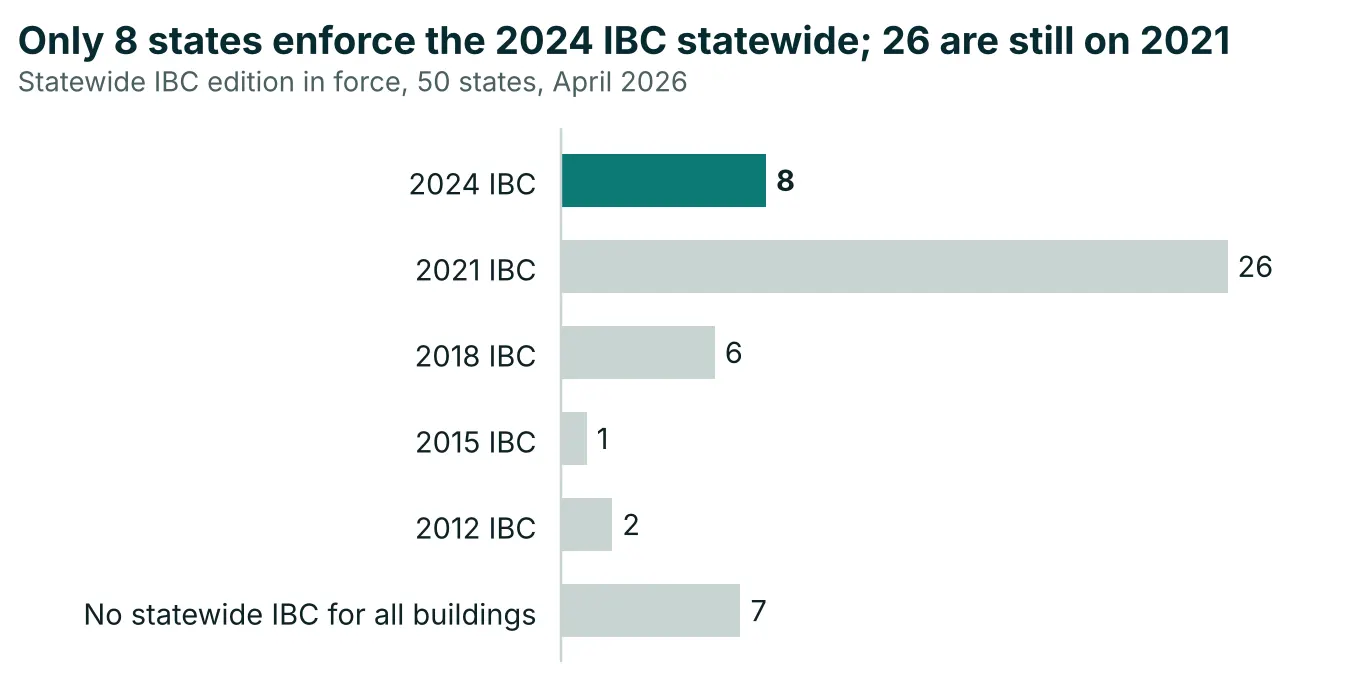
Recent moves show the lag. Washington set May 3, 2027 as the effective date for its 2024 codes. Florida’s 2024-based 9th Edition is scheduled, pending a final rule hearing, to take effect December 31, 2026. On energy, Colorado’s modified 2024 IECC became the state minimum in July 2026, and Illinois adopted the 2024 IECC in November 2025. Other states are moving the opposite way. North Carolina and California froze residential code updates until 2031, and a Missouri bill would cap local energy codes at 2009 IECC stringency.
Vesting: which code applies
The code in force on a key date usually governs. In Washington, a complete application is reviewed under the building permit ordinance “in effect at the time of application”. Other states and cities use different triggers, so owners should confirm the rule in writing.
What this means for 2027 design starts
Based on the pace of 2024 adoptions, most states are unlikely to enforce the 2027 IBC before 2028, and many later. That is this article’s inference, not an ICC forecast. A project starting design in 2027 will usually be permitted under the 2021 or 2024 IBC. Exceptions are large phased projects filing after 2028 and cities that adopt single-exit rules early. Insurers also pay attention, since current codes support better Building Code Effectiveness Grading Schedule standing.
Incentive cutoffs and local performance standards
Federal incentives after June 30, 2026
The One Big Beautiful Bill Act (OBBBA) ended three building incentives, per IRS guidance:
Section 179D: no deduction for property whose construction begins after June 30, 2026. The 2025 maximum was $5.81 per square foot with prevailing wage and apprenticeship. Projects started on time remain eligible even if placed in service in 2027 or later. The IRS FAQ does not define “begins construction” for 179D, so start-date records carry the claim.
Section 45L: credit of up to $5,000 per home, for homes acquired through June 30, 2026. Later closings get nothing.
Section 30C: EV charging credit of 6%, or 30% with labor requirements, capped at $100,000 per item, for property placed in service by June 30, 2026.
One detail affects late finishers. For buildings whose construction began in 2023 or later and that are placed in service from 2027, 179D savings are measured against the tougher ASHRAE 90.1-2019. DOE estimates 90.1-2022 saves 8.9% in energy cost over 90.1-2019, so a design built to 90.1-2022 still starts partway to 179D’s 25% savings threshold.
What remains is permanent 100% bonus depreciation for qualified property acquired after January 19, 2025. Binding contracts signed earlier can disqualify property, so acquisition dates matter.
Building performance standards
BPS rules apply to existing buildings, and new buildings join once they are operating and reporting. A building permitted under a 2021-era energy code in 2027 may face tighter limits within a few years of opening. Key terms, from IMT’s January 2026 comparison matrix unless linked otherwise:
| Program | Covered buildings | Key dates | Penalty or payment |
|---|---|---|---|
| NYC Local Law 97 | Over 25,000 sf | Limits since 2024; stricter limits from 2030 | $268 per tCO2e over limit |
| Boston BERDO | 20,000+ sf or 15+ units | From 2025 (35,000+ sf), 2030 (smaller); 2026 report due Oct. 15 with approved extension | $234 per tCO2e alternative compliance payment |
| Washington, DC BEPS | Private 50,000+ sf; public 10,000+ sf | Cycle 1 ends end of 2026; Cycle 2 begins Jan. 1, 2028 | Up to $10 per sf, capped at $7.5 million |
| Energize Denver | 25,000+ sf | Interim 2028, final 2032 | $0.15–$0.35 per kBtu over target |
| Colorado statewide | 50,000+ sf | 2026 enforcement waived; 29% cut vs. 2021 by 2030 | Up to $2,300 per 30 days from 2030 |
Because the 2027 IECC stays fuel-neutral, BPS will drive electrification in these markets. Designing to code minimum can shift the cost to a later retrofit.
Owner checklist for 2027 projects
Confirm the code of record. Get the adopted IBC and energy code editions, local amendments and vesting trigger in writing for each site. Note any adoption hearing that could land before permit filing.
Map flood exposure to the 500-year line. Check Shaded X Zone status during due diligence and price elevation or floodproofing as an option, even where not yet required.
Screen tenant battery use. Add lithium battery storage and EV battery work to lease use clauses and fire-protection reviews.
Test single-stair schemes. For small multifamily sites, ask whether the city will adopt the four-story single-exit section early.
Rerun test fits for later permits. Check occupant loads, natural light and egress if permitting could slip into a 2027-code jurisdiction.
Write new scope into design contracts. Define delegated-design criteria and truss bracing plans in architect and engineer agreements.
Lock tax positions. Keep 179D construction-start records, 45L acquisition dates and bonus depreciation contract dates with the project file.
Underwrite BPS from day one. Model emissions or energy use against 2030 limits in NYC, Boston, Denver and Colorado before selecting HVAC systems.
Track the 2030 IECC Stretch. Watch whether target markets adopt it, since it could set the next round of energy requirements.
Design teams that build these checks into feasibility reduce redesign risk later; InnoWave Studio applies the same review on its own planning work.
Sources
2027 IECC Scope, Intent and Board Commentary: Final Public Notice (ICC)
ASCE 24-24 to be Included in the 2027 Edition of the International Building Codes (ASFPM)
Model Energy Code Determinations (DOE Building Energy Codes Program)
Request for Information: Methodology for Assessing Affordability and Cost-Effectiveness of Building Energy Codes (Federal Register, May 4, 2026)
ASHRAE Standard 90.1 Introduces New Energy-Saving Requirement (Health Facilities Management)
ASHRAE Separates Energy and Carbon Rules in Standard 90.1 Overhaul (ACHR News)
International Codes: Adoption by State, April 2026 (ICC chart, hosted by MiTek)
9th Edition (2026) FBC Workplan, June 2026 (Florida Building Commission)
RCW 19.27.095: Building Permit Application, Vesting (Washington State Legislature)
How to Prepare for the 2027 International Codes (Green Home Builder)
FAQs for Modification of Sections 25C, 25D, 25E, 30C, 30D, 45L, 45W and 179D under the OBBB (IRS)
Notice 2026-11: Interim Guidance on Additional First Year Depreciation under Section 168(k) (IRS)
179D Tax Credit Update: The Deadline Has Passed (Engineered Tax Services)
Comparison of U.S. Building Performance Standards, January 2026 (IMT)
LL97 Greenhouse Gas Emissions Reductions (NYC Department of Buildings)
Building Emissions Reduction and Disclosure (City of Boston)