A site-level economics framework for acquisition-stage investors and construction lenders evaluating the fastest-growing niche in outdoor hospitality real estate.
The single greatest determinant of whether an RV resort generates $18,000 or $55,000 in net operating income per acre is not location, not brand affiliation, and not even average daily rate, it is the quality of the master plan. In a sector that now commands $10.9 billion in annual U.S. revenue and attracts institutional capital from publicly traded REITs, the master plan has become the underwriting document that separates financeable projects from speculative proposals. According to the KOA 2025 North America Camping Report, 57 million American households camped in the past year, spending $61 billion, and 12.6 million of those households now actively seek cabin and glamping accommodations, an 88 percent increase since 2019. That demand shift is rewriting the economics of site-level revenue, and it is exposing how profoundly unit mix, amenity strategy, and circulation geometry interact to produce, or destroy, investor returns. For construction lenders evaluating feasibility packages and acquisition-stage investors stress-testing pro formas, understanding these interactions is no longer optional. It is the analytical core of the deal.
The arithmetic of unit mix and why it governs RevPAS
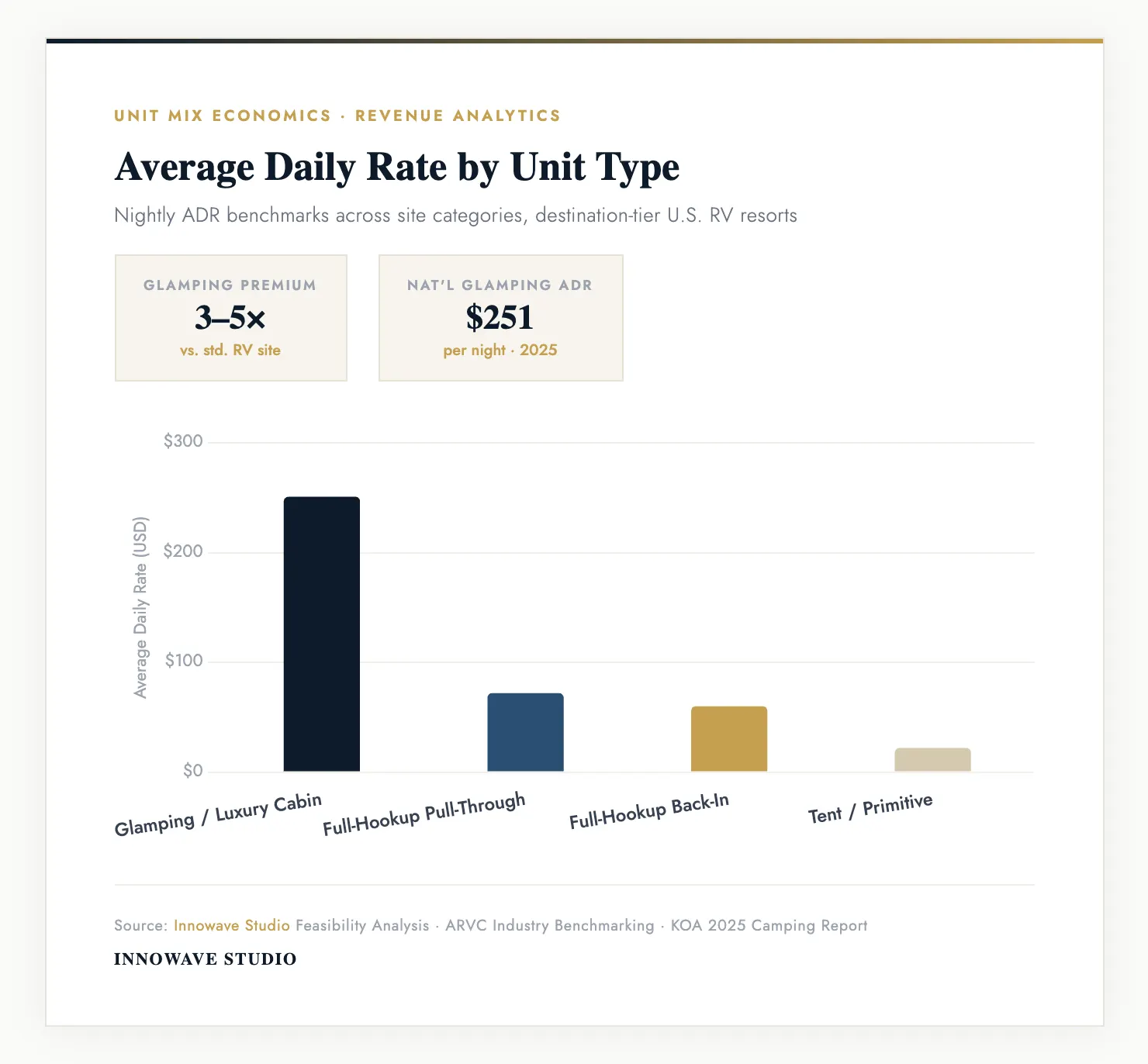
Revenue per available site, the outdoor hospitality equivalent of RevPAR, is a function of two variables that move in opposite directions across site types: average daily rate and stabilized occupancy. Full-hookup pull-through sites, the workhorses of institutional-quality portfolios, command $55 to $90 per night at destination-tier properties, with occupancy rates averaging 68 percent during operating months according to the ARVC 2023 Industry Benchmarking Report. Back-in sites trade at a $5 to $15 per night discount but consume 30 to 50 percent less linear acreage, creating a density arbitrage that directly inflates NOI per gross acre. Glamping and cabin units occupy a different stratum entirely. Cairn Consulting Group data shows the national glamping ADR reached $251 per night in 2025, with annual revenue per unit averaging roughly $50,000, three to five times the yield of a standard full-hookup RV site. Tent sites, by contrast, generate $15 to $30 per night at occupancy rates hovering near 25 percent, making them the lowest-yield category by a wide margin.
The optimal unit mix is therefore not a matter of aesthetic preference; it is a capital allocation decision. A cabin allocation punches well above its weight. A 120-site resort that converts 15 percent of its inventory from standard RV to furnished glamping cabins can lift gross revenue by 20 to 30 percent while adding only modest incremental operating expense, because glamping units carry NOI margins of 40 to 60 percent compared to the 30 to 39 percent typical of hotel operations.
The transient-versus-annual lease mix introduces a second axis of optimization. Sun Communities, the largest publicly traded operator with roughly 59,000 RV sites across 179 communities, actively converts transient sites to annual leases, executing approximately 2,300 conversions in fiscal 2024 alone. The rationale is straightforward: annual sites at Sun produce 5 to 6 percent annual rate growth with operating expense ratios near 46.5 percent, while transient-heavy portfolios like KOA franchises carry expense ratios approaching 70 percent. Equity LifeStyle Properties, which derives 91 percent of property operating revenue from annual sources across its 452-property portfolio, has delivered 4.4 percent compound annual NOI growth since 1998, a consistency that explains why its core manufactured housing and RV assets trade at cap rates below 6 percent.
Which amenities generate measurable NOI lift and which are pure cost centers
Not all amenities are created equal, and the distinction between those that drive rate premiums and those that merely satisfy baseline expectations is critical to capital budgeting. Swimming pools, clubhouses, and modern bathhouses function as threshold amenities, their absence disqualifies a property from institutional consideration, but their presence alone does not command incremental pricing power. The ARVC benchmarking data shows that 81 percent of larger parks already operate pools, which means the amenity has commoditized. What does drive measurable ADR lift is the second tier: pickleball courts, EV charging stations, dog parks with agility features, and high-speed Wi-Fi infrastructure. The KOA 2025 report found that 48 percent of campers now rank Wi-Fi as their most important amenity, a figure that rises to over 60 percent among Gen Z and millennial campers, who represent 61 percent of new entrants to the camping market.
Equity LifeStyle Properties lists pickleball courts, golf courses, restaurants, and laundry facilities among the amenity categories in its 10-K filings, and 55 of its RV resorts have earned TripAdvisor Travelers' Choice Awards, a proxy for the guest experience premium that amenity clustering delivers. The concept of clustering versus dispersal matters enormously. Centralizing high-traffic amenities, pool complexes, clubhouses, camp stores, around a pedestrian hub increases guest dwell time and drives secondary revenue capture through food and beverage, retail, and equipment rentals. RoverPass data shows that online add-on purchases at campgrounds surged 2.5 times year-over-year, while equipment rental revenue (kayaks, golf carts, e-bikes) increased eightfold. A dispersed amenity layout fragments foot traffic and dilutes these ancillary revenue opportunities.
Institutional operators typically invest $3,000 to $8,000 per site in amenity infrastructure above and beyond base site construction, with the dollar figure scaling to ADR targets. Dump stations and laundry facilities, while operationally essential, fall into the cost-center category; they prevent negative reviews but generate negligible direct revenue relative to their maintenance burden.
How circulation geometry creates or destroys leasable acreage
The physical layout of roads, sites, and utility corridors determines what percentage of gross acreage actually produces revenue, and the variance is staggering. Industry benchmarks indicate that 25 to 40 percent of total acreage in a typical RV resort is consumed by infrastructure: roads, utility easements, amenity footprints, landscaping buffers, and regulatory setbacks. A poorly designed circulation plan can push that figure above 45 percent, reducing leasable site density by 10 to 15 percent below what the parcel could otherwise support.
NFPA 1194, the governing standard for recreational vehicle parks and campgrounds, mandates fire lane widths of 20 feet minimum capable of supporting apparatus loads of 75,000 pounds, with dead-end roads exceeding 150 feet requiring approved turnarounds. Minimum separation between individual RV sites is 16 feet, and vertical clearance must reach 13 feet 6 inches throughout. ADA compliance adds further dimensional requirements: accessible sites must be a minimum of 20 feet wide with slopes not exceeding 2 percent in any direction, and accessible routes of at least 36 inches must connect sites to all public facilities. Municipal overlay codes vary widely, Pasco, Washington permits 20 units per gross acre with 15-foot side-to-side vehicle separation, while Sutherlin, Oregon allows 22 sites per acre with a density bonus to 25 if open space is preserved.
The pull-through versus back-in ratio directly governs circulation efficiency. Pull-through sites require open-ended road access, which means one-way loop systems, typically 12 to 15 feet wide, become the natural circulation typology. This is advantageous: one-way loops reduce total pavement area by 30 to 40 percent compared to two-way grid systems requiring 24-foot-wide roads. Angled site placement along one-way loops yields 15 to 25 percent greater site density than perpendicular grid layouts, according to campground engineering consultants. The 60/40 pull-through-to-back-in ratio recommended by the NADi Group balances the premium pricing power of pull-through sites against the density advantage of back-in configurations. Crucially, landscaping buffers and utility corridors should be co-located along road edges, consolidating non-revenue land uses into shared easements rather than consuming separate acreage for each function. Municipal codes typically require 10 to 25 feet of perimeter setback and 10 to 20 percent dedicated open space, which competent designers convert into trail networks and dog parks, turning regulatory overhead into amenity value.
Stabilized NOI per acre across three market tiers
The NOI-per-acre metric synthesizes every decision embedded in the master plan into a single number that investors and lenders can benchmark across markets. At destination resorts, waterfront properties, national park adjacencies, major attraction proxies, site densities of 5 to 8 per acre combine with ADRs of $60 to $100-plus and occupancies above 70 percent to produce $15,000 to $40,000 in NOI per acre. Highway and stopover parks achieve 8 to 12 sites per acre at moderate ADRs of $35 to $60, generating $16,000 to $42,000 per acre through volume rather than rate. Urban-fringe properties, where land costs are highest but demand from both travelers and workforce housing is most consistent, can push $25,000 to $60,000 per acre at densities of 10 to 15 sites.
Construction costs per site range from $15,000 to $25,000 for basic full-hookup installations to $40,000 to $50,000-plus for resort-grade concrete pads with premium landscaping. Cabin and glamping units add $40,000 to $100,000 per unit fully installed. At a blended development cost of $30,000 per site, the consensus figure for modern new-build parks, a 100-site resort on 12 acres requires roughly $3 million in site construction plus $500,000 to $800,000 in shared amenity infrastructure. If that property stabilizes at $500,000 in annual NOI and trades at an 8 percent cap rate, implied asset value reaches $6.25 million, leaving a residual land value of approximately $2.5 million, or over $200,000 per acre. That value-creation spread is what attracts institutional capital.
What construction lenders actually underwrite in a feasibility package
Construction lenders evaluating RV resort proposals apply a framework that begins with the master plan and radiates outward into financial modeling. The site plan itself must demonstrate compliance with NFPA 1194, ADA standards, and local zoning density caps while simultaneously maximizing rentable site count, a tension that only experienced campground design firms resolve well. Conventional banks require a DSCR of 1.20x to 1.35x. Break-even occupancy should fall at or below 45 percent, ensuring the project survives seasonal troughs without covenant violations.
Minimum site counts of 50 to 100 sites represent the practical floor for institutional financing, with the KOA franchise model requiring 70 to 90 sites across at least 10 acres. Income diversification across site types, lease durations, and ancillary revenue streams reduces the lender's perceived concentration risk. A project deriving 65 percent of revenue from annual and seasonal leases, 25 percent from transient nightly rentals, and 10 percent from ancillary sources (camp store, equipment rental, event fees) presents a materially different risk profile than one dependent entirely on summer transient traffic.
Cap rates for institutional-quality stabilized RV resorts currently range from 6 to 7 percent for premium destination assets to 8 to 10 percent for well-maintained properties in secondary markets, according to Parks & Places transaction data showing a 9.3 percent average across 21 sales in 2024. Exit cap rate assumptions should incorporate 25 to 50 basis points of expansion over a projected hold period, reflecting the current interest rate environment. The strongest signal a developer can send to a construction lender is a master plan that demonstrates not merely regulatory compliance but economic optimization, where every acre of land, every linear foot of road, and every amenity dollar is legible as a deliberate contribution to stabilized NOI.
Meta Description: How unit mix, amenity investment, and circulation design in RV resort master planning drive NOI per acre, an analytical framework for investors and lenders.
Sources:
- KOA, 2025 North America Camping & Outdoor Hospitality Report
- ARVC/OHI, 2023 Industry Benchmarking Report
- NFPA 1194, Standard for Recreational Vehicle Parks and Campgrounds, 2021 Edition
- Sun Communities, Inc., 2024 Annual Report and Q1 2025 Earnings (SEC Filings, investor relations)
- Equity LifeStyle Properties, 2024 Annual Report and 10-K (SEC Filings, investor relations)
- Sage Outdoor Advisory, Glamping Market Performance Benchmarks 2025
- RVIA, Recreation Vehicle Industry Association Statistical Surveys
- Parks & Places / RVBusiness, 2024 RV Park Transaction Data
- CBRE, H2 2024 North America Cap Rate Survey
- NADi Group, RV Park Design and Zoning Guidelines
- RoverPass, 2025 Annual Outdoor Hospitality Industry Report
- Campspot / Good Sam, Campground Operating Cost Benchmarks