INNOWAVE STUDIO · DATA AS OF OCTOBER 2026
Dedicated RV and boat storage is still raising rents while general self-storage cuts them. Yardi Matrix’s Fall 2025 National RV & Boat Storage Report put national parking rents at $6.38 per square foot annualized in September 2025, up 4.4% year over year. Yardi called it the strongest increase since it began tracking the segment. Self-storage went the other way: advertised rates fell 1.9% year over year in August 2026 and 1.8% in September 2026. For RV park developers, the gap matters. Storage can use the parts of a site that make poor campsites, and it can earn rent before the campground opens.
The case has limits. No standardized survey tracks RV and boat storage cap rates, and published estimates range from 5.75% (Cushman & Wakefield) to above 8.5% (Oakside). Cities are pausing storage approvals. Atlanta adopted a 180-day moratorium in July 2026, and Elk Grove, California, voted 5–0 in August for what Citizen Portal reported as a two-year pause. Local oversupply is real too: San Antonio added 47.9% of its RV and boat storage inventory in 36 months, and its rent growth fell to zero.
Market data: a niche that is outrunning self-storage
Rents and supply
The Fall 2025 edition is the latest national RV and boat storage report from Yardi that this review could find as of October 2026. Rents rose fastest in small units. According to Yardi Matrix, medium spaces (12x20 to 12x30) averaged $4.92/sf, up 1.5%, and large spaces averaged $3.80/sf. Los Angeles reached $14.99/sf, up 12.8%, and no top-30 metro posted a decline.
Supply growth is slowing. The same report counts 2,060 completed dedicated facilities and 51 under construction, or 2.3% of inventory, down from 3.3% a year earlier. Deliveries over the past 36 months still equal 15.0% of stock. Sales fell to 55 properties in 2025 through the report date, from 151 in 2022, at more than $570,000 per acre.
Facility counts depend on definitions. Toy Storage Nation’s 2026 factsheet counts 4,800 dedicated facilities and 28,500 hybrids. A StorageCafe analysis of Yardi data counts more than 12,300 facilities offering some RV storage. Toy Storage Nation puts the demand base at about 25 million households that own a boat or recreational vehicle needing storage. It also says 86% of HOAs restrict on-site RV and boat parking.
Where demand concentrates
Search data points to suburbs and recreation markets, not urban cores. StorageCafe’s top ten is led by a Houston suburb and filled with retiree, lake-country and desert-resort towns.
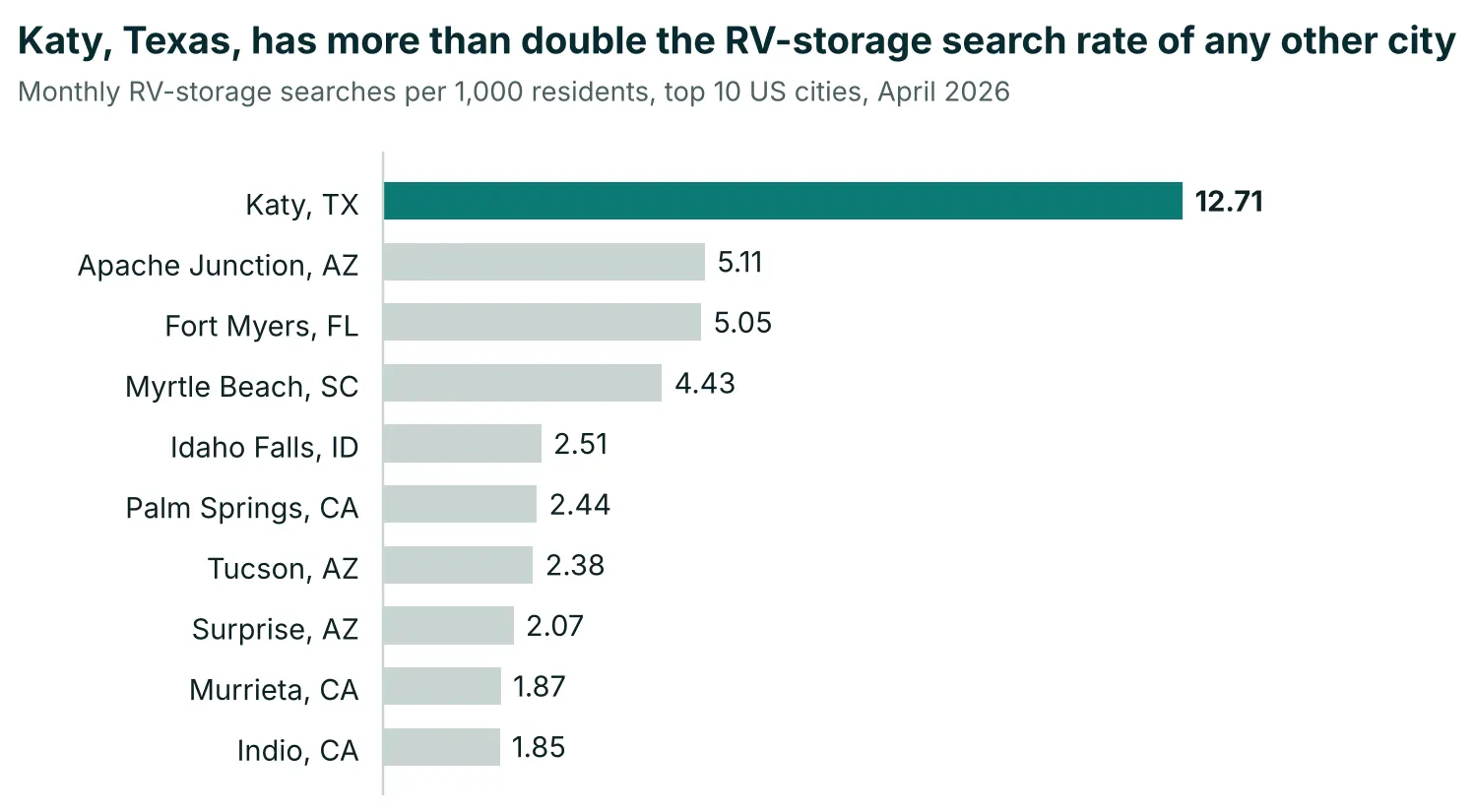
Big cores barely register: Los Angeles logs 0.07 searches per 1,000 residents and Chicago 0.04. Retiree belts, lake country and HOA-heavy suburbs are the same places that support RV parks.
Self-storage is the cautionary comparison
General self-storage is working through a supply wave. Yardi’s Q1 2026 bulletin forecast 51.1 million sf of completions in 2026 and 44 million in 2027. Its Q2 update expects new supply to fall to 1.7% of stock by 2028. RV and boat storage has fewer substitutes, but it runs on the same development cycle.
Cap rates conflict
| Source | Date | Asset | Cap rate |
|---|---|---|---|
| Cushman & Wakefield | 2026 Investment Insider | Stabilized Class A RV/boat | 5.75–6.25% |
| MMCG Invest | Apr. 2026 | Class A / Class B RV/boat | 6.0–7.5% / 7.5–8.5% |
| Oakside | Mid-2026 | Stronger boat/RV facilities | 7.5–8.5%+ |
| Oakside | Mid-2026 | Strong Class A self-storage | 5.0–5.5% |
| Newmark, via MMCG Invest | 2026 | Class A/B RV parks | ~8.0% |
None of these come from a standardized transaction survey. A working range for stabilized Class A storage is mid-6% to 8%, with local sales deciding. MMCG Invest also cites delinquency under 1% and operating expenses of 35–37% of revenue. Treat these as industry estimates, not audited benchmarks.
Zoning and moratoria: the definition decides
The 2026 wave
Atlanta. Mayor Andre Dickens paused new self-storage by executive order on June 25, 2026 (Inside Self-Storage). The council unanimously adopted a 180-day moratorium on July 6 (WSB-TV). In October, the Zoning Commission voted 15–0 to advance ordinance 26-O-1397, which would end by-right approval and require a special-use permit.
Elk Grove, California. The council voted 5–0 on Aug. 26, 2026, to pause new entitlements for “personal storage facilities” (Citizen Portal). That report gives a two-year term; Abridged, writing before the vote, said the proposal had no time limit. The city has 19 storage operations, with three more approved or under construction.
New Franklin, Ohio. Resolution 26-R-06, introduced Feb. 18, 2026, extends a March 2024 moratorium on “Public Storage, Mini-Storage or Self-Storage” permits by one year because the zoning rewrite is running late (city agenda).
Avon, Ohio. Ordinance 68-26 extends a car wash and self-storage moratorium to at least Dec. 23, 2026.
Why cities object
The objections repeat. Elk Grove staff said storage generates “negligible economic activity” and creates pedestrian “dead zones” (Abridged). Atlanta sponsor Dustin Hillis asked whether a site would be better served by “affordable housing, a restaurant, or a bank” (Rough Draft Atlanta). These arguments target infill corridor sites far more than land at the back of a rural campground.
Is RV and boat storage “storage”?
None of the moratorium texts reviewed here name RV or boat storage. Coverage turns on local definitions. Carroll County, Maryland’s August 2026 draft code allows outdoor vehicle storage only as an accessory use, capped at 20% of a self-storage lot. Douglas County, Nebraska, has a separate RV and boat storage use type, which its board amended 7–0 in April 2026. Get a written zoning determination before closing on land.
Entitlement tactics
Seek storage as an accessory use to the campground where the code allows it.
Use enclosed rows on the perimeter as the screen. Modern Storage Media notes that perimeter buildings secure a site without non-revenue walls.
Face unit doors inward and keep drive aisles off the street frontage, as Carroll County’s draft requires.
Offer hours, lighting and use limits through a conditional-use permit or development agreement. MMCG Invest puts conditional-use approval at six months to two years and $25,000–$150,000.
Design: open lot, canopy or enclosed
Spaces and circulation
Modern rigs set the grid. Modern Storage Media recommends 12-ft stalls at minimum and 14 ft preferred, 14-ft gates, 14 ft of canopy clearance, and at least 100 ft between gate and street so rigs queue off the road. Atlas treats 12x40 bays as standard and 14x50 as large. It estimates a 45-ft Class A needs about 37 ft of aisle to back into a perpendicular bay. Enclosed rows typically use 14-ft units 30 to 45 ft deep, with 12x14 doors and 50-ft aisles (Inside Self-Storage).
Density estimates conflict. Atlas puts open 12x40 layouts at 25–35 spaces per acre, canopies at 15–22 and enclosed rows at 12–18. MMCG Invest cites 50–70 RVs per acre on open lots, which implies smaller vehicles or tighter aisles. Underwrite at the low end.
Cost and rent by product
| Product | Build cost (source) | Illustrative cost per space* | Typical monthly rent |
|---|---|---|---|
| Open lot | $30,000–$100,000 per acre (MMCG Invest) | ~$860–$4,000 at 25–35 spaces/acre | $75–$150 |
| Canopy | $36+/sf turnkey (via TSN); $20–$30/sf (MMCG Invest) | ~$9,600–$17,300+ (12x40) | $125–$250 |
| Enclosed drive-up | $56+/sf with doors (via TSN); $38–$65/sf (MMCG Invest) | ~$21,300–$31,400+ (14x40) | $150–$400 |
| Climate-controlled / condo | $72+/sf (via TSN); $60–$100+/sf (MMCG Invest) | Not estimated | $300–$500+ |
Derived here from the per-sf or per-acre figures; excludes land and soft costs. Rents are MMCG Invest ranges from its June 2026 and April 2026 posts. The covered-rent premium is also disputed: MMCG Invest cites 40–80% over open lots, while Modern Storage Media cites 30–40%.
Steel and tariff exposure
Canopies and enclosed rows are steel structures. AGC reported steel mill product prices up 28% and aluminum mill shapes up 25% year over year in September 2026. Since April 6, 2026, Section 232 duties apply to the full customs value of imported metal goods. The cost figures above date from 2025, so re-quote before committing.
Solar canopies
Thousand Trails’ Wilderness Lakes resort in Menifee, California, put a 1.5 MW carport array over 82,000 sf of RV sites. It was expected to produce 2.4 million kWh a year, about half the campground’s use. Federal credits are tighter now. Solar projects that begin construction after July 4, 2026 must be placed in service by Dec. 31, 2027 to claim 45Y or 48E credits. Engineering canopies for future panel loads keeps the option open.
Services and site systems
Access: keypads at RV-cab height or phone entry, on a gate separate from the guest entrance.
Wash and dump: a roofed wash rack with water recycling, since stormwater rules often require cover, and a screened, central dump station (Modern Storage Media).
Power: individually metered outlets in enclosed units for trickle chargers.
Drainage: Toy Storage Nation lists poor drainage and tight spacing between vehicles among common build mistakes.
Phasing and financing: storage first, campground second
Why storage can go first
A single-story storage build takes roughly six to nine months. A greenfield RV park can need 12–36 months of pre-revenue spending, then one to three years of lease-up. MMCG Invest’s curve for Class A canopy and enclosed product in undersupplied markets reaches about 50% at month 6, 75% at month 12 and 90% at month 18. Balanced markets take 18–24 months, and conservative lenders underwrite 36. The same source cites a Missouri facility that absorbed 250 spaces in 90 days; treat that as a best case.
Where storage sits on the site
Storage fits land that makes weak campsites: the back of the parcel, utility easements and flood fringe. Each needs approval. Utilities set rules for parking under lines, and the floodplain administrator decides what is allowed outside the floodway. Keep storage traffic apart from guest arrival. Storage tenants come and go at all hours with long rigs, while guests expect a quiet entry.
Cross-use with the park
Long-stay and seasonal guests are a ready tenant pool. They can park a rig between visits or store a boat or tow vehicle during a stay. The wash rack, dump station and camp store can serve both groups.
Lender and 7(a) treatment
Campground test. Federal 7(a) and 504 rules treat a park as passive real estate unless more than half of gross income comes from transients staying 30 days or less. The sources reviewed do not settle how storage rent counts in that test. Get the lender’s answer in writing.
Storage loans. Self-storage has been eligible for 7(a) and 504 loans since 2010, with up to 90% financing versus 65–75% conventional. Standard 7(a) loans cap at $5 million with 1.15x minimum debt service coverage. SOP 50 10 8.1 took effect Oct. 1, 2026, so confirm terms under the current version.
Institutional debt. A September 2025 CMBS loan on the Quality RV Resort & SS Portfolio in Houston, with 758 pads and 303 storage units, closed at 60% loan-to-value and an 11.2% debt yield.
Platting storage as its own parcel keeps options open. It allows a separate loan, refinance or sale without disturbing the campground.
Risks and a pre-development checklist
Supply risk is local
National undersupply does not protect a submarket. In Yardi’s Fall 2025 data, San Antonio had 11.1% of inventory under construction on top of its 36-month surge, and rents were flat. Jacksonville added 26.1% in 36 months, with 7.7% under construction and 1.0% rent growth. Portland had the highest share under construction, at 14.9%.
Checklist before committing
Map the pipeline. Pull planning records across the trade area, and recheck them just before closing.
Validate demand. Check competitor occupancy, waitlists and covered-versus-open pricing. One Toy Storage Nation guide advises looking elsewhere if local occupancy is below 85%. Add HOA density and proximity to lakes and marinas, which Toy Storage Nation names as demand drivers.
Confirm zoning. Get a written determination on how the code classifies RV and boat storage, and watch council agendas for moratorium proposals.
Price insurance early. Canopies carry wind and hail exposure, and hurricane and snow loads raise structural cost.
Screen the environment. A Phase I should cover fuel, oil, dump stations and wash bays.
Separate security. Use a dedicated gate, cameras and lighting, and give guests no default access to storage rows.
Plan for defaults. Review state storage lien law for abandoned vehicles before the first lease.
Stress-test. Model a 36-month lease-up, an exit cap rate of 8% or higher, and steel re-quoted at current prices.
Storage works best as an anchor when the design treats it as a second business on the same land, with its own entry, parcel and lender file. InnoWave Studio applies that approach when planning mixed RV park and storage sites.
Sources
Matrix National RV & Boat Storage Report, Fall 2025 (Yardi Matrix)
Matrix RV and Boat Storage Report, Fall 2025: research bulletin (Yardi Matrix)
Matrix Self Storage National Report, September 2026 (Yardi Matrix)
2026 self storage reports: Yardi Matrix updates U.S. performance (Yardi)
Matrix Self Storage Supply Forecast Update, Q2 2026 (Yardi Matrix)
U.S. RV and Boat Storage Market: 2026 Outlook and Forecast Through 2031 (MMCG Invest)
Revenue Durability and Project Feasibility in RV and Boat Storage (MMCG Invest)
RV & Boat Storage 2026 Investment Insider (Cushman & Wakefield)
Atlanta City Council Passes 180-Day Moratorium on Self-Storage Development (Inside Self-Storage)
Atlanta pauses construction of new self-storage units for 180 days (WSB-TV)
Atlanta council approves storage moratorium (Rough Draft Atlanta)
Elk Grove adopts two-year moratorium on new personal storage facility entitlements (Citizen Portal)
Too many self-storage places? Elk Grove considers halting new projects (Abridged)
Regular City Council Meeting Agenda and Legislation, Feb. 18, 2026 (City of New Franklin, Ohio)
Ordinance No. 68-26: Extend Moratorium, Car Wash and Storage (City of Avon, Ohio)
Self-Service Storage Facilities Code Amendments, Aug. 18, 2026 (Carroll County, Maryland)
Board approves text amendment clarifying RV and boat storage use type (Citizen Portal)
Building Boat/RV Storage: Site Selection, Design, Types and More (Inside Self-Storage)
RV and Boat Storage Construction Costs, Timeframes and Common Mistakes To Avoid (Toy Storage Nation)
Six Steps to Build a Successful RV and Boat Storage Business (Toy Storage Nation)
AGC Data DIGest, Oct. 12–16, 2026 (Associated General Contractors of America)
Administration Restructures Section 232 Tariffs on Metal and Derivative Products (Phillips Lytle)
Notice 2025-42: Beginning of Construction Requirements (KPMG)
2026 U.S. RV Park Development Cost Benchmarks: Per-Pad Economics Across 50 States (InnoWave Studio)