Floor Area Ratio caps remain the single most consequential, and most reformed, development regulation in American cities, with 2025 marking the most productive year for zoning reform in U.S. history. At least 10 states now preempt local FAR and density limits in some form, Washington state has mandated minimum FARs of 2.5–3.5 near transit (the first state to do so), and New York City's "City of Yes" created new zoning districts allowing up to 18.0 FAR, the highest by-right residential density ever authorized in the nation. Meanwhile, the academic consensus is clear: the "zoning tax" adds $150,000–$400,000 per quarter-acre lot in major coastal metros, and upzoning produces measurable 4–9% increases in housing supply over 5–10 years. This guide maps the current FAR landscape across 40+ major U.S. cities, catalogs every significant reform through early 2026, and analyzes how these limits shape development feasibility.
FAR benchmarks reveal a tale of two Americas
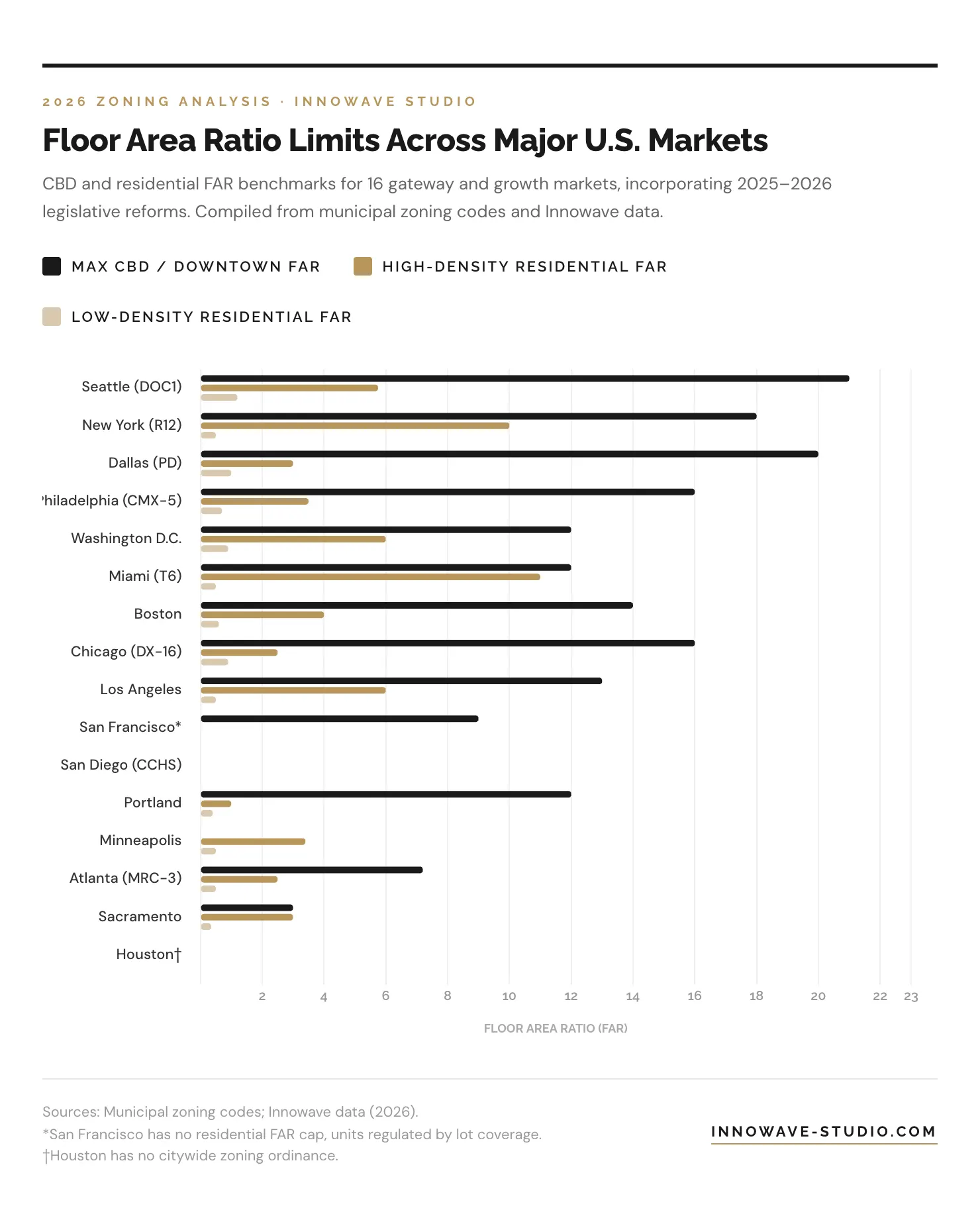
The gap between what cities allow developers to build downtown versus in residential neighborhoods remains staggering, and is the core driver of the national housing shortage estimated at 4.03 million homes as of 2025. Gateway cities permit CBD FARs of 10–21, while their residential zones often cap density at 0.4–0.5. Sun Belt cities increasingly bypass FAR entirely in favor of form-based codes, height limits, and units-per-acre metrics.
Gateway city FAR limits (2026)
| City | Max CBD FAR | Mixed-Use FAR | Low-Density Residential FAR | High-Density Residential FAR | Key Reform |
| New York City | 15.0 (18.0 with R12) | 2.0–6.0 | 0.5 (R1/R2) | 10.0–18.0 (R10–R12) | City of Yes (Dec 2024) |
| Los Angeles | 6.0–13.0 (by Height District) | 1.5–6.0 | 0.5–3.0 | 3.0–6.0+ | New Zoning Code underway; TOC program |
| Chicago | Up to 16.0 (DX-16) | 1.2–3.0 | 0.5–0.9 (RS) | 2.0–2.5 (RM-6/6.5) | Connected Communities (2022) |
| San Francisco | 9.0 (non-residential only) | Varies by SUD | No residential FAR* | No residential FAR* | Family Zoning Plan (Dec 2025) |
| Seattle | 6.0 base / 21.0 max (DOC1) | 4.25 (NC3-65) | 0.5–1.2 (NR) | 3.2–5.75+ (MR/HR) | HB 1110 compliance (2025) |
| Washington, DC | 10.0–12.0 (D-6/D-8) | 1.0–8.0 | 0.4–0.9 (R-1 to R-3) | 5.0–6.0 (RA-8/RA-9) | Height Act constrains all |
| Miami | 5.0–12.0+ (T6 zones) | 3.0–5.0 (T5) | 0.5–0.6 (T3) | 11.0 (T6-60-O) | TSND proposal (2025) |
| Boston | 10.0–14.0 (Financial District) | 4.0–8.0 | 0.6 (1-family) | 4.0+ | MBTA Communities Act |
| Philadelphia | 12.0–16.0 (CMX-5) | 5.0 (CMX-3/4) | 0.7–3.5 (RM) | 3.5 (RM-4) | TOD overlay bonuses |
*San Francisco uniquely exempts residential uses from FAR controls entirely; density is regulated by dwelling units per lot area.
Philadelphia stands out with the most generous bonus system: CMX-5 downtown projects can reach 16.0 FAR by stacking bonuses for public art (+1.0), green building (+4.0), mixed-income housing (+4.0), and transit improvements (+4.0). Seattle's DOC1 zone permits the nation's highest achievable FAR at 21.0 through its TDR and Mandatory Housing Affordability system. New York's newly created R11 and R12 districts (15.0 and 18.0 FAR respectively) await future mapping but signal an extraordinary density ceiling.
Growth market and Sun Belt FAR limits
| City | Downtown/CBD FAR | Mixed-Use FAR | Low-Density Res. FAR | Notable Feature |
| Houston | No FAR (no zoning) | N/A | N/A | Only major U.S. city without zoning |
| Phoenix | Form-based (no FAR) | Density/acre-based | Lot size-based | Walkable Urban Code expansion |
| San Diego | Plan district-specific | 4.0–8.0 (CCHS) | No max residential FAR | CCHS Tier 1: unlimited FAR |
| Dallas | 10.0–20.0 (PD districts) | 10.0–20.0 | 1.0–3.0 | Considering HOME-style reforms |
| San Jose | Per downtown specific plan | 2.0–4.5 (MUN/MUC) | 0.45–0.65 | SB 9 implementation |
| Austin | Coverage-based + PUDs | DB90 program | ~0.40–0.65 (HOME) | HOME Initiative Phases 1–2 |
| Denver | Form-based (no cap in D-C) | Form-based | Form-based | Golden Triangle FAR incentives |
| Nashville | Form-based downtown code | Bulk table-based | Height/coverage-based | Downtown Code updates |
| Portland | 4:1–12:1 (CX + plan district) | 1.5–4.5 (CM1–CM3) | 0.4–1.0 (R zones) | RIP; single-exit stairwell apartments |
| Minneapolis | Flexible (Core 50 district) | 1.5–3.4 (Corridors) | 0.5 (Interior 1–2) | 2040 Plan restored after litigation |
| Atlanta | Up to 7.2 (MRC-3) | 1.7–3.2 (MRC) | 0.50 (R-1 to R-5) | Zoning Code V2.0 rewrite |
| Tampa | 3.5+ (Channel District) | Form-based CBD | Units/acre-based | Channel District expansion |
San Diego's Complete Communities Housing Solutions program deserves special attention: its Tier 1 areas impose no FAR limit whatsoever, a radical departure for a major California city. Portland's Residential Infill Project has produced the most detailed graduated FAR system in the country, scaling from 0.4 FAR for a single home on an R7 lot to 1.2 FAR for an affordable fourplex on an R2.5 lot.
Mid-size city FAR landscape: form-based codes dominate
A critical finding across the 21 mid-size cities researched is that most do not use FAR as their primary density control. Charlotte, Raleigh, Baltimore, Las Vegas, Fort Worth, and others have adopted or are transitioning to form-based codes that regulate building height, lot coverage, setbacks, and frontage rather than explicit FAR ratios.
| City | FAR System | Key Density Control | Notable Detail |
| Sacramento | FAR-primary (pioneering) | 0.35–3.0 by area | First city to eliminate unit caps for FAR-only regulation |
| Charlotte | Form-based (UDO, 2023) | Build-to %, height, frontage | No traditional FAR |
| Raleigh | Hybrid (UDO, 2016) | FAR in O&I districts; form-based elsewhere | Missing middle reforms 2021–2022 |
| Baltimore | Height-based (TransForm, 2017) | No FAR in C-5; unlimited height in core | Seven downtown subdistricts |
| Kansas City | FAR defined in code | §88-810-620 | Prospect Corridor TOD overlay (2025) |
| Milwaukee | FAR in density calculations | Considering FAR removal | Downtown plan recommends form-based |
| Colorado Springs | Height/setback-based | State HB24-1313 mandates 40 du/acre near transit | Compliance deadline Dec 2026 |
| Jacksonville | Height/setback-based | Live Local Act preemption | Administrative approval for qualifying projects |
| Fort Worth | No FAR cap in CBD | Lot size and du/acre | SB 840 allows residential in commercial zones |
Sacramento's approach stands out nationally. Its 2040 General Plan (effective March 2024) made Sacramento the first major U.S. city to eliminate unit-per-lot caps in favor of FAR-only regulation. A 6,000 SF lot with FAR 1.0 can now accommodate a fourplex, sixplex, or any configuration, limited only by FAR, setbacks, and height. Downtown Sacramento allows 3.0 FAR; areas within half a mile of frequent transit allow up to 2.0 FAR; and outer residential neighborhoods are set at 0.35 FAR.
2025 was the most productive year for zoning reform in American history
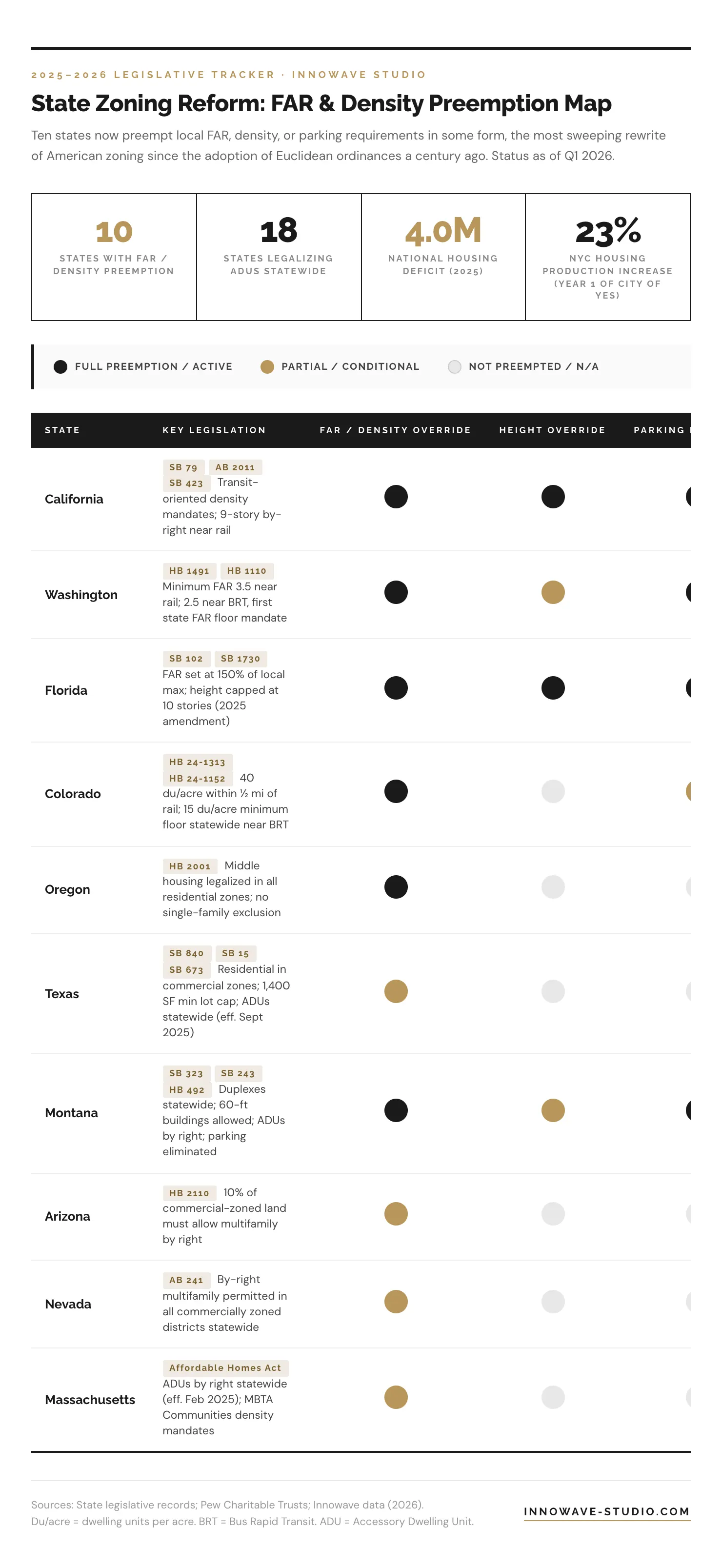
The legislative wave that began with Oregon HB 2001 in 2019 reached an unprecedented crescendo in 2025. Per the American Planning Association and Pew Charitable Trusts, state legislatures enacted "unprecedented reforms" affecting FAR, density, parking, and housing typologies. At least 10 states now preempt local zoning for density or FAR in some form, and 18 states have legalized ADUs statewide.
The landmark bills reshaping American density
New York City "City of Yes for Housing Opportunity" (approved December 5, 2024) represents the most sweeping zoning overhaul since the 1961 Zoning Resolution. The Universal Affordability Preference grants a 20% FAR bonus in medium- and high-density districts for permanently affordable housing. An R6A district moves from 3.0 to 3.9 FAR; R10 districts jump from 10.0 to 12.0. New R11 (15.0 FAR) and R12 (18.0 FAR) districts were created for future mapping. Parking mandates were eliminated in the Inner Transit Zone. Results in the first year are striking: housing production rose 23% in the first 10 months of 2025, with over 100 developments applying for UAP, generating approximately 5,400 homes including 900 affordable units.
Washington State HB 1491 (signed 2025) provides that multifamily units with three or more bedrooms do not count toward FAR limits. The law eliminates off-street parking requirements in station areas entirely. Estimated capacity unlocked: 1.8 billion square feet of new housing in Puget Sound alone. A repeal referendum campaign has been launched.
California SB 79 (signed October 10, 2025, effective July 1, 2026) mandates 9-story (95-foot) buildings within 200 feet of heavy rail stops and 6-story buildings up to half a mile away, with minimum densities of 30–160 du/acre across eight urban counties. An estimated 1.5 million new homes could be enabled in Los Angeles County alone. California AB 2011, as amended by AB 2243, now allows 80 du/acre within half a mile of major transit stops on commercial land, with ministerial approval.
Florida's Live Local Act (2023, amended 2024 and 2025) is the most aggressive state preemption of local FAR: qualifying affordable housing projects receive FAR set at 150% of the highest FAR allowed anywhere in the jurisdiction, with density matching the highest permitted anywhere, and height matching the tallest building within three-quarters of a mile. The 2025 amendments capped height preemption at 10 stories, expanded eligible parcels to religious institution-owned land, and explicitly prohibited discretionary design review.
Colorado HB 24-1313 (Transit-Oriented Communities Act, signed May 2024) requires approximately 30 Front Range municipalities to zone for 40 du/acre within half a mile of rail stations and quarter mile of frequent bus routes, with a minimum density floor of 15 du/acre. A $35 million grant program incentivizes compliance, while noncompliant jurisdictions face potential loss of Highway Users Tax Fund distributions.
State preemption tracker: who overrides local FAR now
| State | Key Laws | What's Preempted | Status |
| California | SB 79, AB 2011, SB 423, Density Bonus Law | Height/FAR/density near transit and on commercial corridors | Active; SB 79 effective July 2026 |
| Florida | Live Local Act + SB 1730 | FAR (150% of max), density, height for affordable projects | Active; 2025 amendments in effect |
| Washington | HB 1110, HB 1491 | Middle housing density; FAR 2.5–3.5 near transit | Active; phased compliance through 2029 |
| Oregon | HB 2001 (2019) | Middle housing in all residential zones | Fully implemented |
| Colorado | HB 24-1313, HB 24-1152 | 40 du/acre near transit; ADUs statewide | Reports due Dec 2026 |
| Montana | SB 323, SB 243, SB 528, HB 492 | Duplexes, 60-ft buildings, ADUs, parking | Upheld by state Supreme Court |
| Texas | SB 840, SB 15, SB 673, SB 2477 | Residential in commercial zones; lot sizes; ADUs; office conversions | Effective Sept 2025 |
| Arizona | HB 2110 | 10% of commercial land for multifamily | 2025 |
| Nevada | AB 241 | By-right multifamily in commercial zones | 2025 |
| Massachusetts | Affordable Homes Act | ADUs by right statewide | Effective Feb 2025 |
Texas's 2025 package is particularly notable for a traditionally property-rights-focused state. SB 840 allows residential development in commercially zoned areas without rezoning. SB 15 caps minimum lot sizes at 1,400 SF. SB 673 legalizes ADUs statewide, overriding local restrictions. These laws affect Houston (minimally, since it lacks zoning), Dallas, San Antonio, Fort Worth, Austin, and every other major Texas city.
The construction cost cliff explains why FAR matters for feasibility
FAR is not merely an abstract planning metric, it determines which construction type is economically viable, and construction type is the largest single cost driver in real estate development. The relationship between allowed FAR and project feasibility follows a staircase pattern defined by three critical construction breakpoints.
Wood-frame (FAR 1.0–3.0, up to 5 stories) costs $170–$250 per SF and represents the most cost-efficient construction type. The ubiquitous "5-over-1" podium building, five stories of wood over one concrete level, emerged precisely because it maximizes density within this cost tier. At FARs below 2.0, garden-style apartments pencil in markets with rents as low as $1,200–$1,800/month.
The critical breakpoint at 7 stories / 85 feet forces a shift from wood to concrete and steel, which the Terner Center at UC Berkeley has documented adds a 40–60% premium to per-SF construction costs. Mid-rise concrete-podium buildings at FAR 3.0–6.0 cost $200–$280 per SF. This breakpoint is why so many cities see a "donut hole" of missing 7–12 story buildings, the FAR range where costs jump but rents may not justify the premium.
High-rise steel and concrete (FAR 6.0–12+) runs $250–$450+ per SF but becomes viable in gateway city CBDs where land costs are extreme enough that spreading them across more square footage overcomes the construction premium. In Denver, Summit Contractors found that high-rise construction actually saves approximately $100 per SF overall compared to mid-rise when factoring in land cost amortization across higher density.
The residual land value equation makes this relationship concrete: on a 10,000 SF lot, increasing FAR from 4.0 to 5.0 adds 10,000 SF of buildable area. At achievable rents of $50/SF annually and a 5% cap rate, that incremental FAR generates $10 million in project value, flowing directly to what a developer can pay for the land. The NAHB and NMHC jointly estimate that government regulation accounts for 32.1% of multifamily development costs on average, with the worst cases reaching 42.6%.
Parking requirements consume otherwise productive FAR. A 200-unit project requiring 1.5 spaces per unit needs 300 structured parking spaces at roughly 350 SF each, that is 105,000 SF of non-revenue-generating space at $30,000–$50,000 per stall. Over 30 major cities have eliminated or reduced parking minimums since 2019, a trend accelerated by state mandates in California, Washington, Colorado, Montana, and Florida's Live Local Act.
What the research organizations and academics say about FAR trends
The academic consensus on FAR's role in the housing crisis is now robust, though a notable 2025 dissent has emerged. Gyourko and Krimmel's landmark 2021 study using micro-level vacant land transaction data estimated the "zoning tax" per quarter-acre lot at over $400,000 in San Francisco, $150,000–$200,000 in Los Angeles, New York, and Seattle, and $60,000–$80,000 in Chicago, Philadelphia, and Washington, DC. Interior Sun Belt cities showed no economically meaningful zoning tax, a finding that helps explain why Houston and Phoenix remain relatively affordable despite rapid growth.
The most rigorous FAR-specific study, Büchler and Lutz's 2024 analysis of 25 years of data from 168 Swiss municipalities, found that increasing allowable FAR produces a 9% increase in housing units within 5–10 years, but only when the upzoning exceeds 50% of the prior FAR limit. Small upzonings (under 50%) produced no significant developer response, a finding with direct policy implications for incremental reform strategies. Peng's 2023 study of NYC Bloomberg-era rezonings confirmed similar dynamics: high upzonings (FAR increases exceeding 92%) produced approximately 8% more housing after 10 years, while small increases (under 30%) yielded only 2%.
The Urban Land Institute's 2023 report "Reshaping the City" documented that three-quarters of land in major U.S. cities remains zoned exclusively for single-family homes, a statistic that contextualizes why FAR reform matters. The Lincoln Institute of Land Policy's "Visualizing Density" database has become an essential tool for planners communicating density concepts to the public. The APA's foundational PAS Report #111 on FAR remains the profession's standard reference, noting that "intensity of land development determines the character of a city and the load on public utilities and services almost as much as the uses to which it is put."
CBRE's 2025 investment outlook warned that "the affordability crisis is nearing a tipping point" and noted increasing state and municipal removal of minimum lot sizes, density limits, and parking requirements. NMHC projects the U.S. must build 4.3 million apartments by 2035 to meet demand. The Federal Reserve Bank of Boston's 2022 study by Kulka, Sood, and Chiumenti may be the most policy-relevant finding: relaxing density restrictions is the single most effective reform type for increasing supply and reducing both rents and home prices, outperforming height-limit relaxation or use-category changes alone.
A provocative counterpoint emerged from the Federal Reserve Bank of San Francisco in 2025: Louie, Mondragon, and Wieland argued that income growth, not supply constraints, better explains affordability differences across cities, suggesting "easing housing supply constraints may not yield the anticipated improvements." This remains a minority view; the authors themselves acknowledge the large body of research supporting the supply-constraint framework.
Tokyo provides the most powerful international comparison. Japan's nationally set zoning system, with only 12 use zones, no single-family-only zoning, no minimum parking requirements, and FAR as a primary control, has enabled housing supply to nearly triple since 1963. London, New York, and Paris increased supply by only 20–30% over the same period. The result: Tokyo remains the most affordable major global city, with average rents roughly one-fifth of San Francisco's.
Conclusion: the FAR reform era has arrived, unevenly
The data tells a clear story. American cities are in the midst of the most significant overhaul of density regulation since the adoption of Euclidean zoning a century ago, but the reforms remain deeply uneven. Washington state's HB 1491 and California's SB 79 represent a new paradigm: state governments mandating minimum FARs rather than merely allowing local governments to set maximums. New York's City of Yes demonstrates that even the nation's densest city can unlock meaningful new capacity, its 23% increase in housing production within 10 months suggests pent-up demand for denser development was enormous.
Three insights emerge for commercial real estate professionals and policymakers. First, the construction cost breakpoint at 7 stories means that FAR limits in the 4.0–6.0 range create a "feasibility desert" in many markets, too expensive for wood-frame, not dense enough to amortize concrete/steel costs. Cities seeking maximum impact should consider reforms that push allowed FAR either below 3.0 (enabling cost-efficient wood-frame) or above 8.0 (where high-rise economics work). Second, Sacramento's FAR-only regulation model, eliminating unit caps entirely, represents a likely future template, already influencing Milwaukee's reform discussions. Third, the most impactful reforms are happening at the state level: state preemption of local FAR limits now affects more urban land area than all municipal reform efforts combined, and the 2025 legislative wave shows no signs of slowing into 2026.
Sources:
Legislative & Government Sources
- New York City "City of Yes for Housing Opportunity" (December 2024)
- Washington State HB 1491 (2025)
- Washington State HB 1110
- California SB 79 (signed October 10, 2025)
- California Density Bonus Law
- Florida Live Local Act (2023, amended 2024 & 2025) / SB 102 / SB 1730
- Colorado HB 24-1313 (Transit-Oriented Communities Act)
- Colorado HB 24-1152
Academic & Research Studies
- Gyourko and Krimmel (2021), "zoning tax" study, Wharton Real Estate
- Büchler and Lutz (2024), FAR and housing supply study (168 Swiss municipalities)
- Peng (2023), NYC Bloomberg-era rezoning analysis
- Kulka, Sood, and Chiumenti (2022), Federal Reserve Bank of Boston
- Louie, Mondragon, and Wieland (2025), Federal Reserve Bank of San Francisco
Industry & Policy Organizations
- American Planning Association (APA), PAS Report #111 on Floor Area Ratio
- Urban Land Institute, "Reshaping the City" (2023)
- Lincoln Institute of Land Policy, "Visualizing Density" database
- CBRE, 2025 Investment Outlook
- NMHC (National Multifamily Housing Council), 4.3 million apartment projection
- NAHB (National Association of Home Builders), regulatory cost study
- Pew Charitable Trusts, 2025 state zoning reform analysis
- Terner Center at UC Berkeley, construction cost research
- Mercatus Center, housing reform policy briefs
- Regional Plan Association, City of Yes analysis
Municipal Planning Departments Referenced
- City of Sacramento Planning Department
- City of Portland Bureau of Development Services
- City of Houston Planning Department
- Philadelphia City Planning Commission
- Seattle Department of Construction & Inspections
Advocacy & Policy Groups
- Futurewise (Washington state TOD/HB 1491 analysis)
- Sightline Institute (Pacific Northwest zoning reform)
- California YIMBY