A ten-foot discrepancy in a rear setback can eliminate an entire floor of leasable space, convert a feasible project into a money-losing one, or add eighteen months of variance hearings to a construction timeline. Yet no single public resource compiles commercial setback data across major U.S. markets, forcing developers, lenders, and municipal planners to navigate a fragmented patchwork of local codes that vary not just city to city but block to block. Setback requirements remain the most underpriced variable in commercial real estate feasibility analysis, responsible for destroying more residual land value than interest rate fluctuations in most pro formas. This analysis spans more than thirty jurisdictions, drawing from municipal zoning codes, the NAHB-NMHC regulatory cost survey, Wharton's Residential Land Use Regulation Index, and ULI's 2023 zoning reform research to map the dimensional landscape that shapes every commercial deal in America.
Setbacks, the mandatory distances between a building and the front, rear, side, and street-side property lines, function differently in commercial contexts than in residential. Residential setbacks preserve neighborhood character and light access. Commercial setbacks serve a more complex set of objectives: traffic sight triangles, fire separation, pedestrian activation, utility easements, and buffering between incompatible uses. A front setback in a C-2 district might be zero feet with a mandatory build-to-line, while the same city's C-1 district demands twenty-five feet of landscaped buffer. Understanding these distinctions, and the dimensional standards that interact with them, separates sophisticated site selection from expensive guesswork.
Dense urban cores have largely eliminated front and side setbacks
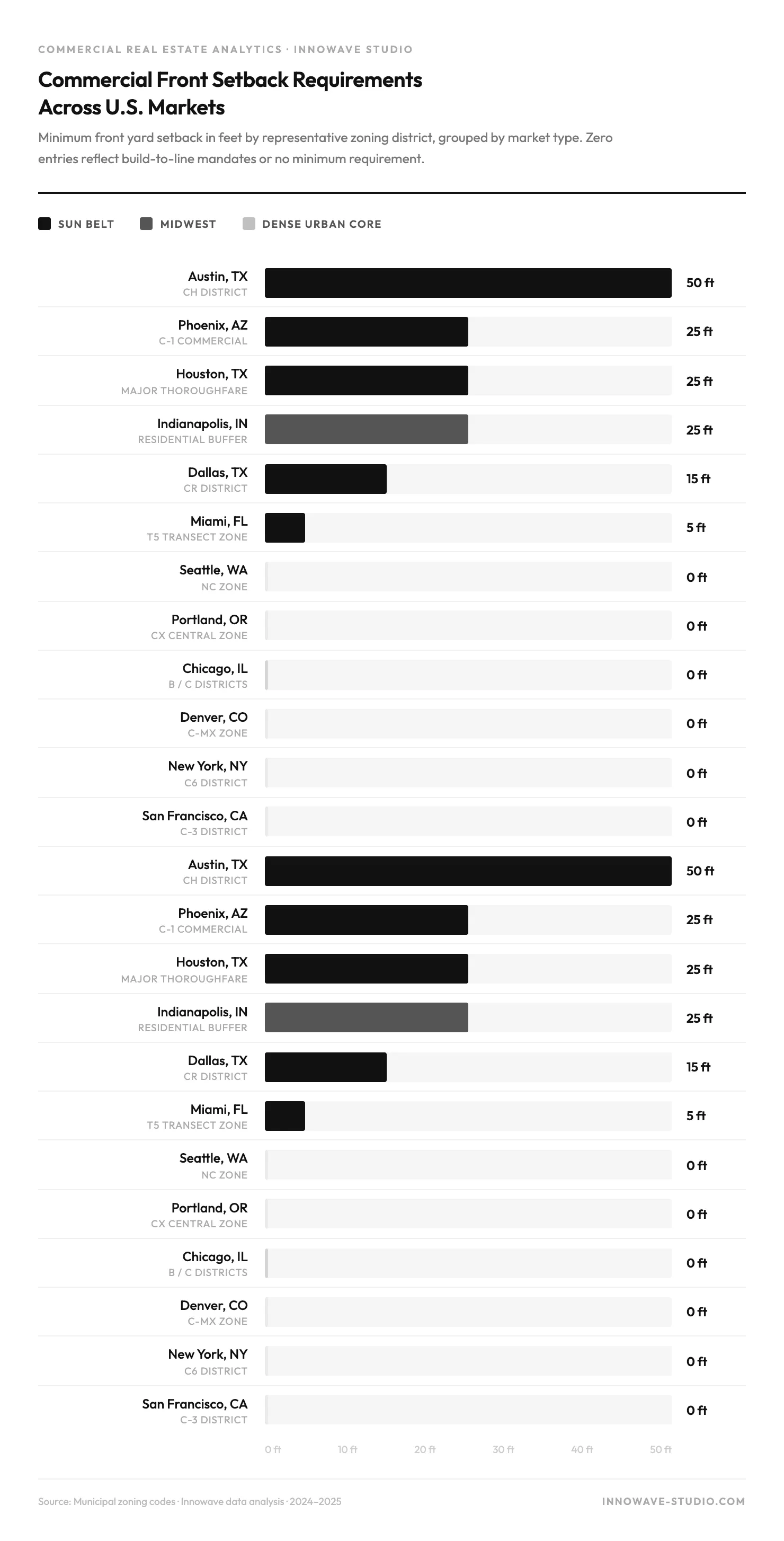
Across all eight major urban core markets analyzed, a striking pattern emerges: zero-foot front and side setbacks are the commercial standard in high-density districts. New York City's C6 zones require buildings to meet the street line, with contextual districts mandating that seventy percent or more of the lot frontage be built within eight feet of the property line. Rear yards typically run twenty feet in districts with R6–R10 residential equivalents, though tower setbacks of ten to fifteen feet above the base apply on wide and narrow streets respectively. FAR ranges from 10.0 to 15.0 in C6-4 through C6-9 districts, with building bulk governed by sky exposure planes rather than traditional setback distances.
Chicago mirrors this approach. Business and commercial districts (B1 through C3) require zero front and side setbacks under Section 17-3-0404 of the zoning ordinance, with rear setbacks of thirty feet applying only to floors containing dwelling units. The city's highest-intensity downtown districts, DX-12 and DX-16, carrying FAR of 12.0 and 16.0 respectively, are entirely exempt from rear setback requirements. San Francisco's C-3 downtown commercial district eliminates rear yard requirements altogether, relying instead on tower bulk controls under Section 270 of the Planning Code, while NCT (Neighborhood Commercial Transit) districts maintain rear setbacks of twenty-five percent of lot depth with a fifteen-foot minimum. Seattle's NC and C zones require zero setbacks on all three sides, with exceptions triggered only when a commercial parcel abuts or faces a residential zone across an alley.
Philadelphia's tiered CMX system illustrates how setback sophistication scales with intensity. CMX-2.5 (Pedestrian Commercial Corridor) mandates zero-foot build-to-line requirements on primary frontage with a fifty-five-foot height cap. CMX-5 (Center City Core) eliminates height maximums in favor of sky plane controls and carries FAR up to 2,000 percent with the /MIN overlay. Portland's CX (Central Commercial) zone permits one hundred percent building coverage with zero setbacks on all sides, while imposing a maximum setback of ten feet on transit streets, effectively creating a mandatory build-to zone rather than a minimum distance requirement. Denver's form-based code takes this furthest: every C-MX and C-MS district carries zero-foot minimums on primary streets, side streets, and interiors, with seventy-five percent of the facade required within a zero-to-five-foot build-to range.
Sun Belt growth markets show the widest setback variation
The regulatory landscape shifts dramatically in Sun Belt markets, where rapid growth has produced a broader spectrum of commercial district types operating simultaneously. Phoenix's C-1 and C-2 districts require twenty-five feet of landscaped front setback for buildings under thirty feet, with an additional foot of setback per foot of height above that threshold, a sliding-scale mechanism that produces wedding-cake building forms near residential boundaries. Austin's code creates a stark internal contrast: the CBD district requires zero setbacks on all sides with no height limit and one hundred percent lot coverage at 8:1 FAR, while the CH (Commercial Highway) district demands fifty-foot front and street-side setbacks with twenty-five feet on interior sides and rear.
Dallas's Central Area districts (CA-1, CA-2) mirror the zero-setback, 100-percent-coverage, 20.0 FAR pattern of dense urban cores, but the city's Community Retail (CR) districts require fifteen-foot front setbacks and twenty-foot buffers adjacent to residential, controlled further by the Residential Proximity Slope, which limits commercial building height on a 1:3 slope measured from residential boundaries. Houston, the only major American city without comprehensive zoning, regulates through Chapter 42 building lines determined by street classification: twenty-five feet along major thoroughfares, ten feet on collector and local streets for commercial uses, and zero in the Central Business District. Private deed restrictions layer additional constraints that vary parcel by parcel.
Miami's transect-based Miami 21 code represents the Sun Belt's most sophisticated approach. T6 (Urban Core) zones require zero-foot build-to at the property line, while T5 (Urban Center) districts allow zero-to-ten-foot front setbacks with five-foot sides when abutting lower-intensity transect zones. Nashville's alternative zoning districts (the "-A" suffix system) replace traditional setbacks with build-to zones of zero to ten feet, and Charlotte's 2023 Unified Development Ordinance eliminated legacy B-1 and B-2 districts entirely in favor of frontage-based standards tied to street type. Raleigh's UDO similarly uses building-type-based dimensional standards within CX districts, with build-to zones of zero to fifteen feet depending on frontage classification. The Sun Belt trend is unmistakable: form-based codes are replacing Euclidean setback minimums, with at least five major markets completing this transition since 2021.
Midwest industrial corridors default to zero with residential triggers
The Midwest pattern is remarkably consistent. Detroit, Cleveland, Kansas City, Milwaukee, and St. Louis all default to zero-foot setbacks across commercial-to-commercial adjacencies, with setback requirements activating only when parcels abut residential districts. Indianapolis is the most generous to residential neighbors, requiring twenty-five-foot transitional yards whenever commercial lots border residential zones, the widest residential buffer standard found in this analysis. Minneapolis, prior to its 2023 code overhaul implementing Minneapolis 2040 Built Form Overlay Districts, required side setbacks of five feet plus two feet per story above the first when commercial abutted residential zones. Columbus's Planning Overlay districts impose maximum setbacks of ten feet, functioning as build-to requirements, while maintaining zero minimums on sides and rear.
Milwaukee's code adds a nuanced dimensional wrinkle: side setbacks increase by 1.5 feet for every ten feet of building depth beyond the district maximum, and by four feet for each story above the permitted height, a sliding-scale penalty that effectively taxes oversized commercial buildings through progressively wider setback requirements. St. Louis determines front setbacks through "building line" surveys that match existing development patterns, available from the city's zoning office for twenty-five dollars. These Midwest markets demonstrate that zero-setback commercial development is not exclusively an urban-core phenomenon but the default condition across a wide range of market sizes.
State preemption is reshaping the setback landscape from the top down
The most consequential shift in commercial setback regulation is occurring at the state level. California's SB 79, signed in 2025, overrides local density limits within a half-mile of qualifying transit stops, establishing minimum densities of thirty dwelling units per acre near BART and Metro heavy rail stations across ten counties. While SB 79 does not explicitly preempt setbacks, it operates in concert with the Density Bonus Law (Government Code §65915), which allows developers to request setback reductions as incentives and to obtain waivers of any development standard, including setbacks, that would physically prevent construction at the permitted density. Los Angeles's TOC program, built on this framework, has already produced over 4,100 housing units through tiered density bonuses that include significantly reduced setback and open space requirements near rail stations.
Colorado's HB 24-1313, signed in May 2024, requires municipalities within the state's five metropolitan planning organizations to achieve zoning capacity of forty dwelling units per acre across transit areas within a half-mile of rail stations and a quarter-mile of frequent bus corridors. The Department of Local Affairs published Transit Area maps in September 2024 and implementation guidance in February 2025. Cities that fail to comply risk losing Highway Users Tax Fund allocations. Florida's Live Local Act takes a different approach: it preempts density and height for qualifying affordable projects on commercial land but explicitly preserves local setback authority, a distinction that has produced at least 180 projects in the statewide pipeline while leaving dimensional standards untouched. Texas's SB 840, advancing through the 89th Legislature, would allow residential development by right in commercially zoned areas statewide at thirty-six units per acre and forty-five-foot heights, a provision housing analysts have called the most muscular residential-in-commercial preemption bill in the country.
Special commercial uses face dramatically different setback regimes
Gas stations, drive-throughs, car washes, RV parks, and marinas operate under setback requirements that bear little resemblance to standard commercial districts. Salt Lake City requires underground storage tanks to maintain thirty feet from property lines and pump islands to sit twenty-five feet from adjacent buildings, with a 350-foot buffer from water bodies and public parks exceeding one acre. Montgomery County, Maryland, imposes a 500-foot setback from dwellings, schools, and wetlands for fuel facilities. Phoenix requires a more modest twelve-foot minimum from street property lines for fuel pumps under Section 701.A.7. Drive-through facilities face stacking-lane setback requirements, Tyler, Texas, mandates thirty feet from lots abutting office or mixed-use zones, and speaker-box placement rules that restrict proximity to residential boundaries. Fort Worth requires full-service car washes to maintain two hundred feet from any residential district, with a conditional use permit required for closer proximity. RV parks typically require ten-to-fifty-foot setbacks from property lines, with Phoenix adding a ten-foot landscaped buffer adjacent to residential zones and a minimum four percent recreational area calculated exclusive of required setbacks.
Marina and waterfront commercial setbacks are governed by an entirely separate regulatory layer. Hawaii expanded shoreline setbacks from forty to sixty feet effective July 2024. NYC's waterfront zoning mandates public walkways, upland connections, and visual corridors that function as de facto setbacks from the shoreline. U.S. Army Corps of Engineers Individual Permits for marina construction average eighteen to thirty-six months, with California Coastal Commission reviews extending up to a decade in contested cases.
The buildable envelope determines what setbacks actually cost
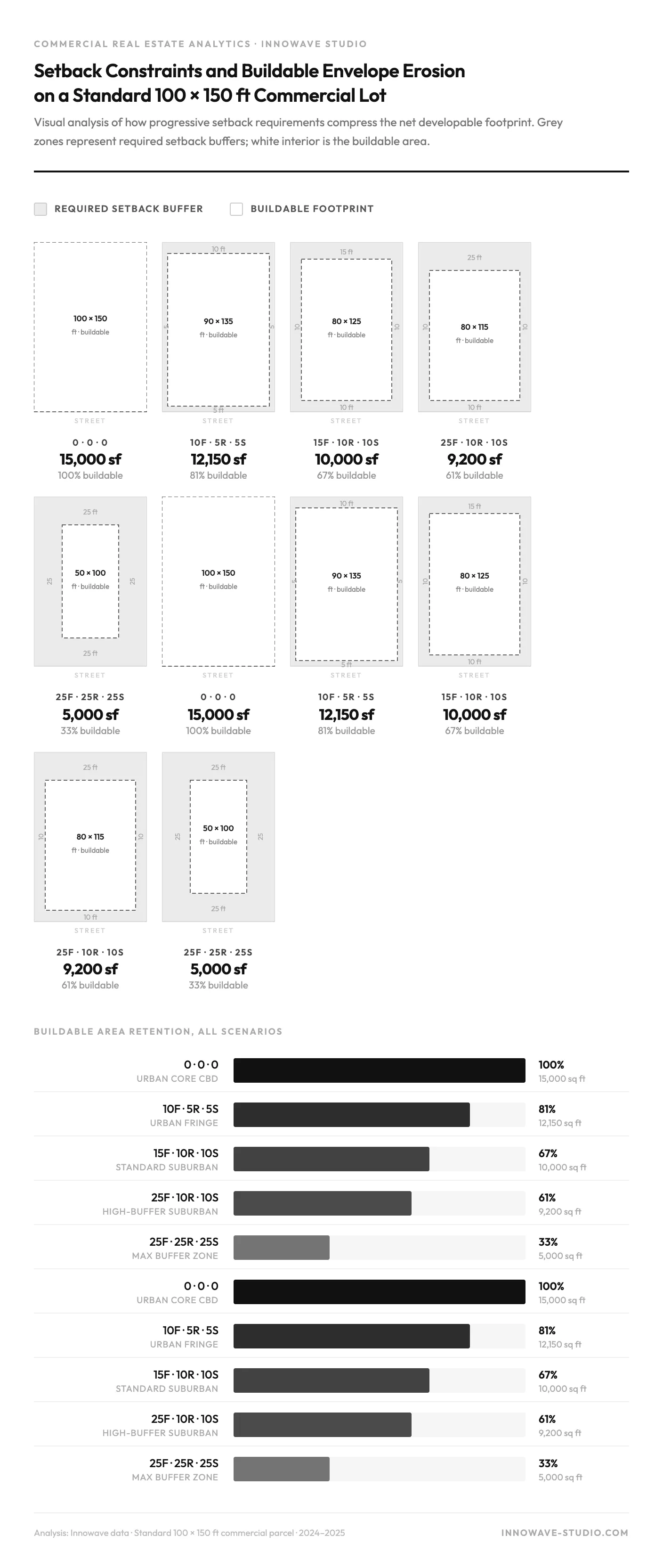
The financial impact of setback requirements becomes clear only when analyzed alongside FAR, lot coverage, and height limits, the three other dimensions that define the buildable envelope. On a standard 100-by-150-foot commercial lot, twenty-five-foot front and rear setbacks with ten-foot sides reduce the buildable footprint from 15,000 to 8,000 square feet, a forty-seven percent loss of developable area. If the remaining footprint cannot accommodate the permitted FAR within height limits, the project either shrinks or goes vertical at significantly higher per-square-foot construction costs. Research from Wharton's WRLURI2018 survey found that the most regulated metro areas, San Francisco and New York, showed no reversal of regulatory stringency following the Great Recession, with regulation increasing over time in most large coastal markets. A 1999 study of Milwaukee suburbs found that an additional ten feet of setback increased housing prices by 6.1 to 7.8 percent, while Quigley and Raphael's California research documented a 4.5 percent increase in owner-occupied housing costs per additional regulation.
The NAHB-NMHC 2022 survey found that regulations account for 40.6 percent of total multifamily development costs, with rezoning alone adding 3.4 percent and NIMBY opposition contributing 5.6 percent plus an average 7.4-month delay. Variance applications, the primary relief mechanism for nonconforming setbacks, carry fees of $500 to $2,500 and total costs of $5,000 to $50,000 including surveys, traffic studies, legal representation, and public hearing preparation. Dimensional variances are approved more frequently than use variances, though no centralized national database of approval rates exists. Lenders underwrite the as-of-right buildable envelope; projects requiring variance approval face conditional loan commitments and additional timeline risk that directly increases carrying costs.
What the data reveals about the next decade of commercial development
The convergence of state preemption legislation, form-based code adoption, and TOD-driven setback reductions points toward a regulatory environment that will look fundamentally different by 2030. Zero-setback commercial development, once confined to Manhattan and a handful of downtown cores, is becoming the default standard across Sun Belt, Midwest, and coastal markets simultaneously. The critical analytical question for developers, lenders, and municipalities is no longer whether setbacks will be reduced but how quickly individual jurisdictions will adapt to the emerging consensus that dimensional constraints destroy more housing supply and commercial feasibility than they protect in neighborhood character.
Sources:
Municipal Zoning Codes & Official Documents
- New York City Zoning Resolution (C6 districts)
- Chicago Zoning Ordinance, Section 17-3-0404
- San Francisco Planning Code, Section 270 & Section 134
- Seattle Department of Construction & Inspections, Commercial Zoning Summary
- Philadelphia Zoning Code, CMX District Dimensional Standards
- Portland Title 33, Planning and Zoning, Chapter 33.130
- Denver Zoning Code, C-MX and C-MS Districts
- Houston Code of Ordinances, Chapter 42, Section 42-150
- Miami 21 Zoning Code, Article 5
- Nashville Metro Government Code, Title 17, Chapter 17.12
- Charlotte Unified Development Ordinance (2023)
- Indianapolis-Marion County Commercial Zoning Ordinance
- Minneapolis 2040 Built Form Overlay Districts
- City of Milwaukee Zoning Ordinance, Chapter 295
- Fort Worth Zoning Ordinance, Section 5.108 (Car Wash)
- Tyler, Texas Code of Ordinances, Section 10-389 (Drive-Through Stacking)
State Legislation
- California SB 79 (2025), Transit-Oriented Development
- California Government Code §65915, Density Bonus Law
- Colorado HB 24-1313, Housing in Transit-Oriented Communities
- Florida Live Local Act (2023)
- Texas SB 840 (89th Legislature)
Academic & Research Institutions
- Wharton Residential Land Use Regulation Index (WRLURI2018), via NBER Working Paper 26573
- Quigley & Raphael, California land use regulation and housing costs study
- Milwaukee suburbs setback-to-price regression study (Cato Institute citation)
- HUD User, The Effects of Land Use Regulation on the Price of Housing
Industry & Trade Organizations
- NAHB-NMHC 2022 Cost of Regulations Report (40.6% multifamily development cost finding)
- Urban Land Institute (ULI), Zoning Reform Research
- American Planning Association (APA)
- National Association of Realtors (NAR)
Government Agencies
- Colorado Department of Local Affairs, Transit-Oriented Communities Implementation Guidance (2024–2025)
- Los Angeles Transit-Oriented Communities Program (UCLA Law analysis)
- U.S. Army Corps of Engineers, Individual Permit timelines
- California Coastal Commission, Coastal development review process
Legal & Professional Analysis
- Holland & Knight, SB 79 analysis
- Buchalter, SB 79 transit zone analysis
- Bilzin Sumberg, Florida Live Local Act analysis
- Brownstein Hyatt Farber Schreck, Colorado HB 24-1313 analysis