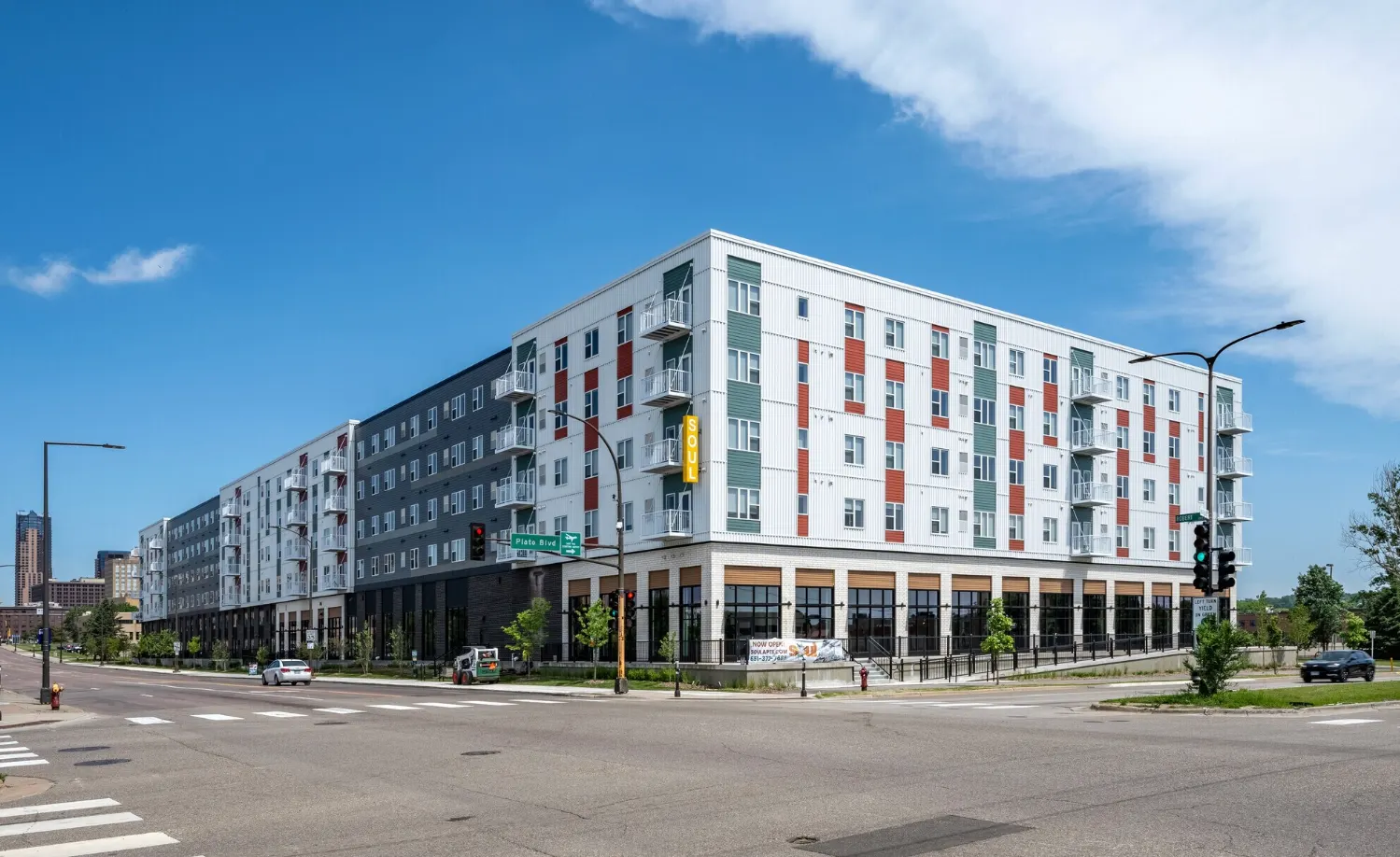
The site plan has become the single most consequential document in affordable housing finance. Across eight major states, site plan elements, transit proximity, accessibility routing, green building commitments, and civil engineering detail, now control anywhere from 15 to 50 competitive scoring points in LIHTC Qualified Allocation Plans, enough to make or break a 9% credit award. With the One Big Beautiful Bill Act (P.L. 119-21) permanently expanding LIHTC allocations by 12% starting in 2026 and lowering the Private Activity Bond financing threshold from 50% to 25%, the pipeline of deals will surge, and so will scrutiny of site plan compliance across HUD, state HFA, and green certification frameworks.
Since 1987, LIHTC has financed 3.7 million housing units across 54,102 projects. Yet NLIHC's 2025 Gap Report documents a national shortage of 7.1 million affordable rental homes for extremely low-income renters. Competition for 9% credits remains fierce: roughly $1.1 billion was allocated nationally in 2025 at $3.00 per capita, while total development costs have climbed 30–40% since 2019. In this environment, a deficient site plan isn't just a technical oversight, it's a deal killer.
HUD's federal baseline sets the floor, not the ceiling
All federally assisted affordable housing must comply with HUD Minimum Property Standards under 24 CFR 200.926d and HUD Handbook 4910.1 (1994 edition), which remains the operative MPS document for multifamily projects. The MPS framework requires site plans to address drainage (structures in Special Flood Hazard Areas must sit at least 2 feet above base flood elevation), vehicular and pedestrian access via public or private streets, all-weather emergency access, independent utility services for each unit, and environmental hazard mitigation covering toxic materials, erosion, and groundwater issues.
For FHA-insured multifamily projects processed under the MAP Guide (HUD Guidebook 4430.G), firm commitment drawings must include a topographic survey at minimum 1″ = 40′ scale with 1- or 2-foot contour intervals, a grading and drainage plan showing finished floor elevations at all building corners and entrances, a landscaping plan at 1″ = 20′ minimum, and an ALTA/NSPS land title survey. Subsurface exploration requires a minimum of one boring per 2,500 square feet of foundation area. These are threshold documents, incomplete submissions halt the underwriting process entirely.
Section 504 accessibility requirements layer additional obligations onto every site plan for projects receiving federal financial assistance. Under 24 CFR Part 8, a minimum of 5% of total units must be wheelchair-accessible and an additional 2% must accommodate hearing and vision impairments. Site plans must show accessible routes connecting dwelling units to all common areas, van-accessible parking with proper access aisles, and grading limited to 2% maximum slope near accessible parking. HUD's 2023 Advanced Notice of Proposed Rulemaking (88 FR 25626) signaled potential increases, the National Council on Disability recommended raising the total to 25%, though no final rule has been published as of March 2026. Developers should note the federal trend toward adopting the 2010 ADA Standards over the aging 1984 UFAS, as HHS has already mandated this transition for its programs.
State QAP scoring turns site plans into competitive weapons
The gap between HUD's baseline and what wins a competitive 9% allocation has never been wider. Each state HFA layers its own scoring matrix on top of federal requirements, creating a patchwork that demands region-specific site plan strategy.
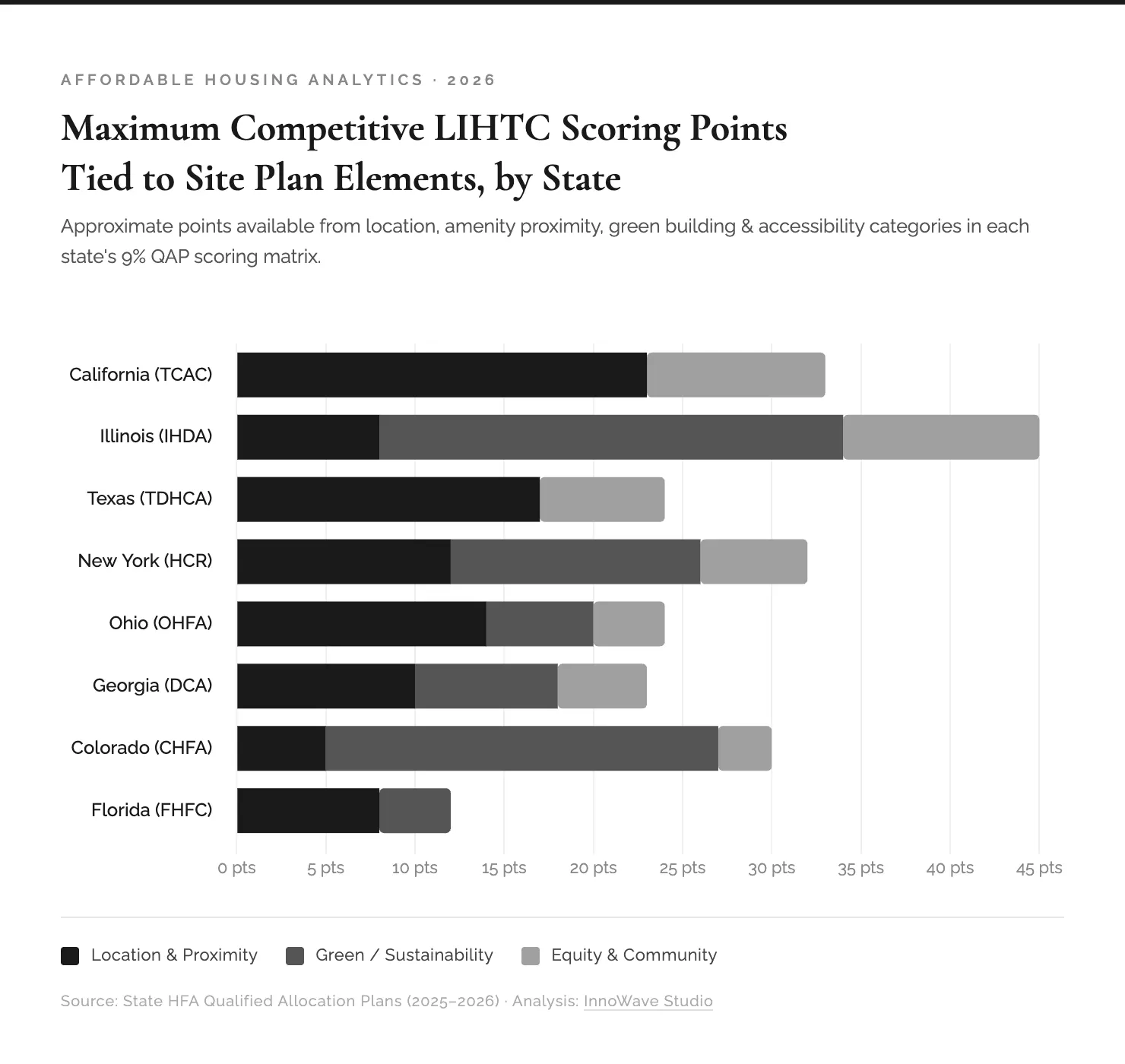
California's TCAC operates the most granular distance-based scoring system in the nation. Site amenity points (up to 15 points) require precise distance measurements to transit stops, grocery stores, parks, libraries, medical clinics, and pharmacies, with distinct thresholds at 1/3 mile, 1/2 mile, and 1 mile. Projects in TCAC/HCD "Highest Resource" or "High Resource" census tracts earn 8 additional points, a scoring category that has measurably shifted where developers build. Transit proximity alone can yield up to 10 points when combined with free transit pass commitments for 15 years. Service amenities add another 10 points. Every distance claim requires color photographs, contact information, and signed certifications, inaccurate claims trigger negative points.
Texas (TDHCA) weights local government support most heavily at 17 points for a municipal resolution, with an additional 7 points available for projects in federally designated Opportunity Zones, a new pathway introduced in the 2026 QAP. Texas bundles amenity proximity into an Opportunity Index scored at the census-tract level and uses proximity to the nearest ISD school as a tiebreaker.
Illinois (IHDA) has emerged as the national leader in sustainability scoring, with up to 26 points available from green building and energy efficiency certifications alone, broken into basic (7 points), advanced (3), net-zero (3), and energy efficiency certification (up to 13). Critically, Enterprise Green Communities' 40 mandatory criteria are a threshold requirement for all Illinois LIHTC projects. IHDA also awards up to 11 points for BIPOC development control or WBE/DBE/MBE certification, among the highest equity-focused scoring nationally. Every proposed site undergoes a mandatory IHDA visual inspection during the Preliminary Project Assessment stage.
Colorado (CHFA) imposes the nation's strictest green building mandate. All LIHTC projects must achieve certification under DOE Zero Energy Ready Home (ZERH), Passive House (PHIUS or PHI), or an equivalent program, not as a scoring bonus but as an absolute threshold. Projects must also provide EV-ready parking, water-wise landscaping, and post-construction energy use reporting, reflecting Colorado's statutory commitment to 100% renewable energy by 2040. Transit-Oriented Development sites earn 3 points, but the real gatekeeping happens at the sustainability threshold.
Ohio (OHFA) stands out for its data-driven approach, scoring locations through a Neighborhood Opportunity Index and Housing Needs Index using quantitative census-tract metrics. The state demands 80% permit-ready architectural plans at final application, one of the highest readiness thresholds in the country, and maintains a separate, regularly updated Design and Architectural Standards document. Florida (FHFC) operates differently from most states, using proximity not for competitive scoring but as a pass/fail eligibility threshold with GPS coordinates verified to sub-meter accuracy. Georgia (DCA) requires green building certification as a threshold item, accepting five programs including the regionally popular EarthCraft standard, and scores proximity to transit, quality schools, and economic development areas across separate scoring sections.
Green certification requirements are fragmenting by region
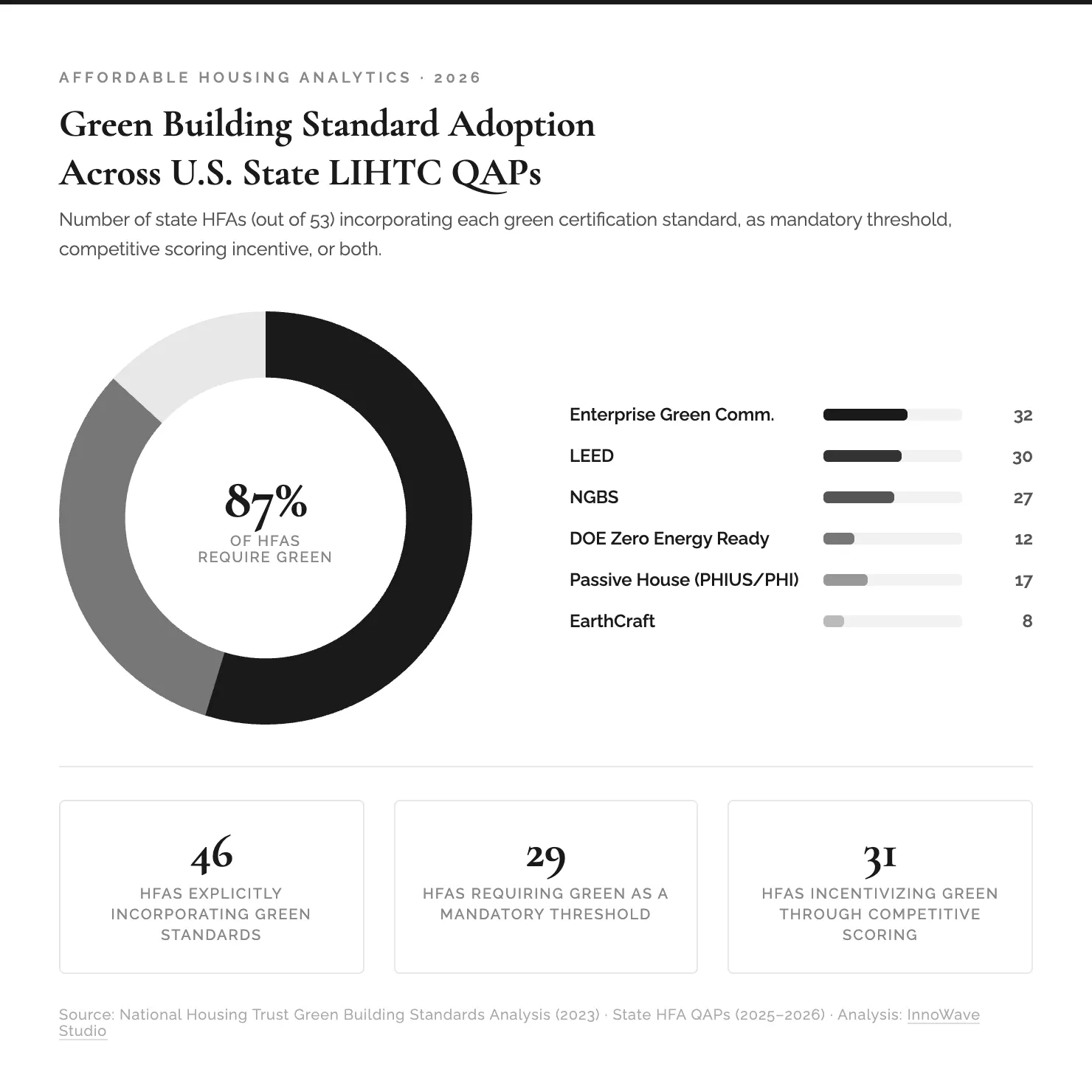
The green building landscape in affordable housing has become remarkably complex. According to the National Housing Trust's 2023 analysis, 46 of 53 state HFAs now explicitly incorporate green building standards, up from 33 in 2017. Twenty-nine require certification as a threshold; 31 incentivize it through competitive scoring. Enterprise Green Communities leads adoption at 32 QAPs, followed by LEED (30) and NGBS (27). Passive House standards appear in 17 QAPs, reflecting rapid growth.
Regional patterns are distinct. The Midwest (Illinois, Ohio, Michigan) leads in mandatory EGC compliance and tiered scoring for higher certifications. The Southeast favors EarthCraft alongside national standards, Georgia accepts five certification programs. The West Coast presents a paradox: California, despite its CalGreen building code baseline, does not require or incentivize third-party green building certification in its QAP, scoring poorly on Building Clean's national analysis. Colorado represents the aggressive end of the spectrum with mandatory net-zero-ready certification. The Northeast integrates sustainability into broader design guidelines; New York's HCR Sustainability Guidelines incorporate Clean Energy Initiative and Solar For All programs, with a 55-year regulatory term for HFA-funded projects.
Enterprise Green Communities' 2026 criteria update emphasizes three themes: energy planning (zero emissions within 20 years), natural hazard resilience, and health-focused design including universal design and indoor air quality. Site-related criteria require ecological assessment and protection of sensitive features, compact development within 0.5 miles of four or more services, proximity to transit with 45+ daily rides, stormwater management for the 60th percentile precipitation event, and water-efficient landscaping.
The deficiencies that kill deals before scoring begins
Across state HFAs, the most common fatal site plan deficiencies fall into predictable categories. Missing or incomplete site documentation triggers immediate rejection at threshold review, Pennsylvania's HFA explicitly warns that "any material deficiency in the application, particularly the omission of documentation relating to the site...may result in the immediate rejection of the application." Zoning non-compliance, submitting without proper zoning or conditional use approvals in hand, remains a persistent failure mode. Environmental assessment gaps, including outdated Phase I ESAs, failure to complete recommended Phase II studies, and neglecting cultural resource database checks (New York requires OPRHP system verification), routinely eliminate otherwise competitive applications.
Point deductions cluster around amenity proximity documentation errors (California's system is particularly unforgiving, with private transit claims requiring Executive Director pre-approval), incomplete green building certification commitments, and cost estimate discrepancies where construction costs don't align between the application and independent third-party estimates. Illinois requires a fresh Community Revitalization Strategy dated within five years for QCT projects, stale documentation means lost points.
The distinction between administrative deficiencies (curable) and material deficiencies (potentially fatal) varies by state. Texas TDHCA provides cure periods for administrative issues but not material gaps. Ohio offers a brief cure window after preliminary scoring. The universal counsel from HFA staff: never rely on cure processes, applications should be submission-ready.
What the 2026 expansion changes for site plan strategy
The One Big Beautiful Bill Act's permanent 12% increase in 9% allocations and reduction of the bond financing test to 25% will reshape the competitive landscape. Novogradac estimates these provisions could finance 1.22 million additional affordable rental homes over 2026–2035. The 25% bond test alone, the single most impactful provision, is projected to enable more than 1.14 million additional units by freeing Private Activity Bond capacity.
FHFA's August 2025 decision to double Fannie Mae and Freddie Mac LIHTC equity investment caps to $2 billion each ($4 billion annually) further expands available capital, with 50% reserved for difficult-to-serve markets. California was among the first states to adopt allocation policies for the new 25% bond test; 35 states plus D.C. were already oversubscribed for rental housing PAB capacity as of April 2025.
For developers and underwriting teams, the practical implications are clear. More deals will compete for awards, intensifying the importance of every scoring point tied to site plan quality. States are simultaneously raising the bar: Massachusetts added a 10% fully accessible unit requirement for new construction elevator buildings in its January 2026 QAP amendment. Ohio's 2027 Design and Architectural Standards update is underway with statewide stakeholder engagement sessions. The HUD budget requested $407 million for climate resilience and energy efficiency in housing for FY 2025, though the Green and Resilient Retrofit Program's $1.4 billion in completed awards was paused in March 2025 and its unobligated IRA funds were rescinded under OBBBA.
Conclusion
The site plan is no longer a supporting exhibit, it is the strategic document around which competitive LIHTC applications are built. Federal requirements under HUD MPS and Section 504 establish a floor that most competitive projects far exceed. The real differentiation happens at the state level, where California's distance-based proximity scoring, Illinois's 26-point sustainability framework, Colorado's mandatory net-zero-ready certification, and Ohio's 80%-permit-set readiness requirement each demand tailored site plan approaches. With LIHTC expansion bringing unprecedented deal volume starting in 2026 and development costs stubbornly elevated at 30–40% above 2019 levels, the developers who win will be those whose site plans are engineered for both regulatory compliance and maximum competitive scoring from the earliest stages of site selection. The era of treating site plans as an afterthought in affordable housing finance is definitively over.
Sources:
Federal Regulatory Sources
- HUD Minimum Property Standards (MPS), 24 CFR 200.926d
- HUD Handbook 4910.1 (1994 edition)
- HUD MAP Guide (Guidebook 4430.G)
- 24 CFR Part 8 (Section 504 accessibility requirements)
- HUD Advanced Notice of Proposed Rulemaking, 88 FR 25626 (2023)
- 2010 ADA Standards
- 1984 UFAS (Uniform Federal Accessibility Standards)
- One Big Beautiful Bill Act (P.L. 119-21)
- IRA Section 30002 (Affordable Housing Energy/Water Efficiency and Climate Resilience Grant Program)
State Housing Finance Agency Documents
- California Tax Credit Allocation Committee (TCAC) QAP, Cal. Code Regs. Tit. 4, § 10325
- Texas Department of Housing and Community Affairs (TDHCA) 2026 QAP
- Illinois Housing Development Authority (IHDA) 2026 QAP
- Colorado Housing and Finance Authority (CHFA) 2025–2026 QAP
- Ohio Housing Finance Agency (OHFA) 2026–2027 9% LIHTC QAP
- Florida Housing Finance Corporation (FHFC) 2025 QAP
- Georgia Department of Community Affairs (DCA) 2024–2025 QAP
- New York Homes and Community Renewal (HCR) 2025 Multifamily Finance 9% RFP
- Pennsylvania Housing Finance Agency (PHFA) Application Package and Guidelines
- Massachusetts Housing and Livable Communities (HLC) January 2026 QAP Amendments
Industry & Research Organizations
- National Low Income Housing Coalition (NLIHC), 2025 Gap Report
- National Council on Disability (NCD)
- Novogradac & Company
- National Housing Trust, Green Building Standards Analysis (2023)
- Enterprise Community Partners, Green Communities Criteria
- Texas Affiliation of Affordable Housing Providers (TAAHP)
- Citizens' Housing & Planning Association (CHAPA)
- Building Clean, QAP Report
- National Council of State Housing Agencies (NCSHA)
Green Building Standards
- Enterprise Green Communities (EGC) 2020 and 2026 Criteria
- DOE Zero Energy Ready Home (ZERH)
- Passive House Institute US (PHIUS) / Passive House Institute (PHI)
- LEED (Leadership in Energy and Environmental Design)
- National Green Building Standard (NGBS)
- EarthCraft (Southeast regional standard)
Financial Institutions & Capital Markets
- Federal Housing Finance Agency (FHFA), August 2025 GSE LIHTC investment cap ruling
- Fannie Mae / Freddie Mac (GSE LIHTC equity investment programs)
- CDFI Fund