INNOWAVE STUDIO · DATA AS OF OCTOBER 2026
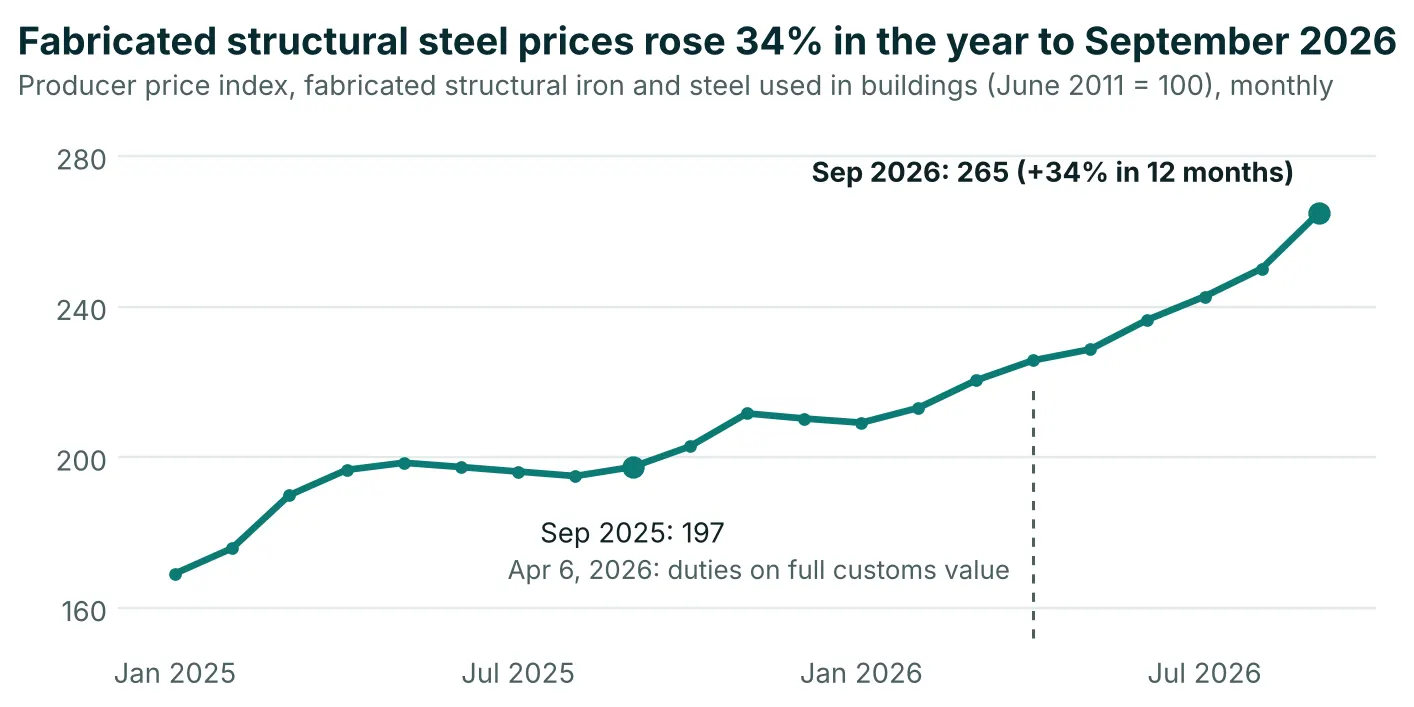
Structural steel is now the most volatile line in many 2027 budgets. The producer price index for fabricated structural steel used in buildings rose 34% in the 12 months to September 2026, while ready-mixed concrete rose about 2%. Trade policy is the main reason for the gap. Since April 6, 2026, Section 232 tariffs of 50% apply to the full customs value of steel, aluminum and copper articles, with 25% on many derivatives.
The result is a domestic steel market priced apart from the world. US hot-rolled band reached $1,310 per metric ton in mid-October 2026, against $490 for world export steel. Electrical gear adds a second exposure, since copper wire, switchgear and transformers have all risen while lead times stay long.
For owners, the frame choice is no longer only about height, program and local trade habits. It is also a bet on metal prices, and on which of those costs a contract can lock, index or share. This article sets out the tariff and price data and compares structural systems using published studies. It then reviews electrical procurement and contract terms, and closes with a phase-by-phase decision sequence.
Where tariffs and prices stand in October 2026
The tariff scope
A proclamation signed April 2, 2026 rewrote the metals tariffs, effective April 6, according to a White & Case summary. Its main tiers are:
50% on articles made entirely or almost entirely of steel, aluminum or copper, mainly HTS chapters 72, 74 and 76, plus part of 73.
25% on steel and aluminum derivatives that are not almost entirely metal, and on other copper articles.
15%, or the normal duty if higher, on certain industrial and electrical grid equipment, until January 1, 2028, when it rises to 25%.
10% on goods made with US-melted or US-smelted metal.
The bigger change is the base. Duties now apply to the entire customs value of a covered product, not only its metal content. For an imported assembly that is 60% metal by value, the dutiable base rises from 60% to 100% of the invoice. AGC’s tariff resource center was updated September 24, 2026. It also lists 15% on HVAC systems and components, 10% on softwood lumber and timber, and 25% on various wood derivatives.
On February 20, 2026, the Supreme Court ruled 6–3 that IEEPA does not authorize tariffs. That ruling did not reach Section 232, a separate national-security statute, and those tariffs remain in effect. Any IEEPA refunds generally go to the importer of record, which has “no legal obligation to pass along any refund to contractors”, AGC notes. JLL adds that the 232 rate has no statutory ceiling or expiration, and a pending Section 301 action could push effective rates above 50%.
What prices have done
Producer prices for inputs to new nonresidential construction rose 11.9% from September 2025 to September 2026, the most in four years. ABC’s index, built on a different basket, shows 11.2%, and ABC’s Anirban Basu attributes a substantial portion to fuel costs from the conflict in Iran. Diesel rose 115%. Metals account for much of the rest, and fabricated structural steel shows the sharpest climb.
| Input (BLS PPI) | 12-month change | Through |
|---|---|---|
| Steel mill products | +27.6% | Sep 2026 |
| Bar joists and rebar | +30.0% | Sep 2026 |
| Copper and brass mill shapes | +30% | Sep 2026 |
| Aluminum mill shapes | +25% | Sep 2026 |
| Copper wire | +27.2% | Aug 2026 |
| Switchgear | +12.3% | Aug 2026 |
| Precast concrete | +10.5% | Sep 2026 |
| Lumber and plywood | +9.6% | Sep 2026 |
| Ready-mixed concrete | +2.3% | Sep 2026 |
Mill prices show the same pattern. SteelBenchmarker’s US hot-rolled band rose from $797 to $1,188 per net ton between mid-October 2025 and mid-October 2026, up 49%. Plate rose from $1,052 to $1,500. The US hot-rolled price now runs 57% above Western Europe’s and 2.7 times the world export price.
Contractors have not yet passed all of this through. The PPI for new nonresidential building bid prices rose only 5.4%, and Turner’s building cost index rose 5.49% in the year to the third quarter. Meanwhile 55% of contractors in an AGC survey had projects canceled, postponed or scaled back in the prior six months. JLL reports contractors are already pricing 2027 and 2028 work with elevated costs.
Steel, mass timber, concrete or hybrid: what the studies show
Cost
The 2023 International Mass Timber Report surveyed US practitioners and found a median mass timber premium under 2%, ranging up to 15%. Experienced teams more often reported cost parity or savings. A WoodWorks comparative series, presented by KL&A in September 2025, found whole-building premiums of 0–6% and structure premiums of 3–16%.
A three-region study by SCB, LeMessurier and Turner Construction redesigned three existing buildings in timber. Against cast-in-place concrete, timber added $19/sf (3%) for a 12-story Type IV-B building in Denver and $37/sf (6%) for a 21-story IV-A building in Atlanta. Both finished 3.5 months faster, and fire protection drove most of the premium. A seven-story IV-C redesign of a Minneapolis stick-frame building cost $16/sf (3%) more, with no schedule change.
These estimates predate most of the 2026 metals increase. Since September 2025, rebar and joist prices rose 30% while lumber and plywood rose about 10%. That shift likely narrows or erases timber’s premium on mid-rise work, though this is an inference, not a published estimate. The size depends on each design’s metal share. Owners should request fresh comparative pricing rather than adjust old studies.
Mass timber is not tariff-free. Softwood lumber and timber carry 10%, and various wood derivatives 25%. Confirm the classification and origin of imported CLT or glulam with the supplier.
Schedule, weight and code
The International Mass Timber Report puts the typical overall schedule saving at about 20%. Cirrus in Denver framed 232,000 sf of wood over a concrete base in 17 weeks. A Toronto study of a 12-story residential tower was co-authored with steelmaker ArcelorMittal. It estimated structural durations of 113 days for timber, 157 for steel and 190 for concrete, with costs within 3.5%.
The same report says a timber building weighs about 20% as much as a steel or concrete structure. Foundation savings matter most on poor soils and in high seismic zones.
Code sets the ceiling. The 2021 IBC allows 18 stories and 270 feet for Type IV-A and 12 stories and 180 feet for IV-B. Type IV-C allows nine stories (eight for residential) and 85 feet. IV-A requires a three-hour frame with all timber protected. IV-C permits almost all timber exposed. The 2024 IBC reduces protection requirements in IV-B, so check which edition the local jurisdiction has adopted. Builder’s risk and property insurance for exposed timber are priced carrier by carrier, so quote them during schematic design.
Carbon and fit
The SCB study reported global warming potential 42%, 22% and 16% lower for the seven-, 12- and 21-story timber schemes. For light industrial roofs, WoodWorks cites panelized wood savings of $1.25–$1.50/sf, about 15%, versus steel joist and metal deck, mainly in West Coast markets. WoodWorks is a wood-industry group.
| System | 2026 price signal | Frame duration (Toronto 12-story study) | Weight | Strongest fit |
|---|---|---|---|---|
| Steel frame | Fabricated steel +34% | 157 days | Lighter than concrete | Long spans, high-rise office, large-bay industrial |
| Mass timber | Lumber +9.6%; wood tariffs 10–25% | 113 days; typically 16–20% shorter | Lightest | 4–12-story office, multifamily, institutional |
| Concrete | Ready-mix +2.3%, rebar +30% | 190 days | Heaviest | Above 18 stories, podiums, below grade |
| Hybrid | Splits exposure | Between | Mixed | Timber over concrete podium; wood roofs on steel |
Hybrids already exist at scale. Platte Fifteen in Denver placed 135,000 sf of mass timber over 145,000 sf of concrete.
Electrical and MEP: the longer-lead exposure
Electrical gear is where tariffs, copper and capacity collide. Copper wire rose 27.2% and switchgear 12.3% in the year to August 2026. JLL put copper 36% higher year over year at midyear.
Supply was tight before the 2026 tariff changes. Wood Mackenzie found unit costs since 2019 up 77% for power transformers and 78–95% for distribution transformers. Imports supply about 80% and 50% of those markets. In its second-quarter 2025 survey, average lead times were 128 weeks for power transformers and about 44 weeks for switchgear. Medium-voltage switchgear prices rose 50% from January 2021 to March 2025.
Building-scale quotes in 2026 run longer than that switchgear average. Terrapin, a commercial general contractor, reports 52–80 weeks for medium-voltage switchgear, 40–65 weeks for 0–5 MVA pad-mount transformers and 32–48 weeks for 500–1,000 kW diesel generators. These are one firm’s procurement data, not a survey, so treat them as a planning range.
Data centers compete for the same gear and trades. The Fed’s Beige Book covering late August to early October noted data center work driving up labor costs in Dallas and San Francisco. JLL forecasts that the share of supply-constrained metro labor markets will rise from 61% to 72% by 2027, with electricians among the most exposed trades.
Practical steps for owners:
Order early. For data center and battery-storage projects, Terrapin advises ordering switchgear and transformers 6–12 months before groundbreaking; for standard commercial work under 5 MW, it advises ordering at permit submission. Deposits of 10–30% typically hold production slots.
Consider owner-furnished equipment. Buying gear directly in design locks price and slot. The owner then carries storage, coordination and warranty handoff.
Engage the utility in schematic design. Service voltage and transformer ownership drive the long-lead list, and late changes force re-specification.
Specify by performance. Name configurations and approved alternates rather than one manufacturer.
Watch the tariff calendar. Covered grid equipment imported after January 1, 2028 moves to 25%, stacked with normal duties. Require suppliers to state HTS code, origin and tariff included.
Cut metal by design. Right-size services, shorten feeder runs and price aluminum feeders where engineers allow. Aluminum is also tariffed, so compare installed cost rather than assume savings.
Contract terms that keep metal risk priced
AGC recommends adding a price escalation provision at contract signing, pointing to ConsensusDocs 200.1. That amendment lists the affected materials and adjusts price using “usually an agreed-upon objective market index”. It also works in reverse when prices fall. As one construction attorney told Construction Dive, “The word ‘tariff’ probably doesn’t exist in any standard form contracts.” ConsensusDocs’ comparison chart lists no AIA equivalent to 200.1, so owners using AIA forms must draft their own.
Terms to negotiate
Index. Name the BLS series and base month, such as steel mill products, fabricated structural steel for buildings or rebar and joists.
Trigger. A Smith Currie article for ConsensusDocs uses a 5% price increase as its example threshold.
Notice. Jones Walker suggests a 7–14 day window to report tariff impacts.
Cap and sharing. The same article proposes a cumulative cap, such as $500,000, with savings from repealed tariffs split between the parties.
Force majeure. Courts construe it narrowly, and it “rarely entitle[s] a party to additional compensation”. Use a specific change-in-law clause instead.
Refunds. State who receives any tariff refund, since the importer of record owns it by default.
Structure and timing
ConsensusDocs suggests cost-of-work agreements over lump sum under uncertainty. It also suggests short bid validity, phasing, allowances or alternates, early procurement with its 750.1 storage rider, prefabrication and higher contingency. Federal projects can use FAR economic price adjustment clauses.
Timing of a guaranteed maximum price matters as much as wording. Setting the GMP after mill orders and switchgear buyout removes most metal risk. Where that is not possible, carry metal packages as allowances: the price “will go up and down depending on how much that price moves”. Deposits for production slots should bring title, insured storage and inspection rights.
An early-design decision sequence for 2027 projects
Structural and electrical choices lock in early, so the sequence matters more than any single clause. The steps below are keyed to design phases.
Feasibility (before schematic design). Estimate the metal share of structure and MEP cost. Confirm the local IBC edition and Type IV adoption. Order geotechnical work early enough to price foundation savings from a lighter frame.
Early schematic design. Price two or three structural schemes in parallel with a construction manager or design-assist trades. Bring in a timber supplier and steel fabricator. Lay out grids on an 8- or 10-foot module so timber panels and steel bays both work.
End of schematic design. Make the timber go/no-go call, which WoodWorks advises by the end of SD for competitively bid public projects. Meet the utility, fix service size and list long-lead gear. Decide whether to buy that gear as owner-furnished equipment.
Design development. Release switchgear and transformer orders by permit submission, or on large-power projects 6–12 months before groundbreaking. Bid the timber supplier by the end of DD or 50% CDs. Draft the escalation clause with named indices and a cap.
GMP or contract award. Set the GMP after metal-heavy packages are bought out. Carry the rest as indexed allowances, and size contingency to the remaining exposure.
Construction. Track the named PPI series monthly. Keep a tariff risk register, a tool covered in an AGC webinar, and watch two dates: the January 1, 2028 step-up for grid equipment and any Section 301 action.
The answer will differ by building. Concrete still fits towers above 18 stories and below-grade work. Steel keeps long spans and large-bay industrial. The studies above suggest mass timber and hybrids compete best from about four to 12 stories. Architects, InnoWave Studio among them, can test these options in schematic design, while changing course still costs little.
Sources
United States modifies steel, aluminum, and copper Section 232 tariffs (White & Case)
Section 232 Metals Tariffs Expanded and Recalibrated: What Importers Need to Know (BDO)
Supreme Court Strikes Down IEEPA Tariffs: What Now? (WilmerHale)
Tariff Refunds Memo for Contractors and Project Owners (AGC)
Construction Input Costs Jump 11.9% as Price Pressures Spread Across Industry (AGC News)
ABC: Construction Materials Prices Jump in September (tED Magazine)
Cost spikes hit bevy of construction materials (Construction Dive)
SteelBenchmarker Report #492 and price history (SteelBenchmarker)
U.S. Construction Market Remains Resilient as Key Sectors Drive Demand (Turner Construction)
Putting Numbers to “It Depends,” 2023 International Mass Timber Report (Emily Dawson)
Understanding the Cost of Mass Timber, presentation slides (WoodWorks / KL&A, Sept. 2025)
Mass Timber for Multifamily Housing: Sustainable, Fast, and Beautiful (SCB)
Tall Wood Buildings in the 2021 IBC: Up to 18 Stories of Mass Timber (WoodWorks)
Mass Timber Design and Cost Optimization Checklists (WoodWorks)
Why Consider a Panelized Wood Roof System for Commercial Buildings (WoodWorks)
Switchgear Lead Times 2026: Transformers and Generators (Terrapin Construction Group)
ConsensusDocs 200.1: Time and Price Impacted Materials (ConsensusDocs)
Tariffs and Price Escalation Resource Center (ConsensusDocs)
Accounting For Tariffs in Construction Contracts (ConsensusDocs, Smith Currie Oles)
Tariff worries force firms to rethink contracts (Construction Dive)