In May a Virginia county turned down a 427-acre data center campus that arrived with a $21 million proffer package and a 6-1 recommendation from its own planning commission. The vote was 4 to 3 against. What killed it was a water estimate and a substation, both of which live on the site plan rather than in the server room. The same pattern is now repeating in Arizona, Ohio, New Jersey and Pennsylvania, and it has quietly rewritten the order in which these projects have to be designed.
The Hanover County, Virginia application had everything a land use attorney would want. It sat on a corridor that made sense. It offered open space, screening, generous setbacks and a proffer package worth roughly $21 million. The planning commission recommended approval 6 to 1. Then on May 27, 2026, the Board of Supervisors voted 4 to 3 to deny the rezoning, deny the building height special exception, and deny the conditional use permit for the substation.
The reason was water. The campus would have drawn somewhere between 600,000 and 2,000,000 gallons a day in a county that buys its water from the City of Richmond. Nobody on the board objected to the architecture. Nobody complained about the massing or the parking count or the landscape buffer. The project failed on a resource question and on a piece of electrical infrastructure that most developers still treat as a utility connection rather than a land use.
That is the shift worth understanding. For two decades, data center siting was a real estate exercise conducted downstream of a power deal. You secured capacity, then you found dirt, then you drew a plan and walked it through a hearing that was mostly a formality because the use was industrial and the tax revenue was enormous. In 2026 that sequence has inverted. The power deal is now contingent on the land use approval in a growing number of states, and the land use approval turns on questions that are answered in feet, gallons and decibels on a site plan.
This is a different argument from the one we made about self storage. There, municipalities moved against a use because it generated almost no employment per acre, and the fight was about what a city wants its industrial land to do. Data centers generate enormous tax revenue and cities know it. The objection is not that the use is unproductive. The objection is that the use consumes resources and imposes conditions on its neighbors at a scale nobody wrote a zoning code to handle. Different fight, same instrument: the ordinance, and the plan set that has to satisfy it.
The map of restriction as of late August 2026
Two states have now acted at the top level, and they did it differently.
New York moved first. On July 14, 2026, Governor Hochul signed Executive Order No. 62, which directs the Department of Environmental Conservation to hold in abeyance all applications for any discretionary permit, approval, license or similar permission for the construction or expansion of a data center. The trigger is a facility that "consume[s] or can consume 50 megawatts of energy or more." The pause runs until the Department of Public Service delivers a final Generic Environmental Impact Statement and findings, framed as up to a year. Manufacturing, research, education and medical facilities are exempt, including quantum computing and biomedical research and the Empire AI consortium.
The order is explicit about what drove it. As of May 2026, it says, nearly 12 gigawatts of data center load requests sat in the New York Independent System Operator interconnection queue, with more than 8 gigawatts of that entering in 2025 alone. That is the state's own characterization of its queue, and it is worth reading as a statement of intent rather than an audited figure. The order also opens a water withdrawal review under 6 NYCRR Parts 601 and 602 and floats a New York Grid Acceleration Fund that would require upfront capital contributions from large loads.
Critically, EO 62 does not touch local permits. Municipal boards in New York retain everything they had before.
Separately, the legislature passed the Responsible Data Center Development Act, S10642 in the Senate and A11560 in the Assembly, on June 4, 2026, by margins of 44 to 16 and 102 to 39. That bill sets its threshold at 20 megawatts rather than 50, requires a public hearing before future DEC permits, mandates an environmental impact report covering water, electricity, land use, tax revenue and pollution, and creates separate water and energy rate classes. As of late August the Governor had not signed it. On August 24, sixty legislators sent a letter urging her to. Several firms following the file expect a veto given that EO 62 already occupies the ground, though that is an expectation rather than a fact.
Pennsylvania took a structurally different route. Executive Order 2026-05, signed August 18, 2026, does not pause anything. It reorders the permit stack. The Department of Environmental Protection will now review a data center permit application only if the developer has made a legally binding commitment to the Governor's Responsible Infrastructure Development requirements, which force the project to pay the full cost of the generation, transmission and distribution capacity it needs, and only if the project has already obtained local approval. The threshold is 25 megawatts, notably lower than the 50 megawatt line in PJM's pending large load rules. The order also pulled AI data centers out of the state's Permit Fast Track Program and banned nondisclosure agreements on these projects.
Read that second condition again, because it is the operative change for anyone drawing plans. In Pennsylvania, local approval now comes first. The state environmental permit is downstream of the municipal hearing. Reporting on the Governor's remarks put the current pipeline at more than 100 proposals under discussion, of which the department had engaged with 58, 15 had filed for at least one permit, and 5 held every permit needed for a first phase.
Texas did not issue an order at all. It rewrote the interconnection rules. Senate Bill 6, enacted in 2025, imposes mandatory curtailment protocols on large loads interconnecting after December 31, 2025, requires standardized load forecasting and financial security, and subjects behind-the-meter arrangements between existing grid-facing generation and new large loads to approval by the Public Utility Commission and ERCOT. The commission must complete its rulemaking by the end of 2026 and is separately evaluating whether the four coincident peak methodology still allocates transmission cost fairly now that the load mix has changed.
The effect is visible in the queue. ERCOT's large load interconnection queue stood at roughly 238.6 gigawatts as of March 2026, of which about 77.5 percent was data centers, with 198 gigawatts of applications arriving in the first quarter alone. Against that, roughly 9.0 gigawatts had received Approval to Energize and observed peak large load consumption was about 3.9 gigawatts. Requests convert to operating load at a rate on the order of 1.6 percent.
Below the state layer, the count depends entirely on who is counting. A tracker maintained by ElectricChoice reported at least 225 moratoriums across 30 states as of August 4, 2026, with Ohio leading at 35, Michigan at 34, Georgia at 24 and North Carolina at 19, and 151 currently in force. The National League of Cities, using a narrower definition, found 76 cities, counties and towns that had attempted a moratorium or ban. Georgia Tech's Energy Policy and Innovation Center counted nearly 40 local governments in Georgia alone. (14) These are different instruments measured different ways, and anyone quoting a single national number should say whose number it is.
New Jersey is the clearest recent cluster. Stafford Township, North Brunswick and East Brunswick all acted on the night of August 24, 2026, described in local coverage as the 35th, 36th and 37th municipalities in the state to restrict the use. Jackson followed the next evening on a 4 to 1 vote. East Brunswick's Ordinance 26-21 amends the zoning code to make data centers a prohibited use in every commercial, business and industrial district in the township.
What the fight is actually about, part one: water
The most useful number in this entire debate is not a megawatt figure. It is gallons per megawatt per day.
The peer-reviewed benchmark comes from David Mytton's 2021 analysis in npj Clean Water, which found that a 1 megawatt evaporatively cooled data center consumes roughly 25.5 million liters annually, about 6.7 million gallons, which works out to roughly 18,000 gallons per day per megawatt. Industry sources land in the same range from a different direction, putting traditional evaporative cooling at roughly 1.8 million gallons per megawatt per year, so a 100 megawatt facility draws on the order of 180 million gallons annually.
Then look at what the alternatives do to that number. Air cooled and adiabatic designs run roughly 0.05 to 0.3 million gallons per megawatt per year, a reduction of somewhere between six and thirty times. Closed loop systems can approach zero. A 100 megawatt evaporatively cooled facility in a hot climate can consume 350 to 500 million gallons a year, while the same capacity air cooled in a cold climate can stay under 50 million.
For scale, Google's disclosed fleet water consumption rose from 4.3 billion gallons in 2021 to 6.1 billion gallons in 2024, against 7.8 billion gallons withdrawn, meaning 78 percent of what it took in was consumed rather than returned. Its largest site, at Council Bluffs, Iowa, withdrew an average of 3.9 million gallons a day and consumed 2.8 million of them.
Here is why this belongs on a site planning page rather than an energy page. The cooling architecture is a site design decision. It determines the size and location of the cooling yard, the mechanical footprint, the water service sizing, the discharge permitting, the acoustic profile and the visual bulk of the campus. It is typically locked in during early engineering, years before anybody stands up at a public hearing, and it is the single variable that most determines whether the project survives that hearing in a water constrained jurisdiction.
Hanover County is the proof. The board did not deny the application because the applicant refused to disclose its water use. It denied it because the disclosed range, 600,000 to 2,000,000 gallons a day, was unacceptable in a county without its own supply. A closed loop design with a smaller draw would have presented a different application to the same board.
Pinal County, Arizona made the same call three months later. On August 26, 2026, the Board of Supervisors voted 4 to 1 to reject the La Osa Energy Center rezoning, a project comprising eleven data center buildings, a 500 megawatt gas plant and battery storage serving up to a gigawatt of load. The applicant had already cut the project by roughly 80 percent and imposed its own water limits. The board still said no, citing water, air quality and noise.
What the fight is actually about, part two: setbacks
If water is the resource question, setbacks are the geometry question, and they are being written into code at distances that have no precedent in industrial zoning.
Henry County, Virginia adopted regulations in late August 2026 requiring a minimum 1,000-foot setback from non-industrial property and 500 feet where the adjoining property is industrial, creating a dedicated Data Center District that requires a special use permit, and banning evaporative cooling and cooling towers outright. Floyd County, Georgia approved a 300-foot setback and buffer adjacent to residential or agricultural zoning, with primary buildings held at least 600 feet from any existing home. Stafford County, Virginia amended its ordinance in October 2025 to require a minimum 750 feet from property lines abutting or facing residential uses, plus a 200-foot vegetative buffer. Calvert County, Maryland permits the use only in its I-1 and I-2 districts and requires at least 200 feet from all property lines and 400 feet from any lot containing a residential building. Tempe, Arizona prohibits a data center building within 500 feet of the property line of any site with a residential use or in a residential district, while Phoenix requires a 30-foot perimeter landscape setback. A draft ordinance in Elk River, Minnesota would require 750 feet from any residential structure and 500 feet from the nearest residentially zoned property.
Now do the arithmetic that a developer has to do, because this is where the abstraction becomes a number.
A square 100-acre parcel measures roughly 2,087 feet on a side. Apply a 200-foot setback on all four sides, which is a conventional heavy industrial standard, and you retain a buildable envelope of about 65 acres, or 65 percent of the site. Apply a 500-foot setback and you retain about 27 acres. Apply 750 feet and you retain just under 8 acres. Apply 1,000 feet and the envelope collapses to a square roughly 87 feet on a side, about a sixth of an acre, which is to say the parcel is not developable at all.
The table below runs that calculation across the parcel sizes these campuses actually trade in. It assumes a square parcel with the setback applying on all four sides, which is the worst case, and it measures gross envelope before a single square foot has been given to stormwater, internal circulation, fire access, parking, generator yards or transformer pads.
| Parcel size | 200 ft setback | 500 ft setback | 750 ft setback | 1,000 ft setback |
| 50 acres | 26.6 ac (53%) | 5.2 ac (10%) | none | none |
| 100 acres | 65.3 ac (65%) | 27.1 ac (27%) | 7.9 ac (8%) | 0.2 ac (0.2%) |
| 200 acres | 149.5 ac (75%) | 87.4 ac (44%) | 48.4 ac (24%) | 20.8 ac (10%) |
| 400 acres | 327.0 ac (82%) | 231.3 ac (58%) | 164.2 ac (41%) | 108.5 ac (27%) |
Three things fall out of that grid.
First, the relationship is not linear and it is not intuitive. Moving from a 200-foot to a 500-foot setback costs a 100-acre site 58 percent of its envelope. Moving from 500 to 750 costs it another 71 percent of what remained. Setback increases that sound like incremental tightening in a public hearing are, at these parcel sizes, order-of-magnitude changes to what the land can hold.
Second, small parcels stop working entirely. Under a 750-foot standard, a 50-acre site has no buildable envelope at all as a square. That is not a design challenge to be engineered around. It is a parcel that has been removed from the market for this use.
Third, and this is the part that reorders acquisition strategy, the penalty falls hardest on the smallest sites. At 400 acres, a 1,000-foot setback still leaves 27 percent of the parcel. At 100 acres it leaves nothing usable. Ordinances written at these distances do not slow data center development evenly. They push it toward very large assemblages and away from the mid-size infill industrial parcels that carried the last cycle.
In practice, most parcels do not abut non-industrial property on all four sides, and the numbers above should be read as the boundary condition rather than the expected case. Henry County's ordinance, for instance, drops to 500 feet where the adjoining property is industrial. That distinction is exactly why the analysis has to be done parcel by parcel against the specific ordinance, using the actual adjacency of the actual site. A rule of thumb expressed in acres per megawatt cannot capture it, because the same acreage yields wildly different capacity depending on what sits across the property line.
Setback standards written for a warehouse district, typically 100 to 200 feet from a residential line, do not scale to these numbers. At 500 to 1,500 feet, the setback is no longer an edge condition. It becomes the primary determinant of how much of the parcel is developable at all, which means the parcel size required to deliver a given megawatt capacity has to be recalculated from scratch under each jurisdiction's ordinance. That recalculation is a test fit, and it needs to happen during site selection rather than after.
This is the same analytical move we ran across asset classes in our acre test, where peak measured demand consistently came in below what codes required. The data center case runs the other direction. Here the code requirement is escalating faster than the operational need, and the binding constraint is not the building envelope but the perimeter around it.
What the fight is actually about, part three: noise
Noise is the most underestimated line item in a data center site plan, because it is continuous rather than intermittent and because the frequencies that carry are not the ones people expect.
A large campus produces sound roughly comparable to a substation or a large refrigerated warehouse, running around the clock. The problem is that low frequency content below 100 hertz attenuates far more slowly with distance than mid and high frequencies, which is why residents at 1,500 feet report a hum that a standard A-weighted measurement at the property line barely registers. Distance remains the cheapest and most reliable mitigation available, which is one reason setback and noise standards keep appearing in the same ordinance amendments.
The numbers now going into code are strict. Henry County, Virginia set a 50 dBA maximum. Stafford County, Virginia set a 55 dB cap. Calvert County, Maryland defers to state regulation at 75 dBA daytime and 70 dBA night in industrial zones, which is comparatively permissive. Practitioner guidance circulating among community groups recommends 50 dBA day and 40 dBA night at the property line where siting and setbacks are inadequate, and not more than 60 day and 55 night even where they are.
Fort Worth's draft rules take a different angle, holding standby generators no closer than 300 feet from homes with required screening, which treats the generator yard as a separately regulated element rather than folding it into the building setback. That is the direction of travel worth watching, because generator yards, fuel storage and transformer pads are typically the loudest and least screenable components on a campus and they are usually laid out last.
The substation is a land use
The single most instructive detail in the Hanover denial is that the board voted separately against the conditional use permit for the substation.
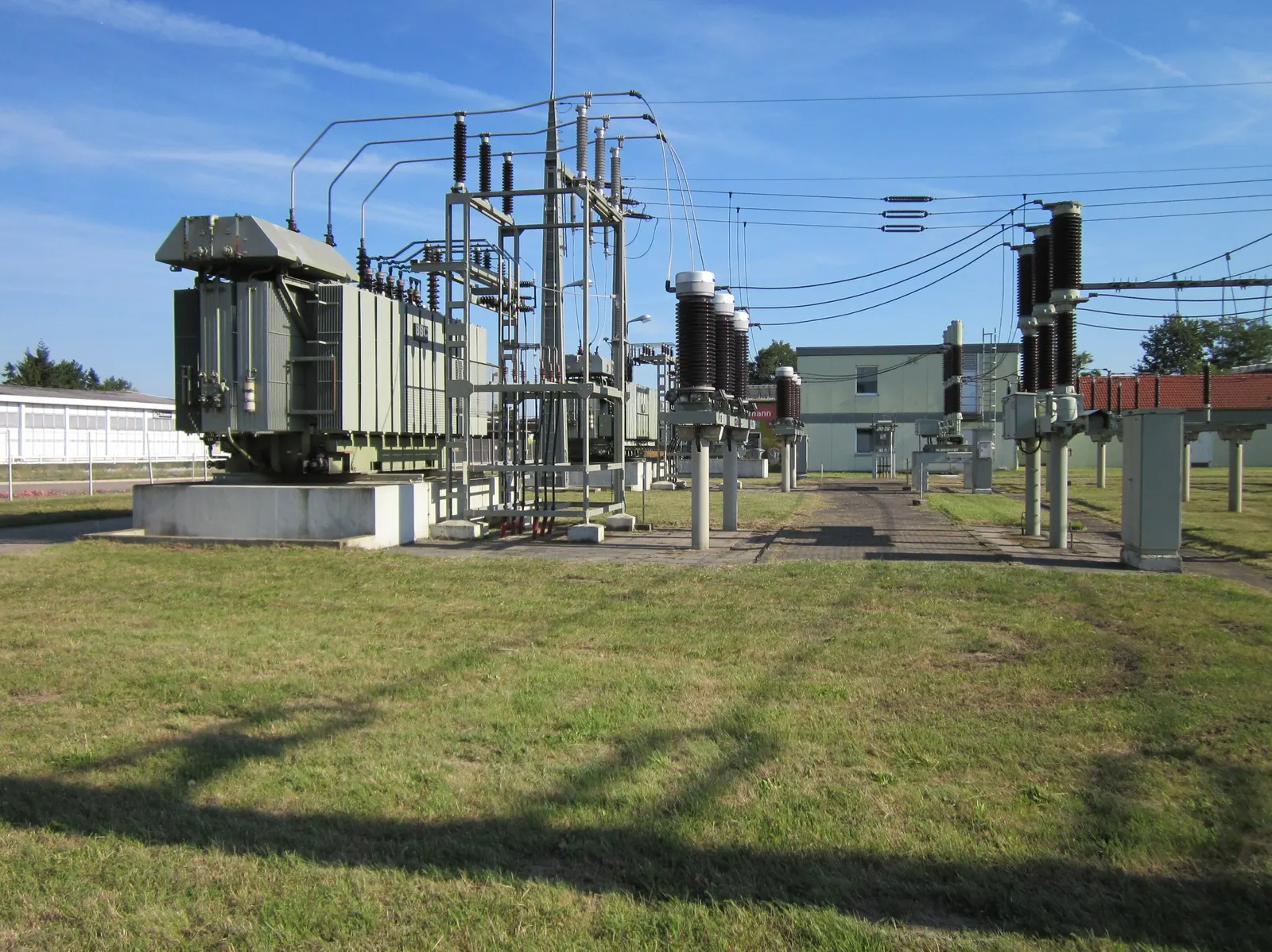
For most of the last twenty years, developers have treated grid interconnection as a procurement problem. You get in the queue, you negotiate with the utility, you pay for upgrades, and the physical infrastructure appears. What the current cycle has established is that the substation and switchyard are a discretionary land use in their own right, subject to their own approval, their own setbacks, their own visual and acoustic scrutiny, and their own possibility of denial even where the main campus is approved.
The ERCOT numbers make the point quantitatively. Roughly 238.6 gigawatts requested, roughly 9.0 gigawatts approved to energize, roughly 3.9 gigawatts actually operating. The overwhelming majority of announced capacity does not become operating load. Some of that attrition is speculative queue stuffing. A meaningful share of it is projects that could not resolve the physical, land side requirements of getting power onto the site.
Pataskala, Ohio made the point without any state involvement at all. City Council voted unanimously to reject Aligned Data Centers' 200 megawatt campus site plan over unresolved power supply questions. Note what was rejected there. Not a rezoning, not a use determination, but the site plan itself, on grounds that would once have been considered a matter between the developer and the utility.
Sometimes the project does not even reach a vote. In Hoffman Estates, Illinois, the developer withdrew its Plum Farms rezoning petition five days before the Village Board was scheduled to decide, after the Plan Commission had already voted 4 to 2 against recommending it. A withdrawal five days out is a decision made after counting votes, and the votes were counted after the plan commission had seen the plan.
Pennsylvania's executive order formalizes what Hanover demonstrated. If DEP will not review your permit until you hold local approval, and local approval includes the substation, then the site plan showing where that substation goes, how it is screened, how far it sits from the nearest residence and what it sounds like at the property line is not a late stage deliverable. It is the document the entire project depends on.
The order of work has changed
Put the three state approaches side by side and a single structural change emerges. New York paused state permits and left local authority untouched. Pennsylvania made local approval a precondition for state review. Texas made interconnection conditional on curtailment obligations and financial commitments. In all three, the leverage moved earlier in the process and closer to the ground.
The practical consequences for anyone developing, financing or drafting these projects:
Site selection now requires a jurisdiction-specific test fit, not a parcel size rule of thumb. A 100-acre site that supports a given capacity under a 200-foot setback regime supports a fraction of it under a 1,000-foot regime. That is not a refinement to be handled in design development. It changes which parcels are worth putting under contract.
Cooling architecture is a site entitlement variable. Choosing evaporative cooling in a water constrained county is a decision to have a difficult hearing. The water number will be disclosed, it will be compared against the jurisdiction's supply, and the comparison will be made in public.
The substation needs a plan sheet before it needs a queue position. Its location, screening, setback and acoustic treatment need to be resolved as part of the campus layout rather than appended once the utility agreement is signed.
Perimeter elements need to be laid out first, not last. Generator yards, fuel storage, transformer pads and cooling equipment drive the noise profile and are the hardest items to relocate once the building footprint is fixed. Under ordinances that regulate them separately, they should be located before the building is.
The site plan is the hearing document. In a proceeding where the applicant is trying to demonstrate that a 400-acre industrial use will not be audible, visible or hydrologically significant to its neighbors, the plan set and the visualizations built from it are the argument. A drawing that shows a 1,000-foot buffer and a screened substation to scale does work that no traffic study or fiscal impact analysis can do.
The AI Now Institute's policy toolkit, which is compiling model standards for local governments, recommends a half mile of residential separation, or 2,640 feet, alongside the setback and siting provisions already adopted in Tempe, Phoenix, Nashville and elsewhere. Nashville tiers its requirements by megawatt and prohibits facilities above 100 megawatts entirely. Whether or not those specific standards spread, the fact that model language now exists means the next wave of ordinances will be written faster and will look more alike than the current patchwork does.
What the plan set has to carry now
If the hearing is where these projects are won or lost, it is worth being specific about which drawings do the work, because the conventional entitlement package was not built for this.
A dimensioned setback and buffer exhibit. Not a note on the site plan saying the project complies. A drawing that shows the applicable setback measured from each property line, the adjacency classification that generates it, and the resulting buildable envelope, with the building footprint sitting visibly inside it. In a proceeding where the central question is separation, a scaled drawing of the separation answers it faster than any narrative.
A substation and switchyard sheet. Location, dimensions, screening, height of the tallest element, distance to the nearest residential structure, and how it is accessed. If the substation requires its own conditional use permit, it needs its own exhibit rather than an outline on the overall site plan.
A perimeter equipment plan. Generator yard, fuel storage, transformer pads, cooling equipment, and the acoustic treatment on each. Fort Worth's approach of regulating generators separately at 300 feet from homes is a preview of where these ordinances are heading, and a plan that has already located those elements deliberately is in a very different position than one that placed them wherever the building footprint left room.
A water schematic tied to the cooling architecture. Service sizing, source, estimated daily withdrawal and estimated daily consumption, stated as different numbers because they are different numbers. The distinction between withdrawal and consumption is the single most common source of confusion in these hearings, and an applicant who explains it before being asked is an applicant who has established credibility on the rest of the file.
Grading, drainage and impervious coverage. A campus of this footprint generates an enormous impervious surface, and detention has to be located inside the buildable envelope that the setbacks left behind. On a site where the setback has already consumed 60 or 70 percent of the parcel, stormwater is competing for the same remaining ground as the building.
Visualizations from the viewpoints that matter. Not marketing renderings. Line-of-sight studies from the nearest residential properties, at the height of the tallest element, with the proposed buffer planting shown at installed size rather than at maturity. Boards have become notably less patient with renderings that show fifteen-year-old trees.
None of this is exotic. All of it is standard site planning work. What has changed is that it now has to be produced early enough to inform whether the parcel is worth buying, rather than late enough to document a decision already made.
What this actually means
There is a version of this story that treats the moratoriums as a temporary political reaction that capital will eventually route around, the way it routed around every previous local objection to industrial development. That reading underestimates what is happening.
Local governments are not passing symbolic resolutions. They are amending zoning codes, creating dedicated districts, writing numeric setback and decibel standards, and requiring special use permits for the substation. Those are durable instruments. A moratorium expires. An ordinance that says 1,000 feet and 50 dBA does not.
And the standards being adopted are not arbitrary. They track the three things that actually generate opposition, which are the water the facility consumes, the sound it makes at the fence line and the electrical infrastructure it drags onto the parcel. Every one of those is settled on a plan sheet, generally before the developer has even engaged a land use attorney.
Hanover County had a project that offered $21 million, a favorable planning commission recommendation and a corridor location that made sense. It lost 4 to 3 on a water estimate and a substation. The building was never the issue. It has not been the issue anywhere.
Frequently Asked Questions
How much land does a data center campus actually need? There is no single answer anymore, because the binding constraint is usually the setback regime rather than the building footprint. A 100-acre parcel under a 200-foot setback yields a very different buildable envelope than the same parcel under the 750 to 1,000-foot setbacks now being adopted in Virginia and Minnesota. On a square 100-acre site, a 1,000-foot setback on all sides leaves a strip roughly 90 feet wide. The correct approach is a jurisdiction-specific test fit during site selection, not a national acres-per-megawatt rule of thumb.
How much water does a data center use per megawatt? The peer-reviewed benchmark for evaporative cooling is roughly 18,000 gallons per day per megawatt, or about 6.7 million gallons per megawatt per year. Air cooled and adiabatic designs run roughly six to thirty times lower, and closed loop systems can approach zero. Because up to 85 percent of the water used in an evaporative system is lost to evaporation rather than returned, consumption and withdrawal are very different numbers, and jurisdictions increasingly ask about consumption.
What noise limits are jurisdictions imposing on data centers? Recently adopted standards include a 50 dBA maximum in Henry County, Virginia and a 55 dB cap in Stafford County, Virginia. Some jurisdictions defer to state industrial standards, which are more permissive, such as Maryland's 75 dBA day and 70 dBA night. Practitioner guidance being circulated to community groups recommends 50 dBA day and 40 dBA night at the property line where setbacks are inadequate. Low frequency content below 100 hertz is the practical problem, because it travels much farther than A-weighted measurements at the fence line suggest.
Does New York's moratorium stop local permitting? No. Executive Order No. 62 directs the state Department of Environmental Conservation to hold discretionary permit applications in abeyance for facilities at or above 50 megawatts. It expressly does not apply to local government permits, which continue to operate as before.
What changed in Pennsylvania? Executive Order 2026-05 does not pause permitting. It requires that a developer make a binding commitment to the state's grid cost requirements and obtain local approval before the Department of Environmental Protection will review the application. The threshold is 25 megawatts. In practical terms, the municipal hearing now precedes the state environmental permit rather than running in parallel with it.
How many local data center moratoriums are there? It depends on the counting methodology, and the range is wide. One tracker reported at least 225 across 30 states as of early August 2026, with 151 in force. The National League of Cities, using a narrower definition, counted 76 cities, counties and towns. Anyone citing a single figure should attribute it, because the instruments being counted are not the same.
Why do data center projects get denied when they offer large fiscal benefits? Because the objections are not fiscal. Hanover County, Virginia denied a campus that offered a roughly $21 million proffer package and carried a 6-1 planning commission recommendation, on the basis of a water draw of 600,000 to 2,000,000 gallons a day in a county without its own supply, and denied the substation conditional use permit separately. Fiscal benefit does not answer a resource or a compatibility objection, and increasingly boards are treating those as distinct questions.
Should the substation be shown on the site plan at entitlement stage? Yes. In a growing number of jurisdictions the substation requires its own conditional use permit and can be denied independently of the main campus. Its location, screening, setback and acoustic treatment should be resolved as part of the campus layout rather than added after the utility agreement is executed.
Sources:
- ZoneWire, Hanover County VA Data Center Rezoning Denied, case study
- Office of the Governor of New York, Executive Order No. 62, Establishing a Temporary Moratorium on Data Centers in New York, July 14, 2026
- New York State Senate, Bill S10642 (2025-2026 session), and Assembly Bill A11560
- Mid Hudson News, State lawmakers urge Hochul to sign data center regulation bill, August 24, 2026
- Commonwealth of Pennsylvania, Office of the Governor, Governor Shapiro Signs Executive Order on Data Center Development in Pennsylvania, August 18, 2026
- The National Law Review, Pennsylvania's New Data Center Executive Order: Two Tracks, One Choice
- FOX 29 Philadelphia, Gov. Shapiro signs executive order placing new guardrails on data center development
- K&L Gates, Update, Senate Bill 6: A Texas Bill Impacting Large Load Development in ERCOT
- Baker Botts, Texas Senate Bill 6: Understanding the Impacts to Large Loads and Co-located Generation
- McGuireWoods, Texas Senate Bill 6 Significantly Expands Regulatory Oversight Over Large Loads in ERCOT
- Interconnection Queue Tracker, ERCOT large load interconnection queue, March 2026
- ElectricChoice, Data Center Moratorium Tracker, current as of August 4, 2026
- National League of Cities, via Route Fifty, Many localities have tried data center moratoriums, tracker finds, August 2026
- Georgia Tech Energy Policy and Innovation Center
- ROI-NJ, North Brunswick, East Brunswick, and Stafford Township ban data centers, August 25, 2026
- Strisker, Data Centers Weekly Briefing, August 24 to 26, 2026
- Patch, Data Centers Banned In East Brunswick, Environmental Group Applauds Move
- David Mytton, Data centre water consumption, npj Clean Water, 2021
- Kova Stack, Datacenter Water Usage 2026
- LSARS, How Much Water Does a Data Center Use, and Data Center Noise: How Loud, How Far, How to Address
- MOST Policy Initiative, Data Center Water Use, citing Google 2025 Environmental Report
- KJZZ, Pinal County rejects massive La Osa data center, August 26, 2026
- WSLS 10, Henry County Board adopts stringent data center regulations, August 28, 2026
- Q102 WQTU, Floyd County Commission approves data center regs, August 25, 2026
- Elk River Data Center, Setback Standards: Facility Comparators and Permitting Approaches
- Calvert County, Maryland, Data Centers, county website
- AI Now Institute, North Star Data Center Policy Toolkit, Local Interventions
- LSARS, Data Center Noise: How Loud, How Far, How to Address
- Community Environmental Defense Services, How to Protect Your Home from Data Center Impacts
- Fort Worth Report, Zoning commissioners deny data center rules, return ordinance to Fort Worth City Council, July 8, 2026
- Strisker, Data Centers Weekly Briefing, July 6 to July 10, 2026