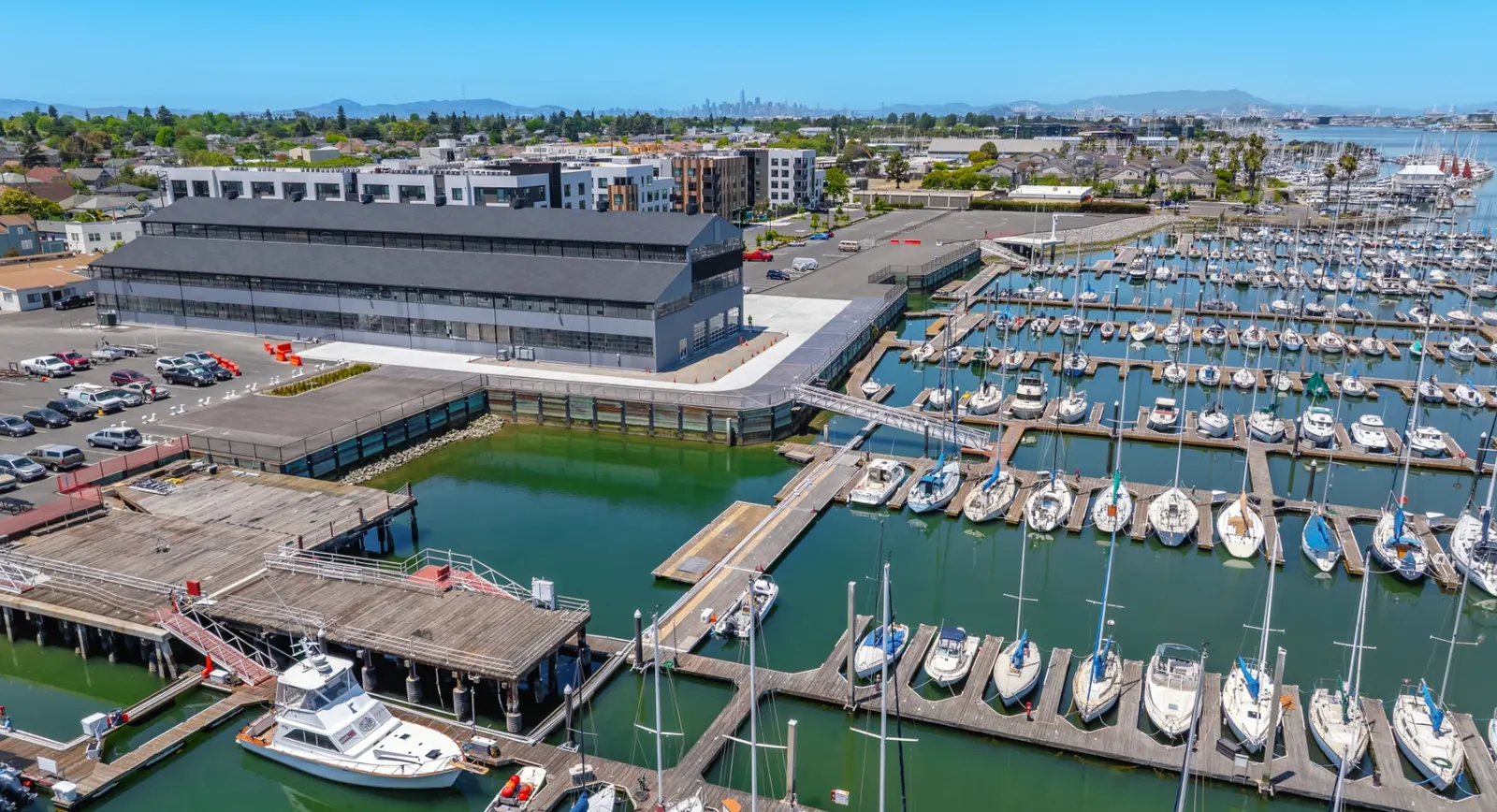
Building a marina in the United States is harder than building almost anything else. A single greenfield project can trigger permits from six or more federal agencies, a state coastal program, a regional water management district, and a local planning department, a regulatory gauntlet that routinely stretches 18 to 36 months and, in extreme cases, has taken nearly four decades from concept to ribbon-cutting. This complexity is not merely an obstacle; it is the defining feature of the marina asset class and the structural moat that makes existing facilities so valuable. Blackstone's $5.65 billion acquisition of Safe Harbor Marinas in 2025, at 21 times estimated funds from operations, was not a bet on boats. It was a bet on barriers to entry.
For lenders underwriting marina construction loans, investors evaluating waterfront assets, and developers assembling feasibility studies, understanding this regulatory architecture is not optional. It is the difference between a project that breaks ground and one that hemorrhages capital for years in permitting purgatory. What follows is a complete dissection of the federal, state, and local regulatory stack governing marina site planning and permitting, supported by current cost benchmarks, market data, and the regulatory shifts reshaping the landscape through 2026.
The federal regulatory stack: six agencies, one choke point
Every marina project of meaningful scale in the United States must pass through the U.S. Army Corps of Engineers, which administers both Section 10 of the Rivers and Harbors Act (governing structures in navigable waters) and Section 404 of the Clean Water Act (governing discharge of dredged or fill material into waters of the United States). These two authorities form the backbone of federal marina permitting, and for new construction, they are almost always processed as a single joint application.
The critical distinction is between Nationwide Permits and Individual Permits. The Corps maintains 57 Nationwide Permits (NWPs) for categories of activities with minimal environmental impact, NWP 28 covers reconfiguration of existing marina facilities, NWP 35 covers maintenance dredging, and NWP 19 covers minor dredging of up to 25 cubic yards. These carry an average processing time of 55 days as of fiscal year 2024. But no Nationwide Permit exists for new marina construction. Every greenfield marina and most substantial expansions require an Individual Permit, which carries a target processing time of 120 days from complete application but in practice averages 18 to 36 months when factoring in the full constellation of required consultations.
The Individual Permit triggers NEPA environmental review. Fewer than 1% of Corps permit applicants require a full Environmental Impact Statement, but those that do face median completion times of 2.2 years as of 2024, down from a historical average of 4.5 years. Most marina projects requiring an Individual Permit proceed through an Environmental Assessment, which under the Fiscal Responsibility Act of 2023 is now capped at one year with a 75-page limit. The real bottleneck, however, is rarely the Corps itself. It is the web of interagency consultations that must conclude before the Corps can act.
Section 401 water quality certification from the relevant state agency must be obtained before the Corps can issue any permit, a process that takes 60 days to one year depending on project complexity and state. Endangered Species Act Section 7 consultation with the U.S. Fish and Wildlife Service and NOAA Fisheries adds 135 days minimum for formal consultation, and for marina projects near manatee habitat, sea turtle nesting areas, or salmon-bearing waters, this is frequently the longest single component of the timeline. Essential Fish Habitat consultation under the Magnuson-Stevens Act runs concurrently but adds its own procedural requirements. And federal consistency review under the Coastal Zone Management Act gives the state coastal program up to six months to concur or object, with the power to effectively veto the project if it conflicts with enforceable state policies.
The formal denial rate for Corps Individual Permits is below 3%, but this figure dramatically understates the regulatory risk. Many problematic applications are withdrawn, redesigned, or abandoned during the pre-application process. The 404(b)(1) Guidelines require the applicant to demonstrate selection of the Least Environmentally Damaging Practicable Alternative, an alternatives analysis that is, by regulatory consensus, the most demanding single requirement in the process. For marina projects, the water-dependent nature of the use eases this burden relative to upland commercial development, but the analysis remains rigorous and, if poorly executed, is a reliable project killer.
How Sackett and NEPA reform reshaped the permitting calculus
The period from 2022 to 2026 has produced the most significant changes to federal environmental permitting in a generation, and marina developers are among the primary beneficiaries.
Sackett v. EPA, decided by the Supreme Court in May 2023, narrowed the definition of "waters of the United States" to require a continuous surface connection to navigable waters, eliminating the broader "significant nexus" test that had governed wetland jurisdiction for nearly two decades. The practical impact has been dramatic: of 9,078 jurisdictional determinations made by the Corps after Sackett, only 1,835, roughly 20%, resulted in classification as regulated waters. Environmental groups estimate the ruling removed federal protection from approximately half of previously regulated wetlands, encompassing roughly 290 million acres. For marina developers, this means certain adjacent wetlands that would previously have required Section 404 permits and costly compensatory mitigation may now fall outside federal jurisdiction entirely, potentially eliminating months of review and six-figure mitigation costs.
The Fiscal Responsibility Act of 2023 imposed hard deadlines on NEPA review for the first time: one year for Environmental Assessments, two years for Environmental Impact Statements. Page limits of 75 and 150 pages, respectively, constrain the scope of analysis. The "One Big Beautiful Bill Act" signed in July 2025 went further, allowing project sponsors to pay 125% of anticipated NEPA preparation costs to halve these timelines, reducing an EA to 180 days and an EIS to one year from notice of intent. These reforms, combined with the Corps' July 2025 interim final rule establishing new NEPA implementing procedures, represent a fundamental acceleration of the federal permitting clock.
Yet the federal story is only half the picture. A two-track regulatory reality has emerged: federal deregulation running concurrent with state-level expansion of climate and environmental requirements. California's Coastal Commission now requires projects to address sea level rise over their entire authorized lifespan. Hawaii expanded shoreline setbacks from 40 to 60 feet in 2024. Virginia designated living shorelines as the preferred alternative for tidal stabilization. Charleston, South Carolina, requires new waterfront construction to achieve 120% stormwater management improvement, meaning runoff must be reduced below pre-development conditions. The net effect is a system where federal timelines are compressing while state and local requirements are simultaneously intensifying, creating jurisdiction-dependent permitting outcomes that vary enormously from market to market.
Six states, six regulatory philosophies: a comparative anatomy
State coastal programs operate under the Coastal Zone Management Act, with 34 states and five territories participating. But the variation in approach, complexity, and timeline is profound, and for developers conducting feasibility analysis, the choice of jurisdiction may matter more than the choice of site.
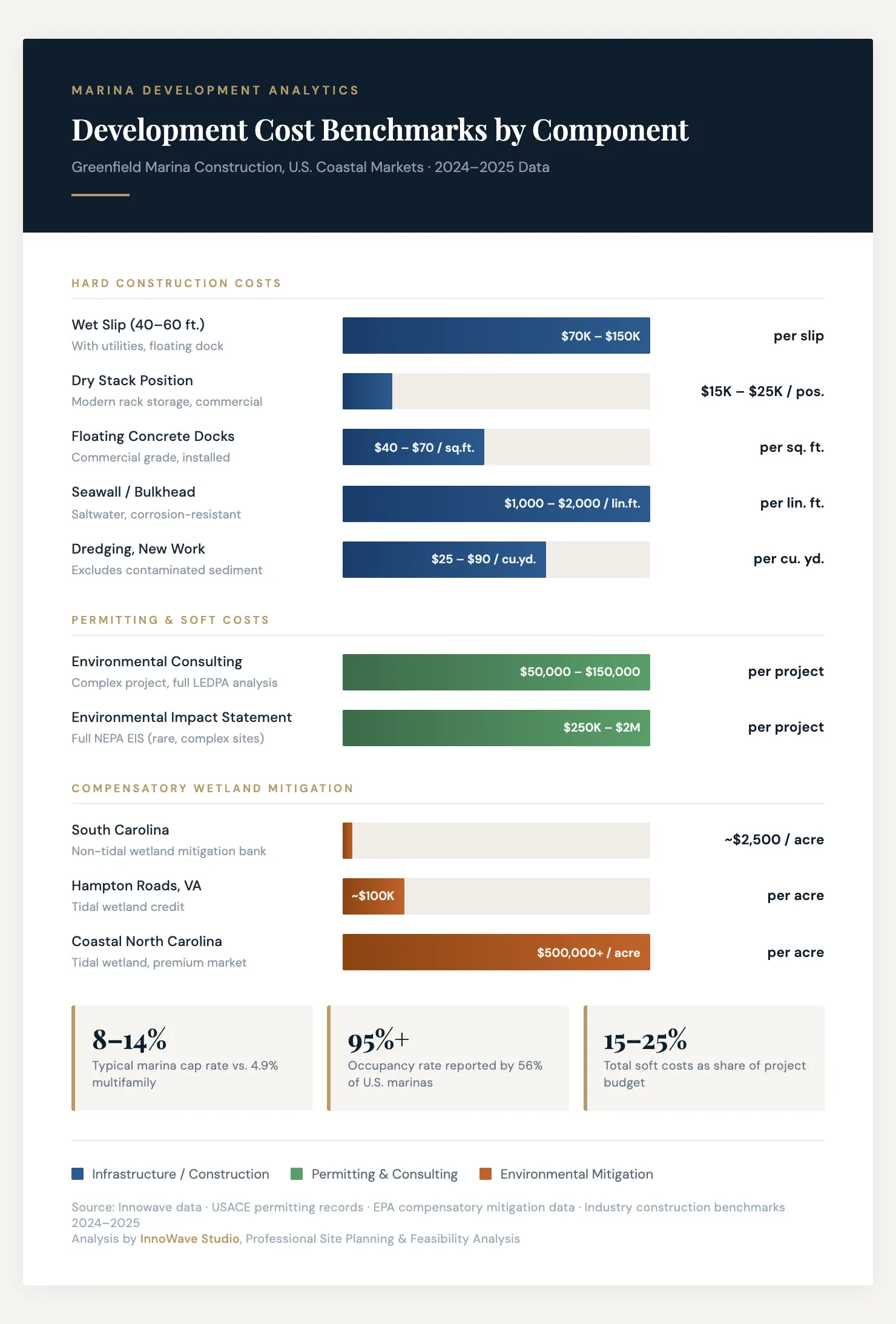
California operates the most complex regulatory overlay in the nation. The California Coastal Commission retains permanent permit jurisdiction over tidelands and submerged lands, issues Coastal Development Permits directly for marina projects (with a 99% approval rate in 2024, though conditions are typically extensive), and maintains a programmatic objection to the Corps' Nationwide Permit program, meaning every NWP in California's coastal zone requires individual CCC consistency concurrence. A single marina project may require a CDP from the CCC, a CEQA environmental document, a State Lands Commission lease, a USACE Section 10/404 permit, a Regional Water Quality Control Board 401 certification, and local permits. The Commission's 2024 Sea Level Rise Policy Guidance adds a further requirement that all waterfront projects address projected climate impacts over their full lifespan. Processing times have improved markedly, total CCC-issued CDP processing dropped to 83 calendar days in 2024 from 194 days in 2020, but the cumulative multi-agency timeline for a new marina in California remains 12 to 24 months or more.
Florida benefits from a joint application system that consolidates Environmental Resource Permits and sovereign submerged lands authorization into a single filing. The state assumed Section 404 permitting authority from the federal government for certain waters, further streamlining the process. But Florida's environmental constraints are substantial: the Florida Manatee Sanctuary Act designates the entire state a manatee refuge, 13 key counties must maintain Manatee Protection Plans governing marina siting, and 42 aquatic preserves covering 2.2 million acres impose heightened development standards. Sovereign submerged lands leases carry annual fees calculated as the greater of a per-square-foot rate or 6% of gross revenue. Recent legislation under the DeSantis administration weakened citizen challenge mechanisms and removed climate change language from state statutes, modestly accelerating approvals. Typical timeline: 6 to 12 months for individual permits.
Texas is widely considered the most permissive major coastal state. The General Land Office operates free Permit Service Centers in Galveston and Corpus Christi that function as one-stop coordination shops across agencies. The Texas Coastal Management Program is a "networked" system that relies on existing agency regulations rather than imposing independent state coastal permits. Federal consistency review typically concludes within 30 to 60 days. Overall marina permitting: 6 to 12 months, often faster for simpler projects.
Washington State imposes the no-net-loss-of-ecological-function standard through its Shoreline Management Act, requiring baseline ecological assessment and mitigation for all marina development. In Puget Sound, ESA-listed Chinook salmon and Southern Resident killer whales create an additional federal overlay. Local Shoreline Master Programs set jurisdiction-specific requirements, and a 2023 legislative amendment now mandates that all SMPs address sea level rise and storm surge impacts. Timeline: 12 to 18 months for complex Puget Sound projects.
New York requires multiple separate permits with no unified application, DEC tidal wetlands permits, protection of waters permits, NYC Waterfront Revitalization Program consistency review, and SEQR environmental review. The tidal wetlands adjacent area regulation extends 300 feet inland from wetland boundaries (150 feet within NYC). New York City's WRP was among the first in the nation to integrate climate change projections into waterfront permitting. Timeline: 12 to 24 months.
North Carolina's CAMA system is among the most streamlined, with minor permits processed in 25 days and a clear three-tier structure (general, minor, major). The Coastal Resources Commission establishes explicit marina siting hierarchies prioritizing non-wetland sites with deep water. Major permits undergo review by 10 state and 4 federal agencies but typically conclude within 6 to 12 months.
What kills marina projects before they start
The formal denial rate understates the true mortality of marina proposals, because the most dangerous obstacles surface during due diligence and pre-application, before a formal filing is ever made. Understanding these project killers is essential to feasibility analysis.
Submerged aquatic vegetation is the single most common deal-breaker. Seagrass beds are classified as "special aquatic sites" under the 404(b)(1) Guidelines and receive heightened protection. In Florida, the Uniform Mitigation Assessment Method requires seagrass recovery targets of 65% coverage within five years, with monitoring extending to a decade. In California, the NMFS Eelgrass Mitigation Policy mandates no-net-loss mitigation. Discovery of SAV on or adjacent to a proposed site can make permitting prohibitively expensive or outright impossible.
Endangered species habitat adds both timeline and uncertainty. Formal ESA Section 7 consultation requires a minimum of 135 days, but in practice, preparation of a Biological Assessment and subsequent review frequently extends the process to 6 to 12 months. In the 13 Florida counties with Manatee Protection Plans, marina siting must be consistent with the plan's boat facility guidelines, and counties like Brevard prohibit marinas entirely in manatee sanctuaries or protection zones.
The alternatives analysis under Section 404(b)(1) remains the most intellectually demanding requirement. The applicant must affirmatively demonstrate that no practicable alternative exists with less environmental damage. While marinas benefit from the water-dependency presumption (eliminating the rebuttable presumption that upland alternatives exist), the analysis must still evaluate alternative sites, configurations, and scales. A poorly constructed alternatives analysis is a reliable basis for permit denial.
Contaminated sediments transform a manageable dredging operation into a costly remediation project. If characterization testing reveals contamination, disposal may require upland confined facilities at costs that can exceed the dredging itself by an order of magnitude. Excessive dredging requirements, sites with insufficient natural water depth, compound costs and environmental scrutiny. And 303(d)-listed impaired waters face heightened Section 401 certification requirements that can effectively preclude new marina development in degraded waterways.
Community opposition, while not a regulatory barrier per se, triggers extended public comment periods, public hearings, and demands for additional alternatives analysis. The Island Gardens Deep Harbour project in Miami required 14 years from voter approval to opening. The Chula Vista Bayfront in San Diego took 38 years from initial concept to completion. ONE°15 Brooklyn Marina filed for bankruptcy after costs doubled, ultimately selling at auction for $3.5 million against a $28 million investment.
Environmental mitigation: the cost of doing business on the water
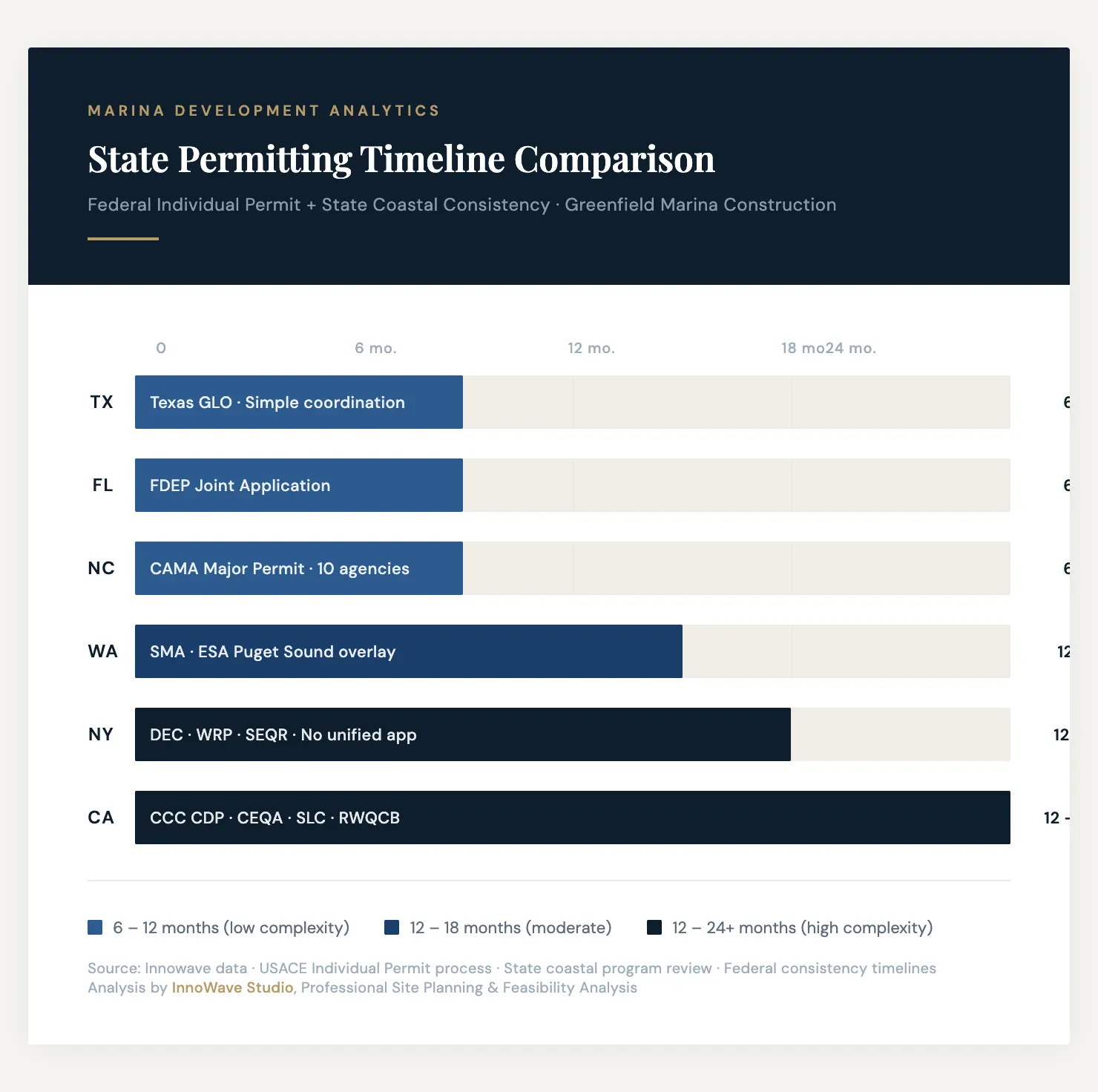
Compensatory mitigation for wetland impacts follows a strict preference hierarchy established by the 2008 Compensatory Mitigation Rule: mitigation banking first, in-lieu fee programs second, permittee-responsible mitigation last. Costs vary by orders of magnitude depending on geography and habitat type. Non-tidal wetland credits in South Carolina may cost $2,500 per credit. In Hampton Roads, Virginia, they approach $100,000 per acre. Tidal wetland credits in coastal North Carolina can exceed $500,000 per acre. Minimum replacement ratios start at 1:1 but escalate to 2:1 for forested wetlands, 3:1 for high-quality habitats, and as high as 10:1 for preservation-only mitigation.
Stormwater management requires marina-specific best management practices: oil/water separators at wash-down areas, bioretention for parking lot runoff, permeable pavement, and covered maintenance areas with contained drainage. Fuel handling triggers SPCC plan requirements for any facility storing 1,320 gallons or more of petroleum aboveground, with plans requiring Professional Engineer certification for facilities exceeding 10,000 gallons. Marinas storing one million gallons or more or conducting over-water fuel transfers must also prepare Facility Response Plans under the Oil Pollution Act.
The trend toward living shorelines as the preferred alternative to hardened structures is accelerating. Florida exempts certain living shoreline projects from permitting if the breakwater toe extends no more than 10 feet waterward of mean high water. The Corps' Nationwide Permit 54 covers simple living shoreline installations. Virginia has made living shorelines the default, and North Carolina simplified permitting for marsh sills under 500 feet. For developers, this preference creates both an opportunity (faster permitting for projects incorporating nature-based solutions) and a constraint (hardened structures face increasing scrutiny and may require demonstration that living alternatives are infeasible).
Wet slips, dry stacks, and the permitting advantage of vertical storage
The choice between wet slips, dry stack storage, and mixed-use configurations carries profound permitting implications that directly affect project feasibility and timeline.
Wet slips require the largest in-water footprint, docks, pilings, floating platforms, and trigger the full suite of environmental concerns: shading impacts on submerged aquatic vegetation, disruption to water circulation, anti-fouling paint leaching, and continuous vessel presence. Every square foot of preempted water surface adds to sovereign submerged lands lease costs in states like Florida (the greater of a per-square-foot rate or 6% of gross revenue). Construction costs run $70,000 to $150,000 per slip for 40- to 60-foot facilities with utilities, and the permitting timeline for new wet-slip marinas tracks the full Individual Permit process at 18 to 36 months.
Dry stack storage offers a markedly different regulatory profile. Boats stored on land in rack systems have minimal in-water time, eliminating anti-fouling paint requirements entirely, a significant water quality advantage that regulators explicitly recognize. Rhode Island's Coastal Resources Management Council encourages marinas to "primarily utilize dry stack storage" for space efficiency. Washington State ecology guidance favors dry stacks to reduce over-water impacts. Construction costs are substantially lower at $15,000 to $25,000 per position for modern facilities, and the reduced in-water footprint compresses both mitigation requirements and permitting timelines. The trade-off is height: multi-level rack buildings of three to four stories may conflict with waterfront height restrictions (Anne Arundel County, Maryland, caps marina districts at 40 feet), and the industrial appearance can generate neighborhood opposition.
Mixed-use configurations combining wet slips, dry storage, fuel, retail, and dining represent the highest-value development model, storage-centric properties earn the lowest cap rates (highest valuations) because storage income is the most predictable and least labor-intensive revenue stream. For investors, the optimal strategy is often acquiring an existing wet-slip facility and adding dry stack capacity as a value-add play, capturing the construction cost differential while leveraging the existing permit baseline.
Local zoning: the last mile of marina permitting
Federal and state permits address environmental and coastal policy. Local zoning determines whether a marina can be built at a specific site, at a specific scale, with specific accessory uses. This final layer is where parking ratios, height limits, setback requirements, and public access mandates shape the economic pro forma.
Waterfront overlay districts are the primary local mechanism. New York City's waterfront zoning mandates shore public walkways, upland connections, and visual corridors for virtually all development seaward of the pierhead line. Boston's Chapter 91, dating to 1866, requires non-water-dependent projects on tidelands to demonstrate "greater public benefit than detriment," mandating public walkways and transient dockage. These requirements directly reduce developable area and add construction costs.
Parking requirements vary significantly and can constrain site planning. Miami-Dade County requires one space per slip for live-aboard marinas, one per two slips for non-live-aboard facilities, and one per three spaces for dry rack storage. Boat trailer parking for launch-ramp-equipped facilities adds substantial land requirements. Some jurisdictions, like Sausalito, California, permit reciprocal parking arrangements, recreational marinas with peak weekend use can share up to 70% of parking with weekday office or industrial tenants.
Height restrictions in waterfront zones are typically lower than inland commercial districts. Anne Arundel County's six distinct maritime zoning districts (MA1 through MC) cap base heights at 40 feet with formulaic increases tied to additional setbacks. View corridor protections may further limit vertical development, constraining dry stack building heights.
Harbor master plans regulate facility siting at the municipal level by inventorying existing capacity, assessing demand, and establishing criteria for new or expanded facilities. In Rhode Island, municipalities must have Council-approved harbor management plans before marina permits can be issued. These plans can either enable or foreclose development depending on how they characterize remaining waterfront capacity.
The most important local trend is the tension between "working waterfront" preservation, protecting water-dependent uses from conversion to residential or non-maritime commercial, and the economic pressure to redevelop marina sites for higher-value uses. In Fort Lauderdale, hundreds of slips have been lost over two decades as condominiums generate more revenue per square foot. This conversion pressure is both a threat to slip supply and an opportunity for developers who can demonstrate that marina operations remain the highest and best use.
The investment case: structural scarcity meets institutional capital
The marina sector's transformation from a fragmented collection of mom-and-pop operations into a recognized institutional asset class is grounded in a single, powerful dynamic: it has never been harder to build a new marina, and demand has never been stronger.
The numbers tell the story. Approximately 10,445 marinas operate in the United States, generating roughly $7.6 to $7.8 billion in annual industry revenue. Only 5% of surveyed marinas are less than 10 years old, reflecting near-zero new construction. Meanwhile, 56% of facilities operate above 95% occupancy, 26% are at full capacity with active waitlists, and 68% raised slip rental rates between 2023 and 2024. Fort Lauderdale reports seven boats for every available slip. Individual marinas report waitlists stretching three to ten years. Renters in high-demand markets are paying 40% to 50% more than pre-pandemic rates.
The supply-demand imbalance is not cyclical. It is structural, enforced by the very regulatory framework this analysis describes. An 18- to 36-month Individual Permit process, the absence of a Nationwide Permit for new construction, six-figure environmental consulting costs, and mitigation requirements that can reach $500,000 per acre of tidal wetland impact, these are not temporary headwinds. They are permanent features of the asset class.
Institutional investors have responded accordingly. Blackstone acquired Safe Harbor Marinas for $5.65 billion in early 2025, representing a 21x multiple on estimated 2024 FFO, a premium that reflects the infrastructure-like qualities of recurring storage revenue with regulatory barriers to competitive supply. Sun Communities had purchased Safe Harbor just five years earlier for $2.11 billion, generating a 2.68x return. Suntex Marinas, now operating 90-plus facilities, formed a $1.25 billion joint venture with Centerbridge Partners in 2024 for acquisitions and capital improvements, with reports suggesting a potential portfolio valuation of approximately $4 billion. KSL Capital Partners reportedly hired advisers to sell its Southern Marinas portfolio at a valuation approaching $1 billion.
Cap rates for best-in-class marinas have compressed to approximately 5%, down from 7% to 8% just a few years prior. This compression, combined with conventional debt costs of 7% to 8%, has created a buyer-seller disconnect that has slowed transaction volume, 78 sales in the $1 million to $20 million range in 2023, down from 143 in 2021, even as median sale prices rose 16% year-over-year to $3.18 million.
The $230 billion engine: recreational boating by the numbers
The demand side of the marina equation is anchored by a recreational boating industry generating $230 billion in annual economic impact, up 36% from $170 billion in 2018. Total retail expenditures reached $55.6 billion in 2024, with aftermarket accessories and boating outings accounting for $24.5 billion. The industry supports more than 812,000 American jobs across 36,000 businesses, with 95% of boats sold in the United States manufactured domestically.
An estimated 85 million Americans go boating annually, with approximately 11 million registered vessels in active use. The post-COVID surge brought nearly one million first-time buyers into the market between 2020 and 2022, and while new powerboat unit sales have declined from peak levels, 238,117 units in 2024, with 2025 projected at 215,000 to 225,000, participation levels remain elevated well above pre-pandemic baselines. The median age of boat owners is now 60 years old, and 61% of boating households earn $100,000 or less, challenging the perception of boating as exclusively a luxury pursuit.
For marina demand specifically, the critical metric is not unit sales but the installed base and the trend toward larger vessels. While 95% of boats on the water are under 26 feet, the fastest-growing segments are mid-size and large vessels that require public marina storage. Boat clubs, Freedom Boat Club alone exceeds 90,000 members, are emerging as "better tenants than individuals," according to marina operators, given their institutional creditworthiness and multi-slip rental patterns. Boating and fishing remain leading drivers of the $1.2 trillion outdoor recreation economy, which represents 2.3% of GDP.
Cost benchmarks for feasibility modeling
Marina development costs are highly variable by geography, scale, and site conditions, but the following benchmarks provide a framework for feasibility analysis across major coastal markets.
| Component | Cost range | Key variables |
| Wet slip (40–60 ft. with utilities) | $70,000–$150,000 per slip | Dock material, water depth, utility infrastructure |
| Dry stack storage (modern) | $15,000–$25,000 per position | Automation level, building height, wind rating |
| Floating concrete docks (commercial grade) | $40–$70 per sq. ft. installed | Wave environment, ADA compliance, hurricane rating |
| Dredging (new work) | $25–$90 per cubic yard | Sediment type, disposal method, contamination |
| Dredging (maintenance) | $15–$30 per cubic yard | Access, volume, disposal proximity |
| Breakwater/wave attenuation | $200–$500 per linear foot | Design wave height, material, water depth |
| Seawall/bulkhead (saltwater) | $1,000–$2,000 per linear foot | Material, tidal range, corrosion resistance |
| Environmental consulting (complex project) | $50,000–$150,000 | Species presence, wetland acreage, state requirements |
| Environmental Impact Statement | $250,000–$2,000,000 | Project scale, number of alternatives, controversy |
| Compensatory wetland mitigation | $2,500–$500,000+ per acre | Geography, habitat type, bank availability |
| Total soft costs | 15–25% of total project budget | Jurisdiction complexity, legal challenges |
Operating expense ratios for stabilized marinas run approximately 60% for basic operations, with storage income carrying the lowest expense ratio of any revenue line. Insurance costs have emerged as a critical variable, with 85% of marinas reporting premium increases in 2024 and rates climbing 20% to 25% annually in storm-exposed markets. FEMA's Risk Rating 2.0 methodology, fully implemented in 2022, prices individual property risk rather than zone-wide averages, adding further cost pressure in coastal flood zones.
Financing remains available but selective. Conventional bank loans carry rates of 7% to 8% at 55% to 65% LTV with three- to seven-year terms. Life company debt offers the most attractive terms for stabilized assets at 6.5% to 7.5%, though maximum LTV rarely exceeds 60%. Private equity targets unleveraged IRRs of 18% to 22%, reflecting the operational complexity and weather risk inherent in the asset class.
Conclusion: where the regulatory tide is heading
The marina development landscape in 2026 is defined by a paradox. Federal permitting reform, NEPA deadlines, Sackett's jurisdictional narrowing, the OBBBA's pay-for-speed provisions, is compressing the federal timeline more aggressively than at any point in the modern regulatory era. Post-Sackett jurisdictional determinations are classifying only 20% of evaluated areas as regulated waters. EIS completion times have dropped 28% since 2020. These are real, measurable accelerations.
Yet state and local requirements are expanding in the opposite direction, creating a jurisdiction-dependent permitting reality where the same project might take 6 months in Texas and 24 months in California. Climate resilience requirements, sea level rise adaptation, living shoreline preferences, enhanced stormwater standards, are being layered onto state coastal programs at precisely the moment federal environmental review is being streamlined. The practical effect is a two-track system where project feasibility depends as much on the choice of state as on the merits of the site.
For the marina sector specifically, three structural realities will define the next decade. First, the supply-demand imbalance is permanent: regulatory barriers to new construction are not diminishing, even as demand remains elevated at 85 million annual participants and 11 million registered vessels competing for a fixed inventory of slips. Second, institutional capital has fundamentally repriced the asset class, the Blackstone transaction at 21x FFO establishes a new valuation paradigm that reflects marinas' infrastructure-like characteristics. Third, the developers and operators who will capture the remaining greenfield opportunities are those who can navigate the full regulatory stack from pre-application through final permit, a capability that is itself a scarce and valuable resource in an industry where the permitting process is the product as much as the marina itself.
Sources:
Federal Agencies & Statutes
- U.S. Army Corps of Engineers (USACE)
- Section 10 of the Rivers and Harbors Act of 1899 (33 U.S.C. §403)
- Coastal Zone Management Act (CZMA)
- Magnuson-Stevens Act (Essential Fish Habitat)
- EPA 404(b)(1) Guidelines (40 CFR Part 230)
- Oil Pollution Act (Facility Response Plans)
- EPA Spill Prevention, Control and Countermeasure (SPCC) regulations
- FEMA Risk Rating 2.0
Legislation & Court Decisions
- Fiscal Responsibility Act of 2023
- "One Big Beautiful Bill Act" (July 2025)
- Sackett v. EPA (Supreme Court, May 2023)
- Compensatory Mitigation Rule (2008)
State Agencies & Programs
- California Coastal Commission (CCC)
- California Environmental Quality Act (CEQA)
- Florida Department of Environmental Protection (FDEP)
- Washington State Department of Ecology
- Washington State Shoreline Management Act
- New York State DEC (NYSDEC)
- New York City Waterfront Revitalization Program
- Lake George Park Commission (New York)
Industry Data & Publications
- National Marine Manufacturers Association (NMMA)
- Marina Dock Age (2024 Annual Survey)
- Leisure Properties Group (2024 Marina Investment Report)
- CAIA (Chartered Alternative Investment Analyst Association)
- University of Florida Warrington College of Business
- Dockmaster Blog
Standards & Codes
- NFPA 303 (Fire Protection Standard for Marinas and Boatyards)
- 2010 ADA Standards for Accessible Design (Sections 235 and 1003)
- U.S. Access Board Chapter 10 (Recreational Boating Facilities)
Corporate Transactions
- Blackstone Infrastructure (Safe Harbor Marinas acquisition)
- Sun Communities
- Suntex Marinas / Centerbridge Partners joint venture
Notable Projects Referenced
- Island Gardens Deep Harbour, Miami
- Chula Vista Bayfront, San Diego
- ONE°15 Brooklyn Marina