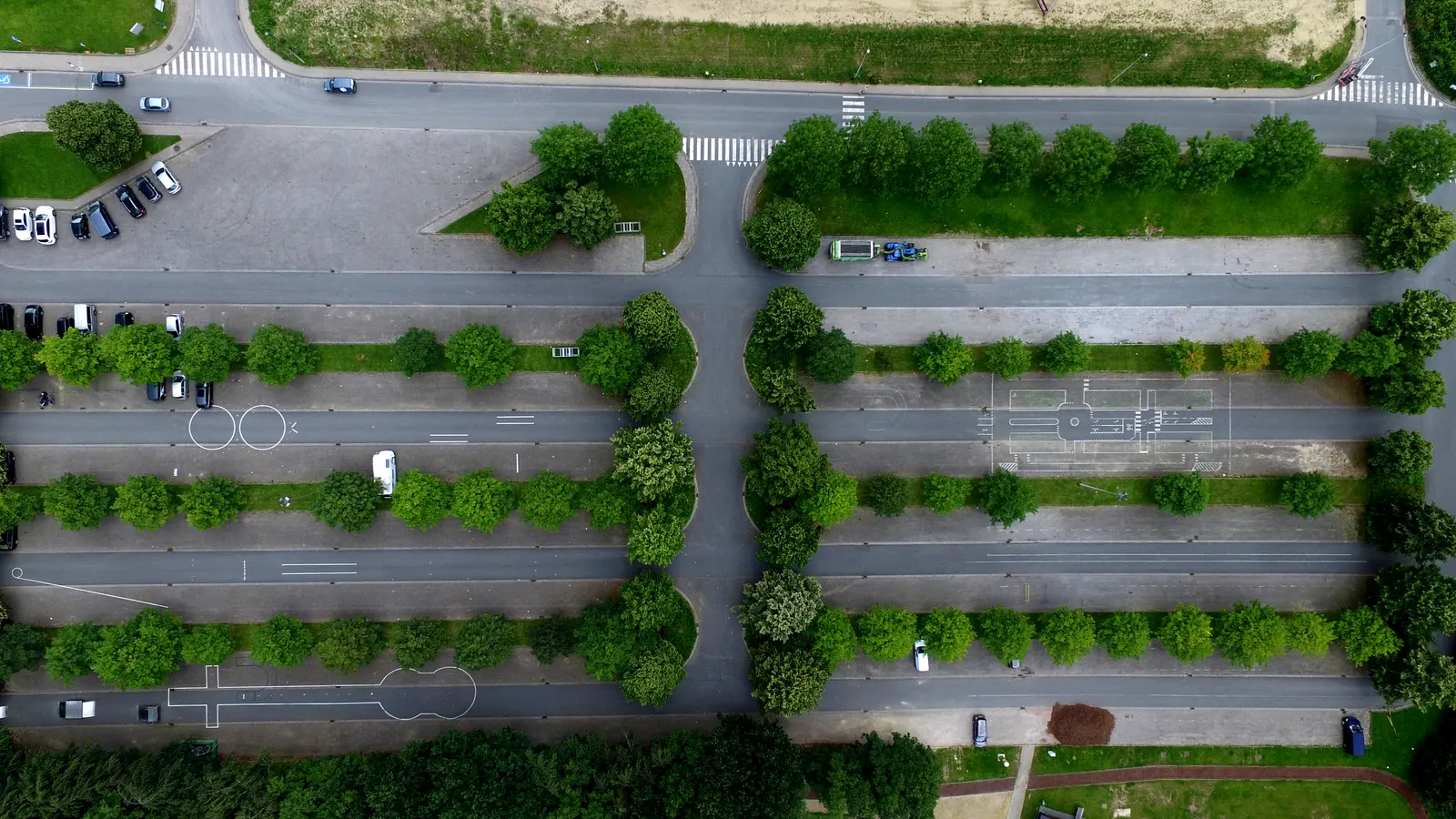
The old industrial rule of thumb was that 15 percent of a greenfield site went to the detention basin. Practitioners now budget closer to 20. While dozens of American cities have spent three years dismantling parking minimums and celebrating the land they recovered, the requirement that consumes the second largest share of a commercial site has been moving in the opposite direction. On September 17 the federal permit that governs it closes for comment.
There is a good story in American land use right now, and it is the parking one. Minimums are falling. Cities that spent seventy years mandating stalls nobody used are repealing the mandate, and the land coming back is real and measurable. We have written about what a single parking minimum costs, measured in apartments, and we have benchmarked the ratios across fifty markets.
Here is the part of that story nobody tells. On a typical commercial site, the second largest consumer of land after the parking field is the stormwater management facility, and while the first was being reformed by city council vote, the second was quietly getting bigger by engineering calculation.
Mark Augustyn, co-founder and chief operating officer of Principle Construction Corp, put the shift plainly in a trade interview about industrial development. "The traditional rule of thumb used to be about 15 percent of your greenfield site would be dedicated to the detention basin," he said. "Today we're using an additional 5 percent, so I like to advise our customers that about 20 percent of that site will need to be devoted to the stormwater detention system."
Five percentage points sounds like a rounding error. It is not. On a 20-acre industrial site, it is a full acre of ground. At the 30 percent building coverage typical of small bay flex product, that acre was roughly 13,000 square feet of leasable building. Nobody voted on it. There was no hearing, no advocacy campaign, no reform coalition. A stormwater manual was updated and the number moved.
And unlike parking, this one is still moving.
What a fifth of the site actually means
Start with the arithmetic, because the percentage hides the scale.
| Site size | At 15 percent | At 20 percent | Land the increase cost |
| 5 acres | 0.75 ac | 1.00 ac | 0.25 ac |
| 10 acres | 1.50 ac | 2.00 ac | 0.50 ac |
| 20 acres | 3.00 ac | 4.00 ac | 1.00 ac |
| 40 acres | 6.00 ac | 8.00 ac | 2.00 ac |
| 100 acres | 15.00 ac | 20.00 ac | 5.00 ac |
On a 100-acre industrial park, the shift from 15 to 20 percent is five acres. Five acres that was inventory and is now a hole in the ground with a headwall in it.
That land is not marginal land, either. Detention has to sit at a low point, which is frequently the same corner a developer would otherwise use for truck maneuvering, trailer storage or a future expansion pad, because those uses also want flat, unencumbered ground. The basin does not take the leftover triangle behind the retaining wall. It takes a usable piece of the site, and it takes it permanently, because a detention facility is typically encumbered by a maintenance easement and a recorded operations and maintenance agreement that runs with the land.
Compare that to the parking reform math we ran previously. There, a jurisdiction lowering a ratio from four stalls per thousand square feet to three hands back roughly 350 square feet of land per thousand square feet of building, and the developer can convert that immediately into building, landscaping or nothing at all. Stormwater runs the other way and it runs quietly. There is no line in the zoning ordinance that says "20 percent of your site." The requirement lives in a drainage manual, expressed as a design storm and a release rate, and it converts to acres only after an engineer has run the calculation on the specific site.
That is precisely why it escapes the reform conversation. You cannot repeal a hydrograph.
Why the number went up: detention became retention
The technical reason for the increase is a shift in what regulators ask stormwater facilities to do, and it is worth understanding because it explains why the land requirement is not going back down.
The old standard was detention. Slow the peak. The site can discharge the same volume of water it always did, but it has to release it at or below the pre-development peak rate, so downstream systems are not overwhelmed. A detention basin is essentially a temporary holding tank with a restricted outlet. It fills during the storm and empties over the following day, and because it is allowed to empty, it can be sized for peak shaving rather than total volume.
The new standard, increasingly, is retention. Keep the volume. The site is required to capture and retain a specified depth of rainfall on site, through infiltration, evapotranspiration or reuse, so that the first flush never reaches the storm sewer at all. That is a fundamentally different engineering problem, because you are no longer sizing for a rate. You are sizing for a volume that has nowhere to go.
The District of Columbia standard is the clearest example of the new model. Sites disturbing 5,000 square feet or more must retain the volume generated by a 1.2-inch storm, the 90th percentile event, and major substantial improvement projects must retain the 0.8-inch, or 80th percentile, volume. The District paired that with something no one else had done, a trading market: up to 50 percent of a site's required Stormwater Retention Volume can be satisfied off site through purchased Stormwater Retention Credits or an in-lieu fee.
Other jurisdictions have converged on similar volumes by different routes. A comparison assembled by New Jersey's environmental agency puts Tennessee at 1 inch retained, West Virginia at the first 1 inch kept with no discharge, Connecticut at the 1-inch volume, New York managing the 90th percentile storm, and federal facilities retaining the 95th percentile event.
The land consequence is direct. Infiltration requires soil that infiltrates, which many commercial sites do not have, and it requires horizontal area, because infiltration rate is a function of surface, not depth. You cannot solve a retention requirement by digging the basin deeper. On clay soils the practical answer is often a larger facility, an engineered media bed, or an underdrained system that costs more and still occupies the same footprint.
The District's credit trading program is the tell. When a jurisdiction builds a market allowing developers to buy their way out of half the on-site requirement, it is acknowledging that the on-site requirement is, on constrained parcels, physically unachievable.
The federal rulebook is open right now
Sitting on top of the state and local volume standards is the federal construction stormwater permit, and it is being rewritten this month.
On August 3, 2026, EPA published notice of the proposed 2027 Construction General Permit at 91 Federal Register 48862, docket EPA-HQ-OW-2025-0760. The comment period, originally set to close September 2, was extended to September 17, 2026. The permit it replaces, the 2022 CGP, expires in February 2027, and the proposed term is five years.
The coverage trigger is unchanged. One acre of disturbance, or less than one acre if the project is part of a larger common plan of development totaling at least one acre. No PFAS or emerging contaminant provisions appear in the proposal. What did change matters more to the people drawing the plans than to the people running the site.
The SWPPP now gets submitted. Under the 2022 permit, an operator had to prepare a Stormwater Pollution Prevention Plan and keep it available. Under the proposal, the operator must submit the complete SWPPP, a URL where it can be found, or the SWPPP site map together with a signed certification, along with the Notice of Intent. This is the single most consequential change for design practice. A document that lived in a job trailer and was reviewed mainly after something went wrong becomes a document filed with the permitting authority at the front end. Documents that get filed get read, and documents that get read get scrutinized.
The water quality language changed after a Supreme Court decision. The 2022 CGP required that discharges be controlled as necessary to meet applicable water quality standards, a broad and open-ended obligation. Following the Supreme Court's 2025 decision in City and County of San Francisco v. EPA, which addressed the enforceability of exactly that kind of generic receiving-water condition, the proposal replaces it with narrative limits tied to observable indicators in the discharge itself: floating, settled or suspended solids, film or sheen, discoloration or odor, scum or foam, and construction debris.
That is a meaningful shift in how compliance is judged. The old standard measured you against the condition of the receiving water, which you did not fully control. The new one measures you against what is visibly leaving your site, which you do. It is more defensible and also more immediate, because an inspector standing at your outfall can make the determination without a lab.
Sediment basins have to be stabilized before first use. The proposal requires that the basin embankment, side slopes, conveyance structures and discharge points be stabilized before stormwater is directed to the basin for the first time. In sequencing terms, this pulls stabilization work earlier in the schedule, which has to be reflected in the erosion control phasing plan rather than discovered in the field.
Several requirements were loosened. Perimeter controls are required only where they may actually receive stormwater from disturbed areas rather than everywhere by default. Stabilization deadlines are simplified in arid, semi-arid and drought-stricken areas. There is temporary relief for unforeseeable snow or frozen ground conditions. Pre-construction photographs are eliminated from the Notice of Termination, though post-stabilization photographs remain. EPA is also considering, though not yet proposing as an operative condition, weekly rather than daily turbidity monitoring for dewatering that extends beyond three days when the first three-day average stays below the 50 NTU benchmark.
The proposal follows Executive Order 14394 on removing regulatory barriers to affordable home construction, which explains the streamlining posture. The homebuilder trade association read it as a clarity and flexibility exercise.
Why the federal permit matters even where it does not apply
Here is a fact that surprises most developers: the federal Construction General Permit governs their project almost nowhere.
EPA is the direct NPDES permitting authority in only a short list of jurisdictions, including Massachusetts, New Hampshire, New Mexico, the District of Columbia, most Indian country lands, Puerto Rico and the territories other than the US Virgin Islands, certain federal facilities, and certain discharges in Oklahoma and in Texas Indian country. By EPA's own count, 47 states and one territory are authorized to run the program themselves.
So why does a permit that directly covers a handful of places reset practice nationally? Because it is the template. State construction stormwater permits are written against the federal model, renewed on their own five-year cycles, and revised in the direction the federal permit moves. When EPA changes how it handles water quality conditions, states follow, and some of them have already moved.
Washington is the clearest case, and it moved further than EPA did.
Washington's 2026 Construction Stormwater General Permit took effect January 1, 2026. It requires that inspections be conducted by a Certified Erosion and Sediment Control Lead on every permitted site regardless of size, weekly and within 24 hours of any discharge. The 2021 permit had exempted sites of one acre or less from that requirement. Sites of one acre or less must now also sample weekly for pH and either turbidity or transparency.
Washington removed its own version of the water quality standards compliance language in response to the same Supreme Court decision, and expanded the contamination disclosure required on the Notice of Intent.
Read that sub-one-acre change carefully, because it is the direction of travel. The historical logic of construction stormwater regulation was that small sites were not worth the administrative burden. Washington abandoned that logic. A quarter-acre commercial infill project in Washington now needs a certified inspector walking it weekly and pulling samples, which is a cost and a schedule item that did not exist on that project two years ago.
Texas is on its own clock. TCEQ began the renewal process for the construction general permit TXR150000 with a stakeholder meeting in mid-2026, and the current permit runs to March 5, 2028. Anyone developing in Texas at scale should be watching that docket the way they would watch a zoning rewrite.
The enforcement paradox
At this point a developer might reasonably ask what happens if you simply get it wrong. The answer is genuinely surprising, and it explains why so many project teams under-invest in this sheet set.
Recent federal enforcement is small. Expedited settlements issued by EPA Region 10 in 2025 for construction stormwater violations include LGI Homes Washington LLC at $4,420, BP Products North America at $3,180, Granite Three LLC at $3,000, and KM2 Contractors at $1,020. In Region 1, an administrative complaint against Hutchens Holding III LLC proposed a $16,200 penalty for conducting construction activity and discharging stormwater without having obtained NPDES permit authorization at all.
Those are not numbers that change behavior on a project with a nine-figure budget. Even the statutory ceiling is modest by development standards: the 2025 inflation-adjusted maximum administrative civil penalty under Clean Water Act section 309(g) is $26,685 per day per violation, subject to a $66,712 cap. It is worth noting that the $37,500 per day figure still circulating on compliance websites is out of date and should not be relied on.
Historically the eye-watering numbers came from national pattern cases against homebuilders rather than from single-site violations. Home Depot settled for $1.3 million in 2008. Hovnanian Enterprises settled for $1 million in 2010 across 591 sites in eighteen states and the District of Columbia. Beazer Homes settled for $925,000 in 2010 and Toll Brothers for $741,000 in 2012. Those are enterprise-level enforcement actions against companies with hundreds of active sites, not the risk profile of a single commercial project.
So the honest conclusion is this: the penalty is not the reason to take the grading and drainage sheets seriously. The reason is that the same drawings determine how much of your site you keep, how many review cycles you burn getting to a permit, and whether the project holds its schedule. The fine is a rounding error. The land and the calendar are not.
Where the review cycles actually go
Every jurisdiction that reviews grading and drainage runs some version of the same loop: submit, receive a check print with a correction list, respond to every comment, resubmit. Los Angeles County Public Works, which maintains separate review tracks for grading plans and for hydrology studies, requires an annotated response to every plan check comment and warns that a resubmittal may be rejected without one.
What is striking, when you read enough of these correction lists, is how repetitive the deficiencies are. Riverside County publishes its typical rough grading and precise grading plan check comments, and the recurring items are unglamorous: pad elevations, drainage swales and structures, outlet velocity reducers and rip rap, energy grade line calculations, the 100-year overflow path when an inlet is assumed blocked, and minimum grades, with the county specifying a 1 percent minimum for parking lots and 0.35 percent for ribbon drains. Phoenix publishes a grading and drainage checklist for subdivision and commercial projects. King County's Surface Water Design Manual devotes an entire chapter to the drainage review process and submittal requirements.
There is a gap in the public record here worth naming honestly. No jurisdiction we could identify publishes first-submittal approval rates or a breakdown of resubmittals by discipline, so anyone who tells you that a specific percentage of site plan rejections trace to grading and drainage is estimating. What the record does show is that the largest jurisdictions in the country run dedicated grading and drainage plan check functions, publish standing lists of the deficiencies they expect to find, and require line-by-line responses before they will look at a resubmittal. Departments do not build that machinery for a discipline that clears on the first pass.
The practical point for scheduling is that each cycle is measured in weeks, and the items generating those cycles are almost all resolvable at the drawing stage by someone who has read the specific jurisdiction's checklist before starting rather than after the first rejection. That is unglamorous work and it is where the schedule is actually won.
Buying the land back
Which brings us to the decision that the 20 percent number forces: whether to pay to put the stormwater facility underground and reclaim the surface.
The cost gap is enormous. Surface detention is cheap per unit of storage. Older EPA-attributed unit costs put wet detention ponds at roughly $0.50 to $1.00 per cubic foot and dry detention basins at $0.15 to $0.30, though those figures come from an earlier generation of cost literature and should be treated as directional. Earthwork alone runs roughly $8 to $12 per cubic yard, which is on the order of $10,000 to $18,000 per acre-foot excavated. Texas A&M's extension program puts detention retrofit facilities in the range of $40,000 to $50,000, with grading at $5,000 to $15,000 per acre and outlet structures at $10,000 to $15,000.
Underground detention is an order of magnitude more expensive per unit of storage. Installed costs run roughly $8.50 to $17.00 per cubic foot depending on system type, with gravel systems around $9.00 to $13.50, arch chamber systems around $12.50 to $17.00, and geocellular systems around $8.50 to $13.00. That is a 10x to 20x premium over surface storage, and those figures come from a manufacturer source, so treat them as the high-confidence end of a range rather than gospel. Practitioner guidance puts a typical underground system at $50,000 to $200,000 or more against $30,000 to $100,000 or more for a retention pond.
Now convert the premium into the only unit that matters, which is $ per acre recovered.
Take a requirement of one acre-foot of storage, or 43,560 cubic feet. Surface storage at $0.50 per cubic foot costs roughly $22,000. The same volume underground at $12 per cubic foot costs roughly $523,000. The premium is about $501,000.
What does that premium buy? A surface basin storing one acre-foot at four feet of average depth needs roughly a quarter acre of storage prism, but side slopes, freeboard, an outlet structure, a maintenance access route and the setback from the property line push the real land take to something closer to four tenths of an acre to half an acre. Put the storage underground beneath the parking field and you recover essentially all of that.
So the premium of roughly $501,000 buys back roughly half an acre, which prices land recovery at approximately $1 million per acre.
That is a usable decision rule, and it inverts the usual instinct. Underground detention is not a premium finish for high-end projects. It is a straightforward land arbitrage that pencils whenever the combined value of the land and the improvement it would carry exceeds roughly $1 million per acre, and does not pencil when it does not. In a dense infill market that threshold is cleared easily. On a greenfield industrial site in a secondary market it is not close, which is exactly why you see surface basins on one and vaults on the other.
The assumptions matter and should be run on the real project: storage depth, system type, soil conditions, groundwater, whether the jurisdiction permits detention beneath drive aisles and fire lanes, and the maintenance obligation, which is materially heavier and harder to inspect underground than a basin someone can walk. But the structure of the calculation holds, and it is a calculation that should be run at concept design, when the site layout can still respond to the answer, rather than in construction documents when it cannot.
Worth noting alongside the construction cost is the design cost, because it is frequently underestimated in early budgets. A standalone SWPPP is commonly quoted around $1,500 to $5,000, and $800 to $2,500 for small sites under five acres. A full commercial stormwater engineering package, meaning the SWPPP plus hydrologic and hydraulic modeling plus sealed plans plus permitting support, runs closer to $10,000 to $25,000 for sites under an acre, $25,000 to $75,000 for one to five acres, and $50,000 to $150,000 or more on larger or hydraulically complex sites. These are vendor and engineering firm quoted ranges rather than survey data, so treat them as order of magnitude. The relevant comparison is not fee against fee. It is the fee against the acre of land the design either wastes or saves, which on most commercial sites is worth several multiples of the entire engineering budget.
Designing for it instead of around it
The 20 percent figure describes what happens when stormwater is accommodated after the fact. It is not a law of physics. Sites that treat it as a first-order constraint routinely do better, and the moves that get them there are not exotic.
Locate the low point before the building. On most projects the building footprint and parking field are set first and the basin goes wherever water ends up. Reversing that order, by identifying the discharge point and the natural low ground first and then placing the building to work with it, frequently eliminates a round of imported fill and shrinks the facility, because a basin working with the existing grade needs less excavation and less structure than one fighting it.
Split the facility. A single large basin has the worst possible geometry for land efficiency, because side slopes, freeboard and access consume a fixed perimeter regardless of volume. Two or three smaller distributed facilities placed in areas that were already unbuildable, such as the corner behind the truck court or the strip inside the landscape buffer, can deliver the same volume with a fraction of the usable land taken.
Make the buffer do two jobs. Where the jurisdiction permits it, biofiltration and conveyance can occupy the same ground as the required landscape buffer or perimeter setback. That land is already committed and generating no revenue. Every cubic foot of storage placed there is a cubic foot not taken from the developable envelope.
Put linear storage under the drive aisles rather than the stalls. When underground storage is justified, the instinct is to place it beneath the parking field. Drive aisles are often the better location, because they carry the same load, they are continuous, and they preserve the option of restriping or reconfiguring the stalls later without disturbing the system.
Phase the sediment basin deliberately. The proposed federal requirement to stabilize the basin before first use means the erosion control phasing plan now drives early schedule. A temporary sediment basin sited where the permanent facility will eventually go, sized and sequenced so it converts rather than gets rebuilt, saves both the earthwork and the stabilization cycle.
Read the credit provisions. Jurisdictions that mandate retention volumes increasingly also publish credits for green infrastructure, disconnected impervious area, tree canopy or off-site trading, as the District of Columbia does with its retention credit market. Those provisions are usually buried in the manual rather than the ordinance, and they are routinely left on the table by teams who never looked for them.
None of this is a workaround. All of it is ordinary competent site planning applied at the moment when it still changes the outcome, which is concept design.
The reform that is not coming
Parking minimums fell because they were legible. A number in a zoning table said four stalls per thousand square feet, anyone could read it, and a city council could delete it in an evening. The reform movement had a villain it could point at.
Stormwater has no such number. It has a design storm, a release rate, a retention volume, a soil infiltration rate and a routing calculation, and the acres it consumes emerge from all of them combined, differently on every site. There is no line to delete. And unlike parking, where the case for reform was that the requirement exceeded observed demand, nobody is arguing that the water is not real. It is real, it is arriving in larger design storms, and the receiving systems downstream are the same age they always were.
So the land take is not going back down. The 15 percent that became 20 will not become 15 again, and the retention standards that drove the change are spreading rather than retreating. The federal permit closing for comment on September 17 will not reverse it either; if anything the mandatory SWPPP submission moves the scrutiny earlier.
What is available is competence. The requirement can be met on a smaller footprint by an engineer who designs for it from the first sketch rather than accommodating it after the building and parking are fixed. It can be met underground when the land math justifies it. It can be met without four review cycles by a team that read the jurisdiction's checklist first. None of that is regulatory relief. It is just the difference between a site plan that treats stormwater as a constraint to be designed around and one that treats it as a leftover.
A fifth of the site is too much land to leave to the leftover.
Frequently Asked Questions
How much of a commercial site does stormwater detention typically consume? Practitioners in industrial development have historically budgeted roughly 15 percent of a greenfield site for the detention basin and now advise closer to 20 percent. That is a rule of thumb rather than a code requirement, and the actual figure depends on the design storm, the required release rate or retention volume, soil infiltration capacity and site topography. On a 20-acre site the difference between 15 and 20 percent is a full acre.
What is the difference between detention and retention? Detention slows the discharge. The site holds water temporarily and releases it at or below the pre-development peak rate, so the basin can be sized for peak shaving. Retention keeps the volume on site through infiltration, evapotranspiration or reuse, so a specified depth of rainfall never discharges at all. Retention is generally the more land-intensive requirement, because infiltration is a function of surface area and cannot be solved by digging deeper.
When does the comment period on EPA's 2027 Construction General Permit close? September 17, 2026, extended from the original September 2 date. The proposal was published August 3, 2026 at 91 Federal Register 48862 under docket EPA-HQ-OW-2025-0760, and would replace the 2022 permit that expires in February 2027.
What are the most significant changes in the proposed 2027 CGP? Four stand out. The complete SWPPP, a URL to it, or the site map with signed certification must now be submitted with the Notice of Intent rather than merely prepared and retained. The broad requirement to control discharges as necessary to meet water quality standards is replaced with narrative limits tied to observable indicators in the discharge, following the Supreme Court's 2025 decision in City and County of San Francisco v. EPA. Sediment basins must be stabilized before first use. And several requirements were streamlined, including perimeter controls, arid-region stabilization deadlines and Notice of Termination photo requirements.
Does the federal Construction General Permit apply to my project? Probably not directly. EPA is the permitting authority in a limited set of jurisdictions including Massachusetts, New Hampshire, New Mexico, the District of Columbia, most Indian country lands and the territories other than the US Virgin Islands. By EPA's count 47 states and one territory administer the program themselves. The federal permit still matters because state permits are written against it and revised in its direction.
What changed in Washington's 2026 construction stormwater permit? The most consequential change is that inspections must be conducted by a Certified Erosion and Sediment Control Lead on every permitted site regardless of size, weekly and within 24 hours of any discharge. The prior permit exempted sites of one acre or less. Those smaller sites must also now sample weekly for pH and either turbidity or transparency.
What is the penalty for a construction stormwater violation? Smaller than most developers expect. Recent EPA expedited settlements for construction stormwater violations have run from roughly $1,000 to $4,500, and a complaint for operating with no permit at all proposed $16,200. The 2025 inflation-adjusted administrative maximum under Clean Water Act section 309(g) is $26,685 per day per violation with a $66,712 cap. The frequently cited $37,500 per day figure is outdated. The large historical settlements, such as Home Depot at $1.3 million and Hovnanian at $1 million, were enterprise-wide pattern cases across hundreds of sites.
When does underground detention make financial sense? As a first-pass rule, when land plus the improvement it would carry is worth more than roughly $1 million per acre. Underground storage runs roughly $8.50 to $17.00 per cubic foot installed against roughly $0.15 to $1.00 for surface storage, a 10x to 20x premium. On a one acre-foot requirement that premium is on the order of $500,000 and recovers roughly half an acre of surface. Depth, soil, groundwater, whether the jurisdiction allows storage beneath fire lanes, and the heavier maintenance obligation all shift the answer, so run it on the actual project at concept design.
Why do grading and drainage plans generate so many review cycles? The recurring deficiencies are consistent and documented in the plan check comment lists that large jurisdictions publish: pad elevations, drainage swales and structures, outlet velocity reducers and rip rap, energy grade line calculations, blocked-inlet overflow paths and minimum grades. Most are resolvable at the drawing stage by reading the specific jurisdiction's checklist before starting. Note that no jurisdiction we could identify publishes first-submittal approval rates, so any specific rejection percentage you see quoted is an estimate.
Sources:
- REJournals, Stormwater detention: The new convention, interview with Mark Augustyn, Principle Construction Corp
- District of Columbia Department of Energy and Environment, District Establishes New River-Protecting Stormwater Management Standards
- District of Columbia Department of Energy and Environment, Stormwater Management Guidebook
- New Jersey Department of Environmental Protection, stormwater workgroup comparison of state retention standards
- Federal Register, National Pollutant Discharge Elimination System, 2027 Issuance of General Permit for Stormwater Discharges From Construction Activities, 91 Fed. Reg. 48862, August 3, 2026, docket EPA-HQ-OW-2025-0760
- United States Environmental Protection Agency, Proposed 2027 Construction General Permit and Related Documents
- The National Law Review, EPA's Proposed 2027 Construction General Permit: Four Issues for Developers to Consider
- Supreme Court of the United States, City and County of San Francisco v. Environmental Protection Agency, 2025
- National Association of Home Builders, Proposed Construction Stormwater Permit Aims to Provide Greater Clarity, Flexibility, and Executive Order 14394
- United States Environmental Protection Agency, About NPDES
- Washington State Department of Ecology, 2026 Construction Stormwater General Permit
- Washington Stormwater Center, 2026 Construction Stormwater General Permit Released
- The National Law Review, Washington's Draft 2026 Construction Stormwater General Permit Out for Public Comment
- Texas Commission on Environmental Quality, Construction General Permit TXR150000
- United States Environmental Protection Agency, Consent Agreement and Final Order, LGI Homes Washington LLC, docket CWA-10-2025-0064
- United States Environmental Protection Agency, Consent Agreement and Final Order, BP Products North America, docket CWA-10-2025-0061
- United States Environmental Protection Agency, Consent Agreement and Final Order, Granite Three LLC, docket CWA-10-2025-0106
- United States Environmental Protection Agency, Consent Agreement and Final Order, KM2 Contractors, docket CWA-10-2025-0073
- United States Environmental Protection Agency Region 1, Administrative Penalty Complaint, Hutchens Holding III LLC, docket CWA-01-2025-0002
- Federal Register, Civil Monetary Penalty Inflation Adjustment Rules, 2024 and 2025
- United States Department of Justice, Home Depot Clean Water Act settlement, 2008
- United States Environmental Protection Agency, Hovnanian Enterprises Inc. Clean Water Act Settlement
- United States Environmental Protection Agency, Beazer Homes USA Inc. Settlement
- United States Environmental Protection Agency, Toll Brothers Clean Water Act settlement announcement
- Los Angeles County Public Works, Land Development Division, Grading plan check services
- Los Angeles County Public Works, Land Development Division, Hydrology Study review
- Riverside County, Typical Rough Grading Plan Check Comments
- Riverside County, Typical Precise Grading Plan Check Comments
- City of Phoenix, Grading and Drainage Subdivision and Commercial submittal checklist
- King County, Surface Water Design Manual, Chapter 2, Drainage Review and Submittal Requirements
- Texas A&M AgriLife, Texas Community Watershed Partners, Cost and Maintenance, and EPA-attributed BMP unit cost literature
- Aqua RainWater, underground detention system installed cost comparison
- Path Light Pro, SWPPP requirements and cost guidance for construction
- CivilSmart, commercial stormwater engineering package cost ranges