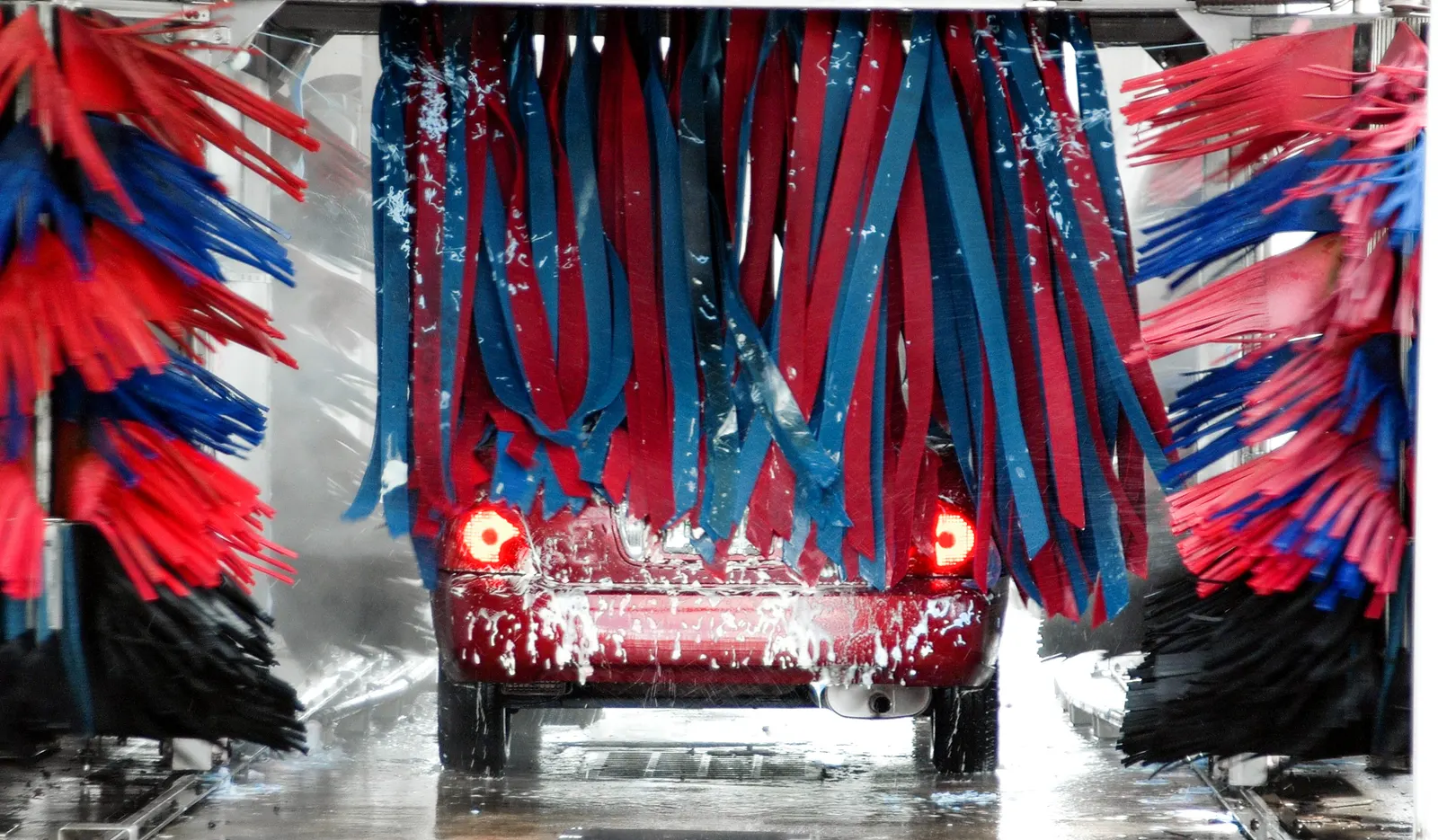
Chick-fil-A's 2025 disclosure reports a median freestanding volume of $9,087,673. Its newest drive-thru-only prototype is 2,997 square feet, and permitted sites run from 0.74 to 1.9 acres. A Tommy's Express car wash costs $4,976,759 to $8,522,378 to build, sits on a multi-acre parcel, and averages $1,647,523. Cost per square foot of building is the number the industry quotes. Sales per land acre is the number that decides whether the pad works.
The building shrank. The parcel did not.
Every major drive-thru brand has published a smaller prototype in the last five years. Taco Bell's Go Mobile format runs 1,325 to 1,400 square feet against a traditional footprint near 2,500. Starbucks has permitted drive-thru-only stores as small as 1,200 square feet against a prior 1,800 to 2,200. Chick-fil-A's drive-thru-only prototype is 2,997 square feet where the traditional store ran 4,000 to 5,000. Recent McDonald's dual-lane builds have come in around 3,895 square feet against traditional stores of 4,500 to 4,625.
The land requirement did not follow the building down, because what replaced the dining room lives outside the walls. Chick-fil-A permits show 21-vehicle stacking on a dual-lane site, with dual-lane examples reaching 42 vehicles and an elevated four-lane test concept sized for 75 cars. Taco Bell's Defy prototype runs four lanes. Wendy's added a dedicated mobile and delivery pickup lane alongside its enhanced single lane. Queue depth is a site plan quantity, not a building quantity, and it has been growing while the building shrank.
What each format actually demands in dirt
Restaurant pads cluster tightly. Chick-fil-A permits run 0.74 to 1.9 acres. McDonald's site criteria describe an ideal freestanding parcel near 50,000 square feet, about 1.15 acres, with corner locations preferred. Taco Bell runs 0.75 to 1.0 acre, with Go Mobile allowing a narrower lot. Wendy's, Burger King, and Raising Cane's each sit near an acre, with Cane's reaching about 1.9 on some sites. Starbucks drive-thru pads run 0.50 to 1.00 acre, with permitted examples as small as 0.41. Dutch Bros works from roughly 0.5 to 0.9 acre.
Two formats break the pattern in opposite directions. Take 5 Oil Change compresses to 0.3 to 0.5 acre on brand criteria, with documented permits from 0.54 to 1.37, because a three-bay stay-in-car service format has no order point and almost no parking. Tommy's Express requires a multi-acre high-traffic site, because a tunnel needs pre-tunnel stacking, pay lanes, and a pull-forward vacuum field. Wingstop is the control at the far end: inline or end-cap, shared center parking, no dedicated land at all.
The trap in the investment number
Franchise Disclosure Document Item 7 is the figure everyone compares, and it is not comparable without normalizing how each brand treats real estate.
McDonald's discloses $1,471,000 to $2,728,000 for a traditional unit with land excluded by design, because the franchisor generally owns or master-leases the real estate and leases it to the operator at rent running above 8.5 percent of sales. Its FY2024 annual report confirms the structure: roughly 56 percent of the land and about 80 percent of the buildings under its restaurants are owned, with net property and equipment under franchise of $20.6 billion including $6.4 billion of land. McDonald's is a real estate business that sells hamburgers, and its Item 7 reads low because of it.
Wendy's discloses $1,108,474 to $2,828,707 with real estate included. Burger King runs $2,064,200 to $4,730,500 for a traditional freestanding unit. Taco Bell's 2024 disclosure showed $1,584,750 to $3,980,200 for a new traditional unit. Popeyes runs $1,188,500 to $3,875,700 freestanding. Take 5 discloses $749,292 to $2,033,733 for a new ground-up center with land purchase generally excluded. Wingstop runs $259,400 to $912,100 with real estate excluded, which its parent corroborates at roughly $580,000 average initial investment excluding real estate.
Tommy's Express is the outlier on both ends: $4,976,759 to $8,522,378 with real estate and site work included in the range.
Three brands in this set do not franchise on standard United States terms. Chick-fil-A operates a franchisor-funded operator model in which the operator pays $10,000 and the company retains the real estate, with disclosed project cost of $426,735 to $2,339,525. Raising Cane's is company-owned. Starbucks is company-operated and licensed only, with no domestic franchise disclosure. Their inputs below are substitutes, not disclosure figures, and should be read that way.
The ranking that inverts
Order the set by sales rather than by build cost and the hierarchy turns over.
Chick-fil-A reports a median freestanding volume of $9,087,673 and an average of $9,161,239 across roughly 2,302 domestic units. On a one-acre parcel, that is the densest land economics in American quick service by a wide margin. Raising Cane's reported roughly $6.6 million per unit for 2024 on a comparable footprint. McDonald's traditional franchised units average $4.002 million. Taco Bell reports a median near $2,304,197. Wendy's franchised units average $2.11 million. Popeyes averages $1,974,468 across 2,279 units. Burger King reports $1,658,463 for traditional units. Starbucks sits near $1.8 million on published trade data.
Then the land-light and land-heavy ends. Take 5 averages roughly $1.36 million across 215 franchised stores, which is modest in absolute terms and strong per acre on a 0.3 to 0.5 acre pad. Wingstop averages roughly $2.13 million on no dedicated land at all, the highest sales-to-land ratio in the group by definition. Tommy's Express averages $1,647,523 across 164 units on the largest parcels in the set, which makes it the weakest sales-per-land-acre format here and the most capital-intensive one.
Read the two columns together and the pattern is clean. Development cost per square foot of building ranks Tommy's and Chick-fil-A near each other. Sales per land acre puts them five and a half times apart.
What this changes for the pad developer
If you are subdividing a corner and selling pads, Take 5 and Wingstop maximize revenue per acre of parent tract, because they consume the least of it. Tommy's consumes the most land per dollar of tenant sales and should be underwritten across a long horizon, particularly given the sale-leaseback pattern visible in the express service sector.
If you are a ground lease lender, the two strongest coverage stories in the set carry corporate credit rather than franchisee credit, because Chick-fil-A and Raising Cane's do not put a franchisee balance sheet behind the rent. McDonald's rent is franchisor-backed for the same structural reason. That is a different underwriting question than a Burger King or Popeyes franchisee lease, and the sales figure alone does not tell you which one you are holding.
The variable you actually control is geometry
Brand criteria set the acreage. Municipal code sets the queue, and when the two disagree the site loses.
San Jose caps drive-thru stacking at eight vehicles per lane. Portland's Title 33.224, effective March 2025, sets 150 feet for a single lane and 80 feet per lane for multi-lane configurations. A Phoenix conditional use permit for a coffee drive-thru was revoked over queue spillover onto the public street. A brand standard calling for 21-vehicle stacking on a site where the code allows eight per lane is not a design preference problem. It is a deal that does not fit.
That test is a one-day exercise at site selection: pull the brand's published stacking depth and lane count, pull the municipal drive-thru standard and the throat length requirement, and check whether the parcel geometry holds both. The brands that shrank their buildings did not shrink what they need on the ground, and the codes that cap queues did not get more generous.
Frequently asked questions
What does it cost to develop a fast food franchise location?
Disclosed total initial investment ranges in 2024 to 2025 documents run from $259,400 to $912,100 for an inline Wingstop, roughly $1.1 million to $2.8 million for a Wendy's with real estate included, $1,471,000 to $2,728,000 for a McDonald's with land excluded, and $4,976,759 to $8,522,378 for a Tommy's Express car wash with land and site work included. The ranges are not comparable until you normalize how each brand treats real estate.
How much land does a fast food restaurant need?
Most freestanding quick service pads run 0.75 to 1.0 acre, with permitted examples from 0.41 acre for a small Starbucks drive-thru to 1.9 acres for larger Chick-fil-A and Raising Cane's sites. Express oil change formats compress to 0.3 to 0.5 acre. Tunnel car washes require multi-acre parcels.
Which franchise generates the most revenue per acre?
Among the formats reviewed, Chick-fil-A leads on a per-acre basis at a median of $9,087,673 on roughly one acre, followed by Raising Cane's at roughly $6.6 million. Wingstop produces the highest sales-to-land ratio in the set because it occupies inline space with no dedicated parcel. Tunnel car washes rank lowest, combining the largest land requirement with volumes near $1.65 million.
Why did drive-thru prototypes get smaller while sites did not?
The dining room was removed and the queue expanded. Dual order points, dedicated mobile and delivery lanes, escape lanes, and deeper stacking all consume land rather than building area, so the parcel requirement held flat or grew while building square footage fell by 20 to 40 percent at several brands.
Sources:
- McDonald's Corporation Form 10-K, fiscal year 2024
- McDonald's 2025 Franchise Disclosure Document, Item 7 and Item 19 summaries
- McDonald's United States site criteria brochure
- Taco Bell Franchise Disclosure Document, March 2024 and 2026 editions, Item 7 and Item 19
- Wendy's 2024 Franchise Disclosure Document, Item 7 and Item 19
- Wendy's Global Next Gen prototype materials, 2022 and 2023
- Burger King 2024 Franchise Disclosure Document, Item 7 and Item 19
- Restaurant Brands International Form 10-K, fiscal year 2024
- Chick-fil-A 2025 Franchise Disclosure Document, operator model disclosure and Item 19
- QSR Magazine, 2025 QSR 50 annual sales report, April 2025
- Yum Brands Form 10-Q, third quarter 2024
- Popeyes Franchise Disclosure Document, 2024 and 2025 editions
- Take 5 Oil Change Franchise Disclosure Document, 2024 edition, Item 7 and Item 19
- Driven Brands Holdings Form 10-K, fiscal year 2024, and sale-leaseback disclosures
- Tommy's Express 2025 Franchise Disclosure Document, Item 7 and Item 19
- Wingstop Inc. Form 10-K, fiscal years 2024 and 2025
- Wingstop 2024 and 2025 Franchise Disclosure Documents, Item 7 and Item 19
- Starbucks Corporation filings and published trade sales data on drive-thru unit volumes
- Dutch Bros Inc. Form 10-K and historical franchise disclosure
- Raising Cane's company-reported average unit volume, 2024
- Municipal planning permits, City of Fontana and City of Bellevue, McDonald's prototypes, 2024
- Municipal planning permits, City of San Jose and City of Escondido, Chick-fil-A prototypes, 2024
- Municipal planning permits, City of Logan and City of Fairfield, Raising Cane's prototypes
- Municipal planning permits, City of Lompoc and City of Cerritos, Starbucks drive-thru prototypes
- City of Portland Title 33.224, drive-through facilities, effective March 1, 2025
- City of San Jose council policy on drive-through stacking
- Texas Department of Licensing and Regulation project filings, Take 5 Oil Change, 2024 and 2025