Planning and Designing an RV Storage FacilityExcerpt: The booming RV market – over 11 million US households now own an RV – has fueled demand for well-designed RV storage facilities. Investors and developers are seizing this opportunity, but success hinges on meticulous planning. From optimal site layout (wide drive aisles, generous parking stalls) to choosing open vs. covered vs. indoor RV storage models, every decision impacts costs and returns. This comprehensive guide outlines best practices in site planning, design, security, and operations for profitable RV storage facilities, with insights on financial metrics, stormwater management, architectural choices, and the most attractive U.S. regions for investment.
Effective site planning lays the groundwork for a successful RV storage facility. First, ensure the chosen land meets size and zoning requirements. RV storage needs substantially more space than standard self-storage – typically 7 to 10 acres of land (around 300,000 sq. ft.) to accommodate large vehicles and wide drive aisles. Early due diligence on zoning is critical: confirm that local ordinances permit vehicle storage on the site or be prepared for conditional-use permits and hearings. Engaging planning boards early can prevent costly delays in approvals.
Location is a key success factor. Aim for sites near major highways or on routes to popular recreation areas (lakes, campgrounds, national parks) frequented by RV owners. High visibility from busy roads and proximity to urban centers or large residential communities will attract customers. Notably, many suburban homeowners’ associations restrict RV parking at home – fewer than 14% of HOAs offer RV/boat storage on-site – which forces owners to seek off-site facilities. A location near these HOA-governed communities or new housing tracts can tap a ready demand from RV owners who must rent storage space. At the same time, the ideal site is close enough for convenience but in a suitably zoned area (often light industrial or commercial zones rather than strictly residential). Balance convenience with land cost: densely populated metro areas have high land prices, so many facilities situate on the outskirts of cities where land is cheaper yet within 20–50 miles of customers.
Pre-construction feasibility is advised – analyze local RV ownership rates, competitor facilities, and rent levels. A thorough market study will inform the unit mix (indoor units vs. outdoor spaces) and amenities. For example, if a region has many large motorhomes but few covered storage options, a developer could differentiate with extra-large covered stalls. Offer a mix of space sizes to capture diverse demand. Common indoor unit sizes range from 10×20 up to 14×40 or larger, with door widths ~12 feet and height clearance of 14 feet to accommodate big rigs. It’s wise to consult with self-storage/RV storage feasibility experts to determine the optimal unit mix and pricing for the locale. Proper planning – including budgeting extra time for permits, weather delays, and construction – will set the project up for success.
Site Layout and Design Recommendations
Design the site layout to handle the unique size and maneuvering needs of RVs. Drive aisles should be extremely generous compared to standard parking lots. A common guideline is a minimum 25-foot wide drive aisle for one-way traffic with large vehicles For 90-degree turning into storage bays or spaces, experts recommend ~50–55 feet of aisle width to accommodate big Class A motorhomes without struggle. These wide lanes allow comfortable turning radii and reduce the risk of collisions. Where possible, design a one-way circulation loop through the facility – this enables use of slightly narrower one-way aisles while preventing two-way traffic jams. Avoid dead-end corridors; every drive aisle should either loop around or provide a turn-around space so that large vehicles never have to back out long distances.
Parking stall dimensions must exceed typical car storage. Outdoor RV parking slots of 12–12.5 feet width are common, with lengths of 30–50+ feet depending on the target market. If indoor enclosed units are provided, consider units 14 feet tall (or higher for bus-style RVs) and 12 feet wide with deep lengths (40+ feet). It can be advantageous to position the largest units on the perimeter of the site – this way, those renters have extra maneuvering room beyond their space, and it keeps the internal circulation smoother.
Layout planning should account for vehicle flow: align entry gates and keypads such that an incoming RV can pull in and out without tricky turning. For instance, an access keypad should be set far enough from the gate (and at an appropriate height) so that even the longest RV can stop, enter a code, and pull forward without protruding into the street. Inside the facility, clearly marked lanes and ample turning radii at corners are vital. Use painted directional arrows and signage to guide one-way traffic and indicate wide turning loops. Slopes should be gentle; keep the site as level as possible to avoid bottoming-out issues on driveways (selecting a level site or grading it properly helps). Additionally, incorporate pull-through parking spaces if space allows – these let RVs drive in and out without backing, highly valued by drivers of large trailers. The overall design aim is to let even a 45-foot motorhome or a truck with a 30-foot trailer navigate the facility with minimal stress.
Open Lot vs. Covered vs. Indoor Storage – CAPEX, OPEX & Yield
RV storage facilities generally offer three tiers of storage space: open outdoor parking, covered parking (roof-only canopies), and fully enclosed indoor units. Each comes with different development costs, operating costs, and revenue potential:
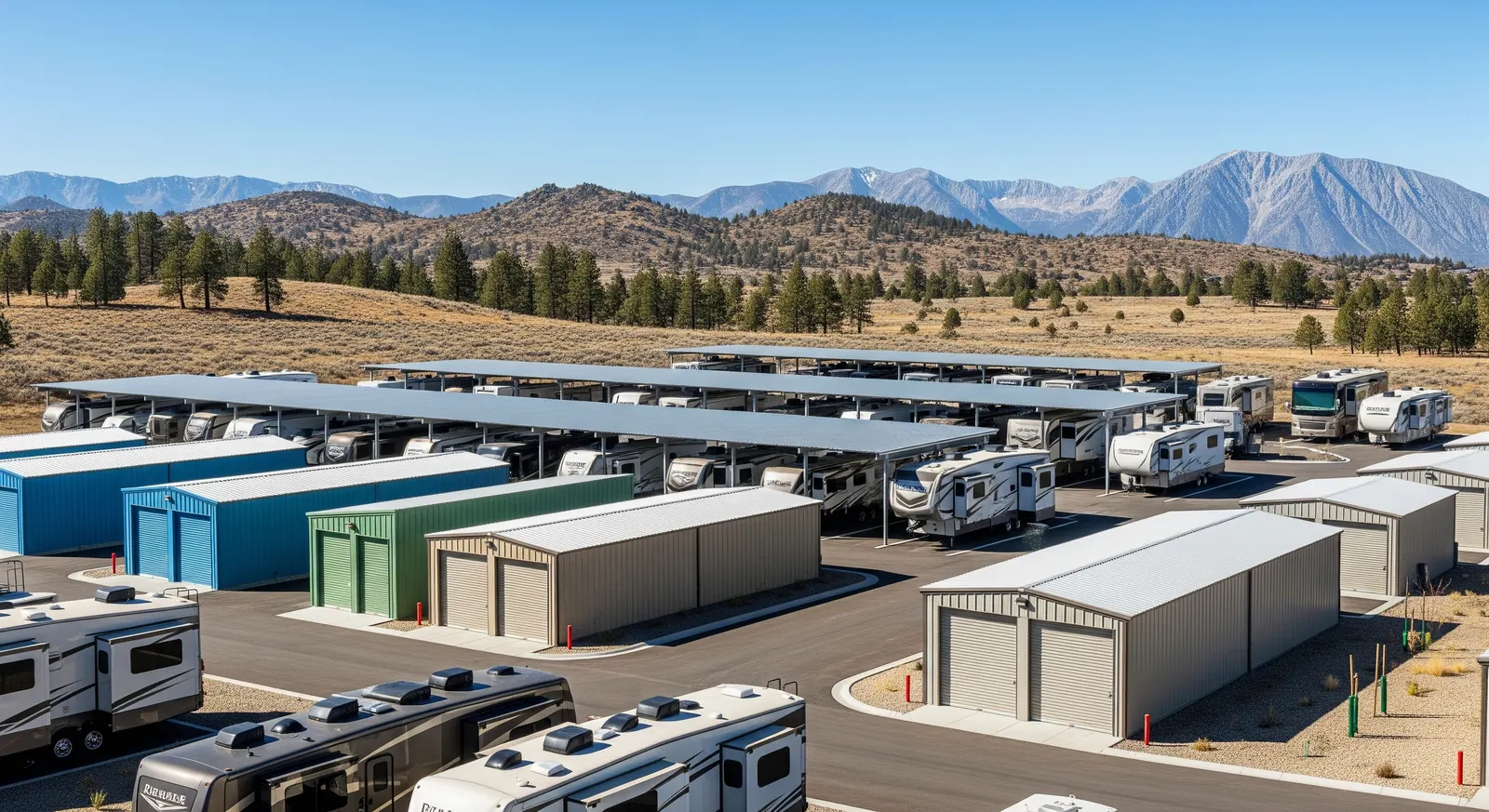
Alt text: A covered RV storage facility featuring a metal canopy sheltering multiple large RVs.Figure: Example of a covered RV storage facility. Covered parking structures incur higher construction costs than open lots but offer weather protection that justifies premium rental rates.
In open lot storage, RVs are parked in a paved or gravel lot with no roof. This option has the lowest CAPEX – primarily land preparation, paving, fencing and lighting – and low OPEX since there are no structures to maintain. However, uncovered storage commands the lowest rental rates and provides no protection from sun or weather. Covered storage(e.g. canopy structures or carports) involves moderate construction costs to build roofed parking bays. These covered spots shield vehicles from rain and sun, so customers pay higher rent than open parking. Fully indoor storage (individual enclosed units or warehouse-style storage) requires the highest investment – constructing large buildings with tall doors, climate control, etc. – and correspondingly higher operating costs (building maintenance, utilities). In return, indoor units can charge premium rates for maximum protection and security. The table below summarizes the comparison:
| Storage Type | Typical Monthly Rent (per RV) | Relative Development Cost | Relative Operating Cost | Key Considerations |
| Outdoor Uncovered | $75–$150 (basic open lot) | Low – just land & paving | Low – minimal upkeep | Vulnerable to weather; ensure drainage and secure fencing. Lowest revenue per space. |
| Covered (Roofed) | $125–$200 (covered parking) | Medium – add metal canopies | Medium – maintain structures | Provides sun/rain protection; needs sturdy construction (wind/snow loads). Mid-range rent and demand. |
| Indoor Enclosed | $150–$450+ (indoor unit) | High – full building construction | High – building maint., utilities | Maximum protection (often climate-controlled). Highest rents, but significantly higher CAPEX. Ventilation and access control required. |
Yield and profit differences: Uncovered storage has the lowest income per unit, but also the lowest cost to build, so it can deliver solid ROI especially in mild climates where customers accept outdoor parking. Covered and enclosed storage cater to higher-end customers willing to pay ~50–200% more in rent for protection, which can increase revenue yield – however, developers must budget for the higher capital outlay and longer payback. For example, a fully fenced outdoor RV lot with security might cost significantly less to develop than a fully enclosed facility, yet the enclosed facility could charge double or triple the rent per space. Many successful facilities offer a mix of these types to capture different price points and balance risk.
From an investment standpoint, RV storage as an asset class offers attractive returns in today’s market. Compared to traditional self-storage properties (which have seen cap rate compression in recent years), RV storage facilities often trade at higher cap rates, meaning potentially higher yield on cost. Recent industry data show average cap rates for storage properties (including RV/boat storage) around 7–8% in 2025, higher than the low-5% ranges seen in hot self-storage markets. Profit margins can be healthy: RV/boat storage involves less day-to-day maintenance than apartments or RV parks (no interior plumbing or appliances to fix), reducing operating expenses. In fact, turnover is low – RV owners often rent long-term, keeping units occupied for 6–8+ months at a time (often over winter). This contributes to steady cash flow and lower delinquency rates since customers have a lot invested in their vehicles (many RVs cost $50k–$300k) and are motivated to pay on time.
When underwriting an RV storage development, investors typically evaluate metrics like internal rate of return (IRR), payback period, and debt service coverage similar to other commercial real estate. Feasibility studies will include sensitivity analyses on lease-up velocity and occupancy needed to break even. Often, achieving stabilization (e.g. ~90% occupancy) may take 2–4 years post-opening, and many projects target a 5- to 7-year paybackperiod depending on market rents and construction cost. Industry experts suggest well-located RV storage projects can achieve IRRs in the mid-teens, reflecting the niche’s higher risk and reward profile (though specific returns vary by project). Overall, the financial performance of RV storage can be compelling – strong demand and limited competitionhave led savvy investors to pursue this niche for diversification and high returns. As with any development, careful financial modeling is needed, but the combination of growing demand and relatively low operating costs makes this asset class a promising venture.
Financial Performance Metrics and Benchmarks
When planning an RV storage facility investment, developers should benchmark key financial performance metrics against industry standards. Occupancy rates for stabilized RV storage facilities often range in the high 80s to 90+% in areas of strong demand. Lease-up can be gradual since filling large vehicle spaces may depend on seasonal cycles (many customers move RVs into storage in the fall). To ensure viability, pro formas should include a break-even occupancy analysis – e.g. determining the occupancy needed to cover all expenses and debt service. Lender guidelines may require showing a Debt Service Coverage Ratio (DSCR) of ~1.25x at stabilized occupancy, and a feasible break-even occupancy (perhaps around 50–60%) to cushion against downturns.
Internal Rate of Return (IRR) is a key metric for investors. Many investors target IRRs in the ~12–18% range for ground-up storage projects, given the development and lease-up risk. Actual IRRs will depend on development cost per square foot, rental rates achieved, and any sale or refinance. Recent sales indicate that high-quality RV storage facilities are in demand by institutional buyers, which helps support profitable exit cap rates. For instance, if cap rates are around 7–8% in this sector, an owner who stabilizes and sells the facility at a 7.5% cap could realize significant appreciation over development cost.
The payback period – how many years for the project’s cumulative cash flow to turn positive – often runs 5–8 years. This depends on the initial capital outlay (land + construction) and net operating income. Because RV storage has higher revenue per square foot than traditional self-storage (average monthly rent ~$134 for an RV-sized unit, versus ~$90 for a regular storage unit), the cash flows can be robust. However, the front-loaded site work costs (large land acreage, heavy pavement, utility installs) mean early-year cash flow might be modest until occupancy ramps up. Therefore, investors should plan for adequate capital reserves through lease-up. Net present value (NPV) and cash-on-cash return are also useful to evaluate, especially if considering refinancing once stabilized (a common strategy – e.g. build, fill, then refinance at a higher valuation to recoup equity).
In summary, prudent financial planning for an RV storage facility involves stress-testing the business model. Use conservative assumptions on rent growth (though note that in 2025, RV storage rents have shown slight growth ~1% YoY even after the 2021–22 boom cooled). Incorporate all expenses: property taxes (often significant given large land area), insurance (including liability and maybe pollution coverage for any on-site dump station), and sufficient maintenance and security costs. By benchmarking against industry data and building in contingency, developers can ensure the project meets required IRR hurdles and achieves a reasonable payback period for the investment risk.
Drainage and Stormwater Management Considerations
Large paved areas and big-roofed vehicles mean RV storage sites must be engineered for effective stormwater management. Each RV effectively acts as a mini roof – during rain, water will sheet off the tops of RVs and can create localized runoff surges. Site design should include robust drainage infrastructure to handle this runoff and prevent flooding or pavement damage. Best practices include grading the lot with a slight slope to direct water to collection points, installing trench drains or catch basins along drive aisles, and sizing retention/detention basins per local code. Many jurisdictions require on-site stormwater detention for large parking facilities; check local regulations and incorporate any required detention ponds or underground chambers early in design. For example, a municipality might mandate that the post-development runoff rate not exceed pre-development levels, necessitating a detention pond to temporarily hold rainwater from all that new impervious surface (roofs + pavement).
Considering environmental impacts is also important. Implementing Low Impact Development (LID) techniques can both satisfy regulations and appeal to eco-conscious customers. Options include using permeable pavers or porous asphalt in some areas to let water infiltrate instead of run off, as well as bioswales or rain gardens at the edges of the lot to naturally filter and absorb runoff. These measures can alleviate the burden on storm drains and reduce standing water. Covering outdoor storage with canopy roofs has a dual effect on drainage: it shields the pavement (reducing direct rain on the ground) but concentrates water flow along roof drip lines. Thus, gutters and downspouts on large canopies should be directed to underground drains or dispersion areas to avoid erosion where water pours off the roof.
Snow and ice management is part of stormwater planning in cold regions. Ensure there is space to pile plowed snow where meltwater will still flow into the drainage system and not toward the stored RVs. And because RV rooftops will dump snow as they melt, maintain aisles wide enough to pile snow or consider protocols for clearing snow off RV roofs to avoid sudden falls. In all climates, a well-drained facility protects both the customer’s assets and the longevity of your pavement. Standing water can damage RVs (and is a red flag for customers), so design your site to quickly shed water. Use durable concrete or asphalt surfaces with proper sealants and slope to help achieve this. Consulting a civil engineer for a drainage plan is highly recommended – they will size the pipes, inlets, and detention correctly. By proactively managing stormwater through good design (graded surfaces, drains, detention ponds, etc.), you’ll prevent flooding and comply with environmental regulations, ensuring a safer and more durable facility.
Security Infrastructure: Fencing, Surveillance & Access Control
Security is a top priority for RV storage customers – these vehicles are expensive recreational “toys,” and owners want peace of mind that their investment is safe. A multi-layered security infrastructure is therefore essential. Start with a strong perimeter: a secure fence encloses the entire facility. Chain-link fencing (galvanized or vinyl-coated) topped with barbed wire or razor wire is common, with typical installation costs around $10–$30 per linear foot depending on height and material. Solid panel fencing or walls can be used for additional privacy and wind screening, but ensure there are no gaps for intruders.
Controlled gate access is the next layer. An automatic sliding or swinging gate at the entrance should be integrated with an electronic keypad or card reader system. Customers can be issued unique PIN codes or access cards for entry, often with 24/7 access capabilities. Be sure to position the keypad appropriately for large vehicles – for instance, align it so that an RV or truck can pull up and the driver can reach it easily without exiting the vehicle. Also, allow plenty of driveway length between the gate and the public road, so an entering 40-ft RV doesn’t stick out into traffic while the gate opens. Modern facilities often use smartphone-based access control or license plate recognition cameras to automate entry.
Surveillance cameras should cover the entire site. High-resolution CCTV cameras (costing $500–$2,000 each depending on features) are typically mounted on poles or building eaves to monitor all drive aisles and unit doors. It’s wise to include a mix of wide-angle cameras for general coverage and some zoom cameras for license plates or detailed views. Off-site cloud recording or a DVR system will store footage; many owners retain at least 30 days of video. Prominently advertise the surveillance to deter thieves (signage like “24-Hour Video Surveillance” is a must). Some high-end RV storage operations even employ live monitoring or remote guarding services for an added level of security.
Adequate lighting is both a security measure and a customer safety feature. Install bright LED floodlights around the perimeter and on light poles throughout the facility. LED lights are energy-efficient and can be set on photocells or timers to illuminate the premises from dusk to dawn. Critical areas such as entry gates, keypad stations, and facility offices should be very well-lit. Motion-activated lights can be used in less-trafficked zones to save energy while still startling any intruders. Not only does lighting deter crime, it also makes customers feel safer when accessing their RV in early morning or late evening hours.
Other security infrastructure elements to consider: alarm systems on indoor unit doors (individual door alarms that trigger if someone opens a unit without authorization), and infrared beam sensors or trip wires along fence lines to detect and alert any breach. In larger facilities, on-site security guards or patrols (even if just periodic drive-by patrols at night) can add peace of mind, though many run unstaffed with technology providing the security. One common pitfall is neglecting to bury conduit for gate sensors or loops before paving – ensure any gate safety loops or magnetic exit sensors are installed under the asphalt to avoid costly retrofits Also, plan for emergency access: provide fire department lock boxes or override codes so first responders can enter quickly if needed.
Ultimately, a reputation for top-notch security will be a selling point for your RV storage facility. Customers will actively choose a facility with perimeter fencing, 24/7 cameras, gated entry, and bright lighting over one without these features. Given that RV owners “dearly safeguard their investment” of tens or hundreds of thousands of dollars, robust security features are not optional – they’re expected in a modern facility. Budget adequately for security in both construction and operations, as it protects both your clients and your business.
Architectural Considerations: Materials, Roofing & Climate-Responsive Design
Designing the structures for an RV storage facility – whether open canopies or enclosed buildings – requires balancing durability, cost, and climate factors. Building materials should be chosen for longevity and low maintenance. For covered parking canopies or enclosed unit buildings, steel construction is often preferred. Pre-engineered steel structures offer strength and clear-span space (no internal columns to obstruct large vehicles), and they can be engineered for the necessary wind and snow loads in your region. Steel framing with metal roofing panels is common for canopy structures. Ensure the canopy design accounts for local wind storms – sturdy steel columns with proper footings, and securely fastened roof panels (plus, consider gable-end walls or bracing if in hurricane zones). In heavy snow areas, use a roof design with adequate pitch and load capacity, or plan to remove snow from flat roofs to prevent overload.
For roofing, metal is ideal for its durability; many facilities use corrugated steel or standing-seam metal roofs on canopies and buildings. These can last decades with minimal upkeep (possibly just periodic repainting or coating). In some cases, conventional shingle roofs might be used on office buildings or aesthetic facades, but they have shorter lifespans. Pavement materials are another architectural choice: asphalt is cost-effective for large lots, yet concrete is more durable especially under the weight of heavy RVs. Some high-end facilities use concrete drive aisles (to resist rutting from RV tires) and asphalt in the parking bays to save cost. Good sub-base preparation and thick pavement sections (e.g. 4+ inches of asphalt or 6+ inches of reinforced concrete) will prevent future settlement issues.
Climate-responsive design ensures the facility performs well in local weather conditions. In extremely hot, sunny climates (Southwest U.S.), providing covered or indoor options is crucial – intense UV and heat can damage RV exteriors, so customers in these regions highly value roof cover. Using light-colored “cool roof” materials or adding insulation under metal roofing can also help keep the interior of covered parking structures cooler. In humid climates, ventilation is key: if you build enclosed units, integrate a ventilation system (ridge vents, gable vents, or powered fans) to prevent condensation and mold. Indoor RV storage may or may not be climate-controlled (heated or cooled); in northern regions, at least providing heat to keep units just above freezing (or using radiant heaters) can protect plumbing in stored RVs and attract winter storage customers. Conversely, in hot areas, full air-conditioning is rare due to cost, but passive ventilation and occasional mechanical ventilation to reduce heat buildup are employed.
Material choice can also reduce maintenance. For example, using galvanized or powder-coated steel canopies will resist rust longer – an important factor if you’re near coastal areas with salty air. Investing in weather-resistant coatings and paints on all metal surfaces helps prevent corrosion. Likewise, opt for heavy-duty, commercial-grade door hardware on enclosed unit doors (springs, latches, etc.) since they’ll be operated by customers frequently and should withstand the rigors of large door sizes. Rolling doors for RV units might be 12–14 feet high, so they need quality components to function safely. Consider wind-rated doors in storm-prone regions.
Another architectural aspect is the office and customer amenities building. Even if much of the facility is outdoor lots, having a small office structure on-site can improve customer service (and curb appeal). This building’s architecture might include a restroom for customer use, a waiting lounge, or retail space selling RV supplies. Use durable, low-maintenance finishes here too (e.g. metal or fiber-cement siding, LED lighting, slip-resistant flooring). It should reflect a professional image – as first impressions count when customers visit. Additionally, landscaping around the front entrance can enhance aesthetics; using gravel, rock gardens, or hardy native plants keeps maintenance low while avoiding a stark appearance. Some jurisdictions may require landscape buffers or fencing that matches neighborhood aesthetics as part of permitting. Complying with these will ensure the facility is both functional and community-friendly.
Finally, look for opportunities to incorporate sustainable design. For instance, installing LED lighting and motion sensors lowers energy costs. Large canopy roofs could potentially host solar panels – generating power to run the facility’s lights and cameras (and showcasing a green initiative to customers). Rainwater harvesting from roofs for use in landscape irrigation is another sustainable practice. Some RV storage developers even integrate on-site services like wash bays with water recycling and oil-grit separators to safely manage runoff. While not every facility will include all these features, being mindful of climate and using quality materials will extend the life of the structures and reduce operating headaches. The goal is a facility that withstands weather and wear, protecting customers’ RVs and upholding a professional image for decades.
Regional Market Analysis: Top U.S. Regions for RV Storage Investment
Demand for RV storage is strong across the United States, but certain regions offer especially attractive fundamentals for new facilities. Key demand drivers include RV ownership density, climate factors, and local regulations/space constraints.
The Sunbelt states consistently rank high for both RV ownership and need for off-site storage. Texas, Florida, Arizona, and California each have massive numbers of RV owners (Texas and California lead in total RV registrations/sales). In these states, a warm climate allows year-round RV use, which means year-round storage demand as well. For example, Arizona’s dry desert climate and intense sun create a strong market for covered RV storage to protect vehicles – many Arizonans will pay premium for a shaded spot. Florida’s abundant boat and RV population (Florida leads the nation in boat registrations and is top 3 in RVs) drives demand for storage facilities near metro areas and coastal hubs. The challenge in some Sunbelt metros is land availability; high growth areas like parts of Florida and California have expensive land and stricter zoning, so while demand is high, so are barriers to entry. Even so, developers are finding opportunities on city outskirts – e.g. in California’s Inland Empire or Central Valley, or the fringes of Dallas-Fort Worth in Texas, where land is cheaper and RV usage is high. These Sunbelt markets also benefit from lots of HOA-governed communities that ban RV parking at home, virtually ensuring a built-in customer base for off-site storage.
In the Mountain West and Pacific Northwest, RV ownership per capita is among the highest in the country. States like Montana, Wyoming, Idaho, Oregon, and Washington have a strong outdoor culture – Montana, for instance, tops the list for RV spending per capita (over $300 per person annually on RVs). Many households in these states own RVs, yet harsh winter weather means those RVs need to be winterized and stored safely for many months. Thus, there is strong demand for indoor or covered storage in cold northern climates. An RV storage facility in the Upper Midwest or Mountain region can fill up every fall as customers seek to shield their motorhomes from snow and subzero temperatures. Minnesota (the “Land of 10,000 Lakes”) is an interesting case – it has the most boats per capita in the U.S. and plenty of RVs too, suggesting that combined boat/RV storage facilities do well there (with customers swapping out summer boats for winter RV storage and vice versa). The key in these regions is offering weather protection: a simple open lot might suffice in summer, but customers will gravitate to enclosed or covered options to survive the winter.
Highly urbanized regions like the Northeast Corridor (e.g. New York, New Jersey, DC area) have lower overall RV ownership rates (due to dense living and less RV culture), but they still present pockets of demand – particularly from affluent enthusiasts willing to travel to store their rigs. Land constraints are severe there, so existing facilities often have waiting lists. Investors might find opportunities just beyond metro areas – for example, in Pennsylvania or upstate New York outside the NYC metro – where many RV owners from the city are storing because local options are scarce.
Generally, areas adjacent to national parks and vacation destinations are prime spots. Think of markets like Denver (gateway to Rockies), Salt Lake City (access to Utah’s parks), or Orlando (starting point for Florida RV tourism): these see heavy RV traffic and often lack sufficient storage capacity, especially during off-season. A Cushman & Wakefield analysis of RV/boat registration data highlights fast-growing counties in Nevada, Utah, Colorado, and Missouri as having strong storage demand relative to supply.
One more driver: climate extremes. In the humid Southeast (Carolinas, Georgia, Gulf Coast), mold and hurricanes are threats – investors in these regions often focus on covered or indoor storage with robust structures (hurricane-rated buildings in Florida, for instance). Meanwhile, in the arid Southwest (Nevada, New Mexico, West Texas), sun and heat are the issue – covered parking and even evaporative coolers or fans in indoor warehouses can be a selling point.
In summary, the most commercially attractive regions for RV storage investments tend to be: Sunbelt states with high RV counts and year-round use (AZ, NV, TX, FL, SoCal); Outdoor recreation hubs in the Mountain West and Pacific Northwest (high per-capita RV ownership but harsh weather, e.g. ID, MT, OR, CO); and metro-adjacent areas nationwide where suburban growth and HOA restrictions force RV owners to look for storage (e.g. outskirts of Atlanta, Chicago, Seattle, etc.). Each region’s demand is driven by a mix of RV ownership demographics, climate, and local policy. By leveraging data on registrations and understanding local usage patterns, developers can identify underserved pockets. For instance, if an area shows a high density of RV registrations but few storage facilities, that’s a clear opportunity. Ultimately, while RV storage can thrive in many locales, those with the right demand drivers – lots of RVs, limited at-home parking, weather that necessitates protection – will offer the quickest lease-up and strongest long-term returns.
Conclusion
Planning and designing an RV storage facility requires a holistic approach – marrying sound real estate fundamentals with the unique needs of large vehicle storage. By following best practices in site selection (ample land, strategic location, proper zoning) and thoughtful design (generous layout for RV maneuvering, well-chosen mix of open/covered/indoor spaces), developers can create facilities that attract and retain customers. Attention to critical details like stormwater drainage, security systems, and durable construction materials will ensure the operation runs smoothly and safely, protecting both the customer assets and the owner’s investment.
Financially, the RV storage niche offers compelling yields, provided projects are planned with realistic performance metrics and an eye on market demand. High-demand regions – from the Sunbelt to the outdoor-centric Mountain states – are ripe for new facilities, especially as RV ownership remains at record levels. As always, success in this sector will come to those who do their homework: understanding local RV owners’ needs, outmaneuvering pitfalls through good design (no dead-end aisles or flimsy structures!), and delivering a secure, convenient place for customers to store their “home on wheels.” Execute on these principles, and an RV storage facility can become a highly profitable, long-term asset in your portfolio – meeting a growing demand while providing peace of mind and service to the RV community.
References
- RecNation Storage – “Ultimate Guide to RV & Boat Storage Facility Construction.” (Blog, 2025)
- Toy Storage Nation – Grennan, B. “Common Pitfalls for RV Storage Facilities: Avoiding Design and Layout Mistakes.” (Oct 5, 2024)
- Toy Storage Nation – Matthews REIS. “Profiting in Boat and RV Storage.” (Aug 20, 2024)
- Toy Storage Nation – Preston, L. “RV and Boat Storage Investment: High Demand and Profitability.” (Jul 7, 2023)
- Roamly – “How Much Does RV Storage Cost in 2025?” (2025)
- Matthews / Yardi Matrix – “Your 2025 National Self-Storage Update.” (Q2 2025 report)
- SpiderDoor – “How to Build a Boat and RV Storage Business in 6 Steps.” (2023)
- Toy Storage Nation – Hallman, C. “What States Have the Most Boats and RVs?” (Aug 16, 2023)