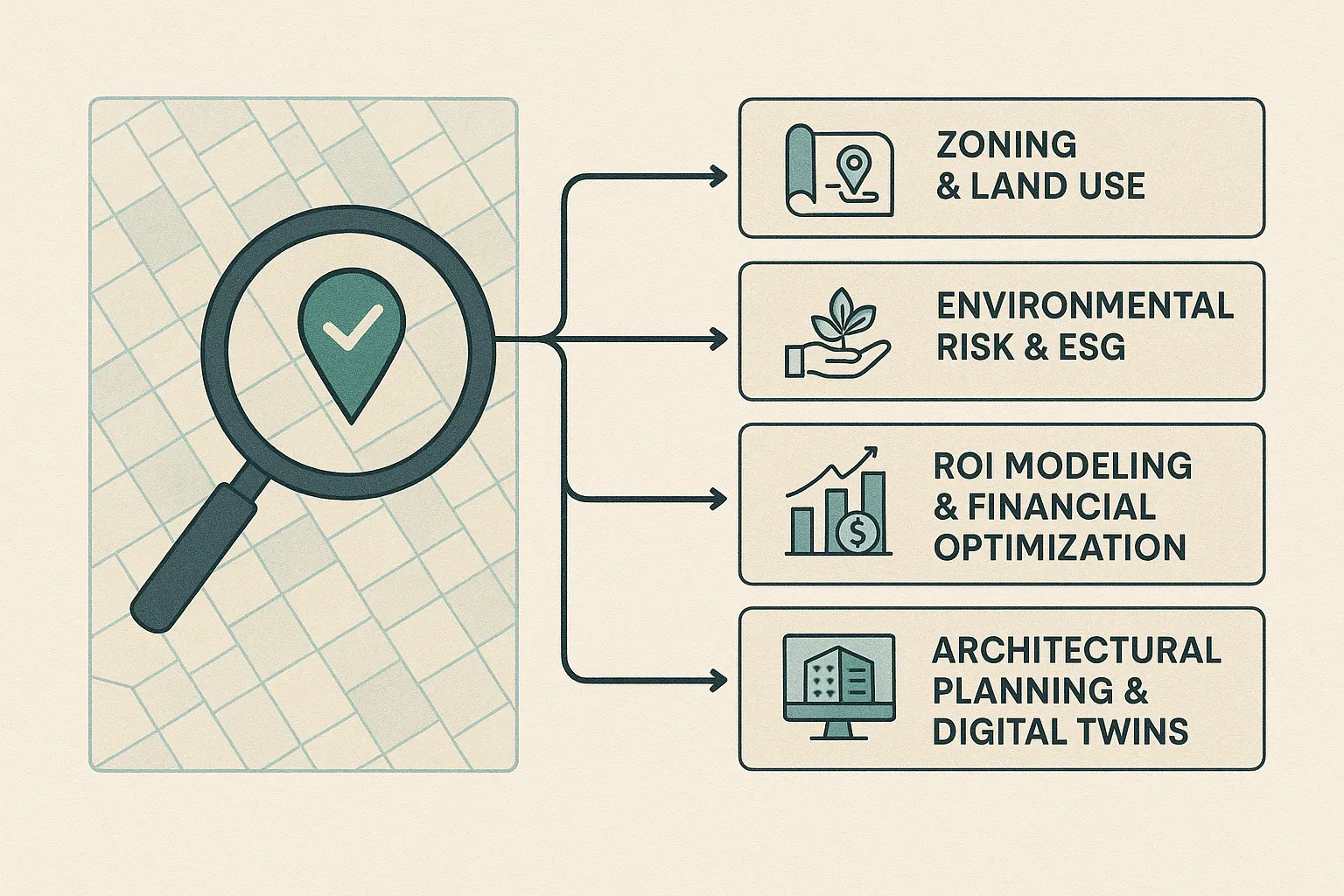
**Discover how AI narrows 1 billion U.S. parcels to one optimal site for commercial and industrial projects, fusing real estate data with smart design.
Let me know if you want variants focused more on investors, developers, or architectural keywords.**
Introduction: The New Era of Data-Driven Site Selection
In commercial and industrial real estate development, “location, location, location” remains a decisive factor for success. Yet choosing the right site has always been a complex, high-stakes decision. Developers and investors traditionally sift through countless options, often guided by local knowledge and gut instinct, to find that one “winning address.” In the United States alone, there are hundreds of millions of land parcels (over 2.26 billion acres of land) available. Evaluating even a fraction of these for zoning, infrastructure, market potential, and risks can overwhelm human analysis. This is where AI-driven site selection enters the picture, revolutionizing how we narrow from 1 billion parcels to 1 optimal site.
Advances in PropTech (property technology) have given rise to powerful AI site selection tools capable of analyzing massive commercial real estate data in seconds. What was once a manual, time-intensive slog is becoming an automated, intelligent process. AI in real estate can aggregate data on zoning laws, demographics, traffic flows, environmental conditions, and more, offering a level of insight and speed previously unimaginable. The result is a smart real estate development approach that blends financial analytics with architectural planning, helping decision-makers move from broad market scans to pinpointing the site that maximizes opportunity.
This article presents a transparent methodology case study of how AI algorithms can winnow down an entire nation’s worth of parcels to a single ideal development site. We’ll examine the process step by step, from initial data filtering to final selection, incorporating both financial and architectural perspectives. Along the way, we’ll see how AI evaluates critical factors like zoning, infrastructure, environmental risk, logistics, and return on investment (ROI). We’ll also explore how this process leads to smarter planning, more sustainable development, and optimal land use, impacting everything from construction costs to time-to-market and design flexibility. Finally, we’ll consider how firms like InnoWave Studio can leverage this AI-driven methodology in real-world applications to deliver projects that are both aesthetically pleasing and financially optimized.
By the end, investors and developers will understand how AI site selection offers a competitive edge: compressing what used to take months of research into mere moments of computation, and providing a data-backed confidence in picking the right site. Let’s dive into the process of going from “1 bn parcels to 1 winning address.”
Why Use AI for Site Selection? (The Investor’s Perspective)
Traditional site selection for commercial or industrial projects involves juggling an enormous array of variables. Think of a developer searching for a new distribution center location or an investor scouting a factory site: they must consider proximity to highways and rail lines, availability of skilled labor, land costs and taxes, utility capacity, zoning restrictions, environmental hazards, community sentiment, and more. Missing a single factor can turn a “perfect” site into a costly mistake. It’s no surprise that developers increasingly use data-driven tools (including AI) to score sites across these dimensions, labor, logistics, climate risk, utilities, and more, because careful selection can yield major logistics cost reductions and faster time-to-market.
From an investor’s standpoint, AI-powered site selection is about de-risking the decision and maximizing ROI. Modern AI site selection platforms can interpret massive datasets and quickly flag locations that align with specific investment goals. For example, an AI model could simultaneously analyze foot traffic patterns, freight costs, local economic indicators, and environmental risks, then highlight a handful of sites nationwide that meet the target criteria. This kind of multi-factor analysis goes far beyond human capability done manually. Machine learning can even incorporate historical trends, training on decades of real estate transactions and market cycles, to predict how property values or demand might evolve in each location. The outcome is a data-informed shortlist of sites where the numbers truly pencil out.
Equally important, AI accelerates the timeline. Rather than spending weeks on feasibility research for each candidate site, a developer can leverage AI to compress that analysis to hours or minutes. One recent example is REplace, an AI-driven platform for energy and data center projects that identifies optimal sites by analyzing 50+ factors and compresses siting timelines from months to seconds. By maximizing ROI and minimizing risk through algorithmic analysis, such tools save time, cut costs, and let teams move on opportunities faster. In a fast-moving real estate market, the ability to make quick, well-informed site decisions is a game-changer.
In short, AI brings a level of speed, precision, and foresight to site selection that aligns perfectly with investor interests. It transforms site scouting from a speculative art into a more predictable science, one that can quantify the trade-offs between locations and spotlight the one site that best balances profit potential and risk mitigation. Next, we’ll walk through how exactly this works in practice, illustrating how an AI might narrow the field from “1 billion parcels to 1 winning address.”
AI-Powered Site Selection Methodology: From 1 Billion to One
How can an AI algorithm take an entire country’s worth of land parcels and funnel them down to the single best choice for a given development? The process involves a sequence of filters and scoring steps, each eliminating unsuitable options and honing in on the prime candidate. Below, we outline a step-by-step methodology that an AI-driven U.S. site selection tool could employ. This approach mirrors a case study process that combines geospatial data analysis with AI, essentially automating what human developers do, only faster and more comprehensively.
Using AI to systematically narrow down potential sites: The map above shows an example of an automated first cut, buffering points of interest (in this case, public schools in Tennessee) with 5-mile radii to identify submarkets worth investigating. Such broad filtering eliminates large swaths of land unlikely to meet development criteria, focusing the search on high-potential regions.
1. Define the Search Universe and Criteria: The first step is setting boundaries on the search. Rather than analyze all 2+ billion acres at once, AI helps identify where to look. This could mean selecting a target region (e.g. Southeastern U.S. or a specific metro area) or using data-driven indicators to pinpoint attractive submarkets nationwide. For instance, an AI can map points of interest that signal development potential, such as major retail chains, logistics hubs, or population centers, and highlight the surrounding areas. If you’re siting a new warehouse, the AI might generate heat maps around interstate highways, seaports, or large clusters of distribution centers. If it’s an apartment or retail project, it might focus on growing suburbs with new schools and rising incomes. This submarket identification step uses commercial real estate data (demographics, economic growth, existing comparable projects, etc.) to trim away regions that don’t meet basic market criteria. In short, AI draws a smarter starting map, saving us from wasting time on parcels in truly unviable locations.
2. Preliminary Filtering – Zoning, Land Use & Size: With target areas defined, the AI next filters individual land parcels by fundamental requirements. Zoning is a critical early filter: the AI can cross-reference each parcel’s zoning designation (industrial, commercial, residential, agricultural, etc.) against the project’s needs. Parcels not already zoned appropriately are flagged, and if rezoning is unlikely or lengthy in that jurisdiction, those parcels are eliminated. (As an example, a city with strict residential zoning might be a non-starter for a new factory, whereas a “pro-development” county with ample industrial zones is far more attractive.) Land use and ownership data are also checked to weed out parcels that simply can’t be pursued – for instance, publicly owned lands, nature preserves, or properties already built out with incompatible uses. Additionally, the AI filters out sites too small or oddly shaped for the project’s footprint. In practice, developers often require a minimum acreage – e.g. a 50-acre minimum for an industrial park. The AI will drop anything below that threshold (much as one automation example removed all parcels under 1 acre when seeking large development sites). By the end of this step, the universe of potential sites is dramatically reduced to those parcels (or clusters of parcels) that meet the basic “buildable” criteria in the right zones.
3. Infrastructure and Logistics Analysis: Next, the AI evaluates connectivity and infrastructure – factors that often make or break a site’s viability for commercial and industrial projects. This involves spatial analysis using GIS: measuring distances and travel times to key infrastructure nodes. For a distribution center or factory, the AI will score parcels based on proximity to transportation corridors (highways, interstates, rail lines, ports, airports) because distance to these can directly impact ongoing logistics costs. Location is king in this regard – being a few miles closer to a major highway or rail terminal can save millions in freight over time. The AI might also incorporate real-time traffic data to favor sites with uncongested routes to market. Alongside transport, utility infrastructure is examined: does the parcel have access to sufficient electric power, gas, water, sewer, and telecom/fiber optic lines? A site lacking utility hookups or requiring expensive new infrastructure will be ranked lower. In fact, power availability has become a decisive factor for energy-intensive facilities (like data centers or chip fabs); sites that can supply ample power quickly have an edge. AI systems can ingest utility grid maps and capacity data to prefer areas where needed utilities are readily at hand. Additionally, labor logistics come into play: the AI can use demographic and commute data to assess whether a site has access to a large labor pool within a reasonable drive time. It can map where the workforce lives and how far they’d commute, ensuring the site isn’t in the middle of nowhere with no employees to staff it. By scoring infrastructure and accessibility metrics, the AI further narrows the list to sites that are well-connected and serviceable – critical for any industrial land optimization effort.
4. Environmental and Risk Screening: After ensuring a site can physically support the project, the AI evaluates whether it should – by checking for environmental red flags and other risk factors. This step is about avoiding sites that carry hidden costs, delays, or future liabilities. Environmental risk analysis by AI might include: overlaying FEMA floodplain maps to see if part of the parcel lies in a flood zone; checking wetlands databases (like the National Wetlands Inventory) for protected areas on-site; and pulling up topography and soil surveys to gauge slope stability or contamination (e.g. superfund sites or brownfields). An AI can rapidly calculate, for each parcel, how much land is actually buildable once you subtract wetlands, steep slopes, or flood-prone areas. Sites with insufficient buildable acreage get eliminated here. Climate and natural disaster risks are also quantified. For example, if a parcel is in a hurricane-prone coastal zone or a high wildfire risk area, the AI will factor that into its scoring – perhaps not discarding the site outright, but noting that any development would require higher construction standards and insurance costs. Many companies now explicitly incorporate climate data when selecting sites, favoring locations with lower exposure to extreme weather events. In this step, AI can even utilize NLP (natural language processing) to scan local environmental reports or news (for instance, searching public records for previous environmental violations on the property, or community opposition related to environmental concerns). The goal of the risk screening phase is to ensure that only sites without major “deal-breakers” (be it flood risk, protected species habitat, pollution plumes, etc.) make it through. By automating this due diligence, AI saves developers from pursuing sites that would likely stall in permitting or incur unmanageable mitigation costs.
5. Financial Feasibility & ROI Modeling: With a pool of technically viable, well-located sites in hand, the AI turns to financial analysis to rank which site offers the best return on investment. This involves aggregating all cost and revenue factors for each site. On the cost side: the AI will compare land prices (or estimated land acquisition cost) and factor in differences in local tax rates, potential incentives, and construction cost variances. It’s common for economic development agencies to offer incentive packages (tax abatements, infrastructure grants, etc.), and an AI can include those in the model. It also considers ongoing operational costs (labor costs in that region, utility rates, transportation costs from that site to distribution points). On the revenue side: the AI might project market demand or rents attainable at each location by examining comps and market trends. For example, if evaluating a site for a new warehouse, the AI can pull current warehouse rents or sales in the area; for a manufacturing site, it might consider proximity to customers (which affects sales and delivery times). All these inputs feed into a total cost of ownership or ROI model for each site. Companies often use a weighted scorecard model at this stage. Each criterion, logistics costs, labor availability, land cost, taxes, regulatory climate, etc., is weighted according to its importance for the project type, and the AI assigns each site an overall score. (For instance, a logistics project might weight transport cost and access at 50% of the score, whereas a manufacturing plant might weight labor and utilities more heavily.) This quantitative scoring makes the trade-offs clear: one site might have cheaper land but worse access, another might be pricier but comes shovel-ready with permits. By scoring and ranking sites on expected ROI and risk-adjusted returns, the AI identifies the top contenders that meet the investor’s financial targets. Notably, state-of-the-art platforms can parse market dynamics and trends too, factoring in growth projections, cap rate trends, and even social sentiment that might affect future value. The site (or sites) that consistently scores highest across these financial metrics will emerge as the front-runner.
6. Final Selection and Human Due Diligence: The last mile of narrowing from a handful of great options to the winning site typically involves human judgment – but AI still plays a supportive role. At this point, the AI has delivered a shortlist (perhaps the top 3 or top 5 sites out of the initial universe) along with detailed data profiles for each. Now, the development team will do on-the-ground due diligence: visiting sites, meeting local officials, and validating the AI’s findings. This is where qualitative factors are weighed. For instance, an AI might rank a site highly on paper, but a visit reveals poor road quality for truck access or a neighboring land use that wasn’t obvious in data (like a landfill next door). Also, community reception is crucial – even a perfectly scored site could face local opposition (the NIMBY factor). Experienced developers will engage with local stakeholders to gauge support. Here, AI can assist by analyzing local sentiment, such as scanning public meeting minutes or social media for resistance to similar projects. Nonetheless, human expertise is key to confirm there are no “unknown unknowns.” Assuming no fatal flaws emerge, the top-ranked site becomes the selected winner. The AI-driven process has thus efficiently distilled countless possibilities down to a single address. Importantly, by using transparent criteria and data-driven scoring, the methodology provides a clear rationale for why that site is optimal – useful when explaining the choice to investors, boards, or regulators. In essence, the AI has enabled a holistic comparison and strategic foresight that de-risks the decision, while still allowing experts to apply wisdom and creativity at the final stage.
By following these steps, an AI-driven system supports a thorough and objective site selection process. Each phase narrows the field, from broad regions down to specific parcels, by evaluating a myriad of factors systematically. The result is a site that best balances all key factors: location advantages, low risks, and strong financial returns. In practice, companies employing this kind of process have found that the right site can reduce logistics costs by millions, enable reliable staffing, avoid costly delays, and even offer tax savings – all contributing to competitive advantage. Conversely, a poor location choice (the kind AI helps avoid) can saddle the project with higher expenses or operational headaches for years.
Now that we’ve seen how AI narrows down the choices, let’s consider in more detail the dual perspectives driving this process: the financial lens and the architectural/planning lens.
Financial Standpoint: Maximizing ROI and Minimizing Risk
From the financial perspective, AI-driven site selection is fundamentally about making smarter investment decisions. Real estate developers and investors are using these tools to ensure that every project begins with the best possible foundation for profitability. By quantifying factors that impact the bottom line, AI helps answer the core question: Which site will yield the highest risk-adjusted returns?
One clear benefit is cost savings and efficiency. AI can incorporate detailed cost components, land acquisition, construction, transportation, taxes, labor, and identify sites where these costs are lowest or offset by incentives. For example, suppose Site A is in a state with higher labor costs and a lengthy permitting process, while Site B is in a state with lower wages and a fast-track permitting environment. The AI’s financial model would likely favor Site B, all else equal, because a business-friendly locale with readily available construction services and a streamlined permit process can mean faster, cheaper project delivery than an area with lengthy permitting and high labor costs. Speed matters financially; every month saved in permitting or construction is a month sooner that a property can start generating income. AI’s ability to compress timelines directly impacts time-to-market, which in turn affects net present value and ROI. As noted earlier, advanced platforms have demonstrated they can shrink site analysis timelines from months to seconds. This means developers can seize opportunities quicker and avoid the carrying costs of prolonged site searches or approvals.
AI also excels at risk mitigation, which is crucial for investors. By analyzing dozens of risk factors (from environmental hazards to market volatility), AI site selection tools effectively perform a comprehensive risk due diligence up front. They can flag, for instance, if a site’s region has a history of volatile lease rates or if a jurisdiction is considering a zoning change that could impede the project. Catching these early allows investors to either price the risk in, plan mitigations, or choose a safer alternative. Some AI platforms even provide an instant go/no-go recommendation on a parcel by aggregating all these signals. Investors appreciate this clarity; it prevents sinking capital into fundamentally flawed sites. In the words of one industry observer, such technology “empowers smarter, lower-risk development at scale” by ensuring that potential pitfalls are identified before money is spent.
Another financial advantage is optimizing for long-term value, not just immediate feasibility. Because AI can ingest market trends and economic forecasts, it helps pick sites that will appreciate or remain competitive over the long run. For example, an AI might detect that one industrial site lies in the path of major infrastructure investments (future highway expansion or port upgrades), suggesting strong growth potential, whereas another site might be in an area likely to face labor shortages a decade out. This strategic foresight is akin to having an “analyst” crunching thousands of data points to future-proof the investment. The result is that the chosen site isn’t just good for today’s project, but positions the asset for resilience and value retention in years ahead.
Finally, the financial perspective values the quantitative rigor that AI brings. When presenting a development deal to investors or a board, having a data-backed site selection analysis lends credibility. Instead of saying “we picked this city because we think it’s up-and-coming,” developers can show objective scores: for instance, how the selected site outranked others on logistics savings, how it benefits from a larger labor shed, or how local tax incentives improve the pro forma by X%. This level of analysis, increasingly common in 2025, is expected by sophisticated investors. It turns site selection into a defensible part of the business case.
In summary, the financial standpoint on AI-driven site selection is that it maximizes ROI by finding lower-cost, higher-yield locations and minimizes risk by filtering out problematic sites. It’s about using big data and predictive analytics to ensure capital is deployed at the site with the best odds of success. Next, we look at the other side of the coin: how AI-assisted site selection supports architects and planners in creating better projects.
Architectural & Planning Standpoint: Smarter Design and Sustainable Development
From the architectural and planning perspective, choosing the right site with AI isn’t just about crunching numbers, it’s about setting the stage for a successful, well-designed project. Architects, urban planners, and engineers gain enormous advantages when site selection is informed by rich data. Here’s how AI-driven site selection supports smarter architectural planning, more sustainable development, and optimal land use:
Early Integration of Design Requirements: When AI evaluates sites, it can include criteria that matter to architects, such as site orientation, topography, and expandability. For example, an architect might want a site with a large flat area for a one-story distribution center design, or conversely a sloped site if planning a multi-level structure that tucks into a hillside. AI can analyze elevation data and flag which parcels have suitable topography or require minimal grading. It can also consider shape and orientation: a south-facing slope might be ideal for solar exposure (beneficial for sustainability), or a wide rectangular parcel might be preferred for a certain building layout. By embedding these preferences early, the AI ensures the final choice is not only financially sound but design-friendly. This reduces costly design changes later, architects don’t have to force-fit a design onto a suboptimal lot, because the lot was chosen to fit the design vision.
Optimizing Land Use and Flexibility: Good site selection aligned with planning principles can lead to optimal land use, meaning the project fits well into its surroundings and makes the best use of the parcel. AI systems can assess not just the parcel itself, but the context: Is there room for future expansion (adjacent parcels or extra acreage)? Is the surrounding land use compatible (for instance, industrial next to industrial, to minimize conflicts)? Some companies intentionally seek sites with adjacent land for expansion or modular growth, and an AI can identify those opportunities. This forward-thinking approach leads to design flexibility. An example from industrial planning: developers often choose sites that allow adding another warehouse or an extension in the future, and they design initial facilities with knock-out walls or modular sections to enable that expansion. An AI that factors in these needs will rank sites higher if they offer such flexibility (e.g., a site in an open industrial park vs. a constrained infill lot). The result is a project that can adapt over time, with the site supporting changes in building size or use, rather than limiting them.
Sustainable Site Development: Sustainability is now a key concern for architects and developers alike. Site selection is inextricably linked to a project’s environmental footprint. AI can promote sustainable outcomes by favoring sites and development strategies that align with environmental best practices. For instance, AI might prioritize brownfield sites or infill locations over greenfield, greenbelt land, thereby helping to minimize urban sprawl and preserve green spaces. Redeveloping an old industrial site (with proper remediation) can be more sustainable than paving over farmland, and many developers and municipalities encourage this. Similarly, an AI might assess potential sites for renewable energy integration (is there enough sunlight for solar panels? Wind patterns for turbines? etc.) or for the ability to incorporate green infrastructure (like space for rainwater harvesting ponds or green roofs). One cited trend is that modern industrial projects strive to meet ESG benchmarks, with features like solar rooftops, rainwater runoff controls, and community-friendly design elements. By including metrics like these in site scoring (e.g., “Does the site allow installation of X square feet of solar panels?” or “Does the site have existing natural buffers that can be preserved?”), AI helps choose locations conducive to sustainable design. Moreover, environmental data in site selection prevents nasty surprises that could derail sustainability goals – for example, avoiding a site that would require filling in wetlands or cutting down mature forests. The AI essentially acts as an environmental planner in tandem with the architect, steering the project toward sites where sustainable design is feasible and impactful. This supports the overarching goal of smart real estate development that is both innovative and responsible.
Improved Collaboration and Creativity: Interestingly, when routine site analysis is handled by AI, architects and planners have more freedom to focus on creative solutions. Rather than spending weeks gathering data on traffic counts or utility maps, the design team can get an AI-prepared dossier on the chosen site almost instantly. This enhanced workflow means early-stage design (conceptual site plans, massing studies, etc.) can start much sooner, with better initial information. Some architecture firms report that integrating AI tools “increases the quality and value of solutions for clients” by allowing them to explore more options in planning and visualization. For example, an architect could take the top three sites from an AI shortlist and quickly sketch different design concepts for each, knowing that all three are solid choices. This fosters a more iterative, creative dialogue with clients, should we build a taller structure on the smaller urban site, or a sprawling campus on the suburban site? The data behind each option is clear, so the design conversation can focus on vision and user experience, not guesswork about site facts. In this way, AI in architecture planning acts as a catalyst for innovation: it removes some constraints and uncertainties, empowering architects to propose bold ideas confident that the fundamentals are in place.
In sum, the architectural perspective values how AI-driven site selection aligns the site with the project’s design goals from day one. It ensures that form and function can follow through because the chosen site supports them. By doing so, it minimizes design compromises, promotes sustainability, and ultimately results in developments that are not just economically sound but also well-integrated into their environment and community. As Viola Sauer of InnoWave Studio put it, having the right data transforms the approach to site planning, enabling designs that “minimize risks and maximize profitability, delivering designs that are both aesthetically pleasing and financially optimized”. This perfectly encapsulates the dual win of blending AI analytics with architectural creativity.
Real-World Application: InnoWave Studio’s Innovative Approach
How can a development firm combine these insights into a real project? InnoWave Studio, a site plan studio, provides a compelling example of leveraging AI-driven site selection methodology in practice. By integrating data analysis with creative design, InnoWave Studio illustrates the future of site selection and project planning.
When InnoWave approaches a new development, they start by harnessing extensive market data and AI tools to shortlist potential sites. Factors like local market trends, labor demographics, and infrastructure capacity are quantified early. With those insights, InnoWave can design site plans that minimize risks and maximize profitability for the specific context. Essentially, the firm uses the AI methodology described in this article as a foundation for its work, ensuring that by the time design work begins in earnest, the chosen site is one that aligns with both the client’s financial goals and the design vision.
Consider how this might play out in a commercial real estate development scenario. Suppose a client approaches InnoWave Studio to develop a new industrial park in the U.S. Midwest. Instead of limiting the search to what the client already owns or a few sites on the market, InnoWave could run an AI-driven site selection sweep across an entire multi-state region. They’d evaluate all those industrial-zoned parcels for logistics (highway/rail access), utilities, size, price, and even overlay things like workforce availability and climate risk – exactly as we outlined earlier. The AI might highlight, say, three counties where the combination of industrial land optimization opportunities and incentives is strongest. Through this process, they can confidently recommend “Site X in County Y” as the prime location, backing it up with data (e.g., freight savings, tax credits, low flood risk, ample labor supply).
Once the site is selected, InnoWave can further leverage technology by creating digital twins or 3D simulations of the proposed development on that site, assessing different layout options virtually. This tech-enabled approach shortens the iterative cycle; adjustments to the site plan happen in a digital sandbox informed by real site data. The benefits to the client are clear: fewer surprises, a faster timeline, and a project that hits the sweet spot of design excellence and financial viability.
Furthermore, because InnoWave Studio specializes in sustainable and innovative designs, the AI-driven process helps align projects with those values. If the methodology flags a brownfield site that could be revitalized, InnoWave can turn a potential environmental liability into a success story of remediation and modern green design. If climate data suggests incorporating resilience features (like elevated structures for a site in a flood-prone area), InnoWave can bake that into the design from the get-go. The result is a development that not only pencils out for investors but is also forward-looking and responsible, a key concern for many stakeholders today.
By applying AI-driven site selection in real-world projects, InnoWave Studio exemplifies how theory translates to practice. They show that embracing these tools isn’t about replacing human expertise; it’s about augmenting it. The planners at InnoWave still make the creative and nuanced decisions, but they do so armed with a wealth of intelligence that previous generations could only dream of. This leads to comprehensive solutions where feasibility, design, and market strategy are all in sync, accelerating project timelines for clients while elevating the quality of outcomes.
For investors and developers reading this, the takeaway is that firms like InnoWave can guide you through an AI-enhanced development journey. The methodology we’ve discussed is not science fiction, it’s being used now to site factories, warehouses, retail centers, and more in optimal locations. And it’s not only for mega-corporations; as data becomes more accessible, even mid-sized developers can tap into these U.S. site selection tools to gain an edge in site acquisition and project planning.
Conclusion: Embracing the Future of Smart Site Selection
The convergence of big data, artificial intelligence, and real estate expertise is fundamentally changing how we answer the question, “Where should we build?” As we’ve explained, an AI-driven site selection methodology can parse 1 billion parcels down to one golden opportunity by systematically evaluating zoning, infrastructure, environmental factors, logistics, and financial returns. The process yields a level of due diligence and strategic insight that protects investments and inspires confidence in development decisions.
For investors, this means higher certainty in achieving strong ROI and fewer nasty surprises lurking in a project’s future. For architects and developers, it means launching projects on sites that truly support their vision, technically, economically, and sustainably. The impacts ripple through the entire development cycle: lower construction costs (thanks to avoiding sites with hidden expenses), faster time-to-market (through streamlined permitting and early problem-spotting), and greater design flexibility (by choosing land that can accommodate growth and innovation). In a competitive landscape, using AI for site selection is rapidly becoming not just an advantage but, arguably, a necessity.
As the industry moves forward, those who embrace these smart real estate development practices stand to reap significant benefits. We are witnessing the rise of a more transparent, data-driven, and strategic approach to development. It’s an approach where human creativity and experience are amplified by AI’s analytical power, not replaced by it. The end result: projects that are better planned, more sustainable, and more profitable.
InnoWave Studio and similar forward-thinking firms invite stakeholders to explore this new paradigm. By leveraging AI tools and deep domain knowledge, they are charting a course for developments that meet today’s needs and tomorrow’s challenges. For anyone interested in seeing these principles in action or seeking guidance on their next project, further resources and case studies can be found on InnoWave Studio’s website. The journey from a billion possibilities to one perfect site is complex, but with AI on our side, the path is clearer than ever before.
Sources:
🌿 Environmental Risk & ESG
- FEMA Flood Map Service Center – Flood zone overlays for parcels
- National Wetlands Inventory (USFWS) – Environmental risk screening
- REsurety – Locational Marginal Emissions data for site-based carbon impact
- ULI + PwC: Emerging Trends in Real Estate – ESG and resilience in site planning
- EPA Superfund and Brownfield Datasets – Contamination risk analysis
💰 ROI Modeling & Incentives
- CBRE Site Selection Whitepapers – Financial modeling and incentive comparisons
- McKinsey Real Estate AI Reports (2023) – How AI boosts ROI in location strategy
- NAIOP Research Foundation Reports – Development cost and return benchmarking
🚛 Infrastructure & Logistics
- Replica – Demographic and mobility datasets for access, commute, and demand
- Placekey – Unified geospatial IDs to merge logistics and infrastructure data
- CoStar/LoopNet – Industrial land comps and utility overlays
- Freight Analysis Framework (US DOT) – Regional freight flow data
🧠 AI Tools & Platforms
- Descartes Labs – Satellite-based land and infrastructure analysis
- Esri ArcGIS AI Plugins – Predictive geospatial modeling tools
🏙️ Architecture & Planning
- Digital Twins – Pre-build simulation environments
- ULI: Design for Resilience – Architectural adaptation to site challenges
🏢 Industry Insights & Strategy
Site Selectors Guild (2024) – Human vs AI in site strategy reports
McKinsey (2023): The State of Real Estate AI – Strategic applications and limitations
CBRE & JLL Location Strategy Briefings – Corporate real estate siting frameworks
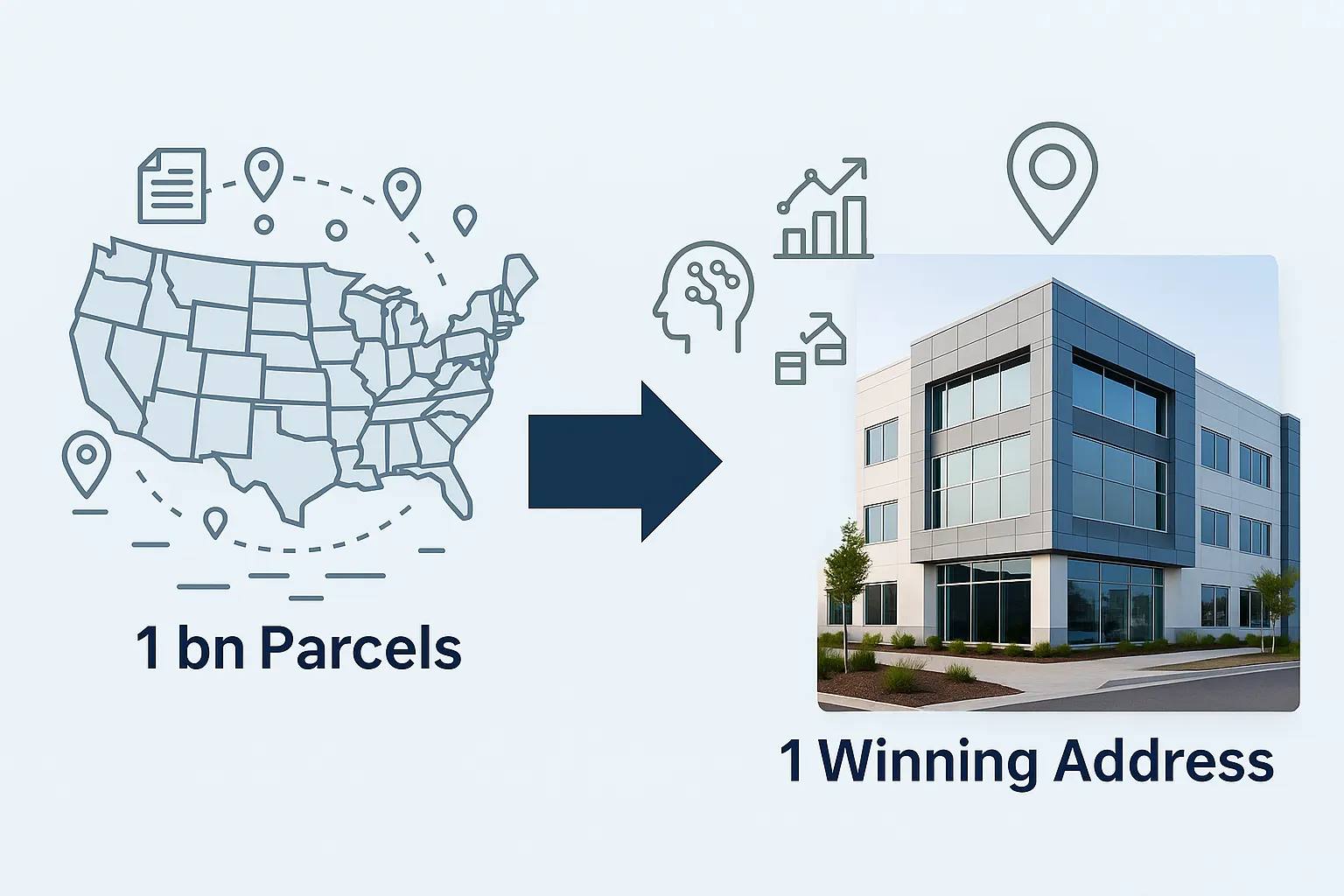
U.S. map with magnifying glass and arrow pointing to a modern building labeled “1 Winning Address.”